
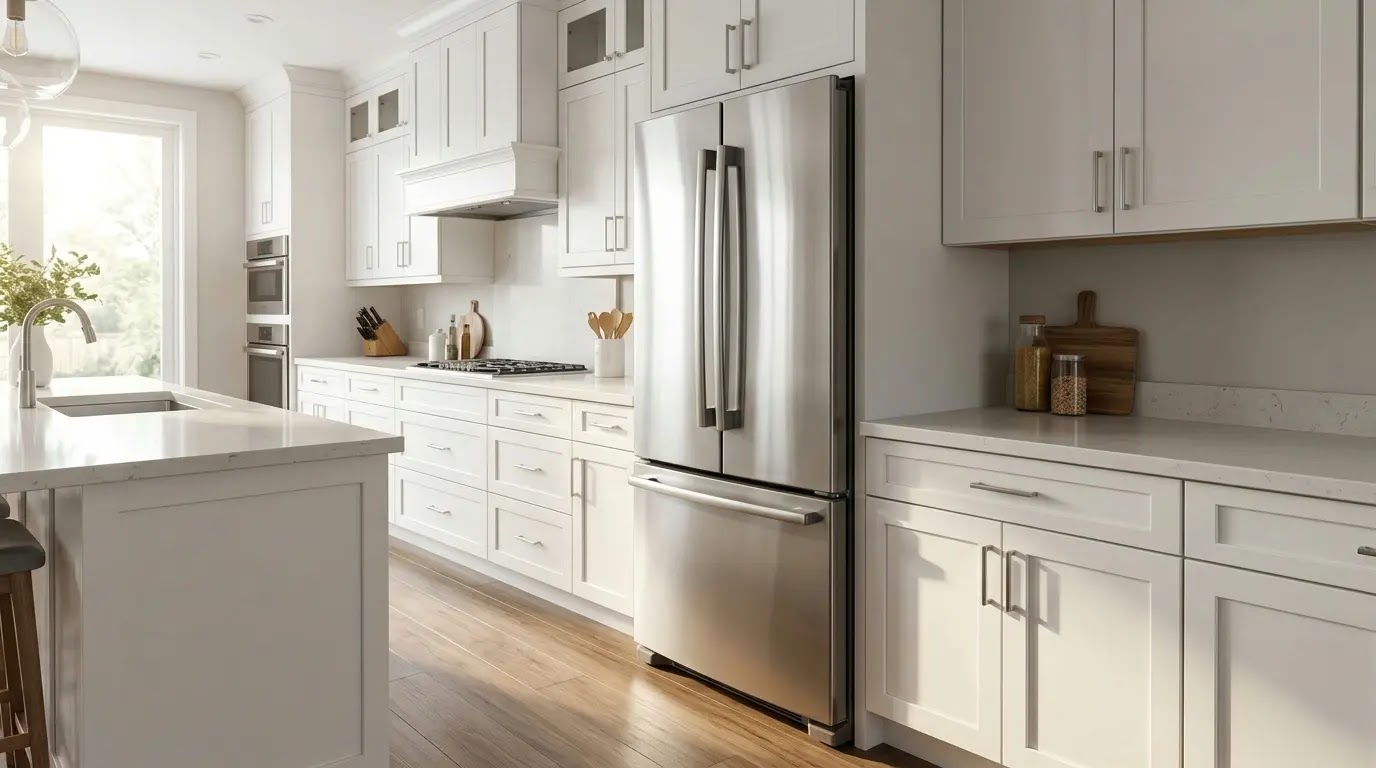
Counter Depth Refrigerator Guide 2026: Dimensions, Fit, and What to Know Before You Buy
A simple guide to choosing a refrigerator that fits perfectly with your kitchen cabinets without wasting money.

The Flush Fit Question
Most people think a counter-depth fridge sits perfectly flush with the cabinets. The truth? It usually sticks out by 2 to 3 inches. This is because the doors need space to open. In this guide, we will show you how to measure correctly so your kitchen looks professional and organized.
Counter-Depth Mastery
THE FIT & THE MATH
INSTALLATION & BRANDS
💡 Click any topic above to jump directly to that section.
Understanding the Real Size (Dimensions)
When you go to a shop or look online, you will see the term Counter-Depth. But what does it really mean? Let’s break it down into simple parts so you don’t get confused.
Design Insight: If you are wondering why smaller fridges cost more, read our deep dive: The Counter-Depth Fridge Myth: Are You Paying a $500 Sleek Tax? (2026)
Cabinet Depth vs. Fridge Depth
In most kitchens around the world, the standard kitchen cabinet is 24 inches (61 cm) deep. A normal refrigerator is often 32 to 36 inches deep. This means it sticks out quite a lot, which can block your walkway.
Simple Term: The Box (Chassis)
Imagine the refrigerator as a large metal box with doors. The Box is the main body. In a counter-depth model, this box is usually 24 to 25 inches deep to match your cabinets. However, the Doors and Handles are extra. This is why the fridge never sits 100% flat unless you plan it very carefully.
The Door Swing: Why You Need Extra Space

This is the part where most homeowners make a mistake. They buy a fridge that fits the hole in the cabinets, but then they cannot open the door fully. Why does this happen?
What is a Zero-Clearance Hinge?
The Hinge is the metal joint that lets the door swing open. Most cheap fridges have hinges that need space on the side. If you put the fridge right against a wall, the door will hit it when you try to open it.
A Zero-Clearance Hinge is a special design that lets the door open straight without moving sideways. Think of it like a door that stays in its own lane. If your kitchen is small, you MUST look for this feature.
Ventilation: Why Your Fridge Needs to Breathe
A refrigerator works by taking the heat from inside and pushing it outside. If the heat has nowhere to go, the fridge will get too hot and stop working after 2 or 3 years. This is a big problem for counter-depth models because they are tucked tightly into cabinets.
Critical Maintenance: Don’t let your compressor burn out. Learn about The 70% Rule: Why Your Counter-Depth Fridge is Failing (Fix It Now!)
Simple Advice for Airflow
- The Top Gap: Leave at least 1 inch of empty space above the fridge.
- The Back Gap: Leave about 2 inches of space behind the fridge so the warm air can rise.
- The Front Vent: Many modern fridges (like 2026 Bosch or LG models) breathe from the bottom front. Never block the bottom of your fridge with a rug or a piece of wood.

Inside Space: Managing a Smaller Fridge
When you choose a counter-depth fridge, you are choosing style over size. You will lose about 15% to 20% of the inside space compared to a standard fridge. For a big family, this can be a problem.
How Manufacturers Help You
Since the fridge cannot be deep, companies make them taller and use thin insulation.
| Technology | What it Means |
|---|---|
| Vacuum Panels | Very thin walls that still keep the food cold. This gives you more room inside. |
| Vertical Design | The fridge is made taller (up to 72 inches) to catch the space lost in depth. |
How to Measure Like a Pro
Don’t just measure the height and width. To make sure the fridge fits your lifestyle, use these three simple steps:
- Walkway Check: Open the fridge doors. Do you still have enough space to walk past? You should have at least 30 inches of space in front of the open door.
- The Handle Math: Remember that handles add 2 inches. Make sure the handles won’t hit your kitchen island or dishwasher.
- Entryway Check: Measure your front door and kitchen door. Many people buy a fridge that fits the kitchen but won’t fit through the front door of the house!
Struggling with a tight fit? Check out our troubleshooting guide: Counter-Depth Refrigerator Fit Issues: Step-by-Step Solutions
The Wall Recess Trick: How to Get a 100% Flush Look
Many people are disappointed when their new counter-depth fridge still sticks out by 3 inches. If you want that perfect built-in look that you see in luxury magazines, there is a technical secret called wall recessing.
What is Wall Recessing?
In simple English, this means cutting a small pocket into the wall behind your refrigerator. By moving the drywall and the wooden studs (the wall’s frame) back by just 2 or 3 inches, you can push a standard fridge much deeper into the space.

Important Safety Note: Never cut into a wall without asking a professional contractor. Some walls hold up the weight of your house (load-bearing walls). If you cut the wrong part, it could be dangerous. Always hire a pro for this recess modification.
Even if you don’t cut the wall, you can get a cleaner look by moving the water valve and the electrical outlet to the side. Most fridges stick out because the thick water hose and the power plug are sitting directly behind the machine, taking up 2 inches of space.
Reliability Audit: Which Brands Last in 2026?
Not all counter-depth refrigerators are built the same. In 2026, we see a clear difference in how brands handle the compact engineering required for these shallow units.
| Brand | Reliability Score | Best Feature |
|---|---|---|
| Bosch 800 Series | High (9/10) | Dual Compressors (Two separate cooling motors). |
| LG Studio | Moderate (7/10) | Craft Ice and Smart ThinQ Diagnosis. |
| Samsung Bespoke | Moderate (7/10) | Interchangeable door panels (Style focus). |
| Fisher & Paykel | High (8/10) | True zero-clearance hinge design. |
Looking for Samsung? We have analyzed the top-rated models in our dedicated list: 5 Best Samsung Counter-Depth Fridges 2026: Sleek & Flush.
The Pro Verdict: If your budget allows, choose a brand with dual compressors. Standard fridges share one motor between the freezer and fridge. In a counter-depth unit, having two separate motors is better because they don’t have to work as hard in a small space, which prevents component fatigue (the part getting tired and breaking).
Why Does a Smaller Fridge Cost 20% More?
It sounds strange: you are getting a smaller fridge but paying more money. There is a technical reason for this. In a normal fridge, manufacturers use thick foam to keep things cold. This foam is cheap but takes up a lot of space.
In a counter-depth fridge, they have to use vacuum insulation panels (VIPs). These are very expensive, ultra-thin panels that provide the same cold protection as 4 inches of foam but in only 1 inch of space. You are paying for the high-tech materials that keep the fridge thin on the outside but big on the inside.
Frequently Asked Questions (FAQ)
Q1: Will my magnets work on a counter-depth fridge?
Ans: It depends on the finish. Most stainless steel models are not magnetic. However, if you choose a 2026 model with a glass front or bespoke finish, you cannot use magnets. Check the material specs before buying if you like to hang photos on your fridge.
Q2: Does Counter-Depth mean the handles are flush too?
Ans: No. Almost all counter-depth handles stick out past the cabinets. If you want a completely flat look, you should look for pocket handles (recessed handles). These are built into the door, so nothing sticks out into your walkway.
Q3: Is a counter-depth fridge enough for a family of four?
Ans: It can be tight. A standard 22 cu. ft. counter-depth fridge is perfect for 2-3 people. For a family of 4 or more, you may find it small. To fix this, many international families keep a small overflow freezer in the garage or basement for bulk items.
Q4: Why is my counter-depth fridge making a loud humming noise?
Ans: This is often due to vibration transfer. Because these units are tucked tightly into cabinets, any small vibration from the motor hits the wood and gets louder. Ensure there is at least a 1/8-inch gap on the sides so the fridge is not touching the cabinets directly.
2026 Final Expert Recommendation
Choosing a counter-depth refrigerator is a design-first decision. If you value a beautiful, open kitchen, the lost storage space is a small price to pay. For the best experience, prioritize a model with a zero-clearance hinge and front-breathing ventilation. This ensures your fridge fits perfectly and lasts for a decade without expensive repairs.
Best Overall: Bosch 800 Series | Best Budget Fit: LG Studio