

Ask ten homeowners to describe a refrigerator noise, and you’ll get ten versions of “it’s humming” or “it’s buzzing,” but ask a technician, and the first question is always the same: is that the compressor or a fan? Getting this wrong is the single biggest reason people replace a $150 fan motor when the actual problem was a failing compressor, or vice versa, so this guide is built entirely around the specific techniques for telling the two apart, not around cataloguing every possible noise.
Table of Contents
Why This Distinction Actually Matters
The compressor and the fans in an LG refrigerator are built completely differently, cost differently to replace, and sit in different locations, but from three feet away, a failing example of either can sound almost identical to an untrained ear. A compressor typically runs $200-$400+ in parts and often requires refrigerant handling if the sealed system is disturbed, while a fan motor is usually a $30-$60 part that’s straightforward to access. Getting the diagnosis wrong doesn’t just cost money; on models like the LFXS26973S or LRFVS3006S, where the compressor is an inverter-linear type, replacing the wrong part can leave the actual fault untouched while you’ve spent money and time on a part that was working fine.
This applies to two separate fans in most LG refrigerator French-door and side-by-side units: the condenser fan at the back near the compressor and the evaporator fan inside the freezer compartment behind the rear wall. Both can be confused with compressor noise and with each other, which is why the techniques below matter more than a simple “where is the sound coming from” checklist. 👉 [LG Refrigerator Making Loud Buzzing/Humming Noise, Full Symptom Guide].
The Core Sound Difference: Hum vs. Whir
The most reliable starting point is texture, not volume. A compressor produces a low-frequency, steady hum or drone; think of the tone of a distant engine idling, consistent and without a rhythmic “whoosh” component. A fan, whether condenser or evaporator, produces a higher-pitched whir with a subtle rhythmic quality to it, because you’re hearing air moving past blades in a repeating pattern, even at high fan speeds where individual blade passes blur together.
The insider trick here: cup your hand loosely around your ear and point it at the sound source from about a foot away, rather than pressing your ear directly against the panel. This creates a crude directional microphone effect that makes the rhythmic whir of a fan noticeably more apparent than pressing flat against the surface, which tends to transmit vibration more than actual airborne sound and can make a fan noise feel more like a hum than it actually is.
The Compressor Cycle Timing Test
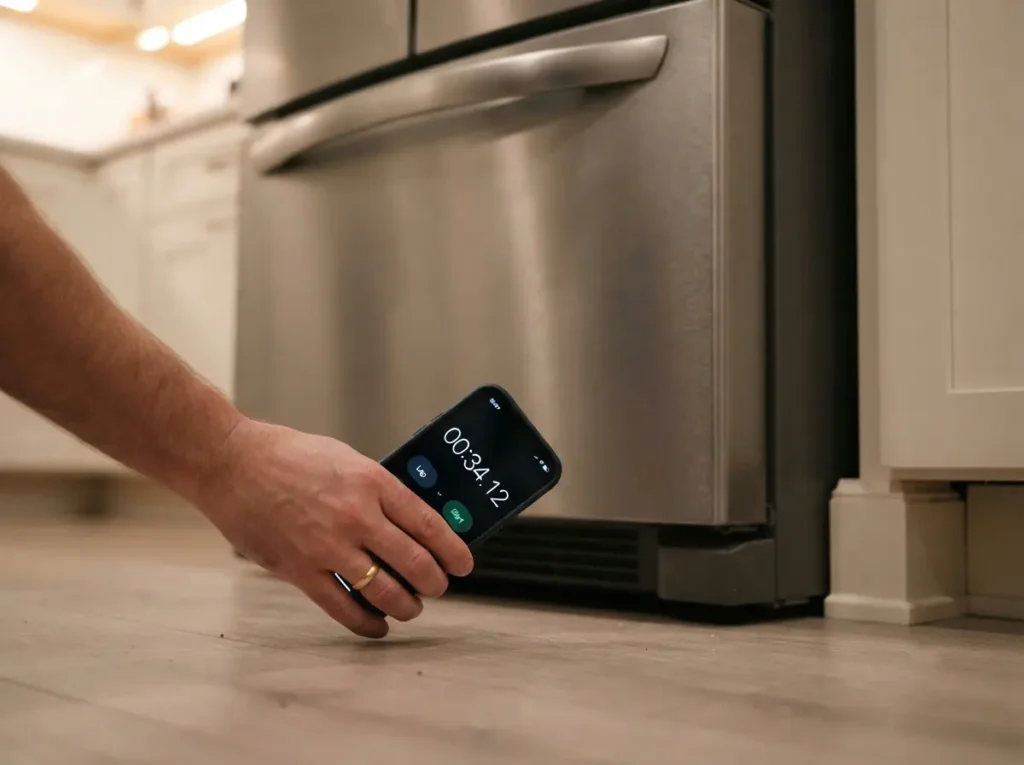
This is the single most useful diagnostic technique in this guide, and it costs nothing but a few minutes with a phone timer. Compressors cycle on and off (or ramp up and down on inverter models) on a predictable pattern tied to cooling demand, typically running for stretches of anywhere from 10 to 40+ minutes depending on ambient temperature, door usage, and compressor type, then pausing or dropping to idle speed.
Fans, by contrast, often run continuously whenever the compressor is active, and evaporator fans specifically are wired to stop the instant the freezer door opens as a safety feature on nearly all LG refrigerator models. So: start a timer, and note when the noise starts and stops over a 15-20 minute window without opening any doors. If the sound persists in a steady, unbroken drone that only changes intensity rather than starting and stopping, you’re more likely hearing the compressor. If the sound cuts on and off in a shorter, more frequent pattern or vanishes the moment you open the freezer door, that’s fan behavior.
The Freezer Door Fan Isolation Trick
Building directly on the timing test, this is the fastest single check for isolating the evaporator fan specifically. Open the freezer door and listen for one to two seconds immediately. LG refrigerator evaporator fans are designed to cut power the instant the door switch triggers, so if the noise you were hearing with the door closed disappears the moment the door opens, you’ve confirmed the evaporator fan as the source. A compressor sound will not change at all when you open the freezer door, since the compressor has no relationship to the door switch.
Be careful with timing on this one: if you wait more than a couple of seconds after opening the door, you may miss the transition and mistakenly conclude the noise “just went away on its own.” The moment of the door opening is the diagnostic window, not the general state of the door being open.

Reading Vibration Instead of Sound
A technique most homeowners never think to try: Place your open palm flat against the refrigerator’s side panel or top surface, rather than listening. Compressor vibration tends to transmit as a low, steady buzz you can feel through the cabinet, often strongest near the bottom-rear corner closest to the compressor compartment. Fan vibration is typically more localized and inconsistent, sometimes barely perceptible through the cabinet at all unless the fan blade itself is unbalanced or hitting an obstruction, in which case you’ll feel a distinct rhythmic tap rather than a steady buzz.
This matters most when ambient kitchen noise makes careful listening difficult; a running dishwasher or exhaust fan nearby can drown out subtle pitch differences, but vibration through the cabinet is unaffected by ambient room noise and gives you a second data point to confirm what you’re hearing.

The Misdiagnosis Pattern I See Constantly
Here’s the one that costs people the most money: a condenser fan blade clogged with dust and pet hair produces a labored, straining sound as it fights against the buildup, and that strained whir gets deep enough in pitch that it’s frequently mistaken for compressor noise, especially by anyone doing the “ear against the panel” test rather than the directional-hand technique described earlier. I’ve had multiple service calls where the customer was ready to authorize a compressor replacement, and pulling the unit out to find a condenser coil packed with debris resolved the entire complaint for the cost of a vacuum cleaner and twenty minutes.
The question worth asking yourself before assuming compressor failure: has the fridge been pulled away from the wall and had the condenser coil cleaned in the last year or two? If the answer is no, that’s the first thing to rule out, not the last, because it’s both the cheapest possibility and the most common actual cause behind sounds that get blamed on the compressor.
Compressor vs. Fan Noise Comparison Table
| Test | Compressor Behavior | Fan Noise Behavior |
| Sound texture | Steady low drone, no rhythm | Whir with subtle rhythmic quality |
| Timing pattern | Runs in long stretches (10-40+ min) | Often continuous while the compressor runs, or cycles differently |
| Freezer door open | No change at all | The evaporator fan stops instantly. |
| Palm-on-cabinet feel | Steady buzz, strongest near bottom-rear | Localized, sometimes rhythmic tap if unbalanced |
| Pitch under load | Generally consistent | Can strain/deepen if the blade is obstructed by dust |
FAQ: LG Refrigerator Compressor Noise vs. Fan Noise
1. Can a failing compressor sound like a fan noise?
It’s uncommon, but a compressor developing internal mechanical wear can occasionally produce a rougher, less pure hum that’s sometimes mistaken for a fan; the timing test (does it stop when the freezer door opens) remains the most reliable way to rule out a fan regardless of exact pitch.
2. Why does my refrigerator sound louder at certain times of day?
Ambient kitchen noise is usually lower during quiet parts of the day, making baseline compressor or fan sounds far more noticeable rather than indicating the refrigerator is actually running louder.
3. Is it possible for both the compressor and a fan to be noisy at the same time?
Yes, and this is where the isolation techniques matter most, since a compressor that’s failing can be running alongside a completely normal fan, and testing them separately (timing and door-open trick) prevents attributing both sounds to a single cause.
4. Does a noisy condenser fan mean I need to replace the fan motor?
Not necessarily. Dust and debris buildup on the fan blade or condenser coil is a far more common cause of strain noise than actual motor failure, so cleaning is worth trying before assuming the motor itself needs replacing.
5. How do I know if it’s the condenser fan or the evaporator fan making noise?
Location is the fastest indicator: condenser fan noise is loudest near the back-bottom compressor compartment, while evaporator fan noise comes from inside the freezer compartment near the rear wall and will respond to the door-open test.
6. Can I use a smartphone app to help identify the sound?
A basic sound-recording app can help you replay and compare the noise against reference clips, though the timing and door-open tests described here remain more reliable than pitch analysis alone for a home diagnosis.
7. Should I worry if the noise only happens right when the compressor starts up?
A brief change in pitch or a short knock at compressor startup is common on many refrigerators, including inverter-compressor LG models, and isn’t automatically a fault; it’s only a concern if that startup sound is loud, harsh, or followed by a sustained abnormal noise rather than settling into the normal steady hum.
Final Word
The compressor-versus-fan noise question comes down to three checks: listen for texture with a cupped hand rather than a pressed ear, time the pattern against the freezer door test, and feel for vibration through the cabinet as a second confirmation. Run through those three before you decide which part is actually at fault, and you’ll avoid the single most expensive misdiagnosis in refrigerator repair.