
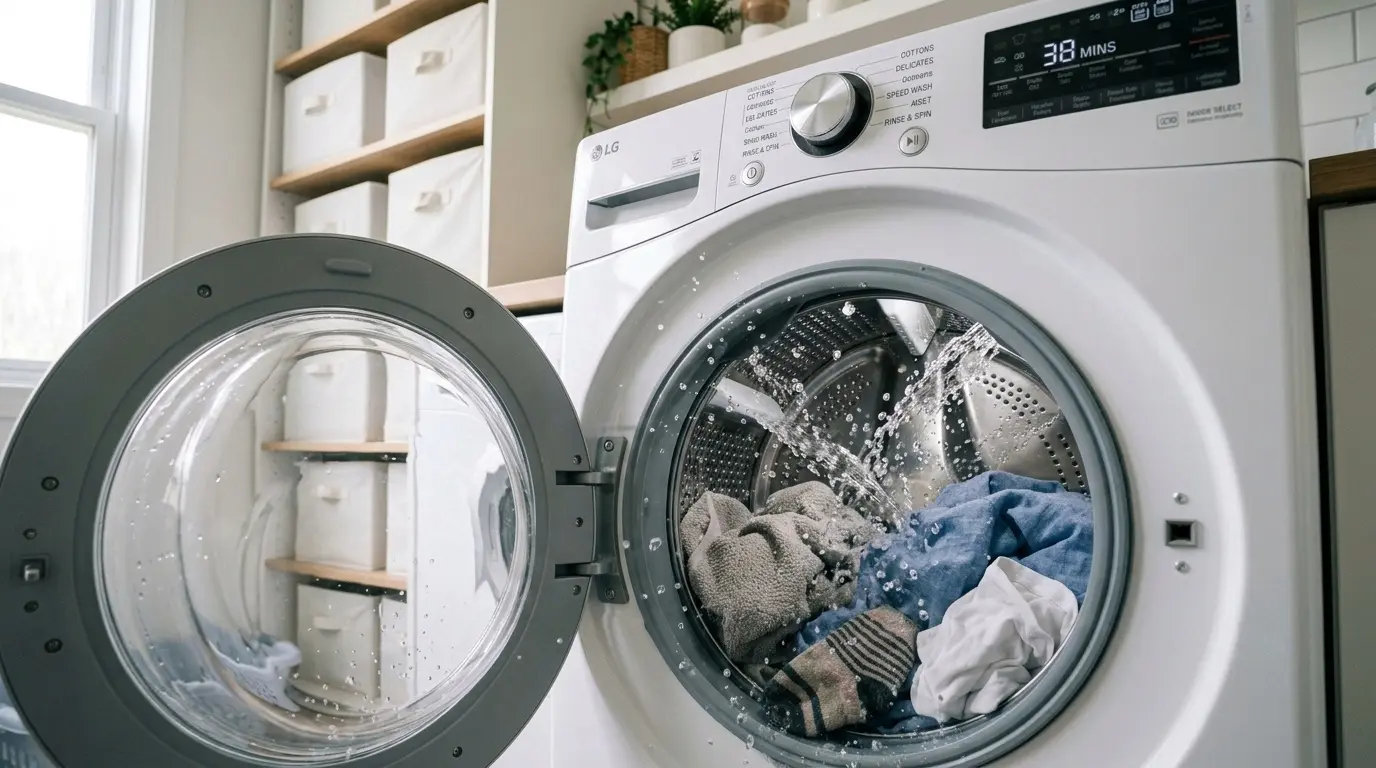
Most people assume a faster wash cycle just means the machine skipped a few steps to save time, and on plenty of budget washers, that assumption is correct. LG TurboWash is the exception worth understanding, because it doesn’t cut corners to save time; it changes the physics of how water and detergent reach the fabric in the first place, which is why a TurboWash cycle can finish in roughly half the time of a standard cycle without sacrificing clean.
Table of Contents
What LG TurboWash Actually Does Mechanically
Standard wash cycles rely primarily on time and drum rotation to get detergent-saturated water into fabric fibers; the clothes tumble through pooled water at the bottom of the drum repeatedly over a long cycle, and saturation happens gradually through repetition. TurboWash changes that approach by actively spraying water directly onto the load from multiple points inside the drum, rather than waiting for tumbling alone to bring fabric into contact with water.
This distinction matters more than it sounds. Passive tumbling-based saturation is inherently slow because it depends on random contact between fabric and pooled water at the bottom of the drum. Active spraying delivers concentrated water contact to the entire load simultaneously and repeatedly, which means fabric reaches full saturation and detergent distribution in a fraction of the time a passive system needs to achieve the same result.
👉 [LG washing machine water hardness buying guide]
The Nozzle System That Makes It Work
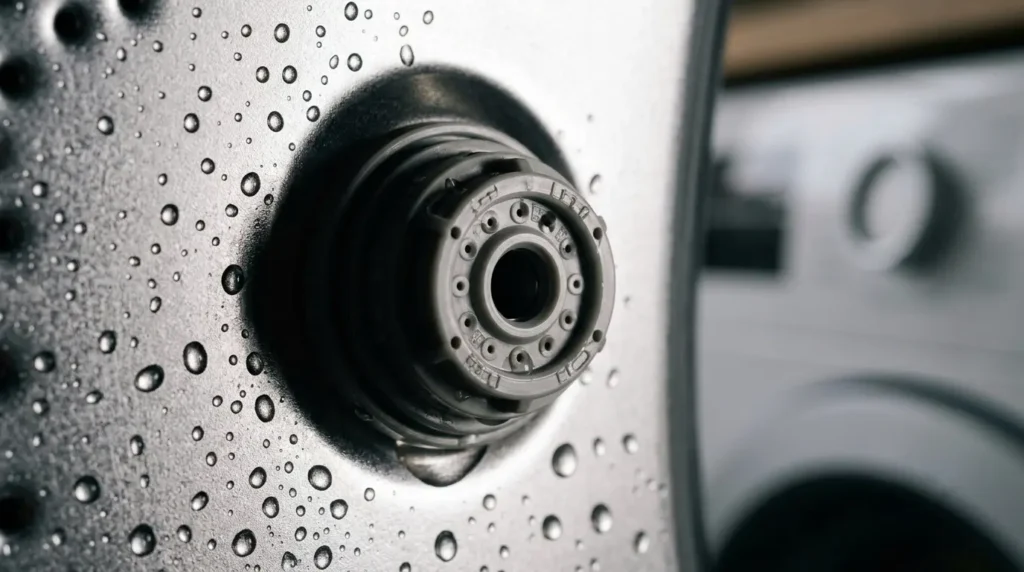
TurboWash’s core hardware is a set of high-pressure nozzles positioned inside the drum, typically integrated into the drum’s rear wall and sometimes the door area depending on the model generation. These nozzles pull water from the machine’s main supply and force it through narrow openings at higher pressure than a standard fill valve delivers, creating a directed spray pattern rather than a simple trickle or pour.
The nozzles operate in coordination with drum rotation, timed so that as the load tumbles past a nozzle’s spray zone, it receives a concentrated burst of water and detergent solution. Because this happens continuously throughout the cycle rather than as a single pre-soak step, the fabric never has time to dry out between saturation events the way it can during the longer pauses of a standard cycle’s tumble-and-wait pattern.
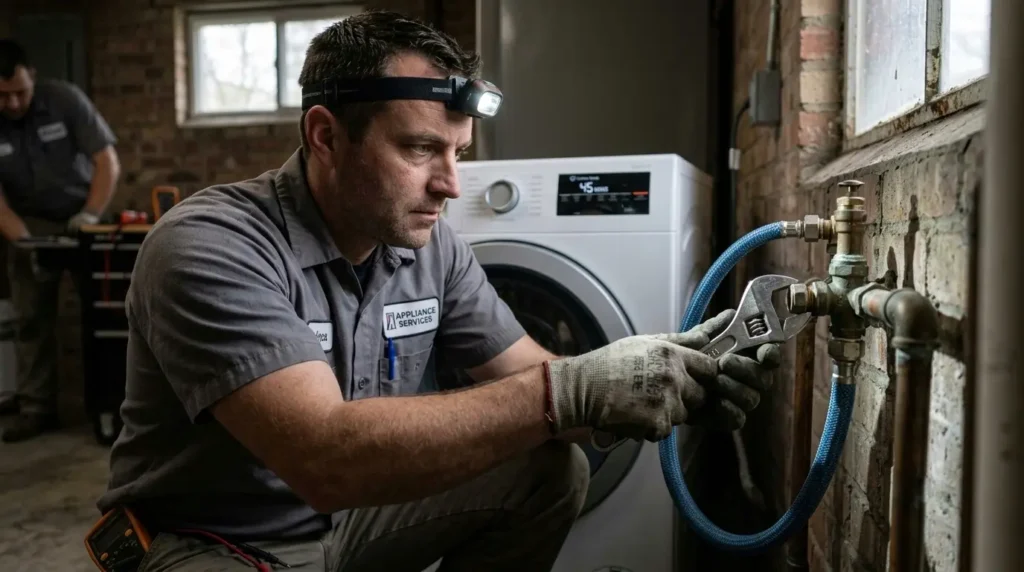
| 💡 Insider Knowledge: When a technician is called for “TurboWash isn’t working like it used to,” the first check is water supply pressure at the household connection, not the nozzles themselves. A partially closed valve or a pressure-reducing fixture elsewhere in the home can starve the nozzles even when the machine itself is fine. |
Why More Water Contact Doesn’t Mean More Water Used
A reasonable assumption is that spraying water at multiple points throughout a cycle must use significantly more water than a standard cycle’s simple fill-and-tumble approach, but this isn’t how LG engineered the system. TurboWash cycles typically use a comparable or only marginally higher total water volume than a standard cycle for the same load size, because the water being sprayed is largely recirculated from the same wash bath rather than continuously drawing fresh water from the supply line.
The efficiency comes from how that existing water is used, not from using more of it. A standard cycle’s water sits relatively static at the bottom of the drum for long stretches, doing its work only when tumbling brings fabric into it. TurboWash’s pump and nozzle system keeps that same water actively moving and making contact throughout the cycle, extracting more cleaning action per liter of water present rather than requiring additional liters to compensate for passive contact.
LG TurboWash vs a Standard Wash Cycle
| Aspect | TurboWash Cycle | Standard Wash Cycle |
| Water delivery method | Active high-pressure nozzle spray | Passive tumbling through pooled water |
| Typical cycle time | Roughly 30-59 minutes depending on load | Typically 50-90+ minutes |
| Water usage | Comparable to standard, largely recirculated | Baseline usage for load size |
| Detergent distribution speed | Fast, continuous contact | Gradual, dependent on tumble frequency |
| Best suited for | Everyday loads, time-sensitive washing | Heavily soiled loads needing extended soak time |
| Mechanical components involved | Additional pump + nozzle system | Standard fill valve and drum motor only |
This comparison highlights the real tradeoff: TurboWash isn’t universally “better”; it’s optimized for speed without sacrificing standard-soil cleaning performance, while a standard or heavy-duty cycle still has an edge for genuinely heavy, ground-in soil that benefits from longer soak exposure regardless of spray pressure.
Where TurboWash Genuinely Helps (and Where It Doesn’t)
TurboWash delivers its clearest benefit on everyday moderately soiled loads, regular clothing, and typical household laundry loads where the soil isn’t deeply embedded, because active spraying reaches full saturation and detergent distribution quickly enough that the shortened cycle time doesn’t compromise the result.
Where TurboWash offers less advantage is on heavily soiled loads requiring extended chemical breakdown time, deeply set stains, greasy work clothes, or loads that genuinely benefit from a long pre-soak period. In these cases, the limiting factor isn’t how quickly water reaches the fabric; it’s how long detergent enzymes need to chemically break down the soil, and no amount of spray pressure accelerates that chemistry. This is why LG pairs TurboWash with separate heavy-duty and pre-soak cycle options rather than positioning it as a universal replacement for every wash setting.
| 💡 Insider Knowledge: A commonly misdiagnosed complaint is “TurboWash isn’t cleaning as well as my old machine’s regular cycle”; the actual cause is usually an overloaded drum blocking nozzle spray paths to fabric in the center of the load, not the technology malfunctioning. Reducing load size resolves this in most cases. |

Common Misconceptions About TurboWash
Misconception: “LG TurboWash is just a faster spin cycle.”
Spin speed and TurboWash are unrelated systems; TurboWash affects the wash phase (how water and detergent reach fabric), not the extraction/spin phase that removes water at the end of the cycle.
Misconception: “LG TurboWash uses way more water to work faster.”
As covered above, water usage is comparable to a standard cycle for the same load size, since the system largely recirculates existing wash water rather than drawing significantly more from the supply.
Misconception: “TurboWash is available on every LG washer.”
It’s a specific hardware feature (the nozzle and pump system) present on select mid-tier and premium LG models; it can’t be activated as a software setting on a base-tier washer that lacks the physical nozzle hardware.
What Affects TurboWash Performance Over Time
Because TurboWash depends on consistent water pressure and unobstructed nozzles, a small number of factors can degrade its performance over years of use even when the rest of the machine is functioning normally. Mineral scale buildup in hard water areas can gradually narrow the nozzle openings, reducing spray pressure and pattern coverage. This is a slower, cumulative version of the pressure-supply issue mentioned earlier but originates inside the machine rather than the home’s plumbing. Periodic descaling maintenance, particularly in hard water regions, helps preserve nozzle performance alongside its more commonly cited benefit of protecting the heating element and inlet valve.
Detergent residue buildup inside the nozzle openings is a less commonly known contributor, particularly when consistently using more detergent than a load requires; the excess doesn’t fully rinse from the nozzle interior between cycles and can accumulate into a partial blockage over months of use.

FAQ
1. Does LG TurboWash clean as well as a standard cycle, or is it a compromise for speed?
For everyday moderately soiled loads, TurboWash’s active spray delivery achieves comparable cleaning results in less time; it’s not a lesser version of a standard wash, it’s a different water-delivery method optimized for speed on typical loads.
2. Why is my TurboWash cycle taking longer than the advertised time?
Cycle time adjusts based on load size, selected soil level, and water temperature setting, so a larger or heavily soiled load automatically extends beyond the shortest advertised TurboWash time.
3. Can I use TurboWash for heavily soiled or greasy laundry?
You can, but a dedicated heavy-duty or pre-soak cycle is generally more effective for deeply embedded soil, since that soil type benefits more from extended chemical breakdown time than from faster water delivery.
4. Does TurboWash use more electricity because of the additional pump?
The additional pump does draw some power, but the significantly shorter cycle time typically offsets this, resulting in comparable or sometimes lower total energy use per cycle compared to a standard-length cycle.
5. Is TurboWash the same technology as TurboWash 360?
TurboWash 360 is an expanded version of the same nozzle-based approach with additional spray points and refined timing, generally found on newer or higher-tier LG models, but both rely on the same core active-spray principle.
6. Can hard water damage the TurboWash nozzles specifically?
Yes, mineral scale can gradually narrow nozzle openings over time in hard water areas, which is why periodic descaling maintenance benefits TurboWash performance in addition to its more commonly known benefits for the heating element and inlet valve.
7. Will overloading the washer reduce TurboWash’s effectiveness?
Yes, significantly, TurboWash’s spray pattern is calibrated for specific load volumes, and an overloaded drum blocks nozzle spray paths from reaching fabric in the center of the load, which is one of the most common causes of disappointing results attributed to the technology itself.
Conclusion
LG TurboWash earns its speed honestly; it’s not a shortcut that skips steps, it’s a genuinely different water-delivery mechanism that reaches full saturation and detergent distribution faster than passive tumbling ever could. Understanding that distinction helps you use it appropriately: reach for TurboWash on your everyday loads, save the heavy-duty or pre-soak cycle for genuinely stubborn stains, and keep loads within the recommended size so the nozzle spray pattern can actually do its job.