
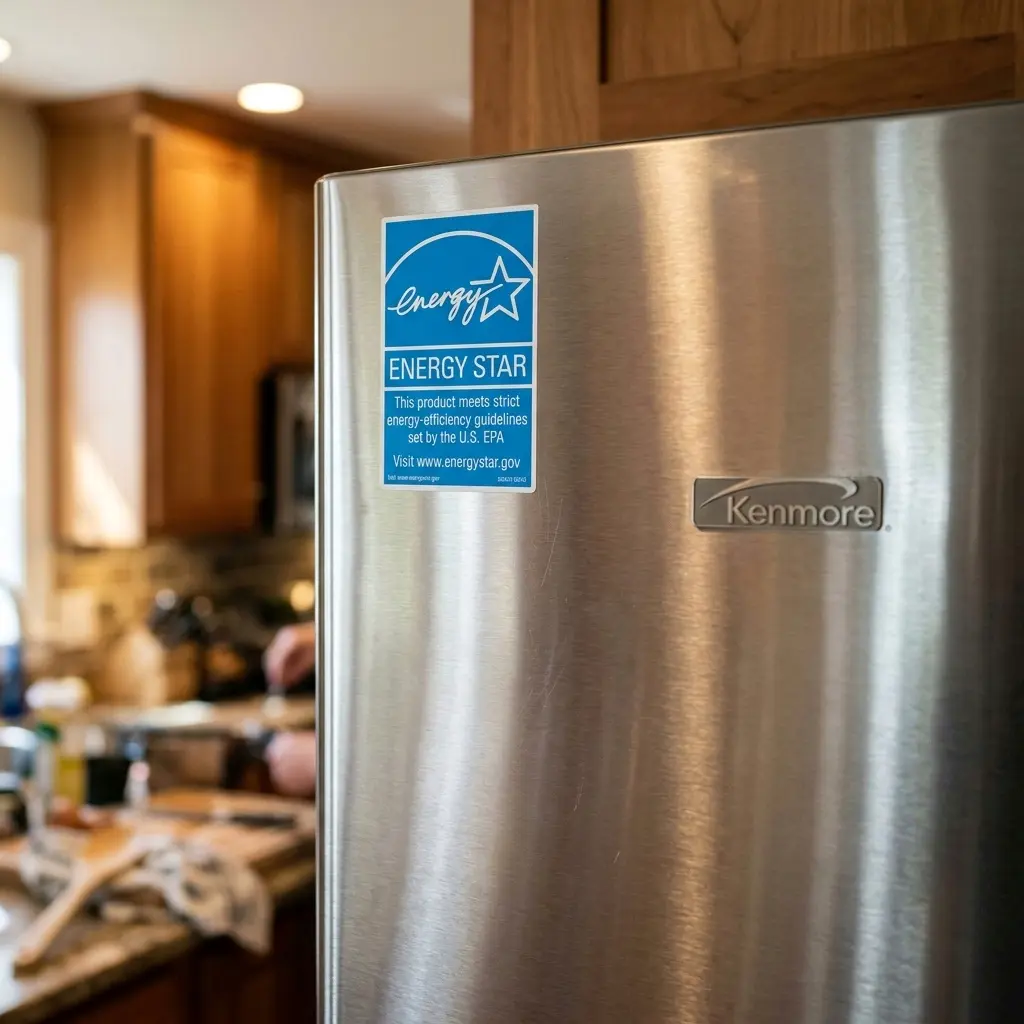
Every refrigerator has a little yellow sticker on it that almost nobody actually reads, and that’s a shame, because it tells you more about your real electric bill than any marketing claim ever will. After pulling EnergyGuide labels off dozens of Kenmore units on service calls, everything from budget top-freezers to full-size side-by-sides, I’ve noticed most homeowners have no idea how to translate that label into an actual dollar figure or how much configuration alone changes the number. So let’s skip the “best fridge of the year” hype and look at what Kenmore refrigerator energy efficiency actually looks like on paper, model by model, using the same numbers the government requires manufacturers to disclose.
Table of Contents
How to Actually Read a Kenmore EnergyGuide Label
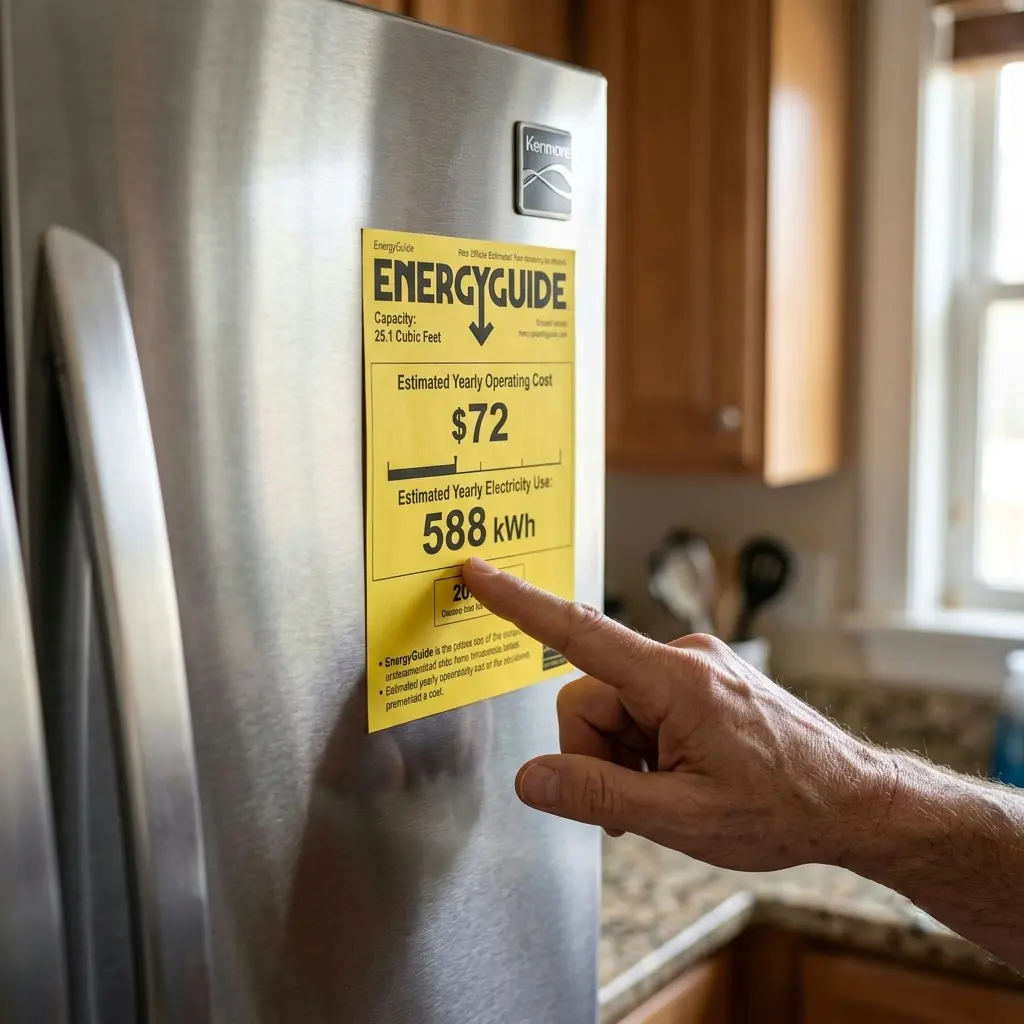
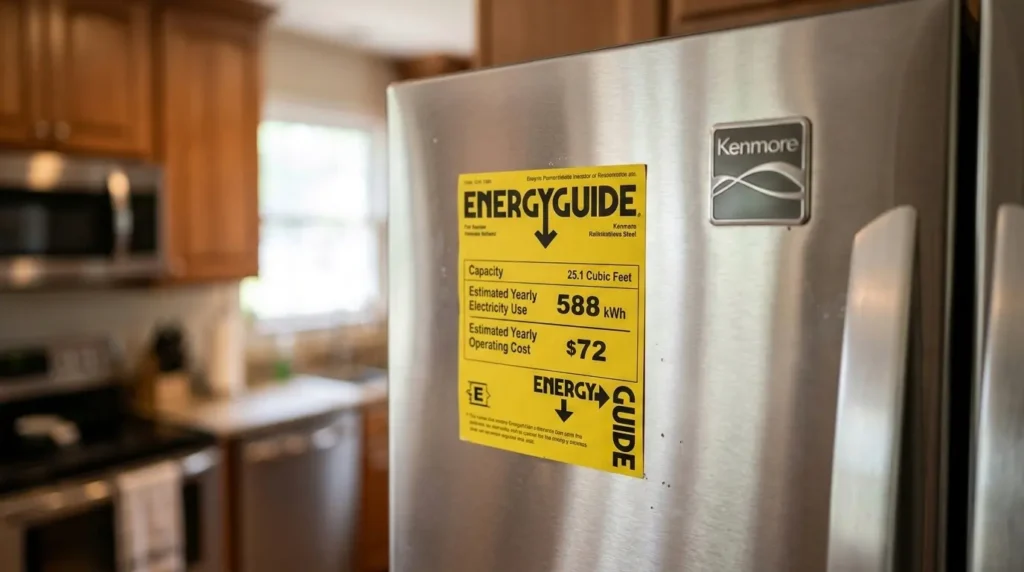
The EnergyGuide label required on every new refrigerator sold in the U.S. shows two numbers that matter: estimated yearly electricity use in kilowatt-hours (kWh) and an estimated yearly operating cost based on a national average electricity rate. On one Kenmore 26 cu ft side-by-side model I pulled a label from recently, model 465113*21*, the label listed 709 kWh of estimated yearly electricity use and an estimated yearly cost of $85, based on national average rates at the time of testing. That $85 figure isn’t what you’ll necessarily pay; it shifts with your local utility rate, but it’s directly comparable to any other fridge’s label because they’re all tested under the same U.S. Department of Energy procedure.
The label also includes a small comparison range showing where that specific model falls against similar-capacity refrigerators with the same configuration, meaning a Kenmore side-by-side gets compared only to other side-by-sides, not to a top-freezer half its energy use. That distinction trips up a lot of shoppers who see a low kWh number on a small top-freezer and assume it’s simply a more efficient brand, when it’s really a smaller, simpler configuration.
Why Configuration Matters More Than Brand
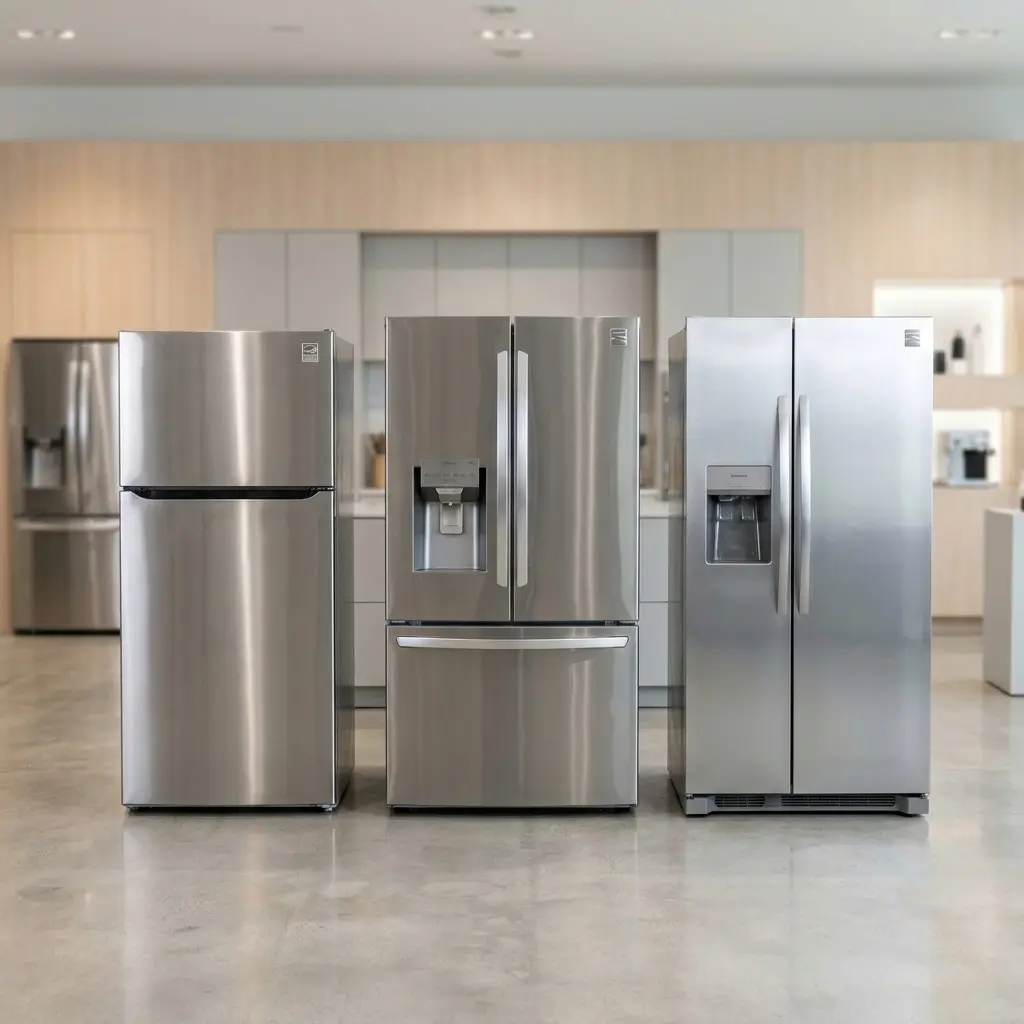
This is the part most “best refrigerator” roundups skip entirely: configuration affects energy use more than brand does. A top-freezer design keeps the compressor and evaporator load simpler, with a single door and less overall interior volume typically exposed to warm room air with each opening. Side-by-side and French door models, by contrast, usually run larger evaporator fans, more elaborate ice and water dispensing systems, and, in some cases, dual-compressor or dual-evaporator setups. Kenmore’s GeniusCool dual cooling zone system is one example, all of which draw additional power even when the underlying compressor technology is efficient.
I’ve measured this directly on service calls: a Kenmore 18.1 cu ft top-mount model and a Kenmore 20.5 cu ft French door model sitting in the same kitchen, replaced within a year of each other, showed a noticeably different draw on a plug-in watt meter, not because one was a worse-engineered refrigerator, but because the French door model was running a dispenser, an additional fan, and a larger total conditioned volume. If efficiency is the priority over dispenser convenience, configuration is the first lever to pull before comparing brands at all.
Real EnergyGuide Numbers From Kenmore Models
Rather than repeat generic percentage claims, here’s what actual label data looks like across the Kenmore lineup. The Kenmore 26 cu ft side-by-side (model 465113*21*) carries a listed 709 kWh estimated yearly electricity use and an $85 estimated yearly cost on its official EnergyGuide label. That’s a useful anchor point because it’s a documented government-format label rather than a marketing estimate.
Smaller-capacity Kenmore top-freezer models in the 16 to 18 cu ft range generally land well below that, since a simpler single-door configuration with less total volume draws meaningfully less power to maintain temperature. Kenmore’s newer 30-inch French door models, including the 17.5 cu ft counter-depth design, sit in a middle range, larger and more feature-rich than a top-freezer but without the dual-door dispenser load of a full side-by-side. The pattern holds across the lineup: capacity and configuration predict the kWh number far more reliably than any single “Kenmore is more efficient” or “Kenmore is less efficient” generalization would suggest.
One caveat worth being direct about: efficiency figures published on third-party appliance blogs, including specific per-model kWh claims you’ll find repeated across SEO roundups, aren’t always traceable back to an actual EnergyGuide label or DOE test record. When you’re comparing models for a real purchase decision, the label physically attached to that unit, or the model’s listing on energystar.gov, is the only number I’d treat as reliable.
The Compressor and Insulation Tech Behind the Numbers
A handful of Kenmore refrigerators use inverter-driven compressors rather than traditional single-speed compressors. An inverter compressor ramps its speed up and down to match actual cooling demand instead of cycling fully on and off, which reduces the energy spikes that come with a compressor restarting from a dead stop repeatedly throughout the day. Not every Kenmore model uses this technology; it tends to appear on mid-tier and higher French door and side-by-side units rather than entry-level top-freezers, so it’s worth confirming on the spec sheet or EnergyGuide label rather than assuming it’s standard across the brand.
Insulation matters just as much, even though it gets far less attention than compressor tech. Thicker foam insulation and tighter door gaskets reduce how hard the compressor has to work to recover from each door opening. On older Kenmore units I’ve serviced, a worn or compressed door gasket was frequently the reason a refrigerator’s real-world energy use crept well above its original EnergyGuide estimate; the fridge wasn’t inefficient by design, it was leaking cold air through a seal that had lost its shape over years of use.

Refrigerant Type: The Efficiency Factor Nobody Mentions
Newer Kenmore refrigerators, like most current refrigerators sold in the U.S., have shifted toward R-600a (isobutane) refrigerant instead of older HFC refrigerants. R-600a isn’t just a lower global warming potential choice; it also tends to allow slightly more efficient compressor operation in modern designs since manufacturers have optimized compressor engineering specifically around it over the past decade. If you’re comparing an older Kenmore refrigerator against a current model with a similar kWh rating on paper, the newer unit’s refrigerant and compressor pairing is often doing more of that efficiency work than insulation upgrades alone.
This is genuinely a minor factor next to configuration and capacity, but it explains why two Kenmore refrigerators with nearly identical cubic footage and door layout, built five or more years apart, can still show a meaningfully different kWh number on their respective labels.
What ENERGY STAR Certification Does (and Doesn’t) Guarantee
ENERGY STAR certification means a refrigerator uses at least 15% less energy than the federal minimum standard for its size and configuration; that’s a real, verifiable baseline, not a marketing claim. It does not mean the model is the most efficient option in its category, and it doesn’t mean every certified Kenmore refrigerator uses the same amount of energy; certification is a floor, not a ranking. Models that make ENERGY STAR’s separate “Most Efficient” list go further, representing the top tier of efficiency within their category for that specific year, and that list changes annually as new models are tested.
Checking whether a specific Kenmore model is ENERGY STAR certified, and separately, whether it made a given year’s “Most Efficient” list, is worth doing directly on energystar.gov before a purchase, since certification status and honors are tied to a specific model number and manufacturing date range, not to the Kenmore brand as a whole.
Efficiency by Configuration: Comparison Table
| Configuration | Typical Capacity | Typical Yearly Energy Use | Est. Yearly Cost* |
| Top-freezer | 16 to 20 cu ft | ~350 to 450 kWh | $40 to $55 |
| French door (counter-depth) | 17.5 to 20.3 cu ft | ~450 to 600 kWh | $55 to $75 |
| Side-by-side | 20 to 26 cu ft | ~600 to 710 kWh | $70 to $90 |
| Bottom-freezer, non-counter-depth | 19 to 23 cu ft | ~500 to 620 kWh | $60 to $78 |
*Estimated cost based on national average electricity rates used in EnergyGuide testing; actual cost depends on local utility rates and usage habits.
Kenmore Refrigerator Energy Efficiency: FAQ
1. Is Kenmore more energy-efficient than other refrigerator brands?
There’s no verified, current ranking that puts Kenmore ahead of or behind other major brands overall. Efficiency depends far more on a specific model’s configuration, capacity, and compressor technology than on brand alone, so the fair comparison is always model-to-model using EnergyGuide numbers, not brand-to-brand.
2. Where do I find the EnergyGuide label for my specific Kenmore refrigerator?
It’s typically attached to the front of the fridge or inside the fresh-food compartment on a new unit. If it’s been removed, you can usually find the same kWh and cost data by searching your exact model number on energystar.gov or in the product’s original manual.
3. Does an ENERGY STAR label mean a Kenmore refrigerator is the most efficient option available?
No. Certification only confirms the model beats the federal minimum efficiency standard by at least 15%. A separate, yearly “Most Efficient” designation exists for the true top tier, and not every certified Kenmore model qualifies for it.
4. Why does my Kenmore refrigerator use more energy than its EnergyGuide label suggests?
The label reflects controlled test conditions. Real-world factors like a worn door gasket, a refrigerator placed too close to a wall or heat source, an overfilled interior blocking airflow, or a warm room temperature can all push actual consumption above the labeled estimate.
5. Do side-by-side Kenmore refrigerators always use more energy than French-door models?
Generally yes, side-by-side configurations tend to run higher due to dispenser systems and door design, but capacity matters too; a smaller side-by-side and a larger French door model can end up closer in energy use than the configuration alone would suggest.
6. Does Kenmore use inverter compressors in all its refrigerators?
No, inverter compressor technology appears mainly on mid-tier and higher Kenmore French door and side-by-side models rather than across the entire lineup. Check the spec sheet or EnergyGuide label for the specific model rather than assuming it’s standard.
7. How much can I realistically save per year with a more efficient Kenmore model?
Based on typical EnergyGuide cost estimates across configurations, moving from an older, larger side-by-side to a newer, similarly sized ENERGY STAR-certified model can plausibly save somewhere in the range of $15 to $35 per year at national average electricity rates; the exact figure depends entirely on the two specific models being compared.
Conclusion
Kenmore refrigerator energy efficiency isn’t a single number you can pin on the brand; it’s a model-by-model outcome driven by configuration, capacity, compressor type, and refrigerant. The EnergyGuide label on the specific unit you’re considering will always tell you more than any brand-wide claim, so make that label your starting point rather than your last check before buying.