
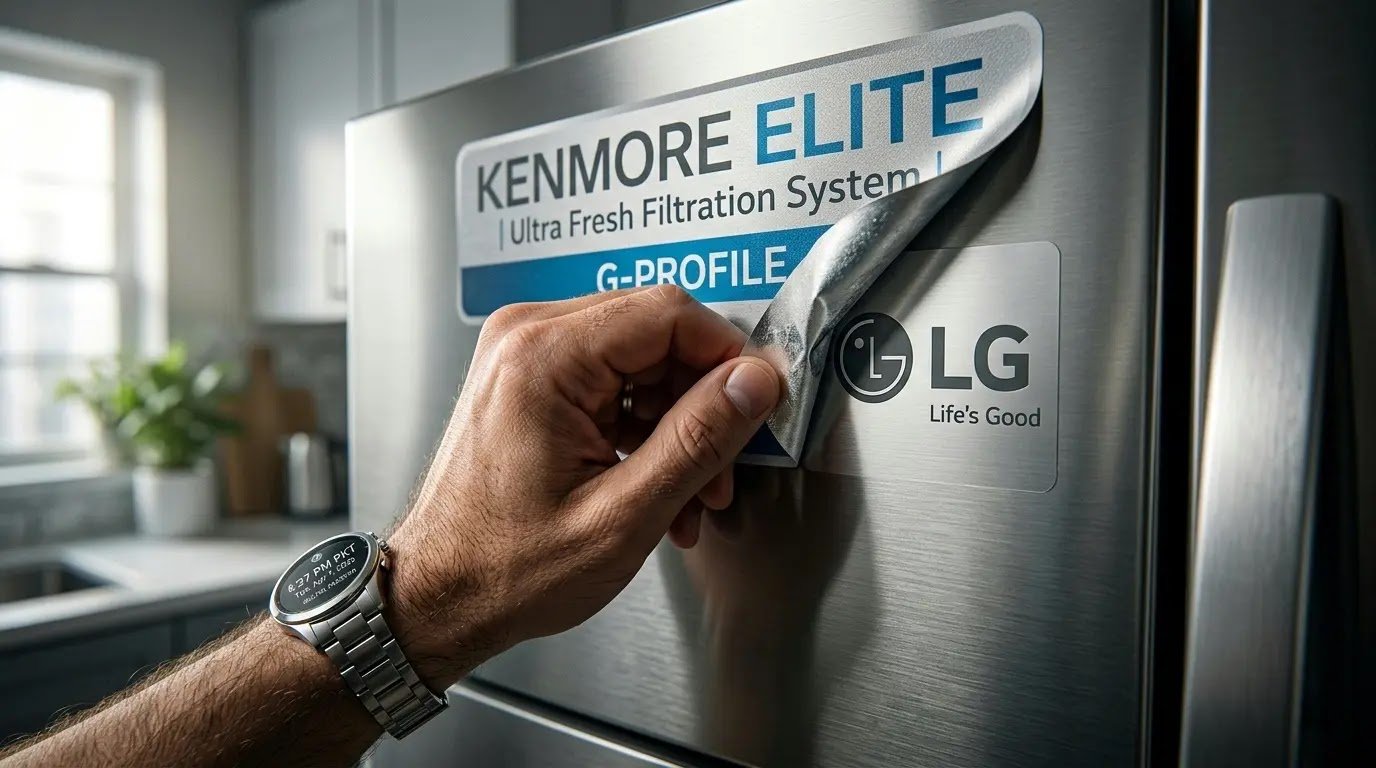
The Kenmore name used to mean “built to last.” Today, checking the model number before you buy matters more than the badge on the door, because “Kenmore Elite” doesn’t tell you who actually built the compressor inside.
I’ve stood in kitchens across North America watching families deal with hundreds of dollars in spoiled groceries from a fridge that looked flawless from the outside. The LED lights are bright, the finish is spotless, and the compressor is silent, for the wrong reason. When I pull the back panel and find an LG-made linear compressor, I usually already know what happened. In 2026, buying a Kenmore Elite refrigerator without checking the model prefix means you might be buying a rebadged LG unit with a documented reliability history, not the original reputation of the Kenmore name.
A quick note for readers outside North America: Kenmore Elite is a Sears-originated retail brand sold almost exclusively in the United States and Canada, so if you’re shopping elsewhere, this specific brand name won’t appear on shelves, but the underlying issue absolutely will. LG-built linear compressors are used across LG’s own refrigerator lineup worldwide, and the identification and warranty principles covered here apply just as directly if you’re evaluating an LG-branded fridge directly rather than a Kenmore Elite.
Quick Take: Check the model sticker before buying. A prefix starting with 795 or 796 means the unit is LG-built, with a documented history of linear compressor reliability issues and class-action settlements behind it. A 10-year compressor warranty sounds reassuring, but it typically covers only the part, not the specialized labor and refrigerant that make up most of the real repair bill. All dollar figures below are USD estimates and will vary by region, currency, and local labor rates.
Table of Contents
The 795 Code: How to Identify an LG-Built Kenmore Elite
Kenmore hasn’t owned a manufacturing plant in decades. It’s a badge brand; the company pays other manufacturers to build the units and applies the Kenmore Elite name to the door. Some Kenmore Elite units are Whirlpool-built and share that platform’s more field-serviceable reputation; the Elite refrigerator line, however, is predominantly built by LG Electronics.
Open your fridge and check the model sticker on the interior side wall. If the model number starts with 795, you’re looking at an LG-built unit under a Kenmore badge. This matters because LG has faced multiple class-action lawsuits over its linear compressor technology, the same compressor design used across most 795 series models. Several of these suits have settled, with LG extending compressor warranty coverage on affected model ranges as part of the resolution. This is a documented, verifiable pattern in the appliance repair trade and in litigation records, not a rumor.
👉 [how to find your refrigerator’s model number and manufacturer prefix]

| Prefix | Generally Understood Manufacturer | Field Reputation (Technician-Observed, Not a Formal Rating) |
| 795 / 796 | LG Electronics | Documented compressor reliability concerns; multiple class-action settlements |
| 110 / 106 | Whirlpool | Generally considered more standard, field-serviceable architecture |
| 253 | Frigidaire (Electrolux) | Mixed reputation; varies by model generation |
| 401 | Samsung | Ice maker components are a more commonly reported issue than the compressor. |
This table reflects general patterns reported by repair technicians and documented litigation, not a formal statistical risk score; always verify your exact model number and its history before making a purchase decision.
Thermal Stress and the Control Board: Why These Fridges Click in Summer
Many sources point to household voltage fluctuations as the primary killer of these compressors. That’s only part of the picture. Modern 795 series inverter boards are generally designed to tolerate normal voltage fluctuations. A more consistent real-world factor is thermal stress on the control board itself.
Inside the Kenmore Elite refrigerator, the control board is packed with capacitors, and the cabinet’s sleek, low-ventilation design doesn’t always give those components room to dissipate heat effectively. When kitchen ambient temperature climbs during summer months, the board can overheat, sending an inconsistent signal to the compressor. This is one of the more commonly reported causes behind the clicking sound owners describe: the compressor struggling to start under a degraded signal rather than starting cleanly.
👉 [LG Smart Inverter compressor technology explained]
The R600a Refrigerant Reality: Why Repairs Get Expensive
By 2026, environmental regulations have pushed most manufacturers toward R600a (isobutane) refrigerant. It’s more eco-friendly than older refrigerants, but it’s also flammable, and repairing a leak requires specialized tools, like Lokring fittings that join pipes without an open flame, which not every local repair shop carries or is willing to use in a customer’s kitchen.
If a 795 series unit develops a leak in the aluminum coils, the warranty picture gets more complicated than it first appears. The compressor part itself may be covered under LG’s extended warranty from the lawsuit settlements, but specialized R600a labor, refrigerant, and tooling are frequently billed separately and can add up to a significant portion of the repair cost, sometimes enough that replacing the unit becomes more economical than repairing it, particularly on older units nearing the end of a typical refrigerator’s service life.

The Display Gap: Why the Screen Can Read Normal While Food Spoils
One of the more common complaints I hear: “The screen says 37°F, so why is my milk spoiled?” The technical explanation is that most Kenmore Elite (795 series) digital displays are designed to show the set point, what you’ve told the fridge to target, rather than continuously updating with a live actual-temperature reading pulled from a sensor near the food itself.
This is a documented gap in many digital refrigerator displays generally, not unique to this model, but it becomes a real problem specifically when a compressor is beginning to fail: internal temperature can rise well above the display’s shown value before an error code like “Er IF” or “Er FF” finally triggers, by which point food may have already spent an extended period at unsafe temperatures.
I want to be precise here: I don’t have a verified source confirming this display behavior is an intentional design choice to avoid service calls, and I’m not going to present that as fact. What’s verifiable is the practical gap between displayed and actual temperature during a failure, and that gap is worth planning around regardless of the reason behind it.
Pro Tip: Keep an inexpensive analog thermometer inside the fridge as a cross-check. Don’t rely solely on the digital display, especially as the unit ages.
👉 [How Long Does an LG Refrigerator Keep Food Safe During a Power Outage?]

Illustrative Scenario: A Composite Field Story
The following is an illustrative composite scenario based on patterns I’ve seen repeated across multiple service calls, not a single verified incident.
A family stocks up before a summer holiday gathering with several hundred dollars in meat, poultry, and fresh produce. Their Kenmore Elite refrigerator is only a few years old and looks pristine. The display still shows a normal set point, but the food inside is warm to the touch. The compressor has gone into a repeating start-and-fail cycle, clicking every few minutes, then shutting down.
A repair estimate in this kind of scenario often lands somewhere in the $700-$1,000 USD range once specialized labor, refrigerant, and tooling are factored in, even when the compressor part itself is covered under warranty. Faced with that math on a unit originally priced in the $2,000-$3,000 USD range, many owners in this situation choose to replace the fridge outright rather than repair it.
This scenario is common enough across the appliance repair trade that it’s worth planning for financially before you’re facing it in real time, even though the specific numbers above are illustrative rather than a guaranteed outcome for any individual unit.
What makes this scenario particularly frustrating for owners isn’t the repair cost alone; it’s the timing. Compressor failures in this category tend to cluster during summer months, when ambient kitchen temperatures are highest and thermal stress on the control board peaks, which means the failure often arrives right when a household is stocking up for warm-weather entertaining rather than at a convenient, low-stakes moment.
The Ice Maker Design Flaw in the 795 Door
On 795 models, the ice maker sits directly in the left door rather than in the freezer cabinet itself. Every door opening exposes the ice compartment to warmer kitchen air, which causes partial melting and refreezing over time, eventually forming a solid block that strains the plastic auger motor until it fails.
Parts availability compounds this problem: as Sears, the U.S. retail chain that originally owned and sold the Kenmore brand before its business troubles reshaped how the name is licensed today, has scaled back, sourcing an exact replacement auger for older Kenmore-branded units is becoming more difficult in some regions, which can turn a relatively minor mechanical failure into a longer repair wait than the underlying problem would suggest.
👉 [Kenmore Refrigerator Not Cooling? 5 DIY Fixes]
What Buying “Kenmore Elite” Actually Means in 2026
The core thing to understand before shopping for this brand at all: “Kenmore” is not a manufacturer; it’s a retail brand that has been licensed out to different appliance makers over the decades. This means two refrigerators sitting side by side under the same Kenmore Elite name can have entirely different internal engineering, reliability histories, and parts ecosystems depending purely on which manufacturer built that specific model.
This is genuinely different from buying a Whirlpool-branded or LG-branded appliance directly, where the name on the door tells you who’s accountable for the engineering. With Kenmore, that accountability is one layer removed, and the prefix code is the only reliable way to recover that information before you buy.
👉 [LG vs. Kenmore Elite Refrigerator 2026: Shocking Hidden Software Lock Exposed!]
Total Cost of Ownership If You Already Own a 795 Series Unit
If you already own a 795 series Kenmore Elite, the practical move isn’t panic; it’s proactive maintenance and a realistic repair budget. Keep the compressor warranty documentation from LG’s settlement accessible, since it can meaningfully offset the cost of a compressor-specific repair if a failure does occur. Clean the condenser coils regularly to reduce thermal load on the control board, particularly during summer months when ambient kitchen heat is highest.
Budget mentally for the possibility that a refrigerant-related repair, if one becomes necessary, may run high enough that replacement is the more economical choice; this isn’t a certainty, but it’s a realistic scenario worth planning for rather than being surprised by.

| Warranty Coverage Question | What’s Typically Covered | What’s Typically NOT Covered |
| Compressor part itself | Yes, under LG’s extended settlement coverage on affected models | — |
| Diagnostic labor to confirm compressor failure | Sometimes, depending on dealer/service terms | Often billed separately |
| R600a refrigerant recharge | Rarely bundled automatically | Usually billed as a separate line item |
| Specialized Lokring tooling/labor for leak repair | Rarely covered | Usually the highest out-of-pocket cost |
| Food spoilage from a failure | No | Not covered by appliance warranties generally |
The gap between “the part is covered” and “the repair is affordable” is where most of the frustration in this category comes from; it’s worth reading your specific warranty documentation closely rather than assuming the 10-year headline number covers the full repair cost.
Common Buyer Regrets and What to Check Before You Buy
The most common regret I hear from 795 series owners isn’t about the fridge’s features; it’s that nobody told them to check the prefix before buying. Many assumed “Kenmore” meant a consistent manufacturing standard the way it did decades ago and were surprised to learn the badge doesn’t guarantee that anymore.
A second common regret: buyers who bought based on the 10-year compressor warranty headline without understanding that the warranty typically covers the part itself, not the specialized labor and refrigerant required to install it, a distinction that matters enormously once a repair is actually needed.
A third pattern worth mentioning: buyers who assume the reliability concern is limited to older units and that a recently purchased 795 series fridge is automatically safe. The linear compressor design at the center of the lawsuits has been used across a wide span of production years, and a new purchase date doesn’t by itself confirm a different, more reliable compressor generation is inside, the model number and its documented history matter more than how recently the unit was bought.
Frequently Asked Questions
1. Is the Kenmore Elite 10-year compressor warranty worth relying on?
It provides real value on the compressor part itself, especially given the documented linear compressor issues behind the LG lawsuits, but it typically doesn’t cover the specialized R600a labor and tooling costs, which can be substantial on their own.
2. My Kenmore Elite is making a clicking sound; can I fix it myself?
Sometimes it’s a simple, inexpensive start relay. If replacing that doesn’t resolve it, the compressor itself may be struggling or failing; unplug the unit to reduce electrical risk and have it inspected by a technician rather than continuing to run it.
3. How do I find my refrigerator’s model number and prefix?
Check the sticker on the interior side wall or near the crisper drawers; it typically lists the full model number, which begins with the manufacturer prefix discussed above.
4. What should I buy instead if I want to avoid the 795 series risk profile?
Kenmore Elite units with a 106 or 110 prefix are generally Whirlpool-built and considered more standard, field-serviceable appliances by most independent repair technicians, though you should always verify the specific model’s own track record before buying.
5. Does every 795 series unit fail, or is this a worst-case exaggeration?
Not every unit fails; plenty run without major issues for years. The concern is a documented, above-average failure pattern specific to the linear compressor design, not a guarantee of failure in every individual unit.
6. If I already own a 795 series fridge, should I get rid of it immediately?
Not necessarily. Register any applicable warranty coverage, keep up with coil cleaning, and budget realistically for the possibility of a costly repair; proactive maintenance meaningfully reduces (though doesn’t eliminate) the risk of an unexpected failure.
7. Are LG-built refrigerators under other brand names, or in other countries, at the same risk?
Yes. Kenmore itself is a North America, only retail brand, so if you’re shopping outside the US or Canada, you won’t see this exact badge, but LG sells the same linear-compressor technology globally under its own name, and the documented lawsuits apply to LG-built units broadly. The same due diligence (checking manufacturer, compressor type, and warranty terms) applies whether you’re looking at a Kenmore Elite or an LG-branded fridge directly in your own market.
Final Verdict
Buying a Kenmore Elite refrigerator in 2026 isn’t automatically a mistake, but buying one without checking the model prefix is a real, avoidable risk given the documented history behind LG’s linear compressor technology. Between the display’s gap between shown and actual temperature during a failure, the added expense of R600a-specific repairs, and a badge that no longer guarantees consistent manufacturing, the burden is on the buyer to do five minutes of due diligence before checkout.
Check your prefix before you buy, or before you assume your current unit is safe from this pattern.