
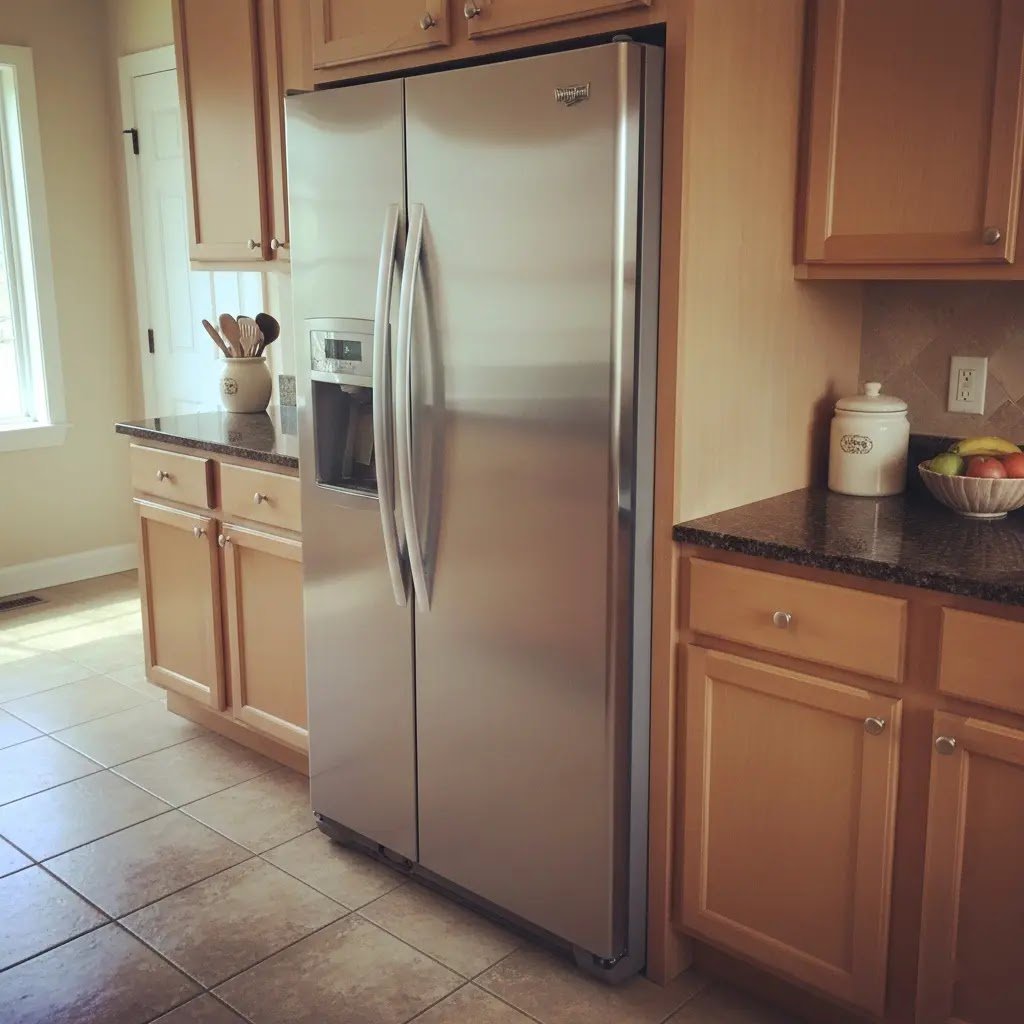
Counter-depth fridges look great until they won’t open fully because they’re too close to a wall or cabinet. If your doors are hitting the woodwork or the unit won’t slide into place, you likely have a clearance issue. Here is how to measure your space and adjust the positioning to prevent the counter-depth refrigerator fit issue and get that perfect built-in look.
Table of Contents
⚠️ Before You Start: Moving a Heavy Appliance Safely
A counter-depth refrigerator, even empty, is heavy enough to injure you or damage your floor if it’s tipped or pushed carelessly. Before starting any of the fixes below:
- Get a second person for anything that involves tilting or sliding the unit, especially on hard flooring where it can slide unpredictably.
- Unplug the fridge before adjusting hinges or removing panels near the back, where the compressor and electrical connections live.
- Mind the pinch points on hinges; fingers get caught between the door and frame more often than people expect during adjustment.
- If your model has a water line for the ice maker, know where the shutoff valve is before you move the unit so you’re not dealing with a leak while also managing the weight.
- Stop and call a professional installer if the fix requires modifying plumbing lines, electrical wiring, or structural elements of the cabinetry.
Tools Needed
| Tool | Purpose |
| Tape measure | Measure fridge depth, width, and clearance |
| Level | Make sure the fridge sits evenly |
| Phillips screwdriver | Adjust hinges or remove panels |
| Flathead screwdriver | Reposition trim or pry gently |
| Wrench or socket set | Adjust leveling legs |
| Soft cloth/towel | Protect the floor and handle small spills |
1. Refrigerator Sticking Out
Symptoms & Diagnostics
- The fridge extends 1–3 inches beyond the countertop.
- Looks uneven with the cabinets.
- Can block walkways in tight kitchens.
Why it happens: Most “counter-depth” models are not completely flush; they need extra space for air circulation, vents, and plumbing behind the unit.
Step-by-Step Instructions
- Measure the depth of your countertop and compare it to your fridge’s specifications. Safety tip: double-check measurements to avoid wall damage.
- Look for models labeled “true counter depth” if a flush fit is critical.
- If needed, recess the wall slightly behind the fridge.
Expert Tip: Even moving the fridge back by 0.5–1 inch can improve its appearance without affecting ventilation.
Cost vs. Replace: Small wall adjustments are low-cost; switching to a true counter-depth fridge can add a few hundred dollars to the purchase price. True counter-depth, panel-ready options have also become more accessible in price over the past couple of years; it’s worth checking current listings before assuming it’s out of reach, since that category isn’t as exclusively premium-priced as it used to be.
The judgment call worth making first: if you’re in a permanent home, recessing the wall is usually worth the one-time effort. If you’re in a rental or a home you’ll list within a couple of years, most buyers won’t notice or care about a 1-inch overhang; it’s rarely worth the wall work in that case.
👉 [Is a counter-depth fridge worth it? Style vs. Space]

2. Door Clearance Problems
Symptoms & Diagnostics
- Doors cannot open fully.
- Hinges hit walls or cabinets.
- The ice maker or shelves are hard to reach.
Why it happens: Fridges need space to swing open. Tight kitchens or incorrect placement block the whole movement.
Step-by-Step Instructions
- Leave at least 2 inches on the hinge side for most standard counter-depth models.
- Use French-door models in tight spaces; they need less clearance since each door swings a shorter arc.
- Adjust the hinge screws if the door bumps into the cabinets.
Worth knowing if you’re considering a replacement rather than an adjustment: some current models use zero-clearance hinge designs (LG’s Counter-Depth MAX line is a clear example) that let the door swing fully open while sitting flush against a wall or cabinet, without needing that standard 2-inch side allowance. That’s a real option if clearance is a hard constraint in your kitchen layout, not just a cosmetic preference.
Expert Tip: Renters can use hinge adapters to allow a full swing without remodeling.
Cost vs. Replace: Minor hinge adjustments cost next to nothing; a French-door model swap is a significant investment.
👉 [Replacing a worn-out door seal]

3. Overhead Cabinet Clearance
Symptoms & Diagnostics
- The top of the fridge or an upper hinge catches on overhead cabinets.
- Doors open at an angle instead of swinging fully flat.
- Under-cabinet lighting or trim gets bumped during normal use.
Why it happens: Kitchen designers sometimes size the upper cabinet opening to the fridge’s listed height without accounting for the extra clearance some hinge and door-swing designs need at the top of their arc.
Step-by-Step Instructions
- Measure from the floor to the underside of the upper cabinet, and compare it against your fridge’s full height, including any listed hinge clearance requirement.
- Check whether your leveling legs have room to lower the unit slightly if it’s sitting a fraction too tall.
- If the gap is only marginal, trimming or removing decorative crown molding above the cabinet opening is sometimes enough.
Expert Tip: This is one of the few fit issues that’s genuinely hard to fix after cabinets are already installed. If you’re at the planning stage of a kitchen remodel, this is worth double-checking against your specific fridge model’s spec sheet, not just its general height.

4. Water Line & Icemaker Hookup Clearance
Symptoms & Diagnostics
- The fridge won’t push all the way back into place.
- A kink or bulge is visible in the water line when you look behind the unit.
- The icemaker works intermittently after a reinstall.
Why it happens: The water line supplying the icemaker needs its own loop of slack behind the fridge. If that clearance wasn’t accounted for during the original cabinet or wall setup, the line gets pinched or forces the whole unit to sit further forward than it should.
Step-by-Step Instructions
- With the water supply shut off, carefully pull the fridge out enough to inspect the line’s path.
- Reroute or add slack to the line so it isn’t sharply bent when the fridge sits at its final position.
- If the wall’s shutoff valve location itself is the problem, that’s a plumbing fix, not a fridge-positioning one; a plumber can relocate it with far less risk than working around it repeatedly.
Cost vs. Replace: Rerouting an existing line is typically inexpensive; relocating a shutoff valve is a plumbing job worth pricing separately from anything fridge-related.
👉 [How to reset your fridge after a power outage]
5. Ventilation Gaps
Symptoms & Diagnostics
- Fridge overheats or runs constantly.
- Cooling performance drops.
- Energy bills increase.
Why it happens: Insufficient airflow makes the compressor work harder.
Step-by-Step Instructions
- Leave the manufacturer-recommended 1–2 inches on top and sides.
- Check that vents are not blocked.
- For very tight spaces, consider a front-vented model.
Expert Tip: Leveling legs also improve airflow; a fridge tilted backward can block vents.
Cost vs. Replace: Free if repositioning the fridge; front-vented models cost more upfront but solve the clearance problem permanently.

6. Leveling and Stability
Symptoms & Diagnostics
- The fridge wobbles or tilts.
- Doors swing back or fail to seal.
- The ice maker or water dispenser may malfunction.
Why it happens: Uneven floors or improperly adjusted legs cause the fridge to be unstable.
Step-by-Step Instructions
- Place a level on top of the fridge.
- Adjust the leveling legs with a wrench until the fridge sits evenly.
- Recheck door alignment and sealing.
Expert Tip: Even a 1/8-inch tilt affects ice makers and water dispensers.
Cost vs. Replace: Free adjustment in most cases; floor shims are a low-cost backup if the floor itself is uneven.

Quick Reference: Issue, Cause, Cost Range
| Issue | Root Cause | Typical Cost to Fix |
| Sticking out past countertop | Standard (not true) counter-depth model | Free–low cost for wall recess; more for a true counter-depth swap |
| The door won’t open fully | Insufficient side clearance | Free (hinge adjustment) to moderate (hinge adapter) |
| Hitting overhead cabinets | Height/hinge clearance not accounted for at install | Often requires trim or cabinet adjustment, not just the fridge |
| Water line kinked or bulging | Insufficient slack behind unit | Low cost, unless the shutoff valve needs relocating |
| Overheating / running constantly | Blocked or insufficient ventilation clearance | Free (repositioning) to moderate (front-vented model) |
| Wobbling or door sealing issues | Uneven floor or unadjusted leveling legs | Free to low-cost |
FAQs About counter-depth refrigerator fit issue
Do counter-depth refrigerators have less storage space than standard-depth models?
Yes. They usually have several cubic feet less capacity, which is a genuine design trade-off rather than a fit issue, worth factoring into your decision before purchase, separate from anything covered in this guide.
Can I install a counter-depth fridge without extra clearance?
No. Even “true counter-depth” models need some clearance for ventilation and door swing, though zero-clearance hinge designs on some current models reduce how much side clearance specifically is needed.
Are counter-depth refrigerators worth it for small kitchens?
Yes, for a sleek look and saved floor space, but consider storage needs for large families before committing to the trade-off.
How do I fix counter-depth fridge door clearance issues in apartments?
Adjust hinges, use hinge adapters, or consider French-door models for tighter swing space, all covered in the Door Clearance section above.
What is the lifespan of a counter-depth refrigerator?
Most last 10–13 years with proper maintenance.
Can I temporarily remove the fridge doors to solve a tight clearance problem during installation?
Yes, on most models the doors can be removed to get the unit through a doorway or into a tight space, then reattached once it’s positioned. This is a delivery/installation technique, not a permanent clearance fix, if the doors need to stay off to open fully once installed, that’s a sign the space itself needs one of the fixes above.
Will adjusting hinges or trimming cabinetry to fix a clearance issue void my appliance warranty?
Adjusting the hinge itself using the manufacturer’s built-in adjustment screws is normal setup and doesn’t typically affect the appliance warranty. Modifying the cabinetry around it is a home-improvement change, not an appliance one, so it wouldn’t affect the fridge’s warranty either way, but check your specific model’s documentation if you’re unsure.
Conclusion
Counter-depth refrigerators are stylish and save space, but careful planning is key. By measuring correctly, leaving adequate ventilation and door-swing clearance, checking overhead and plumbing clearance before you assume it’s just a positioning problem, and leveling properly, you can avoid fit issues and enjoy a fully functional, modern fridge in your kitchen.
Dealing with a fit issue that doesn’t match any of these six? Tell me your model and exactly where it’s catching, and I’ll help you figure out which fix applies.