
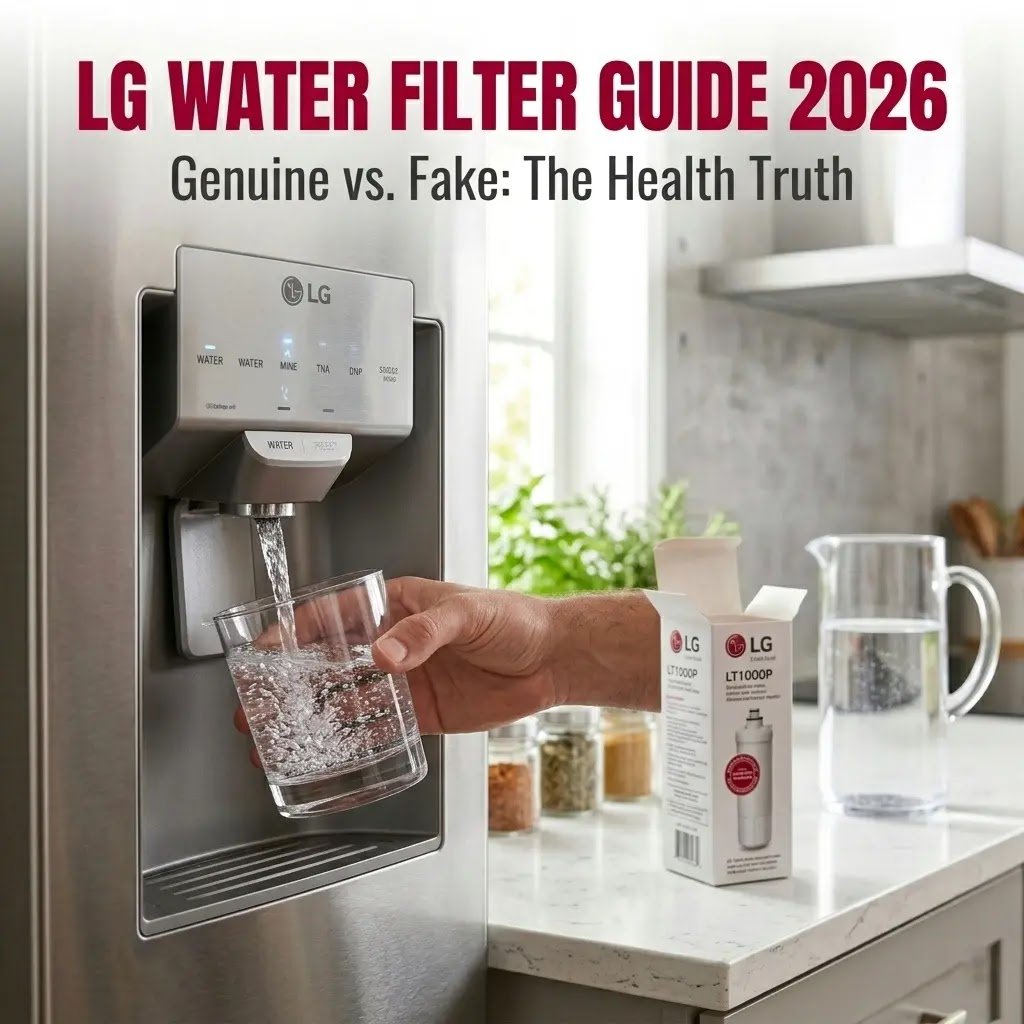
I’ve seen it a hundred times: a homeowner buys a $3,500 LG InstaView, then waits for the little light to tell them when to change the filter. Three months later the dispenser is sputtering and the ice tastes off, because that light is a timer, not a sensor, and the 6-month figure everyone repeats is only half the spec. Here’s what actually determines when your LG refrigerator water filter needs replacing and how to install one without causing the leak that sends people looking for a technician.
Table of Contents
1. The Real Replacement Rule: Gallons, Not Just Months
Here’s the detail most guides skip. LG’s own specification for the LT1000P is 200 gallons and 6 months, whichever comes first, and LG’s guidance is to change it every 3 to 6 months, not a flat six.
That “whichever comes first” is the entire story. Two households on the same filter hit saturation at completely different times:
| Household | Typical Dispenser Use | Realistic Filter Life |
| 1–2 people, occasional dispenser use | Low | Close to the full 6 months |
| Family of 4, daily water + ice | Moderate–heavy | Often 3–4 months |
| Heavy ice use (hot climate, entertaining) | Heavy | Can hit 200 gallons in under 3 months |
| Hard water area, any household size | Any | Shorter, sediment loads the carbon block faster. |
Insider point: if you’re in a hot climate running the ice maker constantly, you can exhaust a filter’s rated capacity while the indicator light still shows two months of “life” remaining. The light counts days. Your water doesn’t.
2. How the Filter Actually Works
Most people picture a sponge. In reality, LG uses a compressed activated carbon block, and the LT1000P filters down to 0.5 microns; for context, a human hair is roughly 70 microns.
That density is why the purge step in Section 6 matters so much and why a saturated filter slows your water flow rather than simply filtering less. As sediment packs into the carbon pores, the same pressure has to push through a progressively tighter block.
3. What NSF Certifications Really Mean
This is where a lot of filter marketing misleads people, so it’s worth getting right.
NSF/ANSI 42, 53, and 401 are not a good-better-best ladder, and 401 did not replace 42. They’re separate categories covering different jobs:
| Standard | What It Covers | Example Claims |
| NSF/ANSI 42 | Aesthetic effects | Chlorine taste and odor, particulates |
| NSF/ANSI 53 | Health-related contaminants | Lead, cysts, mercury, asbestos, VOCs |
| NSF/ANSI 401 | Emerging contaminants | Trace pharmaceuticals, pesticides, BPA |
A single filter can carry all three, one, and none. The genuine LG LT1000P carries NSF 42, 53, and 401.
Two things worth knowing that most LG refrigerator water filter pages won’t tell you:
- Certification is claim-by-claim, not blanket. A filter certified to NSF/ANSI 53 for cyst reduction hasn’t automatically been tested for lead reduction under that same standard. The specific claims live on the performance data sheet, not the box.
- NSF 401 is not a PFAS certification. If “forever chemicals” are your concern, look for PFOA/PFOS claims verified under NSF/ANSI 53 and 58; some filters carry these separately. Don’t assume a 401 badge covers them.
4. Genuine vs. Aftermarket: The Honest Comparison
The common advice is “always buy OEM, and you’ll get a leak.” That’s not quite true, and readers who’ve used a good third-party filter know it. The real dividing line isn’t brand; it’s certified vs. uncertified.

| Genuine LG (LT1000P) | Certified Aftermarket | Uncertified Generic | |
| Typical price | ~$45–55 | ~$15–30 | ~$10 |
| Certifications | NSF 42, 53, 401 | Often 42 and 53; some carry 401. | Frequently none, and vague “tested to” wording |
| Fit consistency | Guaranteed | Usually good | Variable, the real leak risk |
| Warranty concerns | None | Check your warranty terms. | Highest risk |
What to actually avoid: packaging that says “tested to NSF standards” rather than naming a certifying body and standard numbers. That phrasing is not certification, and it’s the single clearest signal you’re buying a flavor filter rather than a health filter.
The fit issue is real, though. LG’s filter housings rely on O-ring compression under household water pressure. A poorly tolerated cartridge can seat imperfectly, and over months of pressure cycling, that becomes a slow weep behind the filter head, which you usually discover as water on the floor, not as a visible drip. This is a manufacturing-quality problem, not an OEM-vs-everyone-else problem: a well-made certified aftermarket filter seats properly, and a badly-made one doesn’t.

5. Signs Your Filter Is Done Before the Light Says So
Because the indicator is a timer, learn to read the machine instead:
| Symptom | What’s Happening | Action |
| Slower dispenser flow | Sediment packed into the carbon block pores | Replace now. |
| Cloudy ice cubes | Dissolved solids getting past a saturated filter | Replace; check water hardness. |
| Metallic and flat aftertaste | Carbon capacity exhausted | Replace and flush lines. |
| The filter is past 200 gallons. | Rated capacity reached regardless of date | Replace now. |
Insider point most guides skip: flow rate is the earliest and most reliable signal. If filling a glass takes noticeably longer than it did a month ago and your home’s water pressure hasn’t changed, the filter is loading up; that shows up well before taste does.
If you want to stop guessing at the gallon count entirely, an inline flow meter on the supply line tells you exactly where you stand.
👉 [LG Refrigerator Water Dispenser Slow and Not Working]

6. The Air-Lock Installation Masterclass
Dispenser sputtering and dripping after a filter change? That’s an airlock. Air is compressible; water isn’t. Trapped air in the line acts like a spring, pushing water out of the nozzle after you release the button.
The purge rule. Manuals commonly say run a gallon through. With the dense carbon block in LT1000P-series filters, run closer to 3 gallons. This does three things:
- Flushes out carbon fines (the harmless black dust in the first glass)
- Clears air pockets that cause post-dispense dripping
- Fully wets the carbon block so it filters at rated performance from the first real glass
Catch the purge water in a pitcher rather than running it down the drain; it’s fine for watering plants.

7. When the New Filter Won’t Work
Installed a new filter and got no water at all? Check the seating. The filter head has a small pin that the cartridge depresses when it’s twisted fully home. If it isn’t rotated to the exact click, the pin stays up and the fridge behaves as though no filter is installed.
Reseat it, twist until you feel and hear the click, then purge again. If the LG refrigerator water filter still won’t flow after a correct reseat, the issue is upstream of the filter, supply line, shutoff valve, and inlet valve, not the cartridge itself.
👉 [LG Refrigerator Ice Maker Troubleshooting Guide]
8. FAQ: LG Refrigerator Water Filter Warnings
Can I run my LG fridge without an LG refrigerator water filter?
Yes, if you use the bypass plug that came with the fridge. Without either a filter and the bypass plug installed, the water and ice dispenser stops working entirely. Running unfiltered water long-term can contribute to mineral buildup in the internal valves, which is an expensive repair.
Why is my dispenser still slow after changing the filter?
Usually an incomplete purge, air pockets restrict flow until they clear, which is why the 3-gallon flush matters. Also check for a kinked supply line behind the fridge, and confirm your household water pressure is within the range your model requires.
Do LG refrigerator water filters remove fluoride?
No. Standard LG carbon filters like the LT1000P and LT700P aren’t designed for fluoride reduction. That requires a dedicated reverse osmosis system installed on the water line before it reaches the refrigerator.
Why does the “Change Filter” light stay on after I replaced it?
It doesn’t reset automatically. On most LG models, press and hold the Water Filter and Filter Reset button for about 3 seconds. If it persists, unplug the fridge for 5 minutes to clear the control board’s memory, then reset again.
Do unused filters expire?
Not on a strict date, as long as the cartridge stays sealed in its original packaging in a cool, dry place. Once the seal is broken, the carbon starts absorbing moisture and odors from the air, so don’t unwrap a spare until you’re installing it.
How do I know how many gallons I’ve actually used?
Most people can’t measure it directly, so estimate: roughly 200 gallons is about 3,200 eight-ounce glasses, including what goes into ice. If your household is heavy on dispensed water and ice, assume you’re hitting capacity closer to the 3-month mark than the 6-month one.
Is it worth replacing the air filter at the same time?
If your model takes one, yes, it’s inexpensive and takes seconds, and pairing the two means you only have to remember one maintenance date instead of two.
9. The Bottom Line
Stop treating the indicator light as the authority. It counts days; your filter measures gallons, and in a busy household those two numbers diverge fast. Set a calendar reminder at the 3-month mark and judge by dispenser flow rate from there; that single habit change catches saturation earlier than the light will, every time.
When you do buy, read the box for named standard numbers rather than “tested to NSF standards,” purge the full 3 gallons, and confirm the click when seating the cartridge. Those three steps prevent nearly every filter-related service call I’ve been sent on.