
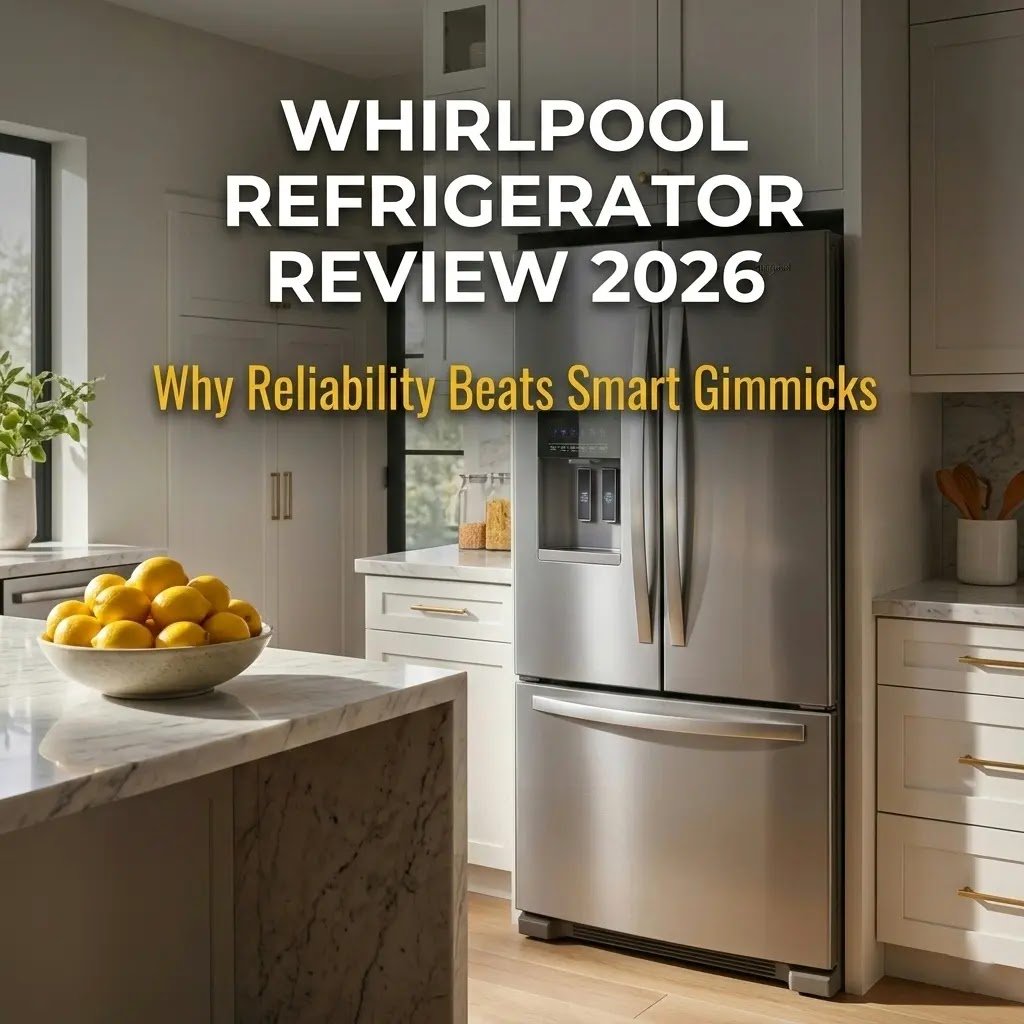
I recently stood in a high-end appliance showroom and watched a salesperson try to convince a young couple that they needed a refrigerator with a built-in AI sommelier. As someone who has spent over a decade dissecting the guts of these machines, I wanted to pull them aside and say, “In five years, that screen will be obsolete, the software will lag, and the motherboard will cost more than your first car’s engine.”
Whirlpool refrigerators: Are they really good, or just good marketing? Buying a refrigerator in 2026 has become a minefield of smart gimmicks, but Whirlpool has remained remarkably stubborn, and that is its greatest gift to you. While competitors are making fridges that are essentially unrepairable tablets, Whirlpool is still making appliances. In this 2026 audit, we are going deep into the copper pipes, the modular PSUs, and the specific model failures of the WRX and WRS series to see if Whirlpool still deserves the “Reliability King” crown.
Table of Contents
1. The Engineering of Reliability: Modular Power Supply Units (PSU)
In the world of 2026 electronics, planned obsolescence is usually hidden in the main control board. Most modern refrigerators use an integrated board on which the high-voltage power supply and the low-voltage logic sensors are soldered together. If a simple, cheap relay on the power side fails, the entire board is trash, and boards on premium smart fridges aren’t cheap to replace.
The “Service-First” Design
Whirlpool’s 2026 architecture (found in models like the WRS588FIHZ) continues to use a separated PSU design. This is a technical masterpiece for the budget-conscious homeowner. By separating the power handling from the smart logic, Whirlpool ensures that a common power surge doesn’t brick the entire refrigerator. I’ve seen technicians fix a dead Whirlpool for well under $100 just by swapping the modular capacitor bank. You simply cannot do that with most Samsung or LG units without replacing the entire proprietary brain board.
👉 [Samsung Refrigerator Control Panel Reset & 2026 AI]
Insider tip: When a Whirlpool tech quotes you a repair, ask specifically whether the failure is on the “power side” or the “logic side” of the board. If it’s power-side, you’re usually looking at a fraction of the cost of a full board swap; most independent techs won’t volunteer this distinction unless you ask.
Close-up of a Whirlpool modular power supply board being tested by a technician. Whirlpool refrigerator review guide

2. Thermal Recovery & Adaptive Defrost: The 2026 Science
When you open your fridge door, you aren’t just letting cold air out, you’re letting humidity in. In 2026, Whirlpool has refined its Accu-Chill™ Temperature Management System. Unlike basic cooling systems that just blast cold air, Accu-Chill uses dual-speed evaporator fans that adjust based on heat load.
Why Adaptive Defrost Beats Fixed Timers
Most fridges use a “fixed-timer defrost” that runs on a set schedule, typically every 8 hours. If you live in a dry climate or don’t open the fridge often, this wastes real energy and causes freezer burn. Whirlpool’s 2026 logic board uses a sensor on the evaporator coil to measure frost thickness directly. If the coil is clean, it skips the defrost cycle entirely. This keeps your frozen food at a more consistent temperature, preventing the ice crystal formation on meat and produce that leads to freezer burn and food waste.
👉 [Refrigerator temperature settings guide, what’s actually optimal]
This matters more than the spec sheet lets on. A fixed-timer fridge doesn’t know the difference between a household of six opening the door forty times a day and a single professional who opens it four times. Adaptive defrost is really a proxy for “does this fridge learn your actual usage pattern,” and that’s the kind of detail a generic spec-comparison site will never mention because it doesn’t show up as a bullet point.
3. Deep-Dive Model Audit: WRX735SDHZ vs. WRS588FIHZ
A Whirlpool external refrigerated drawer filled with fresh snacks and drinks.
Let’s get specific. You aren’t just buying a Whirlpool; you are buying a specific set of engineering choices. Here is how the two heavyweights of 2026 compare:
| Feature Spec | WRX735SDHZ (French Door) | WRS588FIHZ (Side-by-Side) |
| Compressor Type | Variable Speed Inverter | Standard High-Efficiency Inverter |
| Cooling System | Dual-Evaporator (Independent) | Single Evaporator w/ Air Shutter |
| Ice System | Dual Ice (Door + Bin) | In-Door-Ice® Plus |
| Best For | Families of 4+, produce-heavy households | Couples, single professionals, ice-heavy use |
| Average Repair Rating | 9.2 / 10 | 8.8 / 10 |
The dual-evaporator setup on the WRX735SDHZ isn’t just a spec-sheet flex; independent cooling zones mean your fridge compartment doesn’t dry out your produce every time the freezer kicks into a defrost cycle, which is a real, if underrated, source of wilted vegetables in single-evaporator fridges.

Which Model Actually Fits Your Household
Specs only tell half the story, how you live with the fridge matters more than the numbers on a comparison chart.
The large family (4+ people, weekly grocery runs): The WRX735SDHZ’s dual-evaporator system earns its keep here. With that many people opening the door constantly, a single-evaporator fridge struggles to keep humidity stable in the produce drawers. The external ice/water drawer also cuts down on total door openings per day, which indirectly protects your compressor from unnecessary cycling.
The couple or single professional with limited kitchen space: The WRS588FIHZ’s side-by-side layout usually wins here, not because the compressor is better, but because the narrower door swing works in tighter kitchens, and the In-Door-Ice® Plus system means you’re not sacrificing shelf space for an ice maker the way some French door models force you to.
The renter or short-term homeowner (2-4 year horizon): This is the one scenario where Whirlpool’s long-term reliability advantage matters less. If you’re not planning to own the unit long enough to hit that 4-8 year repair window, the modular PSU advantage is largely irrelevant to you, and you may be better served prioritizing upfront price over long-term repairability.
👉 [Built-in vs. counter-depth refrigerators, what fits your kitchen]
4. The “Dirty Secret” of Modern Fridges: Plastic Fatigue
Even though Whirlpool wins on electronics, we have to talk about interior build quality. In 2026, Whirlpool still uses high-impact polystyrene for its drawers. While this is easy to clean, it can become brittle if you consistently run your fridge below 34°F.
Compared to the metal-clad interiors of some Samsung Bespoke models, Whirlpool feels a bit “plasticky.” However, there is a technical reason for this: plastic is a better thermal insulator than metal. In the event of a power outage, Whirlpool’s thick plastic bins actually hold the cold “thermal mass” around your vegetables noticeably longer than thin metal plates. It’s not as pretty, but it’s more functional during a crisis.
Clumped ice cubes inside a Whirlpool indoor ice bin needing a manual reset.
Insider tip: If your crisper drawers feel brittle after a couple of years, check your actual fridge-compartment temperature with an independent thermometer before blaming the plastic. A huge number of “cheap plastic” complaints are actually a fridge running 4-5 degrees colder than the owner realizes.

5. Advanced Troubleshooting: Solving the “Whirlpool Whine”
Many 2026 owners complain about a high-pitched whine. Most manuals will tell you it’s “normal operation,” but as an expert, I can tell you exactly what it is: Inverter Pulse Width Modulation (PWM).
To save energy, Whirlpool’s compressor doesn’t just turn on and off; it “pulses” electricity. If your Whirlpool refrigerator runs constantly and makes this sound, it’s actually a sign the system is working at its most efficient low-speed setting. However, if that whine turns into a clicking sound, you’re facing a start relay failure, a common issue if you haven’t cleaned your condenser coils in over a year.
👉 [Refrigerator condenser coil cleaning guide]
6. Maintenance: The 15-Year Survival Guide
If you want your 2026 Whirlpool to outlast your neighbor’s fancy smart fridge, you need to master three specific tasks, and the exact routine depends on your household.
Vacuum the bottom fin grille.
Whirlpool pulls air from the front bottom. If you have a dog or a cat, this grille becomes a fur magnet within 3 months. Pet-owning households should check it monthly; a fur-free household can usually stretch this to once a quarter. If the compressor can’t breathe, it runs meaningfully hotter, which dries out internal lubrication and shortens motor life.

Gasket Lubrication
Door seals (gaskets) are the most overlooked part. Over time, the rubber loses its magnetic grip. A tiny smear of food-grade silicone grease every year keeps the rubber supple and prevents the mold issues that develop in aging gaskets. A high-humidity household (think coastal climates) should do this twice a year rather than once.
The 2-Inch Rule
Never place your fridge directly against a wall. Leave roughly 2 inches of space. This chimney effect allows heat to rise away from the compressor, meaningfully reducing its workload, a detail most installers skip because it makes the kitchen look less “flush.”
7. Total Cost of Ownership: What Whirlpool Really Costs to Own
This is the section most reviews skip, and it’s the one that actually determines whether you regret the purchase in year three.
Repair cost reality, not sticker price. Whirlpool’s separated-PSU design means the average repair bill skews lower than integrated-board competitors, but “lower” is relative, not free. Budget for at least one moderate repair (a start relay, a door hinge wiring loom, or a capacitor bank) somewhere in years 4-8 of ownership.
| Common Failure Point | Whirlpool (Modular Design) | Samsung / LG (Integrated Board) |
| Power surge / relay failure | Roughly $80–150 | Often $300–500+ |
| Full control board replacement | Roughly $250–400 | Often $400–600+ |
| Door hinge wiring loom | Roughly $30–60 part + labor | Similar, but harder to diagnose without a board scan |
| Typical realistic lifespan | 12–17 years with basic maintenance | 8–14 years, heavily dependent on smart-feature load |
Common buyer regrets. The two complaints I hear most from Whirlpool owners after 1-2 years: the interior plastic feels cheaper than the exterior finish suggests, and the lack of a large touchscreen can feel “dated” next to a neighbor’s connected fridge. Neither is a functional flaw, both are expectation-management issues, and buyers who go in knowing this rarely regret the purchase later.
How it holds up after year one or two. The most consistent feedback from long-term owners isn’t about cooling performance; it stays remarkably stable, it’s about the door seals and the fan noise profile changing slightly as components settle in. Neither is a defect; it’s just worth knowing so you don’t panic and call for service unnecessarily.
👉 [Most reliable refrigerator brands, 2026 rankings]
8. FAQs: Whirlpool refrigerators, are they really good
Q1: Why is there water pooling under my Whirlpool crisper drawers?
This is almost certainly a frozen or clogged defrost drain. When the drain hole (located behind the back panel) gets clogged with dust or a stray piece of produce, defrost water has nowhere to go but forward onto your fridge floor. The fix: flush the drain line with warm water and a small amount of bleach using a turkey baster, a 15-minute job that avoids an unnecessary service call.
Q2: Does the Whirlpool 2026 EveryDrop filter remove lead and PFOAs?
Yes, specifically the Filter 4 (UKF8001) and Filter 2 models are NSF 53 and NSF 401 certified. Unlike generic filters, these are tested to remove up to 99% of lead and emerging contaminants like pharmaceutical residues. Always check the filter number printed on your door to confirm you’re getting 401-level protection.
Q3: My Whirlpool fridge display is flickering; do I need a new motherboard?
Not necessarily. In 2026 French door models, the wiring harness passes through the top door hinge. Over hundreds of openings, these wires can pinch or fray. Before paying for a full board replacement, have a technician check the door hinge wiring loom first; it’s a much cheaper part and a far more common failure point than the board itself.
Q4: How long does a Whirlpool refrigerator actually last?
With basic maintenance, coil cleaning, gasket care, and proper clearance, most Whirlpool refrigerators comfortably reach 12-15 years, with some owners reporting 17+ years on older but well-maintained units. The modular electronics design is the main reason it tends to outlast integrated-board competitors: when something fails, you’re usually replacing a small component rather than the whole “brain” of the fridge, so a single failure rarely ends the appliance’s life the way it can on a fully integrated board. The compressor itself is typically the longest-lived part; the components most likely to need attention first are door gaskets, start relays, and wiring looms, none of which are expensive or difficult for a technician to source.
Q5: Is Whirlpool better than LG or Samsung for reliability?
It depends what you’re optimizing for. Whirlpool generally wins on repair cost and repair accessibility because of its modular design and wide independent technician network; you’re rarely stuck waiting on a brand-specific service center. LG and Samsung often win on smart features, interior finish, and premium aesthetics, but that comes with a trade-off: more integrated electronics generally means fewer, more expensive repair points if something does fail.
Neither brand is “unreliable” in absolute terms; the real question is whether you’d rather pay less over the appliance’s lifetime with a simpler feature set or pay more upfront and on repairs for a more connected experience. If you want to see how the numbers stack up directly, our comparison of LG InstaView vs. Signature refrigerators covers the other side of that trade-off.
👉 [LG InstaView vs. Signature refrigerator comparison]
Q6: Is the Whirlpool “whine” a sign something’s broken?
Usually not. As covered above, it’s typically pulse width modulation from the inverter compressor working efficiently. Only escalate to a technician if the whine shifts into a clicking or grinding sound.
Q7: What’s the biggest thing buyers regret after owning a Whirlpool for a year?
Almost never the cooling performance; it’s the interior finish feeling more basic than the exterior suggests and missing the touchscreen conveniences of pricier connected fridges. Going in with realistic expectations on both fronts prevents most buyer’s remorse.
9. Final Verdict: The 2026 Smart Choice
Whirlpool isn’t for the person who wants to play Spotify on their fridge. It’s for the person who wants to buy a fridge today and not have to think about it again until the 2040s. With modular electronics, adaptive cooling logic that actually saves money, and a repair network that exists in every small town, Whirlpool remains one of the most honest brands in a market full of high-tech decoys.
My Professional Recommendation
If you have a family of 4 or more, go for the WRX735SDHZ French Door. The external drawer and dual-evaporator system are genuine advantages for produce-heavy households. If you’re a couple or single professional, the WRS588FIHZ Side-by-Side offers one of the most reliable ice-making systems in the industry.
Whirlpool isn’t just a refrigerator; it’s a hedge against the rising cost of appliance repairs. Choose reliability, choose Whirlpool.
Have a specific Whirlpool error code that wasn’t covered here? Drop it in the comments, and I’ll give you a technical breakdown.