
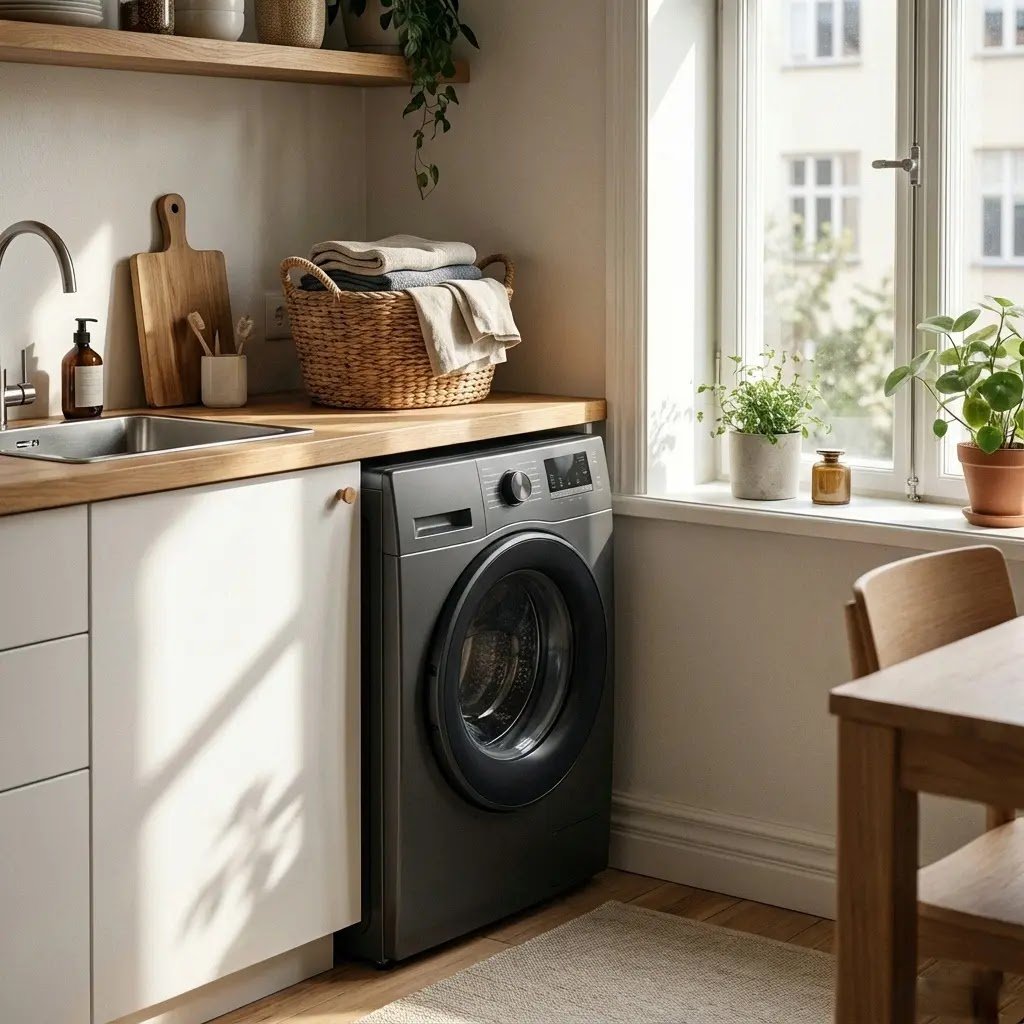
Thinking of buying a portable washer-dryer combo to escape the laundromat? Before you click “Buy Now” on that Panda or LG 2026 model, you need a reality check. Most small-space laundry reviews hide the truth about drainage physics and the “capacity trap.” From apartment-friendly hacks to avoiding burnt-out motors, here are 7 brutal truths about compact washing machines that will save your floors and your wallet.
Table of Contents
1. The Capacity Trap: 11 Pounds Is Not What You Think
The biggest lie in laundry marketing is the claim about how much these machines can actually handle at once. When you see an 11-pound machine, that is almost always a combined number for two different tasks.
The Math Problem: In a common twin-tub unit, the washer might hold 7 pounds of clothes, but the spinner only has 4 pounds.
The Daily Struggle: This means you cannot just dump your wet clothes from the washer into the spinner. You have to split the wet laundry into two separate batches and spin them one at a time. If you try to force a full load into the small spin tub, you will likely snap the drive belt or burn out the motor.
Insider tip: Ask before you buy, “Is that capacity rated dry or wet weight?” Most listings quote dry weight, but wet cotton towels can weigh 2-3x more once soaked. A “7-pound” washer tub might genuinely only handle 3-4 real bath towels comfortably.
2. The Dryer Myth: Hot Air vs. Fast Spinning
Many buyers are disappointed because they don’t realize that a spin dryer is not a real dryer.
The Twin-Tub “Salad Spinner”
The spinner side of a twin-tub machine is just a centrifugal extractor. It spins your clothes at very high speeds (up to 1300 RPM) to squeeze the water out. Your clothes will come out damp and cool, not dry and fluffy. You will still need a drying rack to finish the job.
The Sauna Effect in Small Rooms
All-in-one machines use condensation or heat-pump drying. These machines turn steam back into water inside the drum. Because these are ventless, some of the heat they remove from your clothes is dumped back into your room during the cycle. In a 200 sq. ft. studio apartment, this can make the air feel warmer and more humid than a vented dryer would, especially in summer.
Insider tip: A knowledgeable salesperson will ask what your room’s airflow looks like before recommending an all-in-one unit; a small, sealed room with no window or fan makes the sauna effect noticeably worse than a room with cross-ventilation.
3. Drainage Physics: The 30-Inch Rule
Setting your drain hose at the wrong height is the number one cause of broken pumps and flooded apartments.
Crucial Difference: If your model is a gravity drain (like the Rovsun), the hose must lie flat on the floor. If it has a drain pump, follow the 30-inch height rule to prevent siphoning.
The Siphon Hazard: For top-loading machines, your drain hose must go at least 30 inches up from the floor before it drops into a sink. If the hose is too low, like lying it flat on a shower floor, the machine will fill and drain at the same time. This is called siphoning, and it will quickly burn out your motor.
The Height Limit: Most portable pumps can only push water up to about 5 to 8 feet. If you try to pump water higher than that, the motor will overheat and fail.
👉 [How to fix a portable washer that won’t drain]

4. Faucet Nightmares: Why “Universal” Isn’t Real
The silver adapter that comes in the box is a high-risk part for your home plumbing.
The Thread Issue: North American faucets use over seven different size patterns. If you force a metric adapter onto an imperial faucet, you will ruin the threads on your sink.
The Solution: Do not force the connection. Use a Quick Connect kit specifically matched to your faucet size. This prevents blowouts, where the hose pops off mid-cycle and floods your kitchen.
Connecting a washer to a kitchen sink can be tricky. If your faucet isn’t standard, check out our guide below to prevent leaks and blowouts.
👉 [DIY portable washer installation hacks for apartments]

5. The Walking Problem: The 3-T-Shirt Rule
Portable washers are very light because they don’t have the heavy concrete blocks found in regular machines. This makes them unstable, and it’s also why they’re loud.
Load Balance Hack: Never wash just one heavy item, like a single pair of wet jeans. The heavy mass will stick to one side, causing the machine to violently “walk” or jump across your floor at high speeds.
Always wash items of similar weight together. To stop the shaking, place the machine on high-density EVA foam pads. These pads act as shock absorbers to keep the noise from traveling to your neighbors.
The noise reality nobody puts in the spec sheet: Marketing pages love to quote a single “dB” number for the wash cycle, but that number is almost always measured during the quiet fill/wash phase. The spin cycle, especially at 1300 RPM on an unbalanced load, can be noticeably louder, closer to a running vacuum than a whisper-quiet fridge. If you’re in a shared-wall apartment, plan your wash times around that, not around the spec sheet’s best-case number.

6. Power Grid Stability: RV and Older Buildings
Running a portable washer-dryer is an electrical math game. You can calculate your usage with this formula: Amps = Watts ÷ Volts.
Before plugging in your combo unit, make sure you understand your circuit’s load limits to avoid tripping breakers during the startup surge.
The RV Limit: A 30-amp RV hookup provides 3,600 watts. A dryer cycle can use 1,800 watts. If you run the dryer and the air conditioning at the same time, you will likely trip the main breaker.
The Startup Surge: Motors need a startup surge (often twice their normal running draw) just to start spinning. This can pop fuses in old buildings wired for 15-amp circuits.
7. The Slime Problem: Why Machines Smell
The “wet dog” smell that shows up after a few months is caused by biofilm, slimy bacteria that colonize old soap scum and skin oils left behind in the drum and hoses.
This isn’t a defect, and it isn’t unique to cheap machines; it’s physics and biology, and it happens to every front-loading or sealed-drum washer eventually.
What to check before you buy, not after: Look for a model with a dedicated self-clean or tub-clean cycle, a removable and washable lint/fluff filter, and a drain hose you can fully detach for cleaning. Machines that bury the filter behind screws or use a fixed, non-removable hose turn a five-minute monthly task into a small repair job every time.
The Straight Hose Rule is worth knowing at purchase time too: never store your drain hose in a tight loop. Stagnant water trapped in loops rots over time and creates a smell no amount of cleaning fully fixes, so check how much straight-line space you actually have behind your unit before you buy.
We cover the full cleaning routine, vinegar, baking soda, and timing in a separate guide, since that’s an ongoing-care topic rather than a buying decision.
👉 [Portable washer maintenance schedule you should actually follow]

8. The Real Cost of Ownership Nobody Mentions
This is the section most buying guides skip entirely, and it’s usually the one that determines whether you’re happy with your purchase a year from now.
Detergent costs more than you’d think. These machines require HE (High Efficiency) detergent, which typically costs more per load than regular detergent, and using too much of it is one of the most common causes of suds-related sensor errors, not a mechanical defect.
Parts and repair availability varies wildly by brand. Established brands like LG and GE generally have wider service-network coverage and more available replacement parts (belts, pumps, and door seals). Budget twin-tub brands are often cheaper upfront but can leave you sourcing a generic belt online and doing the repair yourself, since local appliance techs may not stock parts for them.
What tends to go wrong after 1-2 years: The drive belt (from overloading the spin side) and the drain pump (from siphoning or lint buildup) are the two most common failure points reported by owners. Door/lid seals on twin-tub units can also start leaking as the rubber ages, especially if the machine sits somewhere with big temperature swings, like a garage or unheated porch.
The most common buyer regret isn’t usually about wash quality; it’s about drying time. Buyers who skip the “half-load for drying” rule (see Truth #1) end up running two or three drying cycles per load and conclude the machine “doesn’t work,” when the real issue was expectation-setting, not the hardware.
👉 [Buy Best 5 compact Portable Washing Machines for Tiny Apartments (2026)]
9. 2026 Performance Comparison
| Model | Drainage | Drying Tech | Notable For |
| LG Signature 2026 | Pump | Heat pump | Faster full-cycle times among all-in-one units; verify current specs before buying, as manufacturers revise these yearly. |
| GE Profile PFQ97 | Pump | Heat pump | Larger drum capacity, better suited to families than studio units |
| Panda PAN6320W | Pump | Spin only. | Compact footprint, a common pick for small NYC-style studios |
| Rovsun Twin Tub | Gravity | Spin only. | No pump to fail, a plus for off-grid or RV setups, at the cost of manual hose positioning |
Total Cost of Ownership Snapshot
| Factor | Twin-Tub (Budget) | All-in-One Ventless (Mid-High) |
| Upfront price positioning | Lowest | Highest |
| HE detergent needed | Yes. | Yes. |
| Typical belt/pump repair range | Lower parts are simple and widely available online. | Higher, often requires a technician due to sealed components |
| Real-world dry time per load | N/A (spin only, still damp) | Long, often 1.5-3x a standard vented dryer |
| Best fit | Renters testing the waters, RVs, off-grid | Long-term small-space living where a real dryer isn’t possible |
Modern ventless units increasingly use heat-pump technology, which is worth understanding on its own if you’re weighing a heat-pump combo against a traditional vented setup.
Frequently Asked Questions
Q: Why are my clothes still damp after drying for hours?
A: You’re likely overfilling it. All-in-one machines can only dry about half of what they can wash in one go. Take out half the load before starting the dryer cycle, and don’t judge the machine on a full-capacity dry run.
Q: Will this machine ruin my floors?
A: Not if you use EVA foam pads underneath. They absorb vibration and keep the machine’s feet from scratching tile or hardwood, especially during high-RPM spin cycles.
Q: Can I use regular laundry detergent?
A: No. You must use HE (High Efficiency) detergent. Regular detergent creates too many suds, which can trigger sensor errors or, in worse cases, overflow the unit.
Q: How long should I expect a portable washer-dryer combo to actually last?
A: With reasonable care and load balancing, several years is realistic, but the drive belt and drain pump are wear parts, not lifetime parts; expect at least one repair or replacement over the machine’s life, and budget for it.
Q: Is a twin tub or an all-in-one combo the better buy?
A: It depends on your priority. Twin-tubs are cheaper, have fewer sealed components to fail, and are better for RVs or off-grid use. All-in-ones are more convenient (one drum, no manual transfer) but cost more upfront and take longer to fully dry a load.
Q: Do I need a special outlet to run one of these?
A: Usually a standard household outlet works, but check the startup surge and running wattage against your circuit, especially in older buildings on 15-amp circuits or in an RV on a 30-amp hookup, where running the dryer and another high-draw appliance together can trip a breaker.
Q: Can I install one myself, or do I need a plumber?
A: Most renters install these themselves using a quick-connect faucet adapter, but only if the adapter actually matches your faucet’s thread pattern; forcing a mismatched adapter is the most common cause of a mid-cycle leak.
Conclusion
A portable washer-dryer combo is a precision tool, not a “set-it-and-forget-it” appliance. While 2026 models have pushed all-in-one cycle times and capacities further than a few years ago, the underlying physics, drainage height, motor load limits, and circuit capacity haven’t changed at all. To get years of reliable use out of one, respect the 30-inch drainage rule, never wash a single heavy item alone, match the detergent to the machine, and budget mentally for a belt or pump repair somewhere down the line.
If you’re deciding between a budget twin-tub and a pricier all-in-one, weigh your space, your patience for manual load transfers, and how much you actually dry versus air-dry; that trade-off matters more than any spec sheet number.
👉 [Best portable washer-dryer combos for small apartments in 2026]