
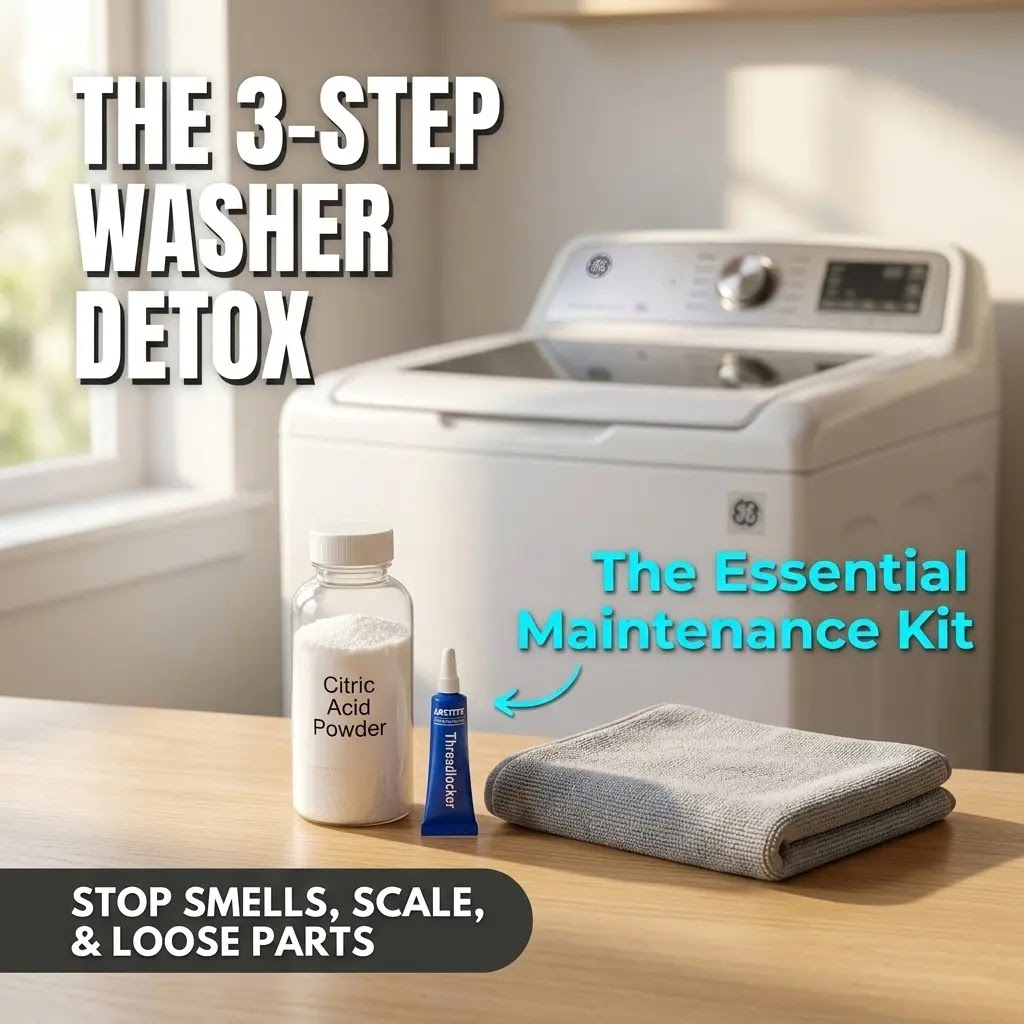
Most portable washer maintenance guides tell you to “just run a cleaning cycle.” That’s not enough, the real failure points are a lot more specific than that.
This is a professional-level ritual covering hygiene, mechanical integrity, and longevity, based on how these machines actually fail.
Table of Contents
1. Stainless Steel vs. Plastic Drum Hygiene
There is a significant difference in how biofilms form based on the material of your machine’s drum.
Polypropylene (Plastic): SEM microscopy shows that plastic is full of microscopic valleys that harbor bacteria. Biofilm grows 1.7 to 2 times faster on plastic than on smoother surfaces because the material is soft enough for germs to soak in.
Stainless Steel: Metal drums are harder and smoother. While germs can still attach, they cannot penetrate the surface, making steel much easier to sanitize. However, even stainless steel drums usually have plastic parts underneath where biofilm hides.
| Drum Material | Biofilm Growth Rate | Why | Sanitizing Difficulty |
| Polypropylene (plastic) | 1.7–2x faster | Microscopic surface valleys let bacteria embed below the surface | Harder, bacteria can hide beneath the visible surface |
| Stainless steel | Baseline (slower) | Smoother, harder surface resists bacterial penetration | Easier, but plastic parts underneath still need attention |

2. The Pulsator Screw: Rust & Vibration Fixes
The Risk: If this screw loosens, the disk can wobble and strip the gears. If it is made of poor-quality steel, it will rust into place.
The Solution: Replace standard screws with SS304 or SS316 stainless steel versions. To prevent loosening, apply one drop of Loctite Blue 242 threadlocker to the screw threads before tightening. This locks it against vibration but allows you to remove it later for cleaning.

3. The Cold Water Trap: Dissolving Soap Sludge
Running portable washers exclusively on cold water is the leading cause of stinky washer syndrome.
Sludge Mechanism: Liquid detergents and pods do not fully dissolve in cold water, especially in the short cycles typical of portable units. This creates a viscous soap sludge that feeds mold.
The Ritual: Intersperse your cold washes with a hot water cycle, at least once every 5 loads. Hot water moves faster and breaks the chemical bonds of trapped body oils and undissolved soap.
Hot water doesn’t just “clean better” in a vague sense, it physically drops the viscosity of trapped soap residue, making it thin enough to rinse away instead of clinging to the drum wall.
It also disrupts the fatty acid bonds in body oils that cold water leaves largely intact, which is why a single cold-only wash routine gradually builds sludge that no amount of detergent alone can prevent.
4. Drain Hose Gunk & Black Mold
The smell you blame on the drum is often actually coming from the drain hose. Because it is corrugated (bumpy), it traps hair, lint, and black mold.
The Fix: To melt the black slime, disconnect the hose from the machine and flush it with very hot water (60°C to 70°C). Do not pour boiling water while the hose is still attached to the plastic pump housing, as it can warp the seals.
5. Hard Water Scale: Protecting Internal Sensors
If you have hard water, white mineral powder (limescale) can coat the machine’s level sensors and heating elements.
Impact: Coated sensors become inaccurate, causing the machine to overfill or underfill. Scale on heating elements forces the machine to use 20–30% more energy to reach the same temperature.
Prevention: Use citric acid instead of vinegar for heavy scaling. It is a more powerful chelant that binds to calcium better without eating through rubber as quickly as vinegar can.
After running a citric acid cycle, always run one quick rinse with plain water to wash away any acidic residue from the rubber O-rings.
6. Microplastic Solutions: Guppyfriend & Filters
Washing synthetic clothes (polyester/nylon) releases up to 700,000 plastic fibers per load, and up to 1.4 million in delicate cycles.
The Barrier: Use a Guppyfriend washing bag for all synthetics. It traps 90%+ of fibers inside the bag so they don’t reach your drain.
External Filters: For a permanent solution, install an external filter like PlanetCare or Filtrol 160 between your machine’s drain and the sink. These catch microplastics before they enter the wastewater.

7. Seal Lubrication & Suspension Balance
Mechanical failure is often caused by ignoring the vitals.
O-Rings: Only use 100% silicone grease. Petroleum jelly or olive oil will cause rubber EPDM seals to swell and rot.
Suspension: If the drum bangs during spinning, perform the Bounce Test. Push the drum down, if it bounces up and down more than once, your suspension springs are shot and need replacement.
When your suspension is weak, the drum hits the cabinet wall during the spin cycle. This impact often knocks internal water hoses loose, leading to a massive flood from the bottom.
Bounce test failed and suspension springs need replacing? That’s beyond routine maintenance.

8. Real-World Scenario: Dorm vs RV Usage Patterns
A dorm or apartment user running 3–4 loads a week on cold water builds up sludge noticeably faster than someone who does laundry twice a week, simply due to more frequent cold-cycle exposure without a hot flush in between.
RV and camping users face a different pattern, infrequent use with the machine sitting closed and damp between trips, which favors mold growth over sludge buildup.
For that usage pattern, leaving the lid open between trips matters more than the hot-water ritual itself.
Portable washer maintenance: FAQs
Q1: Why does my portable washer smell like a wet dog?
Answer: This isn’t just dirty water, it’s a biofilm colony. Because portable washers are made of porous plastic (polypropylene), soap scum and body oils get trapped in microscopic ridges, creating a breeding ground for bacteria.
To fix this, stop using cold water exclusively. Run one maintenance cycle with 1 cup of citric acid and hot water (60°C) to chemically dissolve the slime that normal detergent can’t touch.
Q2: Is it safe to use white vinegar in every wash load?
Answer: No. While vinegar is a great natural softener, it is an acid that can slowly eat away at the EPDM rubber seals and internal O-rings of your portable machine. Using it every day can lead to internal leaks.
Instead, use vinegar only once a month for deep cleaning. For daily softening, stick to a small amount of fabric softener or, better yet, a 10-minute extra rinse cycle.
Q3: Why is the pulsator disk at the bottom loose or wobbly?
Answer: This is a common vibration failure. The single-center screw often works loose due to the high-speed spinning of the motor. If you ignore it, the plastic gears underneath will strip, and the machine will stop agitating.
The pro-fix is to remove the screw, clean it, and apply one drop of blue Loctite 242. This locks the screw against vibration but still allows you to remove it for future cleaning.
Q4: Can I replace a cracked drain hose with a garden hose?
Answer: Never. Garden hoses are not designed to handle the internal water pressure or the heat of a washing machine’s discharge. They can easily burst or kink, causing the internal pump to overheat and fail.
If your hose is cracked, buy a dedicated corrugated universal drain hose. It is flexible enough to handle the pump’s burping action without snapping.
Q5: How do I know if my drum is plastic or stainless steel without disassembling anything?
A: Check the manufacturer spec sheet or model listing first, since it’s usually stated there. If you can’t find it, shine a flashlight into the drum, stainless steel has a slight metallic sheen even under detergent residue, while polypropylene looks matte and slightly textured.
Q6: Can I use both citric acid and Loctite maintenance in the same session?
A: Yes, they address completely different systems and don’t interact. A practical routine is running the citric acid cycle first, then checking the pulsator screw while the drum is still accessible and empty.
Q7: My portable washer is brand new. Do I still need to start this ritual immediately?
A: Yes, especially the drain hose and pulsator screw checks. Vibration-related loosening and hose buildup both start from day one of use, not after years of wear, so waiting for a smell or a wobble means you’re already behind on prevention.
Conclusion: Summary of Care
To keep your portable washer for 5–7 years and stop odors forever, follow this technical ritual:
- Monthly: Run a hot cycle with 1 cup of citric acid to protect sensors and dissolve soap sludge.
- Weekly: Clean the tiny lint trap and leave the lid open for 2 hours to air-dry.
- Quarterly: Flush the drain hose and check the pulsator screw. Use blue Loctite if it’s loose.
- Always: Use Guppyfriend bags for synthetics and grease rubber only with pure silicone.