
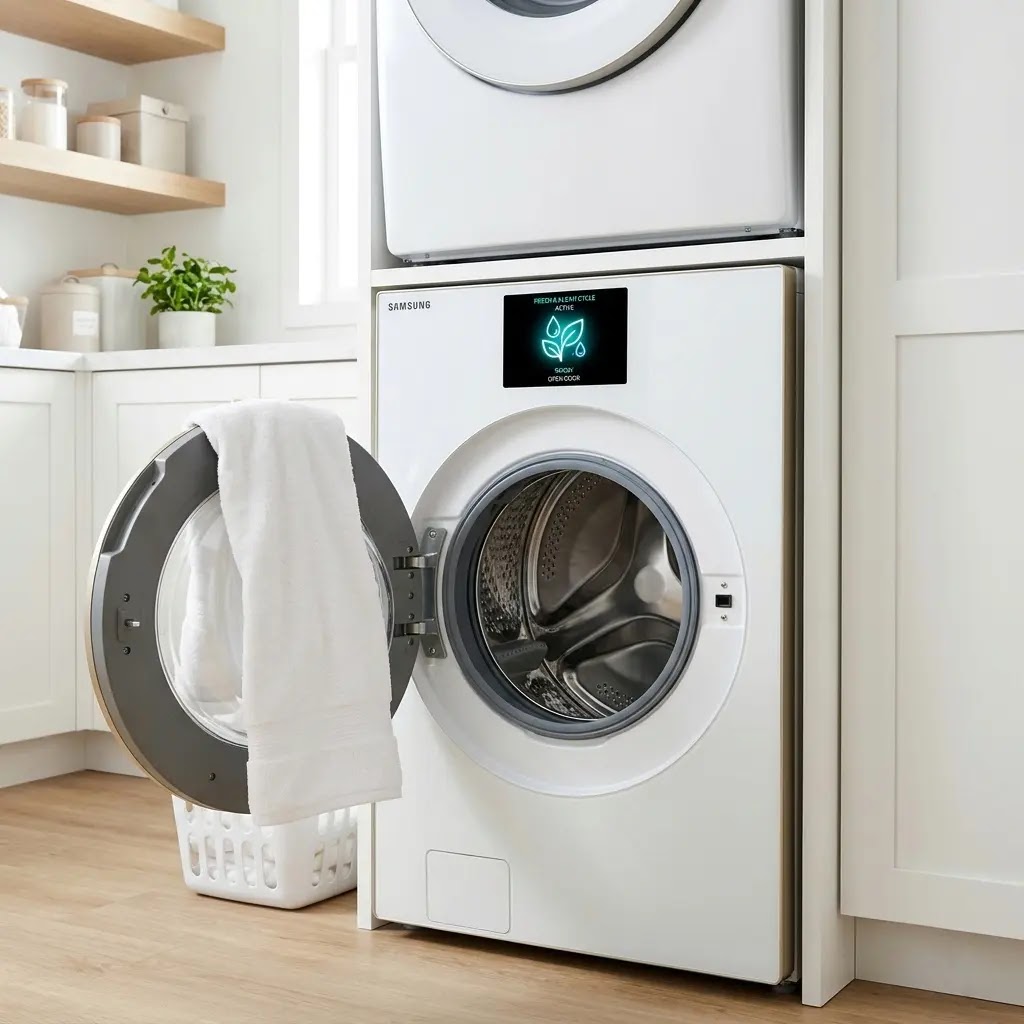
Samsung’s efficient washers can turn stinky and slimy faster than the loud old machines they replaced. Less water passing through means less natural flushing, so residue and moisture stay behind.
If you only wash once a week, your machine sits damp and dark most of the time, which is exactly where mold and “scrud” (that waxy soap buildup) thrive. This Samsung washer maintenance guide is built on repair-side experience and real owner habits, aimed at keeping your washer running for its full lifespan.
Table of Contents
1. Why Efficient Washers Get Slimy Faster
The slime is biofilm, a sticky, waxy layer of bacteria, mold, and leftover detergent. It hides behind the drum and inside the rubber seal.
Most of us wash at 30°C to 40°C to save money, but that doesn’t kill germs. Heavy softeners and liquid detergents don’t always rinse out fully in cold water. What stays behind feeds bacteria like Pseudomonas aeruginosa, which produce that musty smell, and the layer gets thicker and harder to remove over time.
Ecobubble micro-bubbles can also settle in the outer tub, where you can’t see them. On 2026 models, frequent AI Energy Mode use defaults to cold water (20°C to 30°C), which isn’t hot enough to dissolve them, so buildup can come faster than on older machines. The fix is heat, air, and regular cleaning.

2. Keeping It Fresh Between Loads
When the washer sits idle, the small amount of water left in the bottom stagnates. That’s the source of the “stinky sock” smell when you open the door.
If you wash once a week, spend two minutes draining the small residual-water tube after your last load. Don’t let that gray water sit in the pump for days. It makes a bigger difference than people expect.
The air-out rule is the biggest favor you can do for the machine. Leave the door and soap drawer open so the interior can dry. Some Bespoke models have Auto Open Door+ to do this for you, and some have a self-dry fan you can enable in SmartThings that keeps air circulating for about 30 minutes after the cycle. Turn either on if your model has it.
Once a week, wipe the door gasket and pull the rubber fold back rather than wiping only the visible surface. For a full top-to-bottom hygiene pass, see our [Complete Cleaning of a Washing Machine] master guide.
3. The Monthly Deep Clean: Self Clean+
Self Clean+ (also called Drum Clean+) is the machine’s built-in defense against biofilm. It heats the water to a sanitizing 60°C to 70°C, which melts the slime. The drum then spins at high speed so the hot water scrubs the outside of the tub, where you can’t reach by hand.
Run it monthly with an empty drum and no detergent. For a full walkthrough, see [Samsung Washing Machine Drum Clean Cycle: How to Keep It Fresh and Odor-Free]. If a smell survives regular airing-out and this cycle, use the bleach method in the FAQ below.
4. Cleaning the Filters
Two filters do most of the preventive work. Neglecting either is the most common reason people book a repair call for what was really maintenance.
Bottom (drain) filter, every two months. It’s the washer’s trash can, catching coins, hair, and lint. One owner traced a grinding spin-cycle noise to a golf-ball-sized wad of pet hair wrapped around the filter’s internal fan blades. It came out by hand in under five minutes, with no repair call.
- Unplug the machine and open the access door at the bottom front.
- Put a towel and shallow pan on the floor.
- Pull out the emergency drain hose, remove the cap, and let the water flow into the pan.
- Twist the large filter knob left and pull it out.
- Remove coins, hair clips, and lint, then scrub it under the tap with a toothbrush.
| Safety: After a hot wash, wait at least an hour for the water to cool before opening the filter. |
Back (water inlet) filters twice a year. These are the small screens where the supply hoses connect. Unplug the machine and shut off the taps first. Unscrew the hoses, gently pull the mesh screens (usually blue and red) with pliers, and scrub them under the tap with a toothbrush.
Staying on top of both prevents the two most common Samsung complaints, slow draining and slow filling. If you’re already seeing a code on the display, our [Samsung Washer Error Codes: The Complete List] explains each one.

5. The Soap Drawer and Siphons
The drawer is a hidden mold factory. Water standing in it after a wash usually means the siphons (the tiny suction tubes) are clogged. Ultra-concentrated softener is often the cause, because it’s too thick to pass through. Dilute softener 50% with water.
My drawer routine:
- Pull the drawer to its stop, press the colored lever inside, and slide it out.
- Soak the colored siphon caps in warm water.
- Scrub the jet nozzles on the ceiling of the cavity. Calcium or old soap there stops detergent dispensing properly.
Also make sure the washer is level. If it tilts, the siphons can’t start, and the drawer stays full of slimy water.
If your model has an Auto-Dispense tank, cleaning the drawer isn’t enough. Every 6 months, empty the tanks and run a warm water flush from the maintenance setting in SmartThings. That keeps the pumping gears from seizing on hardened, concentrated detergent. Setup steps are in our [Samsung Washing Machine SmartThings Setup] guide.
6. The Bespoke AI Combo’s Hidden Lint Spot
On the Bespoke AI Laundry Combo (wash and dry in one unit), cleaning the removable lint filter isn’t enough. Ultra-fine dust passes through and builds up deep in the lint chute behind it. One household found a buildup the size of a dinner plate blocking airflow entirely.

7. Myths vs. Reality: What to Put Inside
- Vinegar: It’s a popular “natural cleaner,” but Samsung warns that its acidity can degrade rubber seals with repeated use and raise the risk of leaks.
- Citric acid: about half a cup removes mineral buildup without the same seal risk. A citric acid washing machine cleaner is the better choice.
8. Samsung Washer Maintenance Advice for Where You Live
- Hard water (India, the Middle East, the southwestern US): scale coats the heater and drum parts, so the machine works harder to reach temperature. Run Drum Clean+ monthly. If your grid has voltage fluctuation, a voltage stabilizer is a reasonable way to protect the control board.
- Freezing climates (Canada, the northern US, and much of Europe): water left in the lines of a washer in an unheated garage or basement can freeze and crack plastic valves. A common DIY approach, not official Samsung guidance, is to add about a gallon of RV-safe non-toxic antifreeze to the drum and run a brief spin-only cycle before an extended winter absence. This displaces standing water in the pump.
- Humid or tropical climates (Southeast Asia, coastal regions): mold pressure is constant. Once a week, wipe the gasket with diluted bleach, pulling the rubber fold back, because black mold takes hold there first.

9. 2026 Maintenance Checklist
| Task | Frequency | Real Benefit |
| Leave the door and drawer open. | After every load | Dries the interior, stops mold and odor |
| Clean lint filter (combo units) | Every load | Keeps clothes dry, reduces lint fire risk |
| Wipe gasket (fold pulled back). | Weekly | Stops moisture from rotting the seal |
| Run Self Clean+ / Drum Clean+. | Monthly | Cleans the parts of the tub you can’t reach |
| Vacuum lint chute (combo units) | Monthly | Clears fine dust the filter misses |
| Clean the bottom drain filter. | Every 2 months | Prevents drainage issues and grinding noise |
| Flush Auto-Dispense Tanks | Every 6 months | Protects the pumping gears |
| Clean back inlet filters. | Twice a year | Prevents slow filling |
| Recalibration check per your manual | Yearly, or if shaking appears | Keeps load-sensing accurate |
If shaking or banging continues after a recalibration check, see [Fix Samsung Washer Ub & Ur Error: Easy 2026 Spin Guide].
10. Frequently Asked Questions
1. Should I mix vinegar and baking soda in my washer?
No. They neutralize each other. The fizz looks like it’s working, but it’s less effective than the high-heat cycle or using each in a separate step. Vinegar also carries the seal-degradation risk covered above.
2. Why is there still water in my drawer after a wash?
Usually the machine is slightly tilted, so the siphon suction can’t start. Check the leveling feet and make sure the washer doesn’t rock when you push the corners. If it’s level, clean the siphons as described in the drawer section.
3. How much detergent should I use?
Most people use far more than needed. For HE machines, 1 to 2 tablespoons is typically enough. Overdosing is a leading cause of suds lock and the “swamp smell” people mistake for mold.
4. Can I put pods in the detergent drawer?
No. Put pods directly in the drum before the clothes. They don’t dissolve properly in the drawer and can clog the internal pipes.
5. Can I use bleach for a stubborn smell?
Yes, liquid chlorine bleach in the manual detergent compartment only, during Self Clean+. Never put bleach directly in the drum or use it in a regular wash. Prolonged residue can pit the stainless steel with tiny rust holes that snag clothes.
6. Is it normal for a new washer to need this much attention?
Yes. It’s a byproduct of water- and energy-efficient design, because less water means less natural flushing of residue. The extra attention is the trade-off for efficiency, not a sign of a defect.
7. How long should a Samsung washer last?
Many models carry extended coverage on the motor, while the pump, seals and other parts usually have shorter standard terms, so check your model’s documentation. Consistent maintenance (filters, airing out, correct detergent dose) largely decides whether a machine reaches the upper end of its lifespan or needs an early repair.
11. Conclusion
None of this needs a technician. It takes about five minutes a month: door open between loads, both filters cleaned on schedule, and no detergent overdosing.
| Next step: pick the one habit in the checklist you’re not doing yet and start this week. Most early Samsung service calls trace back to one skipped habit, not a design flaw. |