
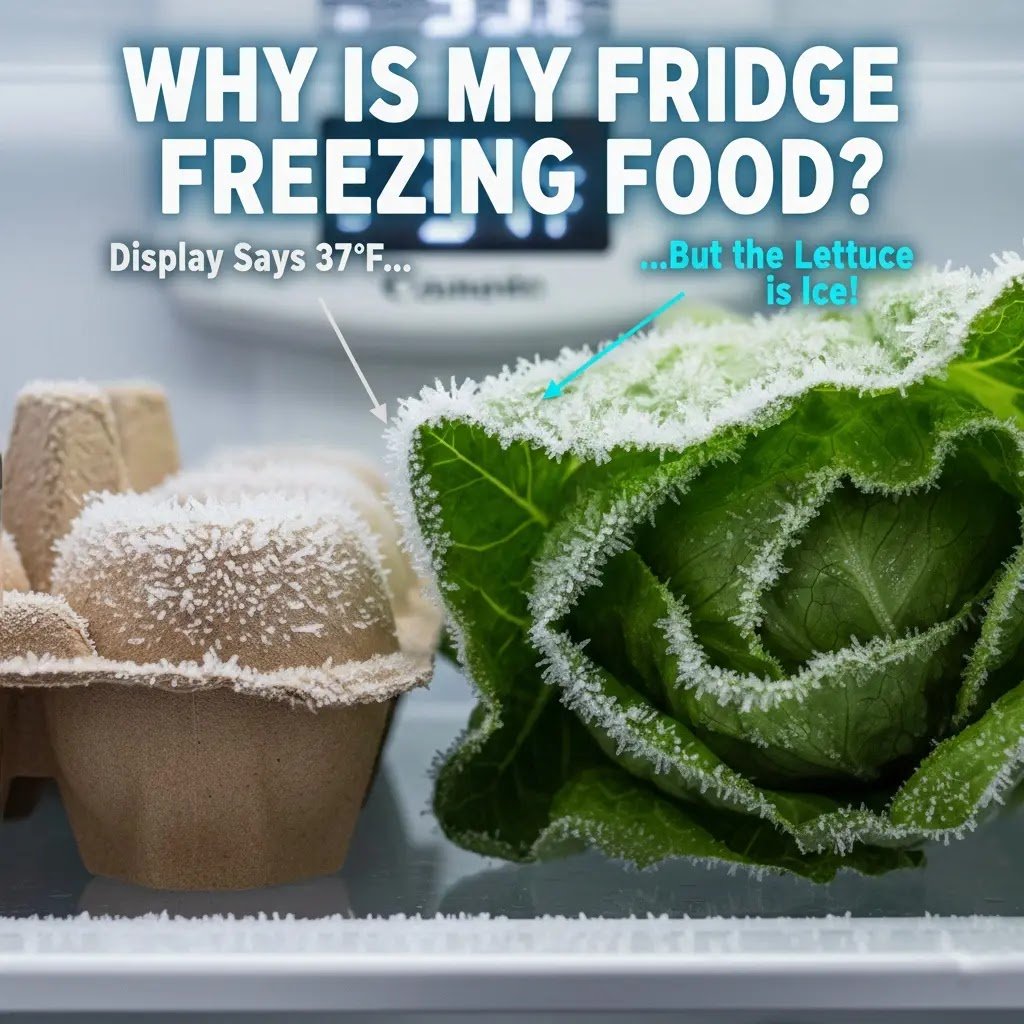
A practical guide to diagnosing GE refrigerator freezing food, airflow, and sensor failures in modern refrigerators.
When you find ice forming on your vegetables, your first instinct might be to blame the thermostat. But modern GE refrigerators operate on a more complex airflow system than the fridges of twenty years ago, and understanding that system is the fastest way to actually fix this, rather than guessing.
A quick note on the lane before we start: this piece walks through several possible causes of one symptom (a fridge section that’s freezing food) rather than a single part-replacement job, since that’s genuinely how this problem needs to be approached; you have to rule causes in or out before you know which part, if any, actually needs replacing.
Table of Contents
1. Safety First: Before You Touch Anything
Several of the checks below involve power, electrical testing, or working near ice and water; read this before you start on any of them.
- Always unplug the refrigerator from the wall outlet before removing any plastic covers or touching electrical sensors or connectors. Testing resistance with a multimeter must be done with the power off, both to protect the board and to protect you.
- If you use a hairdryer to melt ice around the damper motor, keep it on a low setting and be mindful that melted water can drip onto nearby electrical connections. Make sure the unit stays unplugged for this step, not just powered off at any control panel.
- Wear gloves when handling removed plastic covers; edges can be sharp, especially on covers that have been under stress from ice expansion.
- Never break ice off the damper flap by force. Beyond the risk of snapping the delicate plastic linkage, you can also cut yourself on broken ice or plastic edges.
- Stop and call a licensed technician if you notice a burning smell, see exposed or melted wiring, or find water pooling anywhere other than where you’re intentionally melting ice. These are signing the problem has moved beyond a sensor or damper issue.
2. The Mechanics of a Freeze: How Your Fridge Thinks
Your refrigerator is not actually a cooling machine; it’s a heat-removing machine. The cooling engine, or evaporator, lives entirely in the freezer. The refrigerator section relies on a system of vents to steal cold air from the freezer. In a healthy unit, this air is carefully metered. If those meters fail, the fridge section essentially becomes a secondary freezer.
This usually isn’t a failure of the compressor or the refrigerant gas; it’s a failure of the gatekeeper that manages the air.
3. The Air Damper: The Gatekeeper of Cold
Inside every GE refrigerator without a dual-evaporator system, there’s a component called the Air Damper Control, located at the back or top of the fresh food compartment. Think of it as a motorized window: when the fridge gets too warm, the window opens; when it hits the target temperature, it closes.
The mystery freeze happens when this window gets stuck open. This can happen for two reasons: ice can physically jam the plastic gears or the door flap, preventing it from closing, or the motor itself can burn out. If the damper stays open by even a few millimeters, near-freezing air pours into the fridge around the clock, eventually freezing everything near the vent.
TwinChill note: if your GE model features TwinChill technology, it uses two separate cooling systems rather than one shared-air damper design. In these units, a mystery freeze is more likely to trace back to a thermistor reading incorrectly than to a stuck damper, since the airflow is managed differently. Check your model’s door sticker for “TwinChill” before ordering parts, since the two designs aren’t interchangeable.
Observation tip: a repetitive ticking or hunting sound from the top of your fridge is often the sound of a damper motor with stripped gears trying, and failing, to close the air door.

4. Thermistors: The Temperature Eyes
If the damper is the hand that moves the door, the thermistor is the eye that sees the temperature. Most GE models use several small, plastic-capped sensors, one monitoring the freezer, one the fridge, and one the evaporator coils.
The leak connection: before replacing sensors, check your ice maker’s water line. A slow drip can run down the back wall and freeze inside the damper vents. This external ice is often mistaken for a mechanical motor failure; make sure your water line is dry and secure before you conclude the damper motor itself has failed.
A thermistor is a negative-temperature-coefficient (NTC) device: as it gets colder, its resistance goes up. If a thermistor drifts out of calibration, it might report 50°F when the fridge is actually at 32°F. The control board, trusting its sensor, keeps the cooling system running. This is a common failure point because these sensors live in a high-moisture environment and degrade over time.
If your model connects to the GE SmartHQ app, some units will surface a temperature or sensor fault notification before you notice the freezing yourself. It’s worth checking the app before you start pulling covers off.
5. Tools You’ll Need
| Tool | Purpose |
| Digital multimeter | Testing thermistor resistance in ohms |
| Hairdryer (low setting) | Melting ice around a jammed damper flap without force |
| Flashlight | Inspecting the damper and vents clearly |
| Work gloves | Handling removed panels and any broken ice safely |
| Phone with GE SmartHQ app (if connected) | Checking for a sensor fault notification before opening panels |
6. 5 Practical DIY Checks (No Tools Required)
Before spending money on parts, these five checks can often resolve the problem without any technical knowledge.
- The Air Clear Zone: locate your air vents. A large carton of eggs or a bottle of juice sitting right against a vent will freeze almost instantly, and it also prevents the sensor from reading the rest of the fridge’s actual temperature. Maintain about a 2-inch gap.
- The Hard Reset: unplug the fridge for 15 minutes. This clears the control board’s short-term memory; sometimes a software glitch keeps the damper open, and a power cycle forces the board to recalibrate the motor’s position.
- Check TurboCool: GE fridges have a turbo mode for rapid cooling after a party or grocery trip. If left on, the fridge ignores standard settings and runs at max capacity. Turn it off.
- Clean the Door Seals: a poor seal lets warm air leak in. The fridge senses that heat and opens the damper to compensate; this constant stream of cold air can freeze food near the vents while the rest of the fridge stays warm.
- Check Humidity Settings: if your crisper drawer’s humidity vents are wide open, cold air enters the drawer directly. If only your salad were freezing, adjust these sliders.
👉 [GE Refrigerator Door Not Closing Properly]

7. Technical Component Testing
For those comfortable with a bit more investigation, a basic multimeter lets you test these parts directly. See the Safety First section above before starting any of this.
Testing a thermistor means checking its resistance in ohms. At a standard room temperature of about 77°F (25°C), the sensor should read somewhere around 5,000 ohms. Submerged in a cup of ice water (32°F), it should read closer to 16,000-16,600 ohms; these figures are consistent with GE’s own published thermistor specifications, not a rough guess.
If your multimeter shows OL (open loop) or 0 resistance, the sensor is dead. For the damper, you can often visually inspect it by removing the plastic cover. If you see ice buildup around the door flap, don’t break it off; use a hairdryer on a low setting to melt it, since breaking ice manually can snap the delicate plastic linkages inside the motor.
👉 [GE Refrigerator Maintenance: The 20-Minute Forever Ritual]

8. How to Talk to a Repairman
When you call a technician, you want to make sure they don’t simply replace the most expensive part (the control board) without checking the basics first. An informed homeowner gets better service.
Try this: “I’ve noticed the fridge section is freezing. I suspect it might be a stuck-open air damper or a thermistor that’s drifted out of its ohm range. Could you test the resistance on the fresh-food thermistor before looking at the main board?” This kind of specific question often leads to a cheaper, faster repair, since it signals you’ve already ruled out the obvious.
9. Frequently Asked Questions
Q: Is it okay to just turn the temperature setting up?
A: It’s a temporary workaround, not a fix. If the damper is stuck open, even setting the fridge to 45°F won’t stop near-freezing air from leaking in around the vent.
Q: Why did this happen suddenly?
A: A common trigger is leaving the freezer door slightly ajar overnight, which creates heavy frost buildup that can jam the air damper in the open position.
Q: How much does a damper part cost?
A: For most GE models, the part typically runs in the $40-90 range, a far better investment than an unnecessary full refrigerator replacement.
Q: Can I tell whether it’s the damper or the thermistor without opening anything up?
A: Not with certainty, but the pattern helps: a stuck damper usually freezes food near one specific vent while the rest of the fridge stays normal, while a miscalibrated thermistor tends to affect the whole compartment’s temperature more evenly.
Q: Is this covered under a GE warranty?
A: It depends on your unit’s age and warranty terms. Sealed system components often carry longer coverage than electronic parts like dampers and thermistors, so check your specific model’s warranty documentation rather than assuming either way.
Q: How long does a damper or thermistor replacement usually take?
A: For someone comfortable with basic tools, it’s usually well under an hour once you’ve confirmed which part is actually at fault; most of the real time investment is in the diagnosis, not the swap itself.
Q: My model has TwinChill; does any of this still apply to me?
A: The DIY checks in section 6 (vent clearance, door seals, humidity sliders, TurboCool, hard reset) still apply. The specific damper diagnosis in section 3 mostly doesn’t; TwinChill units are far more likely to have a thermistor issue than a stuck damper, since there’s no single shared-air damper managing both compartments.
10. Final Summary
Fixing a GE refrigerator that’s freezing food is rarely about the compressor. It’s almost always about the plumbing of the air, a stuck damper, a drifted thermistor, or an ice-maker leak masquerading as a mechanical failure. By checking for vent blockages, resetting the power, and inspecting the air damper in that order, you can often save yourself a technician visit and a few hundred dollars.
A refrigerator is a system of balance. When that balance shifts, look for the small things, the sensors and the flaps, before assuming the worst.
👉 [GE Ice Maker Not Working? 7 Force-Reset Hacks]