
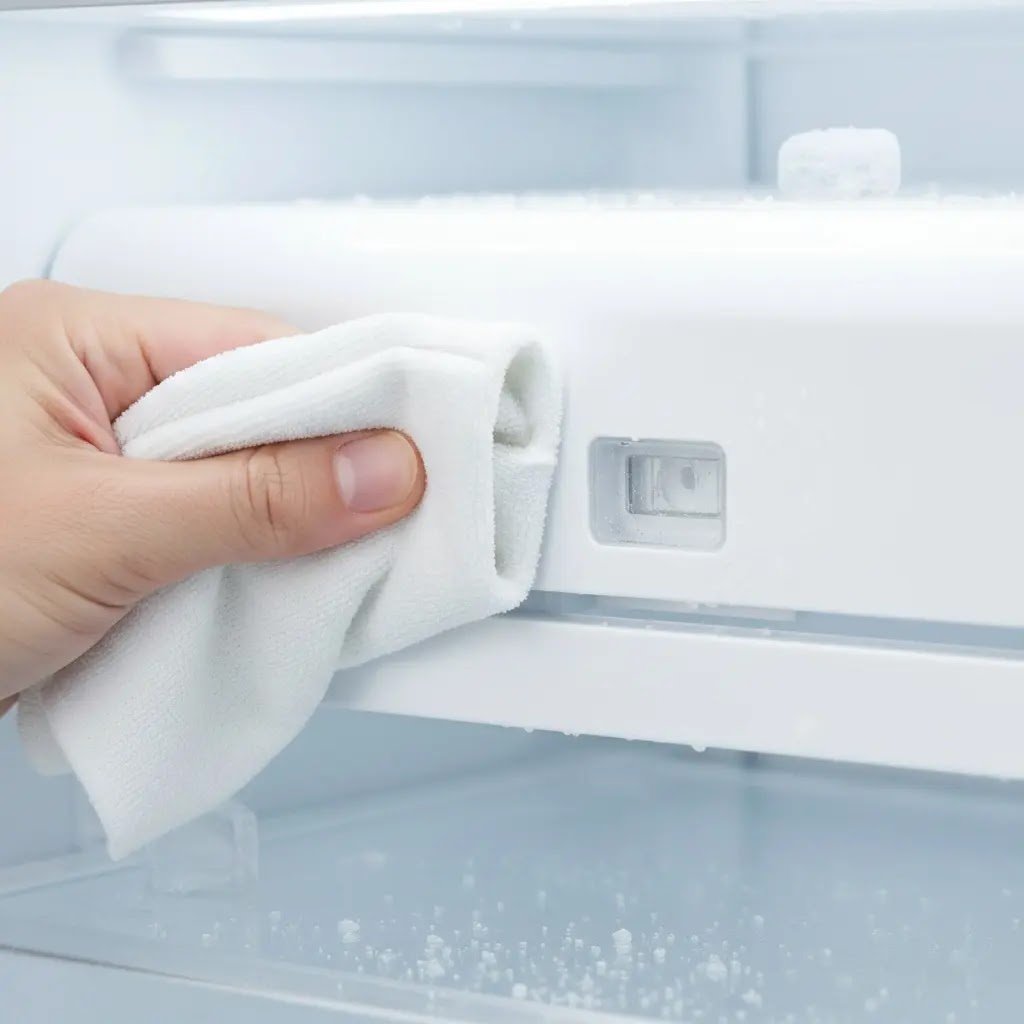
Is your Bosch refrigerator refusing to drop ice despite the bin being empty? Bosch refrigerator ice makers rely on optical sensors (infrared eyes) and strict temperature rules. Usually, it’s not a broken motor but a software lockout caused by a frosted lens or a slight temperature dip. Before you spend hundreds on a technician, use this guide to work through the actual causes in order.
Table of Contents
The Ice-Logic Diagnostic Table
Identify your specific failure point with this overview before doing anything else:
| Symptom | Likely Issue | Solution Level |
| No ice, no sound | Optical sensor “blindness” from frost/fog | DIY, clean lens |
| Small/hollow cubes | Low water pressure or filter restriction | Easy: replace filter. |
| Ice stuck in tray | Thermal logic lock (temp above 0°F) | Moderate: adjust temperature. |
| Water flooding bin | Solenoid valve leak | Requires technician to replace valve |
👉 [Bosch Refrigerator Error Codes Explained] is worth checking first if your control panel is flashing a specific alphanumeric code alongside the ice maker failure; that narrows things down faster than working through this table from scratch.
⚠️ Safety Before You Start
- Unplug the refrigerator at the wall outlet before cleaning near the optical sensors, accessing the inlet valve, or opening any panel near the ice maker assembly.
- Shut off the water supply line at its source before disconnecting anything related to the filter or inlet valve; this prevents an unexpected spray once a fitting is loosened.
- Never touch the solenoid coils or any wiring with wet hands, and never test electrical components while the unit is still plugged in.
- Avoid chemical cleaners on the optical sensor lenses entirely; beyond just being unnecessary, certain solvents can etch the polycarbonate lens permanently, turning a five-minute cleaning fix into a full sensor replacement.
- Watch for sharp edges around the Bosch refrigerator ice maker housing and inlet valve access panel.
- Stop and call a licensed technician if the solenoid valve shows signs of a burned-out coil (complete electrical silence with no humming at all), or if the issue involves the sealed refrigerant system rather than the ice maker itself. Valve replacement involving the water supply line is manageable DIY territory, but anything touching the sealed cooling system is not.
Phase 1: Fixing Sensor Blindness (Optical Cleaning)
Most current Bosch French door models utilize infrared beam sensors. These sensors send an invisible light across the ice bin. If the light is blocked, the machine assumes the bin is full and won’t produce more ice.
The Frost Glitch: Often, moisture from the freezer creates a thin layer of frost (tiny ice crystals) over the sensor’s lens. This frost scatters the light beam, tricking the computer into thinking the bin is overflowing when it’s actually empty.
The Fix: With the unit unplugged, locate the small plastic windows on the sides of the ice maker. Wipe them with a dry, lint-free cloth. Avoid chemicals, as they can etch the polycarbonate (the special transparent plastic) and permanently damage the sensor’s ability to read light correctly.
Phase 2: The 0°F Rule (Thermal Dynamics)
A Bosch refrigerator ice maker is programmed to be genuinely stubborn about temperature. The software generally won’t trigger the ejection cycle (the motor movement that pushes ice out) unless the thermistor (the temperature-sensing chip) records a consistently cold reading, typically right around 0°F (-18°C), for several hours.
The Problem: If your freezer is set to 2°F or 3°F, it’s cold enough to keep food frozen, but the ice maker logic may stay locked out regardless.
A Faster Path: Activating the SuperFreeze or SuperCool function bypasses the standard thermostat and drops the internal temperature rapidly, which often resolves the lockout faster than waiting for a normal setting adjustment to gradually bring the temperature down.
👉 [Bosch Fridge Not Cooling? 5 Effective Fixes Before Calling a Tech] covers exactly how to toggle these functions if you’re unsure where they sit in your model’s menu.

Phase 3: The UltraClarity Filter Trap
Bosch UltraClarity filters are efficient but sensitive to age. As the filter approaches its roughly six-month replacement point, the internal carbon blocks (the filtering material) become dense with debris.
This creates a pressure drop. If water pressure through the filter falls too low, the ice maker’s inlet valve won’t open fully; this results in hollow ice cubes, or in some cases, the system disabling ice production entirely to avoid running the solenoid valve in a partially open state that risks overheating the coil.
Isolating the Cause: Installing a water filter bypass plug temporarily removes the filter from the equation. If ice starts falling normally with the bypass in place, your filter was the actual bottleneck all along.

The Force-Cycle Reset Sequence
If there’s no physical reset button on your model, some Bosch units offer a key-combination path into a diagnostic or service mode. Reported steps for accessing this on certain models:
- Go to the main control panel on the door
- Hold two specific buttons together for several seconds (commonly reported around the Alarm and Fridge+ buttons, though this varies by model generation; check your unit’s manual if this exact combination doesn’t respond)
- If successful, the screen enters a diagnostic menu showing status or fault codes
- From there, some models offer a way to manually force the ice tray to cycle
What this tells you: If the machine responds and manually turns the ice tray, the motor itself is working, and the issue is software/sensor-related rather than a dead motor. If nothing happens even in this forced mode, that’s a stronger indicator of an actual motor failure.
If the specific combination above doesn’t trigger a response on your model, check Bosch’s own support documentation using your unit’s E-Nr (the product identification number found on the appliance’s rating plate) for the exact service-mode steps for your specific model generation, since these can differ between production years.
Mechanical Anatomy: The Inlet Valve
The water inlet valve uses solenoid coils (electrical magnets). When the computer sends power, the magnet pulls a plunger open to let water in.
Diagnostic Sound Check (unit unplugged, then briefly restored to test):
- Humming but no water: The electrical part is functioning, but the valve is likely blocked by sediment (mineral buildup from your water supply)
- Complete silence: The coil has likely burned out internally, and the valve will need full replacement rather than cleaning

Performance Checklist
A few additional factors worth checking once the above phases are ruled out:
- Floor leveling: Bosch ice trays are precision-weighted. If the fridge leans too far back, water can spill over the back of the tray before it freezes properly.
- Door gasket integrity: Check the rubber seal. If warm ambient air leaks in, it creates sensor fog, which causes the same optical failure symptom as the frost glitch in Phase 1, just from a different moisture source.
- Clear the fault history: After fixing whichever part turned out to be the cause, use the reset option in the diagnostic menu to clear stored fault history so old codes don’t confuse troubleshooting the next time something comes up.
👉 [Refrigerator Door Gasket Replacement, Step-by-Step Only] covers the full gasket swap if cleaning and reshaping don’t restore the seal.

FAQ: Bosch Refrigerator Ice Maker Not Working
1. How do I force my Bosch refrigerator ice maker to cycle without going through the full service menu?
Unplugging the unit for about 10 minutes and plugging it back in forces a basic hardware reboot, which resolves some software lockouts without needing to navigate a diagnostic menu at all.
2. Why is the ice maker light blinking on my Bosch?
A blinking light generally indicates an active fault, commonly that the tray didn’t return to its home position after a cycle or that the compartment temperature is too high for the system to safely resume ice production.
3. Can I use a third-party water filter instead of genuine Bosch UltraClarity?
It’s genuinely risky on newer models, since some Bosch units monitor water flow characteristics closely, and a non-genuine filter that doesn’t match the expected flow profile can cause the ice maker to stay deactivated even though water is technically flowing.
4. How long should I wait after cleaning the optical sensors before judging if it worked?
Give it a few hours at minimum, since the system needs to complete a normal sensing cycle with the now-clear lens before it will authorize a new ice production cycle.
5. Is it normal for a Bosch refrigerator ice maker to take longer to “wake up” than other brands after a fix?
Yes, to some extent, the strict temperature-consistency requirement described in Phase 2 means Bosch units are generally slower to resume production than brands with less conservative thermal logic, even once the underlying issue is resolved.
6. Does the SuperFreeze function use significantly more energy?
It uses more energy while active, since it’s deliberately running the compressor harder to drop temperature quickly, but this is meant to be a short-term function rather than a permanent setting, so the energy impact is limited to the time it’s engaged.
7. Should I replace the whole ice maker assembly if none of these phases fix it?
Work through sensor cleaning, temperature, filter/pressure, and the inlet valve check individually first; a full assembly replacement is rarely the actual necessary fix even when multiple smaller factors are involved, and it’s a considerably more expensive part than any individual component above.
Final Word
Modern Bosch engineering is built on precision, which cuts both ways: your Bosch refrigerator ice maker isn’t broken in the traditional sense; it’s simply waiting for the exact environment its logic expects. Work through the sensor cleaning, temperature, filter, and valve checks in order rather than jumping straight to a part replacement. Still stuck after all of that? That’s your signal to bring in a technician rather than keep testing components blind.