
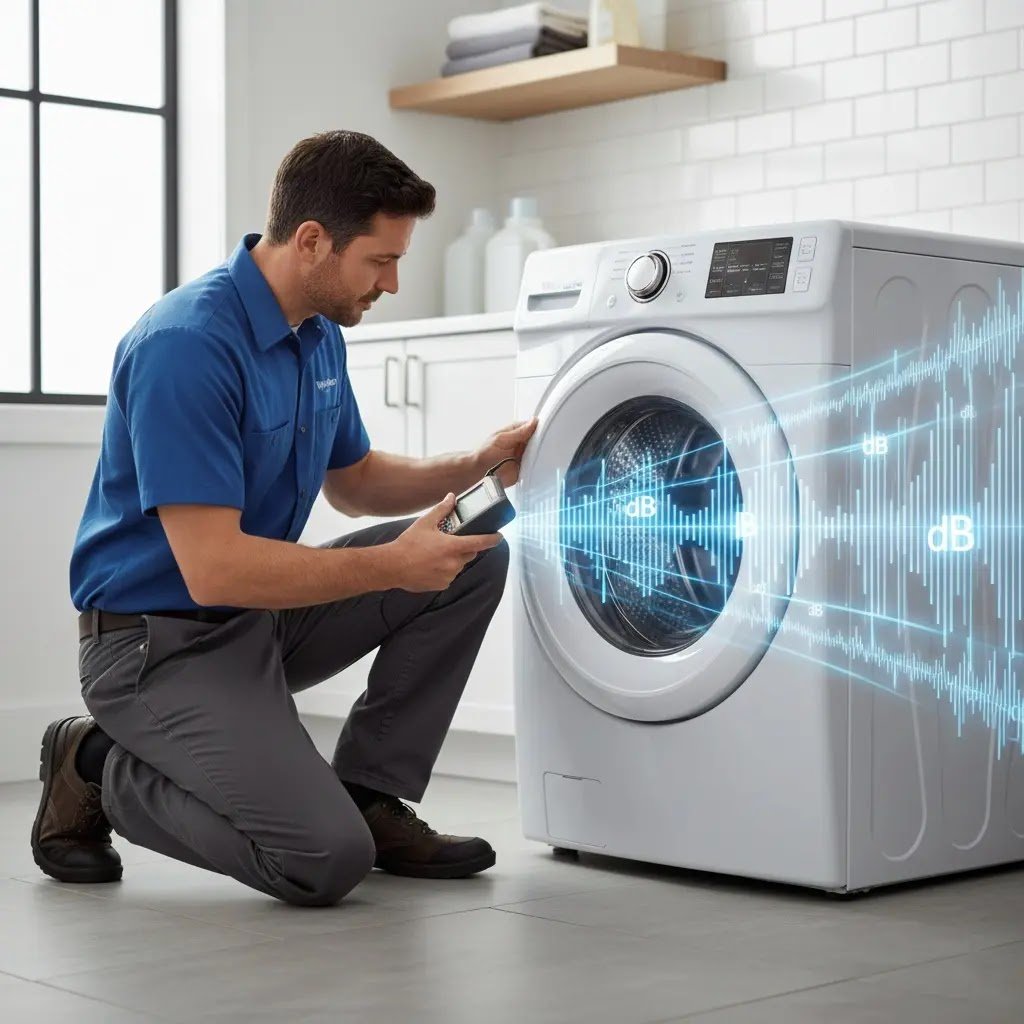
Is your Whirlpool washing machine sounding like a jet engine taking off and a jackhammer during the spin cycle? Don’t ignore it. In years of repair calls, I’ve watched a $20 part turn into a $500 scrap-metal pile simply because the owner waited one more week to find out what the noise actually meant.
Whether it’s a top-load washer banging during spin or a front-loader grinding before it even starts, this guide will help you pin down exactly which sound you’re hearing and how urgent it actually is.
Table of Contents
Why Modern Washers Are (Supposed to Be) Quiet
Modern Whirlpool washing machines use acoustic insulation and, on many current models, brushless DC (BLDC) motors that run nearly silent by design. That baseline matters for diagnosis: when you start hearing a distinct mechanical noise, it almost always means something has physically worn out and shifted, not that “washers are just loud sometimes. ” Your ears are picking up a real signal.
Noise Diagnosis Table
Use this table to narrow down what you’re hearing before reading the details below.
| Sound Type | Likely Cause | Severity | Quick Note |
| Jet engine roar (loudest during spin) | Tub bearing failure | 🔴 High | Stop using the machine; this worsens fast. |
| Heavy banging and machine “walks” | Worn suspension rods/springs | 🟠 Medium | Usually safe to finish the current load |
| Continuous clicking before spin | Shift actuator failure | 🟠 Medium | The spin cycle may not engage at all. |
| Metal scraping / “shh-shh” sound | Object stuck between tub and basket | 🟡 Low–Medium | Can puncture the tub if ignored |
| Rapid rattling during drain | Drain pump blockage | 🟡 Low | Usually a quick clear |
| High-pitched squeal | Worn drive belt | 🟡 Low | Belt tension and wear issue |
The Jet Engine Roar: Tub Bearing Failure
If your washer sounds like a plane taking off during the final spin, you’re likely dealing with tub bearing failure. The bearings are small metal balls in a sealed ring that let the inner drum spin smoothly at high speed. If the tub seal around them leaks, the grease inside washes away, and you’re left with metal grinding on metal.
In Simple Word: the bearings are like the wheels under your drum; once they lose their lubrication, they scream at high speed instead of spinning quietly.
This one is worth taking seriously: a failing bearing tends to get louder over a matter of days, not months, and running the whirlpool washing machine in that state puts real stress on the motor. If you’re also noticing the motor running hot and smelling faintly of burning, that’s a related warning sign covered in our [👉 Signs of a Washing Machine Motor Overheating].

The Jackhammer Bang: Suspension Rod Wear
A violent banging sound during spin, often with the machine visibly walking across the floor, usually points to worn suspension rods. Top-load Whirlpool washing machines hang the tub on four rods with dampening grease inside; once that grease breaks down and a spring loses its tension, the tub starts hitting the cabinet on every rotation instead of floating smoothly.
| In simple words: these rods work like a car’s shock absorbers. When they fail, the whirlpool washing machine bounces because nothing is holding it level anymore. |

The Grinding Click: Shift Actuator Failure
Hearing a rhythmic clicking and grinding specifically before the spin cycle starts, rather than during it? That points to the shift actuator, a small motor that shifts the machine from agitation into spin mode using a plastic gear ring. Once those gears strip, you’ll hear clicking as they fail to engage, and the whirlpool washing machine may simply refuse to spin at all.
| Insider note: this is one of the most commonly misdiagnosed noises. Homeowners often assume it’s the bearings because it sounds “mechanical,” but the timing gives it away: bearing noise gets louder during spin, and actuator noise happens in the seconds before spin engages. |
The Scraping Sound: Something’s Stuck
A consistent “shh-shh” and high-pitched scraping sound usually means an object has slipped between the spinning basket and the stationary outer tub. On modern water-saving designs, that gap is intentionally tight, so coins, bra underwires, and small keys find their way through more easily than you’d expect.
| In Simple Word: it’s a small object trapped where a moving part meets a still part, left alone, it can eventually puncture the tub and cause a permanent leak. |
The Rattling Pump: Drain Pump Blockage
A sharp rattling and vibrating sound specifically while the water is draining points to something caught in the drain pump’s impeller, commonly a button, hairpin, and small coin. Left in place, that object can eventually lock the impeller entirely, causing the pump motor to overheat and fail.
The Push-Test: Diagnosing Front-Loaders
On Whirlpool front-load washer models, the most expensive noise usually traces back to a cracked spider arm, the three-pronged bracket that holds the drum from behind. Here’s a quick way to check without opening the whirlpool washing machine:
- Reach in and push up on the top of the inner drum with your hand.
- If the drum lifts independently of the outer tub, feeling loose, and producing a clunk, the spider arm is likely cracked and corroded.
- If the whole assembly moves together with no play, the spider arm is probably fine, and the noise is coming from elsewhere on this list.
| Repair-vs-replace judgment call: the spider arm sits behind the drum, so replacing it is a major teardown, not a quick swap. On a front-loader more than about five years old, it’s usually worth getting a repair quote before committing, since this specific repair can approach the cost of a new entry-level machine. |

Could It Just Be an Unbalanced Load?
Before assuming the worst, rule out the simplest cause: an unbalanced load. Whirlpool washers use sensors to detect uneven weight distribution during spin, and will usually try to self-correct by adding water and redistributing the load before giving up and either slowing the spin and showing a code (often labeled “UL” and “Ofb,” depending on the model). If your noise happens mainly with single bulky items like a rug and a jacket, and right after you’ve loaded the whirlpool washing machine unevenly, try redistributing the load and running the cycle again before assuming a part has failed.
If the noise persists even with a normal, evenly loaded wash, and if the whirlpool washing machine has started “walking” across the floor rather than just vibrating, it’s worth checking your leveling feet next; a washer that isn’t sitting level will produce noise and vibration that looks a lot like a mechanical failure but isn’t one.
Frequently Asked Questions
Q: Is it safe to keep using my washer if it’s making a loud noise?
A: It depends on the sound. A high-pitched squeal and occasional rattle is usually safe to finish a load and two while you plan a fix. A jet-engine roar and violent banging are signs to stop and address it soon; running a failing bearing and suspension system can turn a cheap repair into motor damage.
Q: My Whirlpool washing machine is quiet when empty but loud when washing; does that change the diagnosis?
A: Yes, that’s a useful clue. Noise that only appears under load often points to suspension wear and an unbalanced load rather than bearings, since a failing bearing typically makes noise during spin regardless of load size.
Q: Can a loud washer actually damage my clothes?
A: Indirectly, yes, if the noise is coming from a stuck object like a coin and bra wire, that object can snag and tear fabric, and if it eventually punctures the tub, you’re looking at water damage on top of the noise.
Q: How urgent is a clicking sound before the spin cycle?
A: Moderately urgent. It usually means the shift actuator gears are wearing down, and once they strip completely, the washer may stop spinning altogether, leaving you with soaking-wet laundry until it’s repaired.
Q: Is it normal for a new washer to be louder than my old one?
A: Not usually. Modern whirlpool washing machines with acoustic insulation and BLDC motors are generally designed to run quieter than older models, so a distinctly loud new washer is more often a sign of an installation issue (unlevel feet, transit bolts left in) than a design difference.
Q: Can excessive detergent cause noise on its own?
A: Indirectly. Too much detergent creates “suds lock,” excess foam that puts extra pressure on the bearings and motor as the machine tries to spin through it. If your noise problem also comes with a musty smell and visible foam buildup, switching to the correct amount of HE (High Efficiency) detergent, HE Liquid Laundry Detergent, is worth trying before assuming a part has failed.
Q: Should I try to diagnose the noise myself and call a technician right away?
A: For anything on the low-to-medium severity end of the table above (scraping, rattling, squealing), a DIY diagnosis is usually reasonable. For a jet-engine roar and a whirlpool washing machine that’s visibly walking across the floor, it’s worth at least confirming the cause yourself using the checks above before deciding whether to repair it yourself and call someone in.
Conclusion
Noise is a symptom, not the disease, and your ears are one of the best diagnostic tools you have. Whether it’s a simple stuck coin and a genuine bearing failure, matching the sound to the cause today is what keeps a $20 fix from turning into a $400 repair bill next month.
Next step: use the diagnosis table above to identify your sound, then head to the matching repair guide linked in that section for the full step-by-step fix. A basic mechanic’s stethoscope, the Mechanic’s Stethoscope for Noise Diagnosis, can also help you pinpoint exactly where on the whirlpool washing machine a sound is coming from if more than one of these symptoms seems to fit. If the noise comes with a musty smell, our [👉 How to Deep Clean a Whirlpool Washing Machine (2026)] covers the biofilm buildup that often causes both at once.