
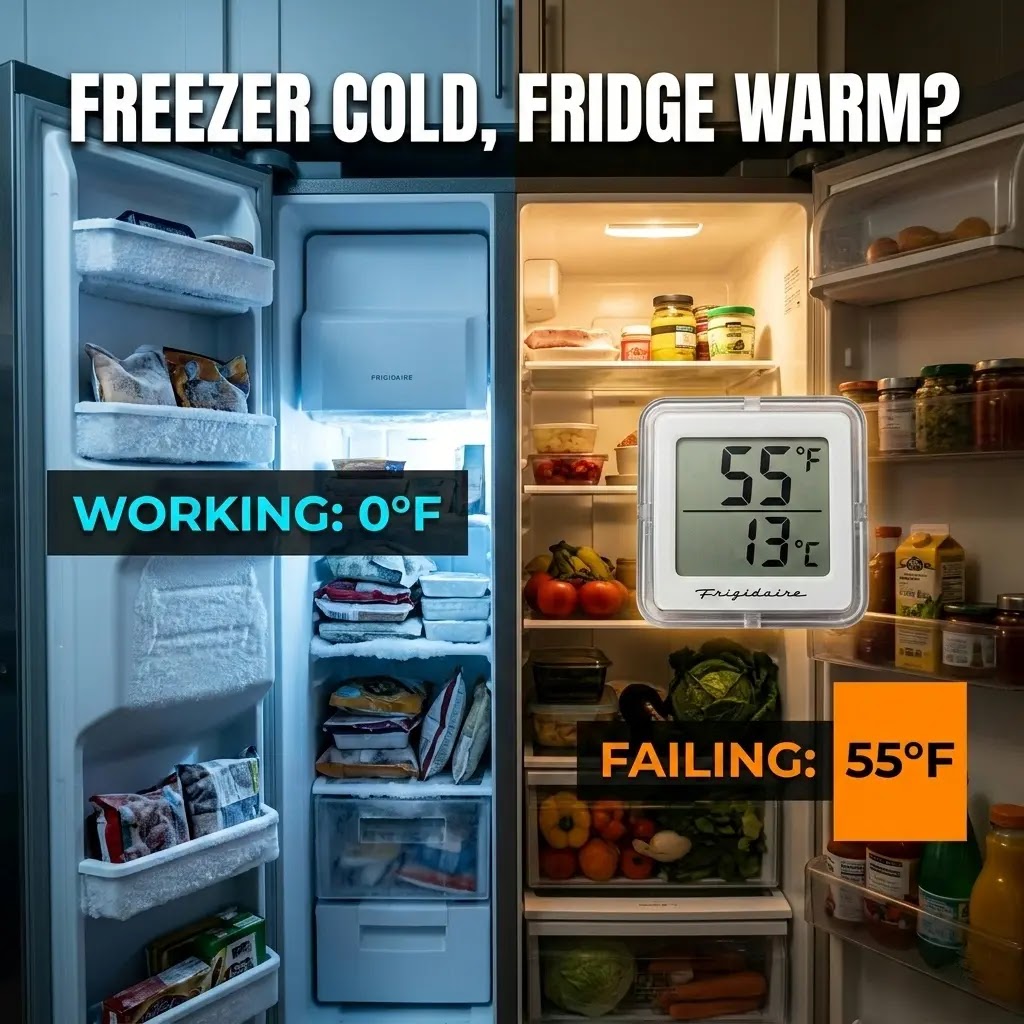
If your freezer is rock-solid but your fridge feels more like a cooler than a refrigerator, you don’t have two broken appliances; you have one broken delivery route. Frigidaire side-by-side units only make cold air in one place, and when that air can’t reach the fridge section, everything downstream starts to spoil. Here’s exactly where that Frigidaire freezer cold, fridge warm route breaks and how to find your specific failure point in under five minutes.
Table of Contents
I. Introduction: The One-Heart, Two-Rooms Logic
A common mistake owners make is thinking the fridge and freezer have two different cooling systems. In reality, most Frigidaire side-by-side units have only one heart, the evaporator coil, and it stays in the freezer. The fridge section acts like a guest; it only borrows cold air from the freezer through a shared duct system. If your freezer is freezing perfectly but your fridge is getting warm, the delivery route between the two rooms is blocked somewhere.
This matters more on newer smart models than it used to. Many current Frigidaire units with Frigidaire Connect (SmartHQ app) will now push a temperature alert to your phone before you’d ever notice a warm gallon of milk, so if you’ve gotten an app notification but the freezer still feels fine, don’t assume the sensor is wrong. Start checking airflow.
For a complete breakdown of every mechanical failure point in this system, see 👉 [Frigidaire Gallery, Not Cooling? 2026 Technical Guide to DIY & Pro Repair].
II. The Primary Suspect: The Motorized Damper Control
Think of the air damper as a small motorized window between the two rooms. When the fridge gets too warm, the control board tells this window to open, letting cold air from the freezer rush in. If the damper’s plastic gears strip out or freeze shut, that cold air stays trapped in the freezer permanently.
Quick check: Listen at the top-right area of the fridge section. A grinding or clicking sound usually means the damper motor is straining against ice or a stripped gear, not a healthy sign.
That sound alone is enough to narrow the problem down, but confirming and replacing the damper motor involves multimeter testing and part-specific steps that go beyond a quick diagnostic.

III. The Silent Killer: Defrost System Failure
If the defrost heater fails to turn on, frost on the evaporator coils never melts, and over weeks, it builds into a solid wall of ice. Air simply can’t move through ice, so even a fan spinning at full speed can’t push cold air past the blockage into the fridge.
Why this one is dangerous to DIY blindly: A lot of owners reach for a hairdryer to speed things up. Don’t. Frigidaire units have a thermal fuse rated well below hair dryer heat, and popping it causes a permanent defrost failure; the unit will never auto-defrost again until that fuse is replaced.
Quick check: Open the freezer and look at the back wall behind the shelves. If you see a visible sheet or chunk of ice rather than light frost, this is very likely your cause.
IV. The Return Air Vent: The Circulation Loop
For cold air to enter the fridge at the top, old air has to leave through the bottom and flow back into the freezer; it’s a continuous loop, not a one-way delivery.
The Freezer Door Trick (a genuinely useful diagnostic):
- Open the fridge door and hold your hand at the top air vent.
- While keeping the fridge door open, also open the freezer door.
- If you suddenly feel a gust of cold air only when both doors are open, your return vent is frozen or blocked by food; opening the freezer door gave the air an alternate exit to complete the loop. If air still doesn’t move with both doors open, the top damper (Section II) is your more likely culprit.

V. Evaporator Fan Motor: The Engine of Air
The evaporator fan physically pushes cold air through the duct system. If it stops, the fridge section stays warm even when the freezer reads -10°F, because there’s cold air being made but nothing moving it.
Many Frigidaire models display SY EF on the control panel when this fan fails. On smart-connected models, this same failure often also triggers an app push notification rather than just the panel; it’s worth checking your phone if you have a connected unit. If you have European appliances too, our guide on 👉 [Bosch Fridge Freezer Temperature Problems] covers how fan and sensor behavior compares across brands. If Frigidaire refrigerator displays more errors, check out our Guide on [ Frigidaire Error Codes: Fix SY EF & SY CF ]
VI. Thermistor: The Sense of Touch
The thermistor tells the control board how cold the fridge actually is. If it’s lying, reporting “cold” when the fridge is genuinely warm, the board will never tell the damper to open because as far as the computer knows, nothing is wrong.
Quick check: A thermistor doesn’t always fail cleanly (open or shorted); sometimes it drifts, giving a slightly wrong reading instead of an obviously broken one. This drift failure is sneakier because the fridge behaves almost normally, just runs a few degrees warmer consistently. If your fridge sits at 50°F instead of 37°F for no obvious airflow reason, a drifting thermistor is worth suspecting even if a basic multimeter test looks “close enough.”
VII. Service Mode Diagnostics
Frigidaire units include a built-in service mode that lets the fridge test its own components, fans, dampers, and heaters without you removing a single panel.
Quick check: If you’re comfortable with basic diagnostics, most models enter service mode by holding two specific buttons for 10 seconds (the combination varies by model). Inside, individual component tests let you confirm whether the damper motor and evaporator fan respond to commands at all, which tells you immediately whether you’re chasing an electrical problem or a mechanical/ice-blockage one.
VIII. Final Verdict: Airflow vs. Gas Leak
Check the frost pattern on your freezer’s evaporator coils; it tells you almost everything:
- Airflow issue: Coils fully covered in thick, even white ice → defrost or fan problem. Cheap, straightforward fix.
- Sealed system issue: Ice only on one small corner, rest of the coil bare and dry → refrigerant leak or failing compressor. This is a different repair category entirely.
A sealed-system repair typically runs $800 or more. On an older unit, replacement is usually the smarter financial call than sinking that much into a repair.
Maintenance tip: Dirty condenser coils force the compressor to run hotter and longer, which accelerates exactly the kind of sealed-system wear that leads to leaks. Our guide, 👉 [How to Clean Refrigerator Coils in 5 Easy Steps] is a five-minute task that protects the compressor long-term.

IX. Comparison: Airflow Issue vs. Sealed System Issue
| Signal | Airflow Issue | Sealed System Issue |
|---|---|---|
| Coil frost pattern | Thick, even coating across coils | One small icy patch, rest bare |
| Freezer temp | Normal (0°F to -10°F) | Often slightly warm too |
| Compressor sound | Normal cycling | May run constantly, or hiss |
| Typical fix cost | $0–$150 (fan, damper, defrost parts) | $800+ (refrigerant, compressor) |
| DIY-friendly? | Often, yes. | No, requires requires EPA-certified technician |
Frigidaire freezer cold fridge warm Helpful FAQs
Why is my freezer working fine, but the fridge is warm even after I cleaned it?
This is the One-Heart design at work. Since cold air is only made in the freezer, a warm fridge means that air is physically blocked somewhere in the duct path. Check the bottom-left return vent for food blockages first; it’s the easiest thing to fix. If that’s clear, the motorized damper at the top is the next most likely cause.
What does the SY EF error code mean?
It stands for “system evaporator fan” and means the freezer fan isn’t spinning. Sometimes ice has jammed the blades; often the fan motor itself has failed electrically and needs replacement.
Is it okay to use a hairdryer to speed up defrosting? –
No, technicians strongly advise against it. Frigidaire units have a thermal fuse that can blow within seconds under hairdryer-level heat. Once it blows, the fridge stops auto-defrosting permanently until that fuse is replaced.
What is the freezer door trick for testing airflow?
Open both doors and feel the top vent inside the fridge. If cold air only starts flowing once the freezer door is also open, your return vent is frozen or blocked, a classic circulation loop failure, not a damper or fan problem.
Can a smart/connected Frigidaire model show this problem differently than an older unit?
Yes, somewhat. On Frigidaire Connect (SmartHQ app) models, temperature swings and fan fault codes like “SY EF” can push directly to your phone, sometimes before you’d notice by hand. The underlying mechanical causes are identical to older models; only the way you’re alerted changes.
Does a warm fridge always mean the compressor is failing?
No, and this is the most common misdiagnosis. In the large majority of cases with a genuinely cold freezer, the compressor and sealed system are fine; the problem is a blocked, iced-over, or electrically dead component in the airflow path (damper, fan, or defrost heater). Compressor and refrigerant issues are the less common cause and usually come with a distinct partial-frost pattern, as shown in Section VIII.
How urgent is this repair: will my food spoil?
If the fridge section is sitting above 40°F, perishables are already at risk within a few hours. Move critical items (dairy, meat, leftovers) into a cooler with ice while you diagnose, since most of these fixes take longer than a single evening once parts are involved.
Conclusion
A warm fridge with a cold freezer in a Frigidaire unit is almost always an airflow war, not a total system failure. Because the whole design relies on one cooling source in the freezer, any blockage in the loop, a stuck damper, a dead fan, a blocked return vent, or an iced-over evaporator, will cause the fridge section to warm up while the freezer stays perfectly fine.
Start with the free checks: clear the vents, run the freezer door trick, and listen for damper-motor noise. If the coils are fully iced over, it’s a defrost problem. If ice is isolated to one corner, you’re likely looking at a sealed system issue and should get a certified technician’s quote before investing further.
👉 Ready to fix the specific part causing your airflow block? Jump to our full repair guide: [Frigidaire Gallery Not Cooling? 2026 Technical Guide to DIY & Pro Repair] for step-by-step parts, testing, and replacement instructions.