
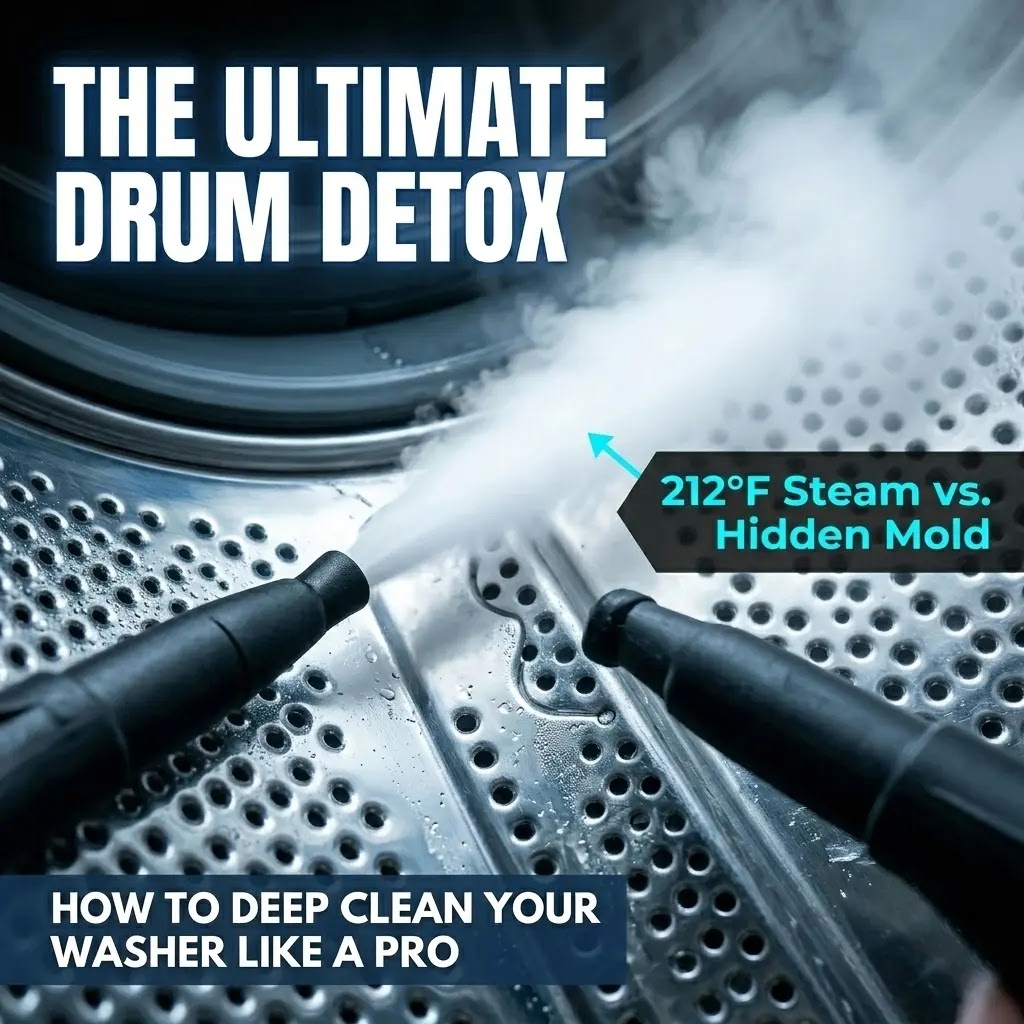
Steam cleaning your washer sounds like the safest, most natural way to sanitize it; no harsh chemicals, just hot vapor. But from a material science standpoint, that handheld steamer might be doing more damage than the grime it’s removing.
Table of Contents
I. The 2026 Trend vs. Mechanical Reality
Many homeowners are steering away from strong chemicals like bleach and chlorine over health concerns, which has made handheld steam cleaners genuinely popular as a “natural” sanitizing option. There’s a real conflict here, though: manufacturers like Samsung, LG, and Whirlpool design their machines to handle steam generated internally during a controlled built-in cycle, not a high-pressure handheld steamer applied externally by hand. The rest of this guide walks through why that distinction matters more than it might seem.
II. Material Science: Heat’s Impact on Polymers
Modern washing machines rely on specific plastics and rubbers chosen for how they perform under normal operating conditions, not under a focused blast of near-boiling steam.
The gasket (EPDM rubber): your door seal is typically made from EPDM, a rubber compound generally chosen specifically for its heat and weather resistance; it’s a genuinely durable material for this application. That said, repeated direct exposure to concentrated, high-temperature steam at close range, well beyond what the seal encounters during a normal cycle, can still accelerate surface hardening and micro-cracking over time at the edges and folds, which is where seals typically fail first anyway. The mechanism is less about a single dramatic “oil leaching” event and more about cumulative thermal stress in exactly the areas most prone to wear.

The outer tub (polypropylene): modern tubs are commonly made from polypropylene, which has a heat deflection temperature commonly cited around 100°C under low-stress conditions, close enough to what a handheld steamer produces that there’s very little safety margin. Just like a plastic spoon left in hot tea can soften and warp, a polypropylene tub subjected to concentrated steam can lose its shape slightly, which throws the drum out of balance and shows up as excess shaking during spin. This applies across brands; a Samsung Bespoke tub and a Whirlpool Cabrio tub are both commonly polypropylene, so neither is inherently safer here.
III. The Silent Killer: Bearing Grease Liquefaction
The bearings that let your drum spin smoothly are packed with thick, high-temperature grease and protected by a lip seal. Pressurized steam behaves differently from splashed water when it comes to seals; vapor under pressure can work its way through microscopic gaps that liquid water typically can’t cross as easily.
When steam does reach the bearing area, the heat can liquefy the grease, which then washes away rather than staying in place to do its job. Without proper lubrication, metal starts grinding against metal, and that kind of wear is a major contributor to the loud roaring noise associated with bearing failure. Our [👉 Washing Machine Repair: Spotting Faulty Motors Before They Fail] guide covers how to catch this early, before it becomes a full failure.
The cost reality: once bearings fail this way, repairing it often costs close to, or more than, what the machine is worth, making replacement the more practical option in many cases.

IV. Electronic Condensation: The Invisible Threat
Pressurized steam can penetrate gaps that liquid water simply can’t reach, including behind the control panel, where it can get underneath the protective conformal coating on the circuit board.
That trapped moisture leads to corrosion on the board over time. The machine might keep working fine immediately afterward, but intermittent electronic faults showing up weeks later are a common downstream result. If you own an LG and start seeing error codes after a steam-cleaning attempt, our [👉 LG Washer Repair Guide: Fix OE, LE & UE Codes (2026 DIY)] covers how to troubleshoot from there.

V. Why Built-In Steam Cycles Are Safe
If your machine has a dedicated Steam button, using it is genuinely safe; the engineering is controlled by software rather than left to a person aiming a handheld nozzle:
- Temperature capping: sensors keep the internal steam temperature well below what a handheld steamer produces, hot enough to help sanitize, and cool enough to stay within what the plastics and rubber are designed for.
- Intermittent injection: the machine pulses steam gradually rather than blasting continuously, which avoids creating concentrated hot spots.
- Low, controlled pressure: internal steam systems use gentle vapor rather than the higher-pressure output of a handheld cleaner.
VI. Expert Protocol: If You Must Steam
If you’re going to use a handheld steamer anyway, these precautions genuinely reduce (though don’t eliminate) the risk:
- Keep distance: hold the nozzle several inches back from any surface rather than touching it directly to the machine, letting the steam cool slightly before contact.
- Stainless steel only: limit steaming to the stainless steel drum itself. Avoid the rubber gasket entirely, along with any plastic agitators, drawers, or trim.
- Avoid the glass entirely; thermal shock risk: most front-loaders use tempered glass doors. Tempered glass is strong under normal use but genuinely sensitive to sudden temperature differences; hitting a cold glass door with a focused, near-boiling steam blast can create enough internal tension to cause the glass to fail suddenly and dramatically. Never point a handheld steamer at or near the door glass.

VII. The Best Alternatives for Deep Cleaning
Oxygen-based cleaning chemistry is generally a safer and more effective route than external steam for reaching hidden grime without the material risks above. Our [👉 Washing Machine Cleaner Not Working? The Biofilm Secret explains why the right chemical approach often outperforms steam at reaching buildup, as steam physically can’t dissolve. If mineral scale specifically (rather than biofilm or grime) is your main concern, our [👉 How to Descale a Washing Machine (2026 Guide)] covers the citric-acid approach in full.
For product recommendations that won’t stress EPDM rubber or polypropylene tubs, see our [👉 Best Washing Machine Cleaners 2026: A Simple Guide to a Fresh Washer].
| Comparison | Handheld Steam | Sodium Percarbonate |
| Sanitization reach | Surface only | Reaches into biofilm more thoroughly |
| Material safety | Higher risk (warping/cracking) | Generally safe for EPDM and polypropylene |
| Bearing integrity | Risk of grease washout | No comparable risk |
| Typical cost | $30–$80 for a steamer | Roughly $10–$20 per treatment |
| Electronics risk | Moderate to high (condensation) | None, no vapor penetration involved |
A sodium percarbonate-based cleaner is the more consistently safe option across both material types described above.
VIII. Frequently Asked Questions
Q: Is it safe to steam the detergent drawer?
A: No, the thin plastic used in most detergent drawers tends to warp or soften quickly under concentrated steam. Warm, soapy water and a soft brush handle this area fine without the risk.
Q: Why does my machine roar like a jet engine after steam cleaning?
A: This is a classic sign of bearing damage; the steam likely reached the bearing, liquefied it, and washed it away, leaving metal grinding against metal without lubrication.
Q: Can I use steam on the front control panel?
A: No, steam penetrates around buttons and seams more easily than it looks like it should, and moisture reaching the circuit board behind the panel can lead to corrosion that shows up as intermittent faults weeks later rather than an immediate, obvious problem.
Q: Will this void my warranty?
A: Quite possibly, many manufacturers specifically warn against using high-pressure or handheld steam cleaners on their appliances in the owner’s manual, so check your specific model’s documentation before assuming it’s covered if something goes wrong afterward.
Q: Is it safe to steam the rubber door boot on a front-load washer?
A: No, this is actually one of the higher-risk areas specifically because it has more exposed surface area than smaller seals elsewhere in the machine, giving concentrated heat more opportunity to accelerate hardening and cracking over repeated exposure.
Q: Does steam damage top-load washers the same way as front-load models?
A: The core risks, bearing grease and plastic tub warping, apply to both designs, since both commonly use polypropylene tubs and greased bearings. Top-load washers don’t have a tempered glass door or as large a rubber boot, so the glass-shatter and gasket-drying risks are lower, but the bearing and electronics risks are essentially the same.
Q: How long does it take for steam damage to show up after just one cleaning session?
A: Bearing and gasket effects from a single session are usually minor and cumulative rather than immediately obvious; one exposure alone rarely causes a dramatic failure on its own. Electronic corrosion is the exception: a single heavy steam exposure near the control panel can be enough to trigger intermittent faults within weeks, since corrosion continues spreading internally even after the moisture itself is long gone.
IX. Conclusion: Summary of Findings
Steam cleaning is marketed as a natural, chemical-free solution, but it carries genuine, material-specific risk for the way these machines are actually engineered; concentrated heat and pressure can degrade rubber seals, warp plastic tubs, and liquefy the grease your bearings depend on.
The technician’s choice: for a deep clean that doesn’t gamble with any of that, a sodium percarbonate cleaner delivers active-oxygen cleaning power at temperatures the machine’s own materials are actually built to handle, no steamer required.
Next step: if you’ve been using a handheld steamer on your machine, switch to your built-in steam cleaning cycle (if your model has one) or a sodium percarbonate treatment for your next deep clean, and keep the handheld steamer for surfaces it’s actually designed for.