
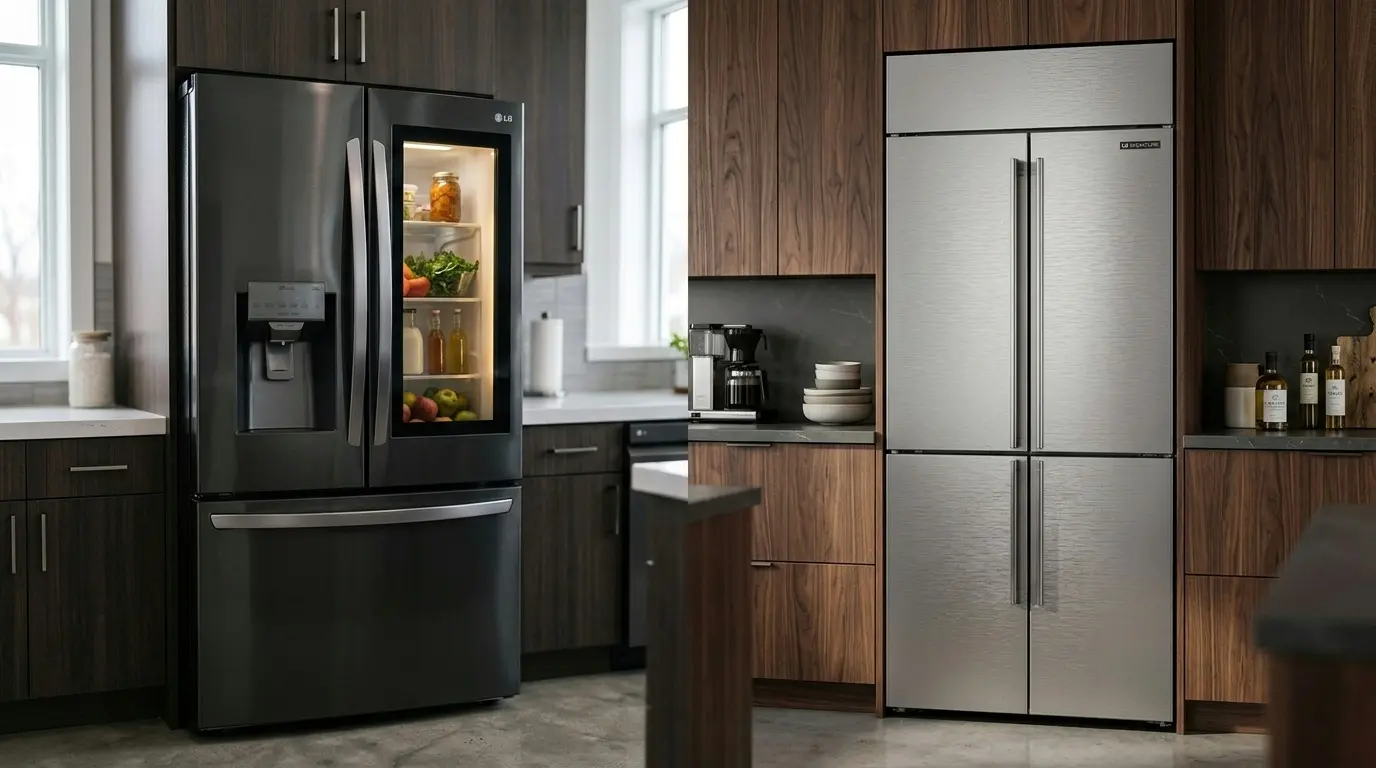
Every few weeks a reader writes in with some version of the same question: should I get an LG InstaView refrigerator, or is it worth stretching the budget for LG Signature? The honest answer is that the question itself rests on a false premise, and once that’s cleared up, the decision gets a lot easier. This isn’t really a matchup between two competing refrigerator lines. It’s a comparison between a single door feature and an entire premium tier that happens to include that feature, plus a fair amount more. Plenty of showroom staff either don’t know the difference themselves or don’t bother explaining it, because a refrigerator that sounds one-of-a-kind is easier to sell at a four-figure premium.
This article breaks down, spec by spec, exactly what separates a mainstream refrigerator from the LG Signature line, capacity, door mechanics, finish, smart features, warranty coverage, and what tends to go wrong with each after a couple of years of daily use. By the end you’ll know precisely what you’d be paying the Signature premium for and whether that premium buys you anything that actually matters in day-to-day kitchen life.
In This Article
These Aren’t Actually Two Competing Product Lines
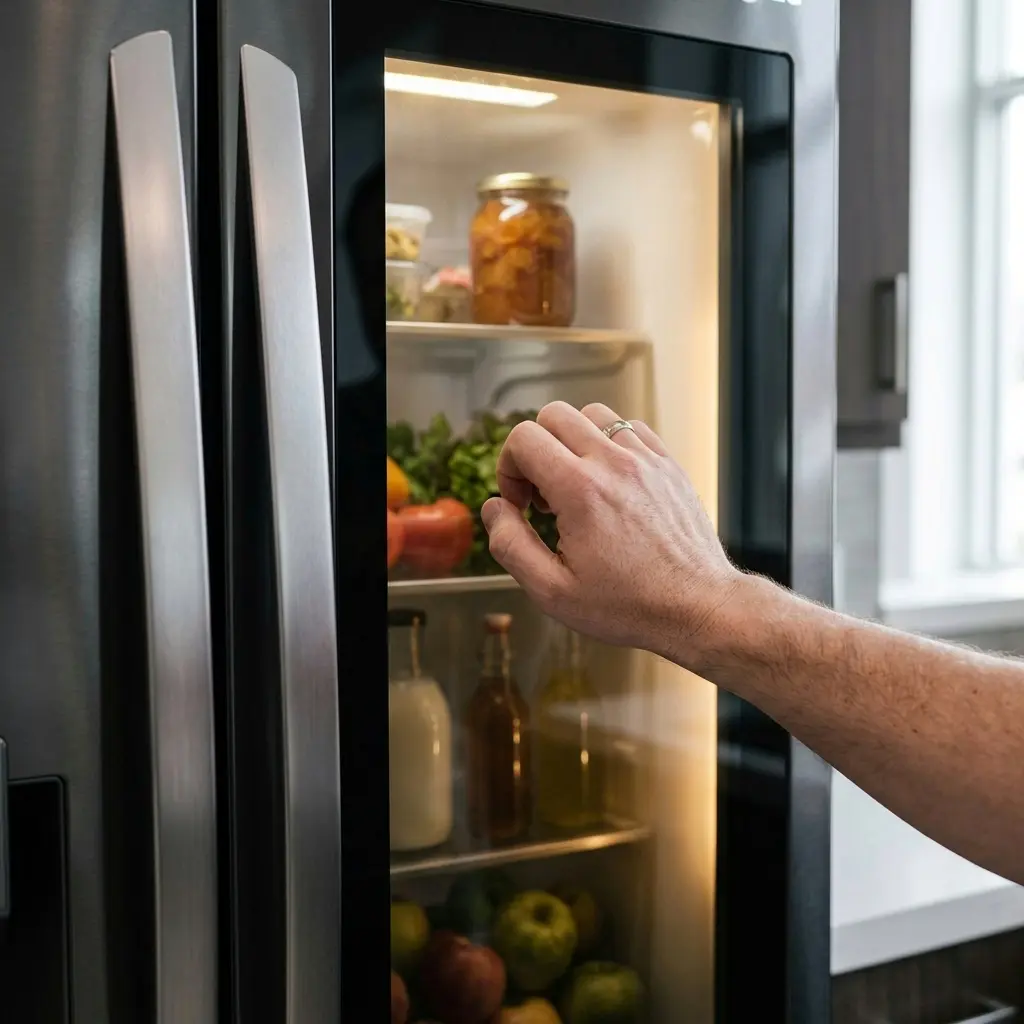
LG introduced InstaView in 2016 as a single feature: a tinted glass panel built into the refrigerator door that illuminates when you knock on it twice, letting you see inside without opening the door and losing cold air. It debuted on LG’s premium Signature line, but LG expanded it to mainstream French-door and side-by-side refrigerators within the same year, which is exactly where the confusion starts. Today, InstaView shows up on dozens of models spanning a wide price range, not on one specific product.
LG Signature, on the other hand, is not a feature at all. It’s LG’s ultra-premium sub-brand, sitting parallel to LG Studio, and it spans refrigerators, ranges, dishwashers, and laundry appliances. Its refrigerator lineup has historically centered on one flagship model at a time, the LG Signature LUPXC2386N Refrigerator being the best-known example, a 36-inch counter-depth four-door unit that includes InstaView as one feature among several, not its headline selling point.
| Personal note: The thing that actually separates a Signature refrigerator from a mainstream InstaView model isn’t the glass panel; both have it. It’s the tier of components underneath: door hinge assembly rated for higher cycle counts, a foot-sensor auto-open mechanism, cabinet-depth construction, and a longer manufacturer support queue reserved for the premium line. None of that shows up in a spec sheet screenshot, which is exactly why the two get confused. |
So when someone asks, “InstaView or Signature,” the more useful question is, “Do you want the knock-and-see feature on a refrigerator that fits a normal kitchen budget, or do you want the full premium package that InstaView happens to be bundled into?” The rest of this comparison treats it that way, a representative mainstream InstaView model against the Signature flagship, feature by feature.
Head-to-Head: Core Specs at a Glance
Before getting into the details, here’s how a typical InstaView model stacks up against the LG Signature refrigerator on paper. Treat the price figures as positioning, not quotes; always confirm current pricing with the retailer since both figures move with promotions and model-year changes.
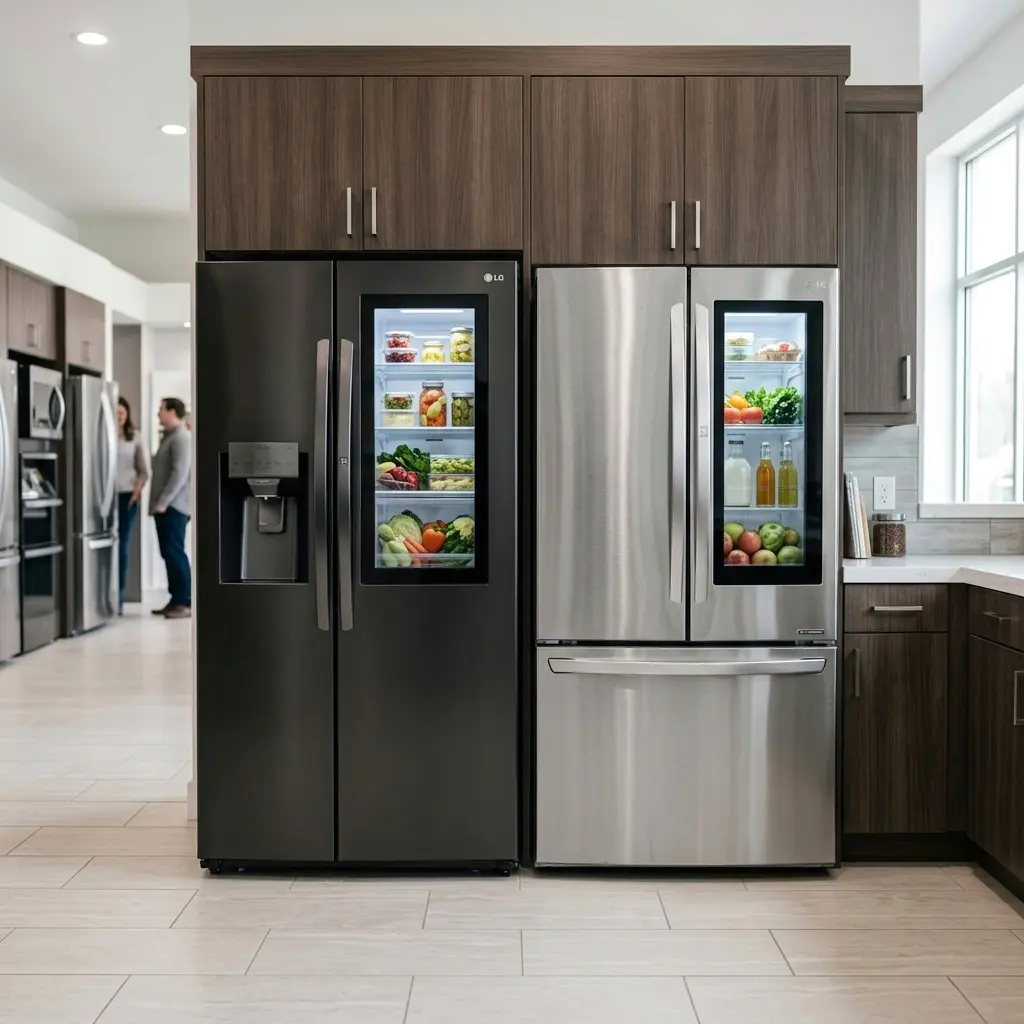
| Spec | Mainstream InstaView (e.g. LMXS28626S) | LG Signature (LUPXC2386N) |
| Configuration | Side-by-side or French door | Counter-depth French 4-door |
| Capacity | ~26–28 cu. ft. (varies by model) | ~22.8–23 cu. ft. (claimed) |
| InstaView panel | Yes | Yes |
| Door-in-Door | Yes, on InstaView models | Yes |
| Auto Open Door (foot sensor) | No | Yes |
| Exterior finish | Black stainless or PrintProof stainless | Textured Steel (exclusive) |
| Voice commands (“Hi LG”) | No | Yes |
| WiFi Eclipse display panel | Select models only | Yes |
| Compressor warranty | 10-year parts / 5-year labor (linear compressor) | 10-year parts / 5-year labor (linear compressor) |
| Typical retail bracket | Mid-range premium | Ultra-premium (roughly 2.5–3x) |
Door Technology: LG InstaView Panel, Door-in-Door, and Auto-Open Door
Both refrigerators share the two door features people actually associate with the InstaView name: the knock-twice mirrored glass panel and the Door-in-Door compartment that puts everyday items like milk, juice, and condiments behind a smaller, separate door so you’re not swinging the whole refrigerator door open for a quick grab. On this specific technology, a $2,500 InstaView model and a $7,000+ Signature model perform identically, the panel lights the same way, and the reduction in cold-air loss is the same underlying engineering.
Where Signature pulls ahead is Auto Open Door, a foot-sensor system that lets you open the refrigerator hands-free when your arms are full of groceries, plus a ColdSaver panel positioned to further limit cold air escape around the door-in-door compartment. Signature models also add LG Voice Command setup and troubleshooting through ThinQ’s “Hi LG” wake phrase, letting you open the door or change dispenser settings by voice.
| Personal note: Auto Open Door is the feature that sells the floor model in the showroom and gets used the least at home. Most Signature owners report using it heavily for the first few weeks and then defaulting back to just pulling the handle because the sensor needs a clean, unobstructed foot swipe to trigger reliably, and it doesn’t work well on textured or uneven kitchen flooring. The panel that actually earns its keep long-term is the passive ColdSaver barrier, since it keeps working without you doing anything. |
If you’re weighing whether the extra door mechanics are worth it, it helps to think about how often you actually walk into the kitchen with both hands full versus how often you’d use a foot sensor purely because it’s there.

Interior Layout, Capacity, and Cooling System
This is the category where the two diverge more than most buyers expect, and not in the direction people assume. Mainstream InstaView side-by-side and French-door models typically run in the high-20s cubic feet range, while the Signature flagship comes in lower, at roughly 22.8 to 23 cubic feet claimed capacity. That’s not a mistake or a downgrade; it’s a byproduct of Signature’s counter-depth construction, which is built to sit flush with your cabinetry rather than protrude into the kitchen. Counter-depth units trade cabinet volume for a built-in look, and no brand has found a way around that trade-off yet.
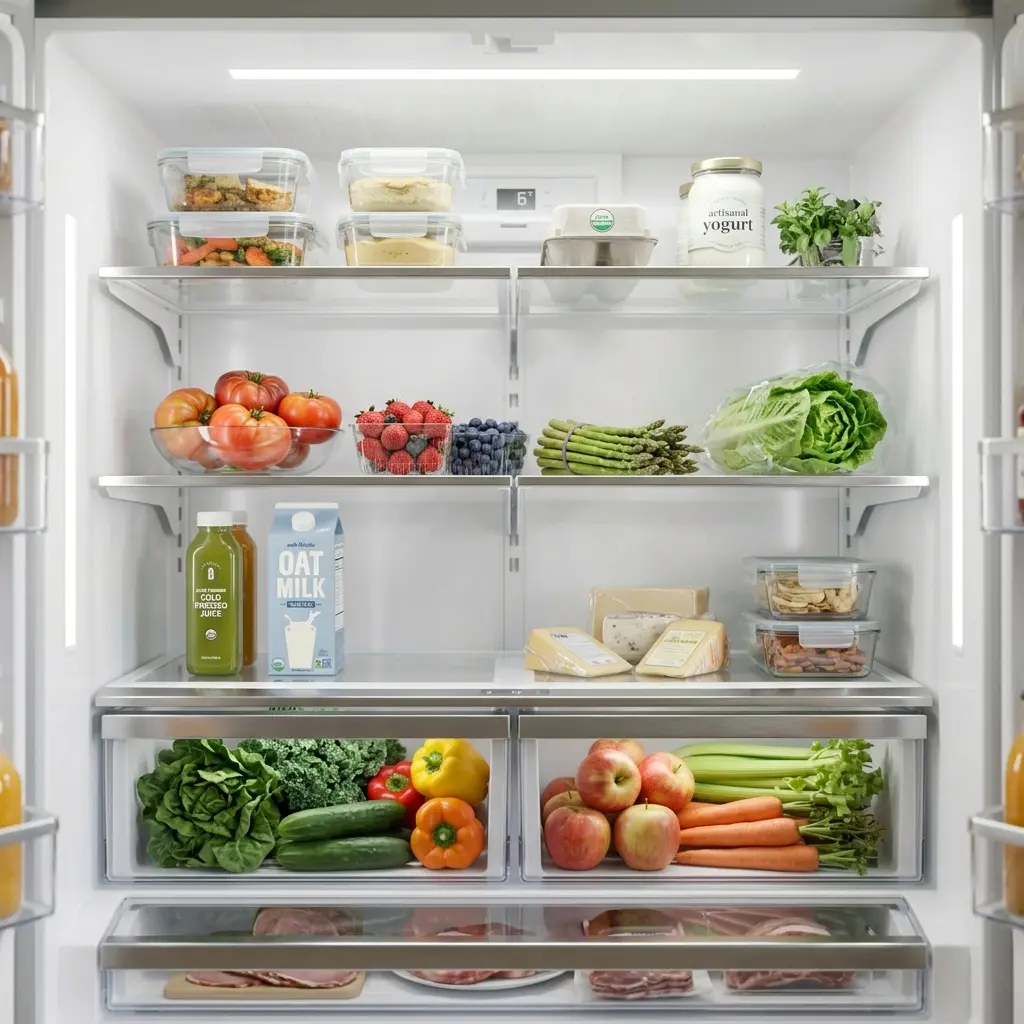
Both refrigerators use LG’s Multi Air Flow system, which circulates cold air through vents around the cabinet rather than relying on a single cold zone, and both include a Custom Chill pantry drawer with adjustable temperature settings for meat, produce, or deli items. Interior lighting differs slightly; Signature uses LUMIShelf under-shelf lighting across every shelf, while mainstream InstaView models typically light the interior from the top and sides only.
| Personal note: The “claimed” capacity on every spec sheet, from both brands, is measured before shelving, bins, ice maker housing, and compressor compartment intrusion are subtracted. In real-world use, expect 10–15% less usable space than the number on the box, and counter-depth models like Signature lose proportionally more of it, since the cabinet itself is shallower to begin with. If maximizing grocery storage for a large household is the priority, a standard-depth LG InstaView model will out-store the Signature flagship despite costing a fraction of the price. |
Design, Finish, and Kitchen Fit
Mainstream InstaView refrigerators are available in black stainless steel and LG’s PrintProof stainless finish, both designed to resist fingerprints with a quick wipe-down. Signature ships exclusively in Textured Steel, a finish LG doesn’t offer anywhere else in its lineup, a slightly grained, matte-leaning stainless that’s built specifically to avoid the smudge patterns you get on glossy stainless while giving the appliance a heavier, more architectural look.
The bigger practical difference is depth. Standard InstaView units are full-depth refrigerators that typically extend a few inches past your cabinet fronts, fine for most kitchens, and it buys you the extra interior volume discussed above. Signature’s counter-depth build is designed to sit nearly flush with surrounding cabinetry, which matters a lot in a remodel where the refrigerator is meant to look built-in rather than freestanding. If you’re renovating and the appliance’s silhouette against your cabinet line is part of the design plan, that’s a legitimate reason to pay the Signature premium that has nothing to do with the InstaView panel at all. For a broader look at how depth affects both fit and capacity

Smart Features and ThinQ Compared
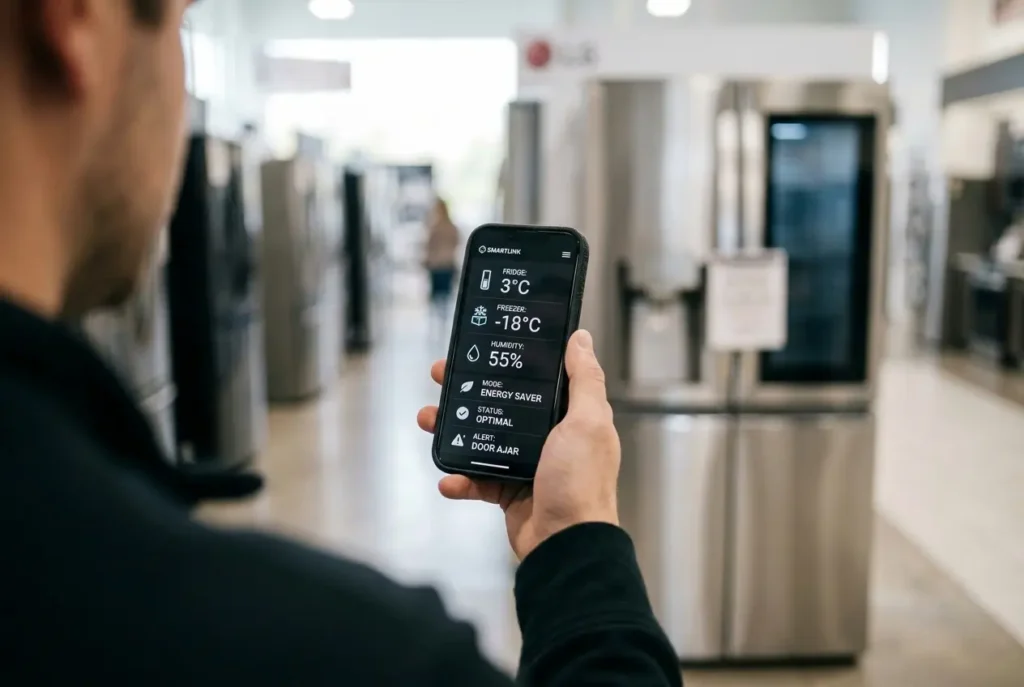
Both lines run on LG’s ThinQ platform, which handles Wi-Fi connectivity, remote temperature adjustment, filter-replacement alerts, and diagnostic error reporting through the LG ThinQ app. If your main interest in “smart” features is being notified when the door’s been left open or getting a heads-up before your water filter needs swapping, a mainstream InstaView model covers that ground just as well as Signature does.
Signature adds two things on top: the WiFi Eclipse Display, a status panel integrated into the InstaView glass that shows temperature and connectivity information without you knocking to look inside, and full voice command support through “Hi LG.” Some mainstream InstaView models include a basic Eclipse-style display as well, so check the specific model rather than assuming it’s Signature-exclusive.
| Personal note: A knowledgeable salesperson should ask one question before recommending either fridge: Do you actually use your phone to manage kitchen appliances, or would you be buying the ThinQ integration because it’s listed as a feature? Usage data from smart-home reviewers consistently shows steep drop-off in app engagement after the first month for appliance apps in general, refrigerators included. If you already ignore your smart thermostat’s suggestions, the smart layer on either of these units is unlikely to change that habit. Read 👉 [LG ThinQ App Setup and Common Connection Issues] before assuming Wi-Fi setup will be plug-and-play; it’s usually the single most common support call LG dealers field on both product lines. |
Price Positioning and Total Cost of Ownership
Sticker price is the most obvious gap between these two, but it’s not the only cost that matters over the life of the appliance. Here’s how the two compare on total cost of ownership, using relative positioning rather than fixed numbers, since retail pricing shifts with promotions and model-year changes.
| Cost Factor | Mainstream InstaView | LG Signature |
| Retail price bracket | Mid-range premium | Ultra-premium, roughly 2.5–3x InstaView |
| Energy operating cost | ENERGY STAR certified; comparable annual cost | ENERGY STAR certified; comparable annual cost |
| Extended warranty cost | Lower, wider provider selection | Higher, often manufacturer-only options |
| Replacement parts availability | Broad, high production volume | Narrower, lower production volume, longer lead times |
| Local technician familiarity | High, most appliance techs service these | Lower, fewer techs trained on Auto Open Door mechanics |
| Resale / trade-in value retention | Moderate | Higher in absolute terms, similar in percentage terms |
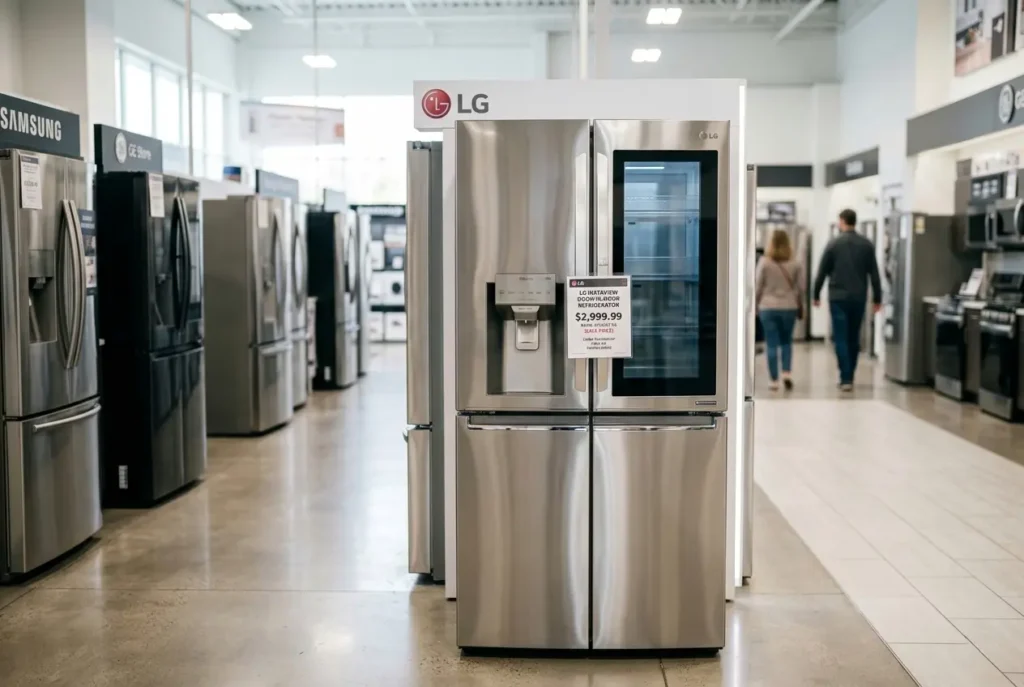
The energy line is worth pausing on, since it’s where people most often assume Signature must be more efficient because it costs more; it isn’t, meaningfully. Both are ENERGY STAR certified and use the same linear compressor technology, so your monthly electricity cost will land in a similar range regardless of which one you buy. The real cost gap over time comes from parts and service, not electricity. Compare current listings for the LG InstaView Side-by-Side Refrigerator LMXS28626S against the LG Signature Counter-Depth Refrigerator LUPXC2386N before deciding, since promotional pricing can temporarily narrow the gap.
Reliability, Common Issues, and Repair Considerations
Here’s a detail that surprises a lot of Signature buyers: the core refrigeration warranty is identical across both lines. LG backs its linear compressor with 10 years of parts coverage and 5 years of labor on both the mainstream InstaView models and the Signature flagship, alongside the standard 1-year full parts-and-labor warranty and 5-year sealed-system coverage. Paying the Signature premium does not buy you longer or better protection on the part most likely to fail expensively, the compressor. What it buys is fit, finish, and door mechanics, not core reliability.
After a year or two of daily use, the issues that show up tend to be similar across both lines: Door-in-Door magnetic gasket wear that lets in warm air over time, and 👉 [LG Refrigerator Ice Maker Not Working: Common Fixes] is the single most frequent service call on any LG French-door or side-by-side model, InstaView or not. Signature adds one failure point mainstream models don’t have, the auto open door foot sensor, which can need recalibration if it becomes overly sensitive (opening on its own) or unresponsive (not opening at all).
| Personal note: Because Signature refrigerators ship in far lower volumes than mainstream InstaView models, independent appliance repair techs run into them less often. That doesn’t mean the appliance itself is less reliable; it means when something does go wrong, you’re more likely to be waiting on a specialized part or a technician who needs to look up the mechanism before servicing it, rather than one who’s fixed a dozen of the same unit that month. Factor that lead time into your decision if you can’t be without a refrigerator for more than a day or two. |
Which One Actually Fits Your Kitchen and Budget
A few real scenarios make this easier to apply to your own situation:
- Budget-conscious upgrade: You want the knock-and-see convenience without a luxury price tag; a mainstream InstaView model like the LG InstaView French Door Refrigerator LRFS28XBD delivers the same door technology as the Signature at a fraction of the cost.
- Kitchen remodel with built-in cabinetry: if the refrigerator needs to sit flush and look architecturally integrated, Signature’s counter-depth build and Textured Steel finish earn their premium here in a way no mainstream model can replicate.
- Large family needing maximum storage: skip Signature’s counter-depth trade-off entirely; a full-depth InstaView side-by-side or French-door model in the high-20s cu. ft. range will out-store it, often for a third of the price. See 👉 [Best LG Refrigerators for Large Families] for capacity-first picks.
- First-time appliance buyer or renter: neither of these is likely the right call; a non-InstaView LG French-door model covers the fundamentals without paying for door features you may not use.
- Entertaining-focused household that values hands-free convenience: this is the one scenario where Auto Open Door genuinely earns its keep, since it’s built around exactly the full-arms, in-and-out kitchen traffic that entertaining creates.
Frequently Asked Questions
Is LG Signature just InstaView with a different name?
No. InstaView is a single-door feature, the knock-twice glass panel, available across many LG refrigerators. LG Signature is a separate ultra-premium sub-brand whose flagship refrigerator happens to include InstaView along with several features InstaView-only models don’t have, like Auto Open Door and a textured steel finish.
Does LG Signature come in a side-by-side configuration?
Historically, LG’s Signature refrigerator lineup has centered on a counter-depth French 4-door configuration rather than a side-by-side layout. If you specifically want a side-by-side with InstaView, look at mainstream models like the LMXS28626 series instead.
Are LG Signature and LG InstaView refrigerators covered by the same warranty?
Yes, on the core refrigeration system. Both carry LG’s standard 1-year full warranty, 5-year sealed-system coverage, and 10-year parts / 5-year labor coverage on the linear compressor. Signature does not extend that coverage further.
Can I buy just the InstaView feature without paying Signature prices?
Yes. InstaView and Door-in-Door are available on numerous mainstream LG French-door and side-by-side refrigerators at mid-range premium pricing, well below Signature’s ultra-premium bracket.
Is the LG Signature refrigerator worth the extra cost over a standard InstaView model?
It depends on what you’re optimizing for. If a flush, built-in aesthetic and hands-free door operation matter to your kitchen design, the premium buys real, usable differences. If you mainly wanted the knock-and-see panel, a mainstream InstaView model delivers the same core technology for significantly less.
Do LG Signature refrigerators have more capacity than InstaView models?
Generally, no, the opposite. Signature’s counter-depth construction typically yields a lower claimed capacity, around 22.8–23 cu. ft., compared to the high-20s cu. ft. common on full-depth mainstream InstaView French-door and side-by-side models.
Is LG Signature still being made, or can you still buy the LUPXC2386N?
LG periodically updates its Signature refrigerator lineup, and specific model numbers like the LUPXC2386N can be phased out and replaced with successor models over time. Check current availability and specifications directly with LG or an authorized retailer before purchasing since Signature production runs are smaller and inventory shifts more than on mainstream lines.
Conclusion
Once you stop treating this as a fight between two rival refrigerators, the decision is fairly straightforward. If what drew you in was the idea of knocking on the door to peek inside without losing cold air, that technology is available on mainstream InstaView models for a fraction of Signature pricing, and it performs identically. If what you actually want is a flush, cabinet-integrated appliance with hands-free door operation and a finish nothing else in LG’s lineup offers, Signature is doing something a mainstream model genuinely can’t replicate, and that’s the only scenario where the premium is buying you a different product rather than the same feature with a bigger price tag.
Before you buy either one, measure your kitchen’s cabinet depth, be honest about how often you’d use a foot-sensor door versus just pulling a handle, and compare current pricing and availability directly through LG or an authorized retailer, since both lines see frequent promotional pricing and periodic model updates.