
TechElectronicLive.com, Washing Machines & Refrigerators
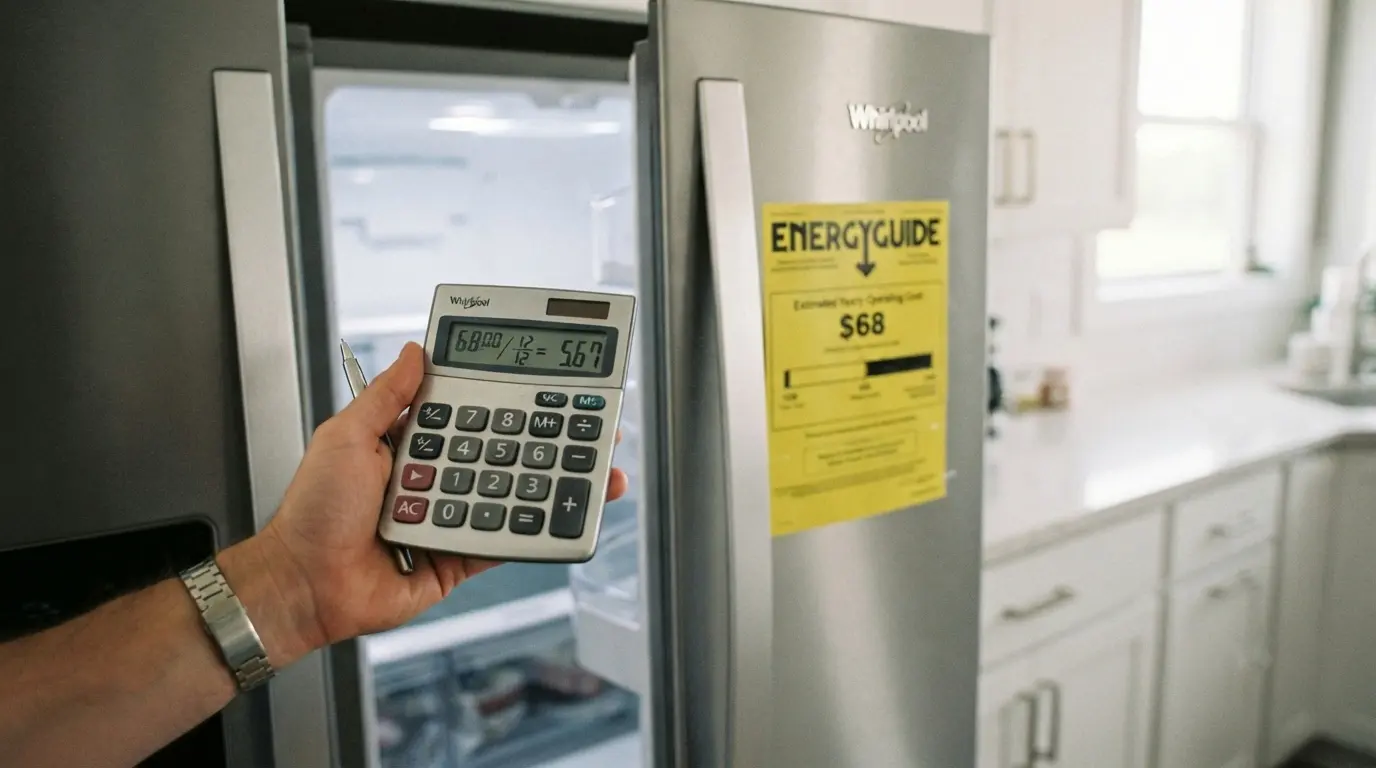
Every Energy Star sticker on a refrigerator makes the same implicit promise: buy this, save money. But after years of pulling actual utility data and helping customers compare old units to new Whirlpool Energy Star models, I can tell you the honest answer is more nuanced than the yellow tag lets on, and knowing the real math matters before you assume a new fridge will magically shrink your electric bill.
This article breaks down exactly what Whirlpool refrigerator Energy Star certification means, how the savings are actually calculated, and how to estimate what it means for your specific household: not a general buying guide, not a repair guide, just the energy math.
Table of Contents
What Energy Star Certification Actually Requires
Energy Star isn’t a marketing label a manufacturer slaps on a product; it’s a certification program jointly managed by the U.S. Environmental Protection Agency (EPA) and Department of Energy, and for refrigerators, it requires a unit to use meaningfully less energy than the federal minimum efficiency standard while still meeting performance requirements for temperature consistency and capacity.
Refrigerators are tested under standardized conditions in a controlled lab environment, measuring kilowatt-hours (kWh) consumed per year under typical usage simulation. To earn certification, a model generally needs to demonstrate consumption meaningfully below the federal baseline requirement for its size and configuration category; the exact percentage threshold has been adjusted over the years as the program has tightened standards, so a fridge certified five years ago and one certified today aren’t necessarily held to identical efficiency math.
This matters because “Energy Star certified” tells you a refrigerator is more efficient than the legal minimum; it doesn’t tell you how much more efficient compared to your specific current refrigerator, which is really the number you care about.
How Whirlpool Refrigerators Qualify
Whirlpool participates in the Energy Star program across most of its current refrigerator lineup, including French door, side-by-side, and top-freezer configurations. Not every Whirlpool model is Energy Star certified; certification depends on the specific model’s compressor technology, insulation quality, and design efficiency, so it’s worth checking the individual model rather than assuming brand-wide certification.
Newer Whirlpool refrigerators commonly achieve certification through a combination of improved compressor technology (many current models use variable-speed compressors instead of older single-speed compressors, which cycle on and off constantly and waste energy in the process) and better door seal and insulation engineering that reduces how hard the compressor has to work to maintain internal temperature.
You can verify certification for any specific Whirlpool model directly through the Energy Star product database at energystar.gov, searching by model number. This is the most reliable way to confirm a specific unit’s status rather than relying on in-store signage alone.
The EnergyGuide Label: Reading the Real Numbers
This is the part almost nobody actually reads carefully, and it’s the single most useful piece of information for estimating real savings.
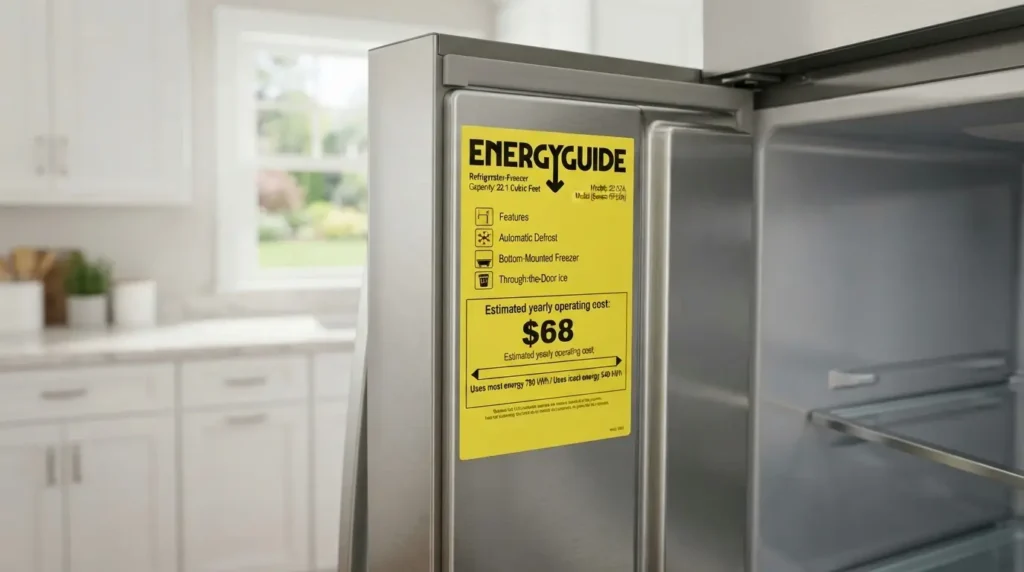
Every refrigerator sold in the U.S., Energy Star certified or not, carries a yellow EnergyGuide label required by the Federal Trade Commission. This label shows the estimated annual energy consumption in kWh per year, along with an estimated yearly operating cost based on a national average electricity rate, and critically, it shows a comparison range against similar models on the market, so you can see where a specific Whirlpool unit falls relative to its category, not just whether it’s “efficient” in the abstract.
The estimated cost on the label uses a national average electricity rate, which may not match your actual utility rate. If your local rate is higher than the national average (common in states like California, Massachusetts, or Hawaii), your real savings will be higher than the label suggests. If your rate is lower (common in states with cheaper regional power, like Washington or parts of the Midwest), your real savings will be smaller than the label implies.
Old Fridge vs. New Energy Star Fridge: Realistic Savings
Here’s where I want to be careful, because this is where marketing tends to oversell the story. The real savings you’ll see depend heavily on how old your current refrigerator is, not just whether the new one is certified.
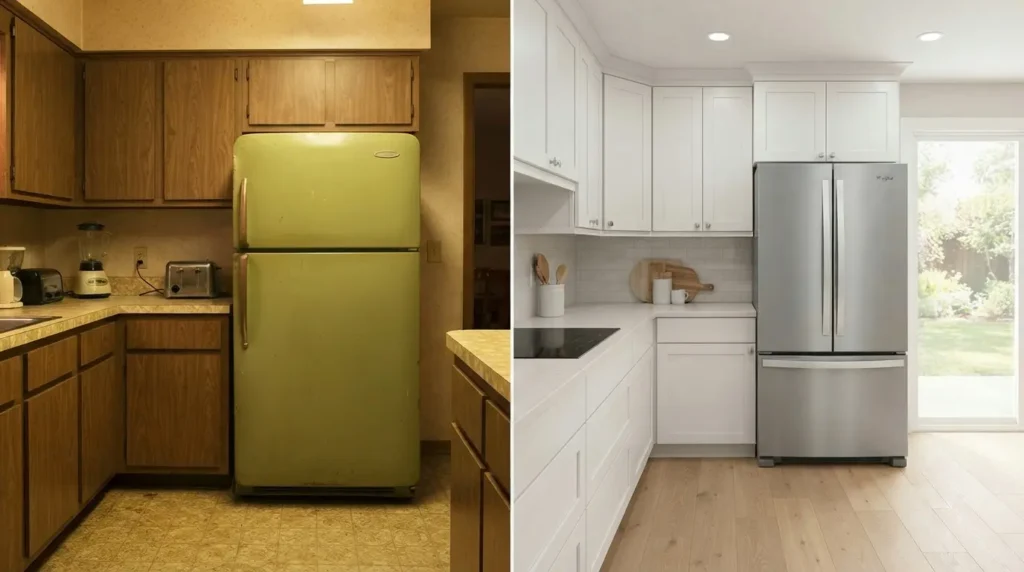
A refrigerator from the early-to-mid 2000s or older, particularly one still running its original compressor, is typically far less efficient than current standards; refrigeration technology, compressor design, and insulation materials have all improved substantially over the past two decades. Replacing a genuinely old refrigerator (15+ years) with a current Energy Star Whirlpool model often produces a real, noticeable reduction in energy consumption, sometimes cutting refrigerator-related electricity use meaningfully compared to the old unit.
However, if you’re replacing a refrigerator that’s only 5-8 years old and was already reasonably efficient when purchased, the gap between your current unit and a new Energy Star model is much smaller; the efficiency curve has flattened somewhat as the technology has matured, so recent-generation units aren’t as dramatically different from each other as very old units are from current ones.
Factors That Change Your Actual Savings
Several variables affect what you’ll actually see on your bill, and I’ve watched customers get frustrated when their savings didn’t match a salesperson’s promise because these factors weren’t accounted for:
- Refrigerator size and configuration: Larger capacity units and side-by-side configurations generally use more energy than top-freezer models of similar Energy Star status, since more interior volume and more door openings both increase compressor workload.
- Ambient kitchen temperature: A refrigerator working in a hot garage or an unair-conditioned kitchen in a warm climate works harder and uses more energy than the same model in a climate-controlled space, regardless of certification.
- Door-opening frequency: Households that open the refrigerator door frequently or leave it open longer increase compressor cycling, which affects real-world consumption differently than the standardized lab test.
- Ice maker and water dispenser use: Built-in ice makers and water dispensers add measurable energy draw beyond the base refrigeration cycle.
- Your actual electricity rate: As covered above, your local kWh rate directly scales your real dollar savings up or down from the label estimate.
When Energy Star Savings Matter Most (and When They Don’t)
If your current refrigerator is old, inefficient, or showing signs of compressor strain (running longer cycles than it used to, noticeably warm exterior sides, higher-than-expected electric bills), replacing it with a current Energy Star Whirlpool model is likely to produce real, worthwhile savings over the appliance’s lifespan, and that’s before factoring in the reduced risk of a costly breakdown from an aging compressor.
If your current refrigerator is relatively recent and already reasonably efficient, the energy savings alone probably won’t justify replacement on cost grounds; in that case, the decision to upgrade is more about features, capacity, or reliability than about the electric bill.
👉 [Read More: Signs your Whirlpool refrigerator compressor is failing]
Estimated Annual Cost Comparison Table
The figures below are illustrative ranges based on typical EnergyGuide label patterns for standard full-size refrigerators, not guaranteed figures for any specific model; always check the actual EnergyGuide label for the unit you’re considering.
| Refrigerator Age/Type | Typical Estimated Annual Energy Cost Range* |
| Pre-2001 standard refrigerator | Highest range, often well above current Energy Star models |
| 2001–2010 standard refrigerator | Moderately higher than current Energy Star models |
| Current non-certified Whirlpool model | Slightly above Energy Star certified equivalent |
| Current Energy Star-certified Whirlpool model | Lowest range within its size/configuration category |
*Actual costs vary by local electricity rate, refrigerator size, and usage patterns. Always reference the specific unit’s EnergyGuide label for accurate figures.
FAQ: Whirlpool Refrigerator Energy Star
1. Does Energy Star certification mean a Whirlpool refrigerator will pay for itself in energy savings?
Not always, and not quickly. For an old, inefficient refrigerator, savings can be meaningful over time; for a recent, already-efficient unit, the payback period may exceed the appliance’s practical lifespan.
2. Are all Whirlpool refrigerators Energy Star certified?
No. Certification depends on the specific model’s compressor and design, so it’s worth confirming certification status for the exact model you’re considering rather than assuming brand-wide qualification.
3. Where can I verify if my specific Whirlpool model is Energy Star certified?
The Energy Star product database at energystar.gov allows you to search by brand and model number for official certification status.
4. Does a bigger Whirlpool refrigerator always use more energy than a smaller one?
Generally yes, all else being equal, since more interior volume requires more cooling capacity, but configuration (side-by-side vs. top-freezer, for example) also affects consumption independent of pure size.
5. Does the EnergyGuide label cost estimate match my actual electric bill?
Not exactly, it’s based on a national average electricity rate, so your real cost will be higher or lower depending on your local utility rate.
6. Do ice makers and water dispensers significantly increase energy use?
They add measurable draw beyond base refrigeration, though the exact impact varies by model and how frequently the ice maker cycles.
7. Is it worth replacing a 6-year-old refrigerator with a new Energy Star model just for energy savings?
Usually not on energy savings alone, the efficiency gap between recent-generation units is much smaller than between old and new technology, so replacement in that case is typically better justified by other factors.
Final Word
Energy Star certification on a Whirlpool refrigerator is a real, EPA-verified signal of efficiency, but “how much you’ll save” depends entirely on what you’re replacing, your local electricity rate, and how you use the appliance day to day. Read the actual EnergyGuide label for any model you’re considering, and compare it honestly against your current refrigerator’s age and condition before assuming the savings will be dramatic.
Curious whether your current refrigerator is costing you more than it should?
👉 [Read More: How to tell if your Whirlpool refrigerator is running inefficiently