
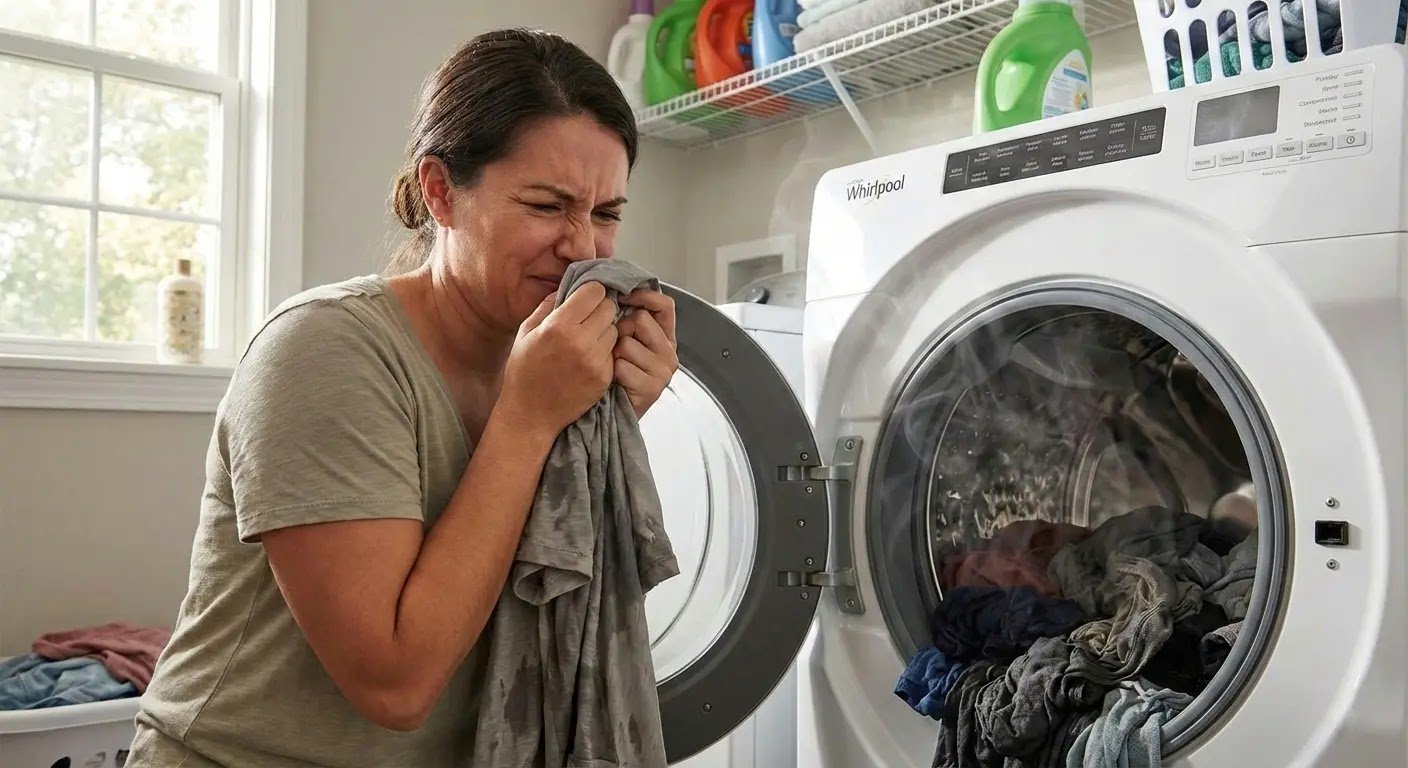
If your Whirlpool washer smells bad and started smelling like a swamp or literal sewage, you aren’t alone. Modern High-Efficiency (HE) machines are effective at saving water. Still, they have a hidden hygiene paradox: because they use less water and operate at cooler temperatures, they often fail to flush out waxy residues that cause foul odors.
This guide combines official Whirlpool maintenance guidance with real-world technician habits to get your machine back to a factory-fresh scent.
Table of Contents
⚠️ Before You Start: One Rule That Matters More Than Any Other
You’re about to see bleach used in several steps below and vinegar in others. Never combine bleach and vinegar in the same step or back-to-back without a full rinse in between; mixing them produces chlorine gas, which is toxic and can be fatal in an enclosed space like a laundry room. Use one or the other for any given cleaning session, and make sure the machine has run a full rinse cycle before switching from one to the other.
The Science of the Stink: What Is Scrud?
Technicians call the gunk inside your machine “scrud” or “biofilm.” This is a biologically active layer of bacteria and mold that feeds on liquid fabric softener and undissolved detergent.
In Whirlpool front-loaders, this sludge often hides behind the drum or in the spider bracket, where it stays perpetually damp. Over time, this buildup undergoes anaerobic decomposition, releasing the sulfurous sewage smell that users often complain about.
👉 [Washing Machine Gasket Mold? The Bleach Soak & Pro Fix.]

Model-Specific Deep Clean Solutions
While a basic cleaning cycle helps, different Whirlpool models have different blind spots that require a unique approach.
1. For Front-Load Washers: Gasket and Filter Focus
Front-load models are prone to mold because the airtight rubber door seal (the gasket) traps moisture.
- The Bleach-Rag Hack: Pull back the rubber folds to find trapped hair, lint, and stagnant water. If you see stubborn black spots, soak old rags in a 50/50 bleach-water solution, stuff them into the gasket folds, and let them sit for 30–60 minutes.
- Drain the Pump Filter: If the smell is sewer-like, the pump filter (usually behind a panel at the bottom front) is likely clogged with rotting debris. Unscrew it slowly; expect 1–2 cups of smelly water to pour out, and rinse the filter under a tap.
- Freshness Tech: If your model has the FreshFlow™ Vent System, always select the Dry Drum Cycle after your laundry is done to automatically dry the drum and gasket.

2. For Top-Load Washers: Agitator and Tub Soaking
Top-load odors often stem from keeping the lid closed, which traps moisture in the fabric softener dispenser or the tub.
- Agitator Cap Scrub: If your machine has a central agitator, gently pull or twist off the removable cap. Use an old toothbrush to scrub the interior where mold frequently hides.
- The 30-Minute Bleach Agitation: Fill the tub with hot water and add 1 cup of liquid chlorine bleach. Let it agitate for a few minutes, then pause the cycle and soak for 30 minutes before finishing.
- Removable Agitator Maintenance: For 2-in-1 models, remove the agitator periodically to clean the impeller wash plate beneath it.
👉 [Whirlpool Washing Machine Making Loud Noise? 5 Sounds That Mean Danger]

Step-by-Step Maintenance Protocol
Step 1: The Nuke Cycle (Drum Sanitization)
Place one Affresh® tablet (or 1 cup of liquid chlorine bleach) directly in the drum. Run the clean washer cycle. If your model doesn’t have this option, use the Sanitize or Heavy Duty setting with the hottest water available.
Insider note: don’t interrupt this cycle once it starts. Whirlpool’s own guidance is specific about this: if you need to stop it partway through, press Power rather than opening the door and start it fresh rather than resuming. An interrupted clean cycle can leave cleaner or bleach sitting in the drum without properly rinsing, which defeats the purpose and can leave residue on the next load.
Step 2: Detergent Drawer & Ceiling
Remove the drawer and soak it in warm, soapy water. Use a brush to scrub the ceiling of the dispenser cavity where black mold grows on the water spray nozzles.
If your model uses a Load & Go™ bulk dispenser instead of (or in addition to) a traditional drawer, don’t skip it; this is a blind spot the traditional drawer advice above doesn’t cover. These dispensers hold enough detergent for 20 to 40 loads, which means they can go a long time without being opened or rinsed. Whirlpool’s own guidance recommends rinsing the Load & Go container out whenever you refill it, switch detergent types, or if the washer sits unused for an extended period, all of which are easy to forget, specifically because the dispenser is designed to be low-maintenance.
👉 [Whirlpool vs. Mini Washers: 2026 Laundry Tech Audit]

Daily Habits to prevent the Whirlpool washer smell bad
| Habit | Why it Works |
| Leave Lid/Door Ajar | Allows moisture to evaporate, preventing mold growth |
| Switch to Powder | Powders often contain oxygen bleach and leave less scrub than liquids |
| Use Vinegar as a Softener | Softener is mold food. Vinegar acts as a natural descaler without the waxy residue |
| Hot Wash Weekly | Helps melt away surfactant film that cold water can’t dissolve |

Regional Advice: Hard Water (Pakistan & India)
In regions with high mineral content (e.g., Punjab, Sindh), limescale acts like Velcro for mold.
- Monthly Descaling: Use dedicated descalers like Calgon or Dr. Beckmann (widely available on Daraz for this region) to protect your machine’s heating element.
- Borax Hack: Adding 1/2 cup of borax to your loads helps soften water and acts as a natural antifungal.
Insider note when cleaning stops working: if you’ve run the Nuke Cycle, cleaned the gasket, drained the pump filter, and the smell is still there or comes back within days, that’s usually a sign it’s migrated past what’s reachable inside the machine, into the drain hose or the household standpipe it connects to. No amount of Affresh or bleach inside the drum will fix a smell that’s actually coming from the drain line itself; that’s worth investigating separately rather than repeating the same cleaning steps and expecting a different result.
👉 [Washer Cleaner Not Working? The Biofilm Secret]
Frequently Asked Questions (FAQs)
How often should I deep clean?
Whirlpool recommends every 30 cycles or once a month, whichever comes first for your household’s laundry volume.
Can I use dishwasher pods to clean my washer?
No. Dishwasher tablets require higher temperatures and can cause excessive foam or clumping, which worsens buildup instead of clearing it.
Is vinegar safe for my washer?
Technicians generally consider vinegar safe when diluted (around a 0.4% concentration), but Whirlpool warns that excessive or undiluted use over time could damage specific rubber components.
Can I mix bleach and vinegar?
Never; see the safety note at the top of this guide. Mixing them creates toxic chlorine gas, which is fatal.
Does Affresh actually work better than plain bleach?
They target slightly different things. Bleach is stronger against mold and bacteria in a single pass; Affresh is formulated to break down the mineral and detergent scale that bleach alone doesn’t dissolve as well. Alternating between them month to month, rather than always reaching for the same one, tends to cover more of what actually builds up.
Why does my washer still smell bad right after I just ran a wash cycle?
This usually means the odor source isn’t inside the drum where your clothes sit; it’s in the gasket folds, the pump filter, or the dispenser, none of which get a deep clean during a normal wash. A regular cycle moves water past these spots without actually cleaning them.
Will a smelly washer make my clean laundry smell too?
Yes, and this is often the first sign something’s wrong before the smell becomes obvious with the door closed. If clothes come out with a musty or sour smell even though they went in clean, that’s the washer transferring odor during the wash rather than removing it.
Final Summary Checklist
- Daily: Leave the door/lid open and remove wet clothes promptly.
- Monthly: Run the Clean Washer cycle with Affresh or bleach; don’t interrupt it once started.
- Quarterly: Clean the drain pump filter, detergent drawer housing, and Load & Go dispenser if your model has one.
- Always: Use HE-rated detergent and avoid overdosing.
Still smelling something off after working through this checklist? Tell me your model and where the smell is strongest (drum, gasket, or drain) in the comments, and I’ll help you narrow down what’s left to check.