
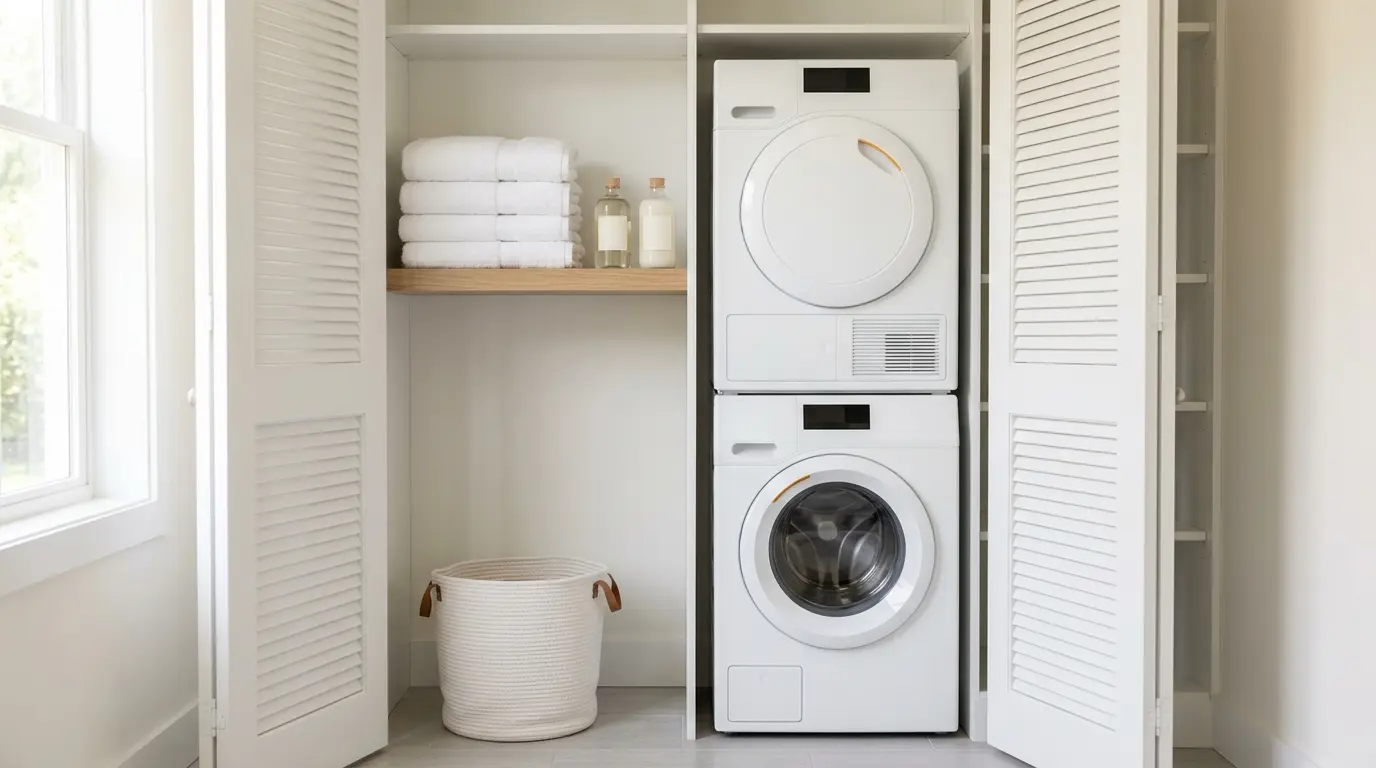
A 24-inch washer that can sit under a dryer, takes a 240-volt connection, and holds 2.2 cubic feet is a very different purchase from a full-size 120-volt machine. This Bosch 800 Series WAW285H2UC review goes through the published specifications and Bosch’s own manual to show who this compact washer suits, what it asks of your laundry space, and what to confirm before you buy.
This review is based on manufacturer documents, ENERGY STAR-related listings, and retailer pages. It does not claim hands-on testing. Where published sources disagree, the article says so.
Table of Contents
Which Bosch Is This? The 800 Series and 500 Series Naming
Bosch’s spec sheet and its support page both list the WAW285H2UC as the 800 Series 24-inch compact washer with Home Connect. 👉 Bosch WAW285H2UC spec sheet and Bosch WAW285H2UC support page
The name matters because Bosch also sells a 500 Series compact washer, the WAW285H1UC. It shares many numbers with this one, including capacity, size, spin speed, and the listed energy and water use. It is a different model, though. According to Bosch’s sheet for the H1UC, the differences are:
| Feature | WAW285H2UC (800 Series) | WAW285H1UC (500 Series) |
| Interior light | Yes (LED) | No |
| Leak protection | AquaStop Plus (AquaStop base plus AquaShield hose) | AquaShield hose only |
| Wash noise (Bosch rating) | 50 dBA | 51 dBA |
| Spin noise (Bosch rating) | 71 dBA | 71 dBA |
| Door ring | Not specified here | Silver |
| ENERGY STAR Most efficient claim | Not made on its sheet | Stated by Bosch (2023) |
This review covers only the H2UC. If a listing, article or comment mixes the two, check the full model number. Anything said about the H1UC’s efficiency designation does not transfer to this washer.
Bosch 800 Series WAW285H2UC Specs at a Glance
| Spec | Published detail |
| Type | 24-inch compact front-load washer, stackable |
| Capacity | 2.2 cu ft; the drum holds 17.6 lb (8 kg) of regular cotton. |
| Tub | Stainless steel |
| Maximum spin | 1,400 rpm |
| Heating | Internal water heater |
| Programs / options | 14 programs, 10 options |
| Connectivity | Wi-Fi via Home Connect |
| Interior light | LED |
| Size | 33 1/4″ H x 23 1/2″ W x 25″ D |
| Weight | 164 lbs net per Bosch’s sheet |
| Electrical | 208/220-240 V, 60 Hz, 10.5 A, 2,520 W |
| Listed energy / water use | 84 kWh/yr; 2,379 gal/yr |
| Door | Left-hinged, not reversible |
On weight, the manual calls the 164 lb figure approximate gross, while two retailer pages list 160 lbs. If you are planning a stair carry or a delivery crew, treat it as roughly 160 to 165 lbs and confirm with the seller.
Capacity: Who It Fits and Who It Doesn’t
2.2 cubic feet is the compact class. Bosch’s manual gives the drum load as 17.6 lb (8 kg) of regular cotton. Some program limits are lower: SuperQuick 15 is rated for a quarter load and Sanitize for a half load.
Some typical scenarios:
- One or two people in an apartment or condo. A 24-inch footprint fits a closet or a stacked column where a full-size pair will not. Weekly loads of clothes, towels, and a set of sheets are within the stated drum limit, though the sheet-and-towel combination may need splitting.
- A small family doing frequent loads. This works if you are happy to run the washer more often. Bulky items such as comforters may be limited by the drum, so check the manual’s Bulky/Large Items guidance for your item.
- A larger household doing a weekly marathon. This is where a compact washer typically becomes a chore. If your pile regularly fills a full-size drum several times over, a compact machine means more cycles and more time.
- A second washer for a basement, guest suite, or secondary laundry area. The compact size is an advantage here, as long as the electrical and water connections are available.
A question worth asking before buying is how many loads you realistically do per week and how big your largest single item is. Many buyers compare cubic feet without thinking about bulky bedding, which usually decides whether a compact washer is workable.
Programs, Options, and Speed Perfect
According to Bosch’s manual, the dial offers Cotton, Towels, Whitest Whites, Sanitize, Hand Wash/Wool, Bulky/Large Items, Drum Clean, Spin/Drain, Rinse, Quick 30, SuperQuick 15, Delicates, Perm Press Heavy Soil, and Permanent Press. Bosch WAW285H2UC Use and Care Manual
Available options include EcoPerfect, Prewash, Rinse Plus, Remote Start, Finish in (delay of up to 24 hours), Spin Speed, Temperature, SpeedPerfect, and Stains. The Stains option offers settings for oils/food, blood, red wine, and grass.
Two points about these are easy to miss.
SpeedPerfect has a stated basis. Bosch says it can wash up to 40% faster, measured against the Perm Press Heavy Soil cycle run without SpeedPerfect. That is a comparison with one specific cycle, not a general speed-up across all programs. Treat it as a ceiling for that situation.
Quick cycles are short by name. The manual describes Quick 30 as about 30 minutes and SuperQuick 15 as about 15 minutes. Quick cycles typically suit lightly soiled, small loads. The quarter-load limit on SuperQuick 15 is a real constraint.
No independent wash performance or lab test results were verified for this review, so claims about stain removal or cleaning scores are left out.
Water and Energy Figures, and What They Leave Out
Bosch’s spec sheet lists 84 kWh/yr of energy use and 2,379 gal/yr of water use, and lists the washer as ENERGY STAR certified. Consumer Reports’ product page also shows it as ENERGY STAR qualified. Consumer Reports, Bosch 800 Series WAW285H2UC
Three cautions apply when reading those numbers:
- The test basis isn’t stated. The sheet does not say how many cycles per year the figures assume. Compare them only with other washers rated on the same basis.
- Wi-Fi changes the picture. Per the manual, with Wi-Fi turned on the automatic switch-off is disabled, and Bosch says energy consumption increases. If the listed figure matters to you, it is worth knowing it may not reflect an always-connected setup.
- The efficiency data in a utility rebate list is for a different model. A rebate list from PSEG Long Island shows the 500 Series WAW285H1UC with an IMEF of 2.2, 84 kWh/yr, and an IWF of 3.7 (qualified 7/31/2020). That entry is for the H1UC, not the H2UC, so don’t apply its IMEF and IWF values to this washer without checking the listing for the H2UC itself.
Bosch also does not make an ENERGY STAR Most Efficient claim for the H2UC on its sheet, so avoid repeating that designation for this model.
Noise and Spin Speed
Bosch rates this washer at 50 dBA while washing and 71 dBA while spinning. One retailer page (Ferguson) lists a wash figure of 60 dB, which is a conflict with Bosch. The manufacturer’s number is the one used here, but a gap that size is worth being aware of if the washer will sit near bedrooms or an open-plan living area.
A decibel number on a spec sheet does not capture everything:
- Spin is the louder phase, and the maximum spin speed is 1,400 rpm. High spin speed typically extracts more water, which may shorten drying time, but it also adds vibration and noise during that phase.
- Vibration depends on the floor and the leveling as well as the machine. A compact washer on a wood-framed upper floor can behave differently from one on a slab.
- The spin speed option lets you lower the spin speed, which is the obvious lever if noise matters more than extraction.
Leak Protection: AquaStop Plus
Bosch describes AquaStop Plus as the AquaStop base plus the AquaShield hose, confirmed in both the spec sheet and the manual. This is specific to the H2UC; the 500 Series H1UC has the AquaShield hose only.
The manual adds a point that matters at installation. Use the new AquaShield hoses shipped with the washer, and do not reuse old hoses. Third-party accessories and hoses are also excluded from warranty coverage. Leak protection depends on the specific hose system, so swapping in a generic hose may undermine the feature you paid for.
For a washer in a closet, upstairs unit, or finished space, this is arguably the strongest practical reason to choose the 800 Series over the H1UC. That is a reading of the feature list, not a performance claim.
Installation Requirements to Check Before Buying
Compact washers are often chosen for tight spaces, so installation is where this model can go wrong. According to Bosch, the washer needs:
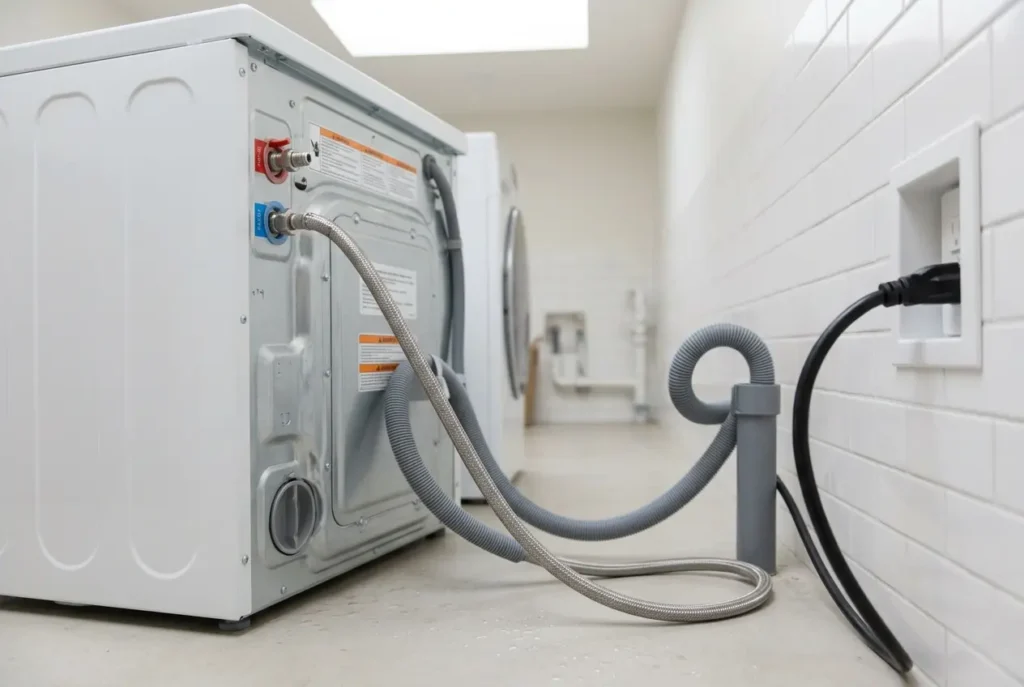
| Requirement | Published detail |
| Voltage | 208/220-240 V, 60 Hz |
| Circuit | Individual branch circuit: 15 A breaker if on an individual 208/240 V, 15 A minimum branch circuit |
| Cord | Included NEMA 6-15 3-prong cord, 63″ long |
| Extension cords | Do not use |
| Grounding | Must be grounded; GFCI recommended |
| Water supply | Maximum 140 °F (60 °C); 14.5 to 145 psi; at least 2.2 US gal/min |
| Drain | Drain point at most 39 in above the floor; drain hose 57″, inlet hose 48″. |
| Clearances | Sides about 0.6 in.; top 6.3 in.; rear 2.5 in.; front 2.4 in.; ventilation 63 sq in. top and bottom |
A few of these deserve explanation:
- This is a 240-volt design. A buyer replacing a 120-volt washer may find the outlet does not match. The accessory list includes power adapters WTZPA20UC (4-prong) and WTZPA30US (3-prong), and the right choice depends on your outlet. Have an electrician confirm what you have before you order.
- The cord length is 63 inches per Bosch. One retailer lists 69 inches, so use Bosch’s figure when measuring the distance to the outlet.
- Door-open depth is 42.5 in at 90 degrees. The door opens 180 degrees, which helps loading in tight spots, but you need clear floor space in front.
- Transport bolts must come out. The manual says to remove all four before first use, then run the Drum Clean program with no laundry, adding 1 to 2 tablespoons of detergent first.

- Original Bosch power adapter for electric dryers
- Converts NEMA 14-30P outlet to NEMA 10-30R appliance plug
- Designed for Bosch and Thermador dryers only
Stacking, Pedestal, and Door Swing
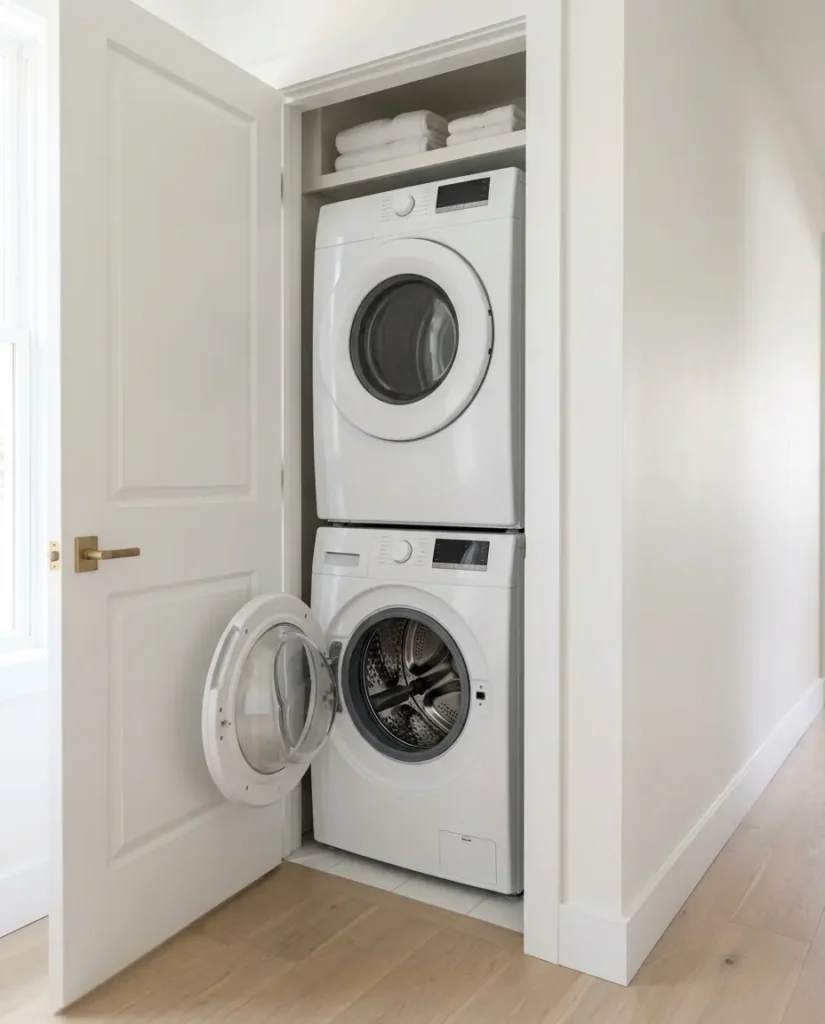
The washer is stackable, but with limits. According to the manual, only a Bosch dryer of the same dimensions should go on top, using the kit named in the dryer’s manual. Do not stack the washer on a dryer or on another washer. The accessory list names two stacking kits, WTZ11400UC and WTZ20410UC, and the extracted text does not clearly say which includes a shelf, so confirm with your dryer’s manual or Bosch before ordering. The minimum stack height is listed as 67 3/4 inches, which matters for closet ceilings.
The door is left-hinged and not reversible, confirmed by the sheet and the manual. In a laundry closet where the door swings toward a wall, that is a layout decision you make before you buy, not after.
Home Connect and the Wi-Fi Trade-Off
Home Connect adds app control over Wi-Fi. Per the manual, Remote Start works only with the door closed and the washer on your home network.
The trade-off is that enabling Wi-Fi disables the automatic switch-off and, according to Bosch, increases energy consumption. For someone who values remote starts, that may be an acceptable cost. For someone chasing the lowest energy use, leaving Wi-Fi off keeps the washer closer to the listed figure. It is a feature that sounds more useful in marketing than it often is in a compact laundry setup where you are usually home to press Start.
Warranty and Cost of Ownership
Bosch’s US/Canada warranty, as written in the manual:
- 365 days from original purchase
- 30 days for cosmetic defects
- 730 days for printed circuit boards and the drive motor, parts only (labor excluded)
- Service must be by an authorized provider
- Coverage is for the first purchaser only, is not transferable and applies to household use
The one-year term is confirmed by both the manual and Consumer Reports. The two-year parts-only item appears only in the manual.
This changes the ownership math. The two-year coverage on the circuit board and drive motor excludes labor, so a repair after year one could still carry a service bill. Beyond the purchase, plan for:
- Electrical work. If your space lacks a suitable 208/240 V circuit, an electrician’s visit is part of the real cost.
- Accessories. A pedestal, stacking kit or power adapter is a separate purchase.
- Energy and water. The listed 84 kWh/yr and 2,379 gal/yr give a rough guide, with the caveats above.
- Service access. Warranty service must go through an authorized provider, so check who services Bosch near you.
Check current prices at your retailer, as they change frequently.
Buying a Discontinued Model
Ferguson and Designer Appliances both list the WAW285H2UC as discontinued. Designer Appliances names the WGB246AXUC as the newer model, which is a single-source claim, so verify it before relying on it.
If you find one, read the details carefully:
- Because the warranty is first-purchaser only and not transferable, a used machine may have no manufacturer coverage. For open-box or floor stock, ask the seller in writing what warranty applies.
- Ask whether it ships with the new AquaShield hoses and the transport bolts. The manual says to use the new hoses that come with the washer.
- Availability of parts for a discontinued model is not documented in the materials reviewed here. Ask a local authorized service provider before you buy.
Pros and Trade-Offs
Pros (from published specs):
- Compact 24-inch footprint with stackable design
- 1,400 rpm maximum spin
- Internal water heater and stainless steel tub
- AquaStop Plus leak protection and an LED interior light
- 14 programs and 10 options, including quick cycles
Trade-offs:
- 2.2 cu ft capacity is small for large households or bulky bedding
- 208/220-240 V electrical needs, which may require a new circuit or adapter
- Door is left-hinged and not reversible
- Wi-Fi use disables auto switch-off and raises energy use, per Bosch
- Reported discontinued, so supply, parts and warranty need checking
- 2-year coverage is parts only, with labor excluded
FAQ
1. Is the WAW285H2UC a 500 Series washer?
No. Bosch lists it as the 800 Series. The 500 Series compact washer is the WAW285H1UC, a different model.
2. How much laundry does it hold?
The capacity is 2.2 cu ft. Bosch’s manual gives the drum load as 17.6 lb (8 kg) of regular cotton, with lower limits on some programs, including a quarter load for SuperQuick 15 and a half load for Sanitize.
3. Does it need a special outlet?
It is rated 208/220-240 V at 60 Hz and 10.5 A. The included cord is NEMA 6-15 and 3-prong, and Bosch lists adapters for 4-prong and 3-prong connections. Bosch says to use an individual branch circuit and no extension cord. Have an electrician confirm your setup.
4. Can I stack a dryer on it?
Yes, but only a Bosch dryer of the same dimensions, using the kit named in that dryer’s manual. Do not stack it on a dryer or another washer.
5. Can I change the door swing?
No. The door is left-hinged and not reversible, according to both the spec sheet and the manual.
6. Is it ENERGY STAR certified?
Bosch lists it as ENERGY STAR certified at 84 kWh/yr and 2,379 gal/yr, and Consumer Reports lists it as ENERGY STAR qualified. Bosch makes the ENERGY STAR Most Efficient claim only for the H1UC.
7. What detergent and bleach should I use?
Bosch recommends HE detergent. The manual says not to use chlorine bleach or color-safe bleach, and states that oxygen-based bleach is safe. Detergent pods go in the bottom of the drum, not the dispenser.
Verdict
The Bosch 800 Series WAW285H2UC suits a specific buyer: someone with limited floor space, a 240-volt connection (or an electrician to provide one), a modest laundry volume and a plan to stack a matching Bosch dryer. For that buyer, the published specs point to a well-featured compact washer, with leak protection and an interior light that set it apart from the H1UC.
It is a poorer fit for households that wash bulky loads or high volumes, for anyone who needs a reversible door, and for anyone who cannot confirm service and parts for a model that retailers report as discontinued.
Before you commit, confirm four things: your outlet and circuit, your door clearance, the warranty terms the seller will honor and how many loads you actually run each week. If all four line up, it is worth a close look.