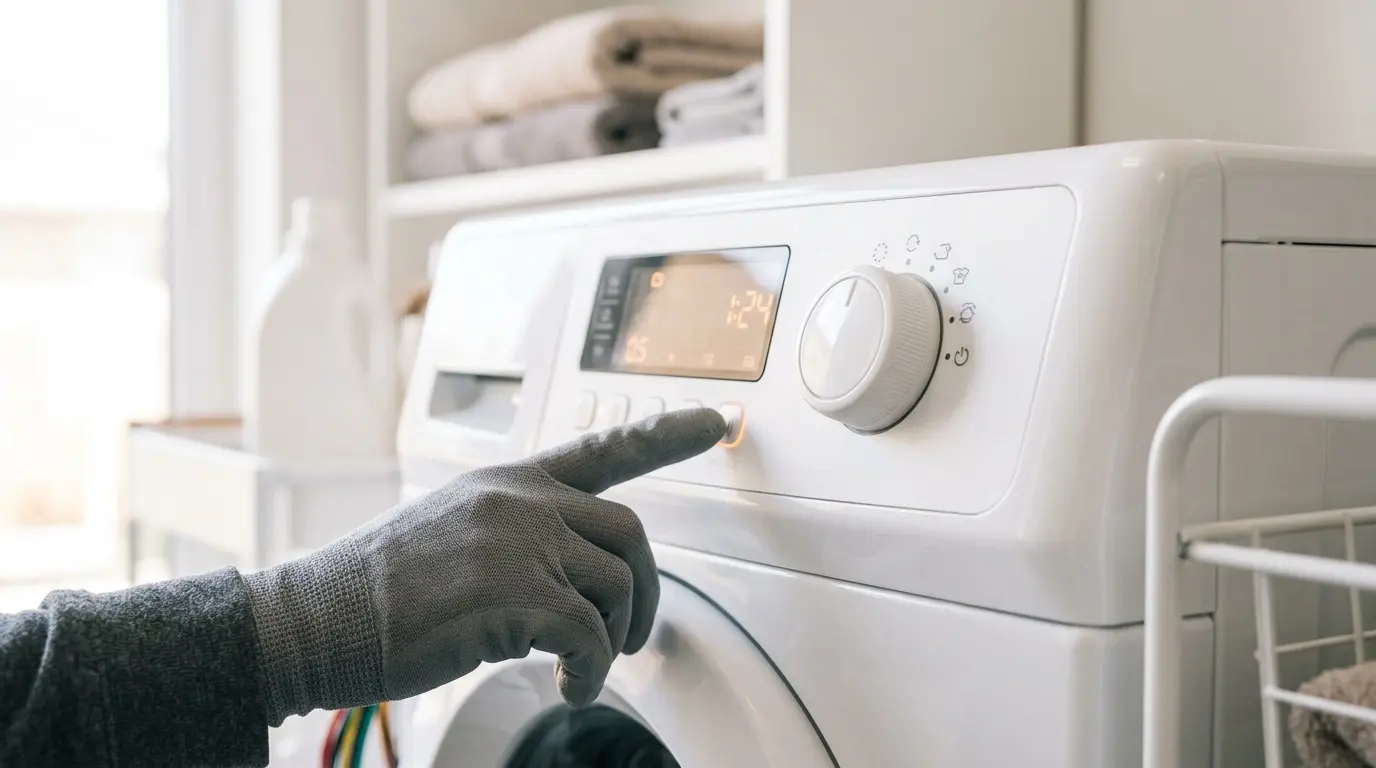
A code on your Frigidaire’s display isn’t a verdict. It’s a pointer, and most people buy the wrong part because they read it as a diagnosis. This Frigidaire washer error code guide explains what each code family tells you, and just as importantly, what it doesn’t.
Frigidaire is an Electrolux brand, and its code formats have shifted across generations. Many front-loaders show E-codes, some older machines use F-prefixed codes, and top-loaders like the FFTW series can differ again. I’ve grouped everything by code family, because the logic holds even when the exact digits change. Always confirm your specific number against your model’s manual.
Table of Contents
How Frigidaire washer error codes are built
The control board doesn’t understand your washer the way you do. It watches sensors and a clock. When a sensor reading falls outside its expected range, or something it expects to happen doesn’t happen in time, it throws a code.
That second type matters most. A large share of codes are timeouts: water didn’t fill in time, didn’t drain in time, or the door didn’t confirm locked in time. A timeout tells you that something failed to happen, not what stopped it. A drain timeout can come from a dead pump, but it’s just as often a clogged filter or a kinked hose, and the board can’t tell those apart.
The tens digit usually groups the system: the 10s for water in, the 20s for water out, and so on up the range. That grouping is what the sections below follow.
Fill codes (the E10 family)
A fill code means the board expected the water level to rise within a set time, and it didn’t. The washer is telling you water isn’t arriving fast enough, or the level sensor isn’t reporting that it did.
The usual suspects are the ones outside the machine: a tap that’s only partly open, a kinked hose behind the washer, clogged inlet screens, or low household pressure. Homes on well water or recently disturbed plumbing show this more than most. If none of that fits, the inlet valve that opens for each fill is the next candidate.
Quick check: Start a cycle and listen. If you hear no water entering at all, the problem is on the supply side. If water is clearly running and the code still appears, the level sensor isn’t seeing it, which points to the family below.
For the full walkthrough, see [Frigidaire washer E10 fill error fix: inlet screens and water inlet valve].

Frigidaire Washer Error Code Drain Codes (the E20 family)
This is the code homeowners meet most often and the one most often misdiagnosed. It means the water level didn’t drop within the allowed time.
Almost everyone assumes the drain pump has failed. In the field it’s far more often something upstream of the pump: a filter packed with lint and coins, a drain hose that’s kinked behind the machine, a standpipe set too high, or a household drain that’s backing up. The pump gets blamed because it’s the only part people know exists.
Quick check: With water sitting in the drum, listen while the washer tries to drain. A humming pump that moves no water suggests a blockage. Complete silence suggests the pump isn’t getting power or has failed electrically. That one distinction saves a lot of guessing.
Blockage or pump: the fix path is in [Frigidaire washer E20 drain error: drain pump filter, hose, and pump check].
Water level and sensor codes (the E30 family)
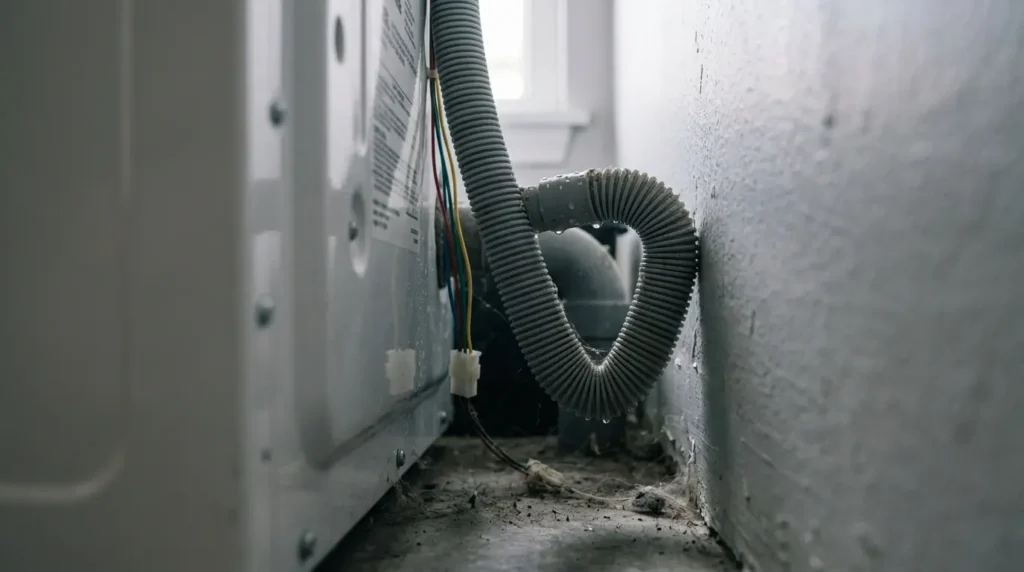
Front-loaders measure water level with a pressure sensor connected to the tub by a thin air tube. As water rises, it compresses the air in the tube, and the sensor reads that pressure. It’s elegant, and it’s also fragile in one specific way: anything that disturbs the tube or the air inside it produces false readings.
A pinched, loose, or soap-clogged tube is a common cause, and so is the sensor itself. The part most guides skip is that oversudsing fools this system.
| INSIDER TIP: OVERSUDING FOOLS THE LEVEL SENSOR. Excess foam in the tub changes what the sensor sees, and the board reads it as a level fault. I’ve watched owners replace a perfectly good sensor after a week of using too much detergent. |
Quick check: Look in the drum after the code appears. Heavy foam or a slick residue is your first clue. A clean, normally filled tub sends suspicion back to the tube or sensor.
If you suspect the sensor side, [Frigidaire washer water level sensor error: pressure switch and air tube check] covers how to separate the two.
Door lock and latch codes (the E40 family)
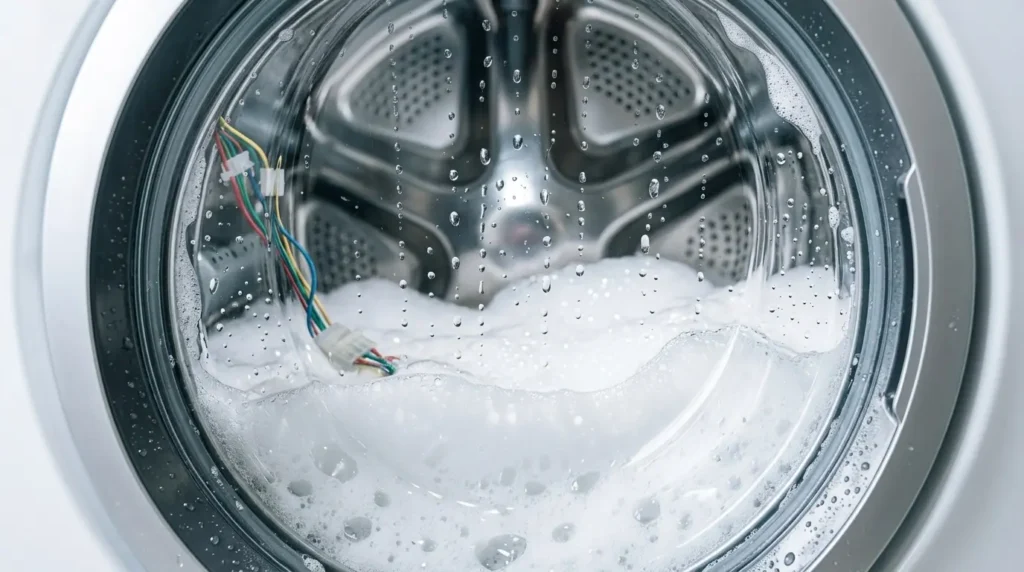
Before the washer fills, the board wants confirmation the door is closed and locked. Lose that signal, or never get it, and you get a code in this family.
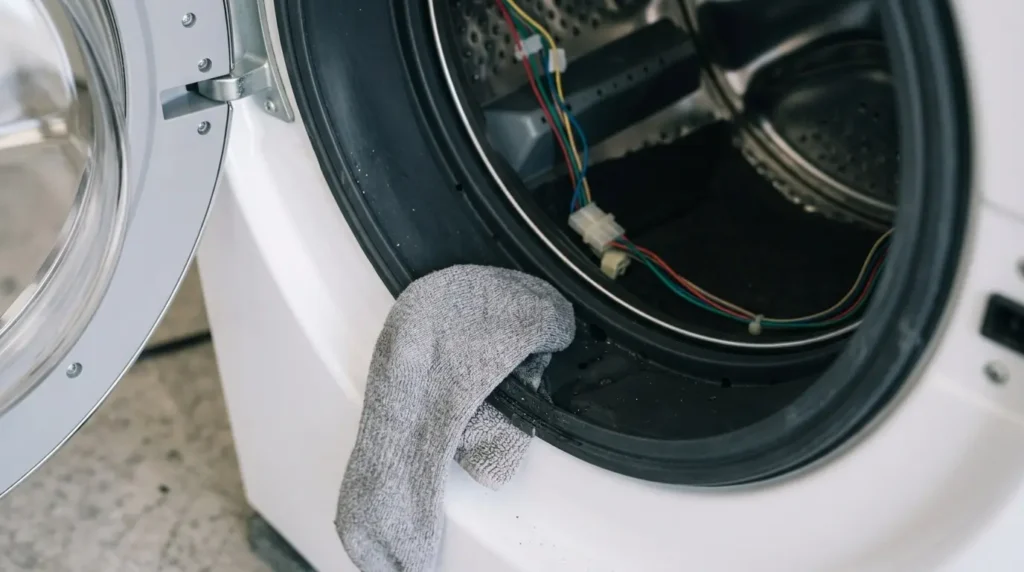
The obvious suspect is the lock assembly, and sometimes it is the culprit. But a surprising number of these codes come from the door not seating properly: a sock pinched in the gasket, a drum so overstuffed the door barely latches, or a worn strike that no longer lines up with the lock. The lock gets condemned when the door is simply never closing cleanly.
Quick check: Close the door and listen for a firm click. Then try to pull it open before starting. A door that clicks but feels loose, or one that needs a hard push to catch, is telling you it’s a mechanical alignment problem rather than an electrical one.
If the door itself checks out, continue with [Frigidaire washer door lock error: how to test the lock assembly].
Motor and drive codes (the E50 family)
Here the board commands the motor to spin and then watches feedback, usually from a tachometer or Hall sensor, to confirm the drum is actually turning at the right speed. If the commanded and measured speeds don’t agree, you get a motor-family code.
Causes range from the mundane to the expensive: a heavily unbalanced or overloaded drum that the motor can’t accelerate, a loose wiring connector, a worn motor, or the motor control board itself. That spread is exactly why this family deserves caution before you spend money.
Quick check: Note whether the code appears only with big, bulky loads or with any load. A code that shows up only on heavy comforters suggests load-related strain. A code on an empty drum suggests hardware.
| INSIDER TIP: REPAIR OR REPLACE? This is where I have the money conversation with customers. On a machine past roughly eight to ten years, a motor or board diagnosis, plus parts and labor, can approach the price of a comparable new washer. On a machine a few years old, the same code is usually worth chasing. The washer’s age and the code’s family together decide it, not either one alone. |
For the component-level breakdown, see [Frigidaire washer motor error: motor vs. motor control board diagnosis].
Control board and communication codes
Codes at the high end of the range on many models point to the electronics: the board’s memory or communication between the main board and the user interface board. These are the codes people fear most, because “bad board” is the assumption.
It’s rarely the first answer. Power events, a surge, or a brief brownout can leave a board confused, and a full power reset clears many of these one-off events. A code that vanishes after a reset and stays gone was never a failing board.
What technicians look at before touching anything
Every technician has a short list they run before opening a panel, and none of it needs tools:
- When did the code appear? At power-on, at the start of the fill, mid-cycle, or during the final spin? The timing narrows the system faster than the number does.
- Does it return after a power reset? Unplug the washer for a few minutes, plug it back in, and run it again. A code that returns immediately is real. One that doesn’t was likely a glitch.
- What was in the drum? Load size and type explain more motor and door codes than most people expect.
- Was the last week of washing different? This is the question customers never think of, and it’s the best one I ask. Slower draining, longer fills, or a louder spin in the days before the code usually mean the machine has been declining gradually, and the code is the last step, not the first symptom.
Frigidaire washer error code families at a glance
| Code family | What the board is reporting | Most common cause | Often misdiagnosed as |
| E10 (fill) | Water didn’t arrive in time. | Partly closed tap, kinked hose, clogged inlet screens | A failed inlet valve |
| E20 (drain) | Water didn’t leave in time. | Clogged filter or kinked drain hose | A failed drain pump |
| E30 (level/sensor) | Level reading out of range | Oversized, blocked, or loose air tube | A bad pressure sensor |
| E40 (door) | Lock not confirmed | Door not seating, worn strike | A failed lock assembly |
| E50 (motor) | Drum speed doesn’t match command. | Overloaded or unbalanced drum, loose connector | A failed motor |
| Higher-range (electronics) | Board or communication fault | Power glitch, then possibly the board | A failed control board |
FAQ: Frigidaire Washer Error Code
1. Do Frigidaire E-codes and F-codes mean the same thing?
Not necessarily. Formats and numbering differ between generations, and top-loaders can differ from front-loaders. The family logic (water in, water out, level, door, motor, electronics) carries across, but confirm exact meanings in your model’s manual.
2. Can I clear a Frigidaire washer error code by resetting it?
Unplugging the washer for a few minutes and restarting can clear a one-time glitch. If the same code returns right away, treat it as a real fault, because a reset only clears the display and the memory, not a blocked filter or a failing part.
3. Why does the code appear only on certain cycles?
Different cycles ask different things of the machine. Bulky-item cycles stress the motor, heated cycles use the heater and water level differently, and long soaks stretch fill and drain timers. A code tied to one cycle is a useful clue about which system is under strain.
4. Is a drain error always the drain pump?
No, and it’s usually not. A clogged filter, a kinked hose, or a backed-up household drain produces the same code. The pump is the last thing I’d suspect until the path in front of it is clear.
5. Why did the code show up after a storm or power outage?
Surges and brownouts can leave the board in an odd state. If the code cleared after a power reset and hasn’t returned, it was probably a glitch and not a failed part.
6. Does an error code mean my control board is bad?
Rarely. The board is the messenger, and it’s usually reporting a problem with a sensor, a blockage, or a mechanical fault elsewhere. The board becomes a real suspect only when an electronics-family code persists after a reset.
7. Where do I find my model number to look up my exact codes?
It’s typically on a tag inside the door opening or on the back or side of the cabinet, though placement varies by series. Use the full model and serial number when searching for a manual.
Final word
Next time a code appears, don’t reach for a part number. Write down the code, when in the cycle it appeared, and whether it came back after a power reset. Those three notes will get you further than any generic list. Then pick the matching link above for the step-by-step fix.