
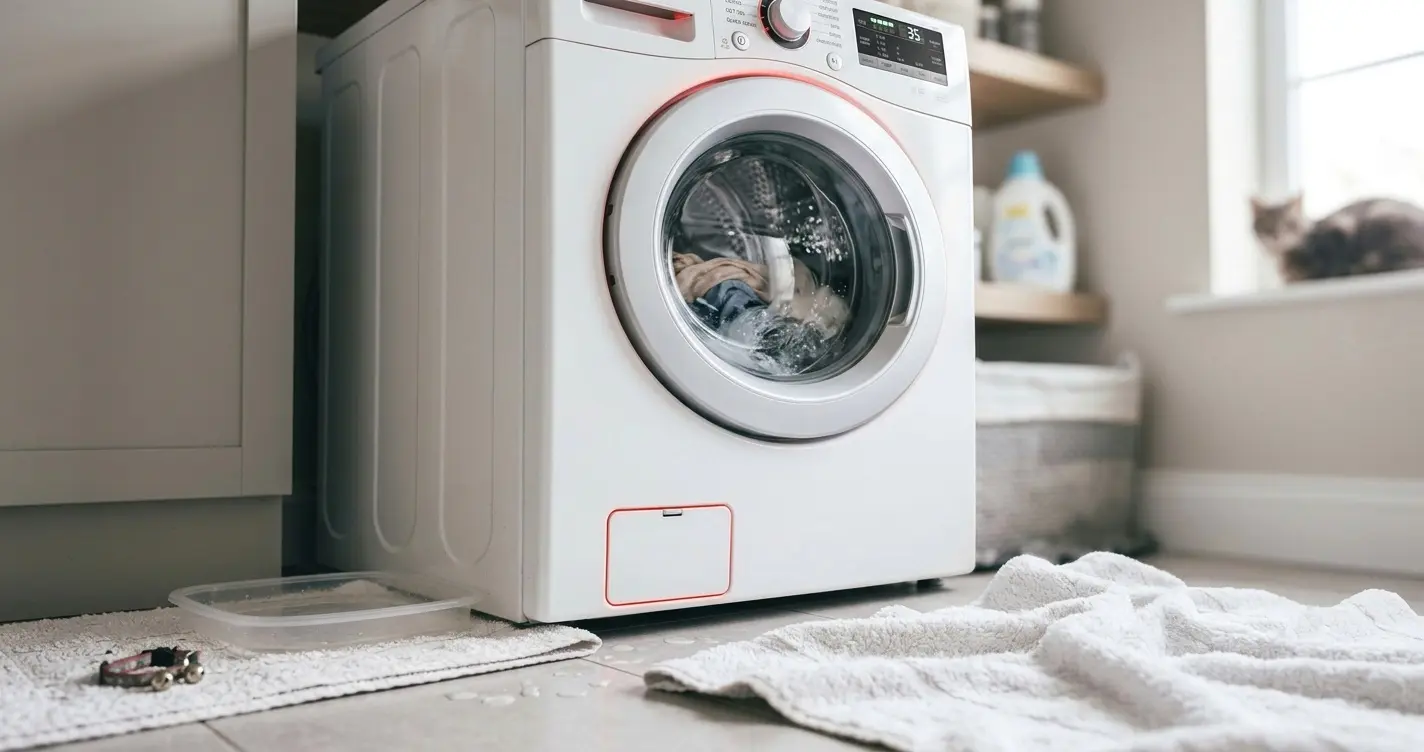
LG Washer Buzzing But Not Draining: That low buzzing hum during the drain cycle, followed by a tub full of water that just won’t leave, is one of the most common calls I get, and in about eight out of ten cases, the fix costs nothing but twenty minutes and a towel.
Table of Contents
What That Buzzing Sound Actually Means
The buzz you’re hearing is the drain pump motor spinning; it’s doing its job electrically, but nothing is moving through it. That’s the key diagnostic clue. If the pump were dead, you’d hear silence, not a hum. A buzzing sound with no water leaving the tub almost always means the pump is trying to push water or spin its impeller against a physical obstruction, a clog, a jammed impeller, or a blocked hose, rather than an electrical failure of the pump itself.
You’re looking for something physically stuck in the drain path. On front-load models like the LG WM3900H or WM4000H series, that drain path runs from the tub, through a coin trap/filter access at the bottom front, into the pump housing, and out through a corrugated hose to your standpipe or drain.
Technician’s first move: before opening anything, I always run the “Drain & Spin” cycle if the model has one and listen. A steady, unchanging buzz for the full cycle usually means a hard blockage. A buzz that comes and goes, or seems to surge and drop, usually means the impeller is contacting debris intermittently, often a coin or a small sock that shifts position. That five-second listening test alone tells me whether I’m dealing with the coin trap first or the hose first.
👉 LG Washing Machine Common Problems: 7 Signs to Watch For
Safety First, Read This Before You Touch Anything
| ⚠ SAFETY FIRST, READ BEFORE YOU BEGIN |
|---|
| Unplug the washer from the wall outlet before removing any access panel. Don’t just switch it off at the door lock; disconnect power completely. The tub will still hold standing water, even if the cycle failed. Place old towels and a shallow pan under the drain filter access before opening it. Water may be hot if the cycle included a warm or hot wash. Let it cool for 15–20 minutes, or test with the back of your hand near the filter door first. Never run the washer with the front access panel removed and the machine plugged in. The drum and pump can activate unexpectedly. If you smell burning or notice scorch marks near the pump housing, stop; this points to an electrical fault and needs a licensed appliance technician. Shut off your home’s hot and cold water supply valves before removing any panel near hose connections if you’re not fully comfortable with those connections. Two-person lift: if you need to tilt or move the washer away from the wall, get a second person; these units are front-heavy and awkward to tip alone. |
If any of this makes you uneasy, or the buzzing persists after the steps below, that’s the point to call a licensed technician rather than keep pushing, especially if it involves anything beyond the front filter/hose area.
Step 1: Check the Drain Filter (Where Most Fixes End)
This is where I start every single time, because it resolves the majority of buzzing-and-not-draining calls on its own.
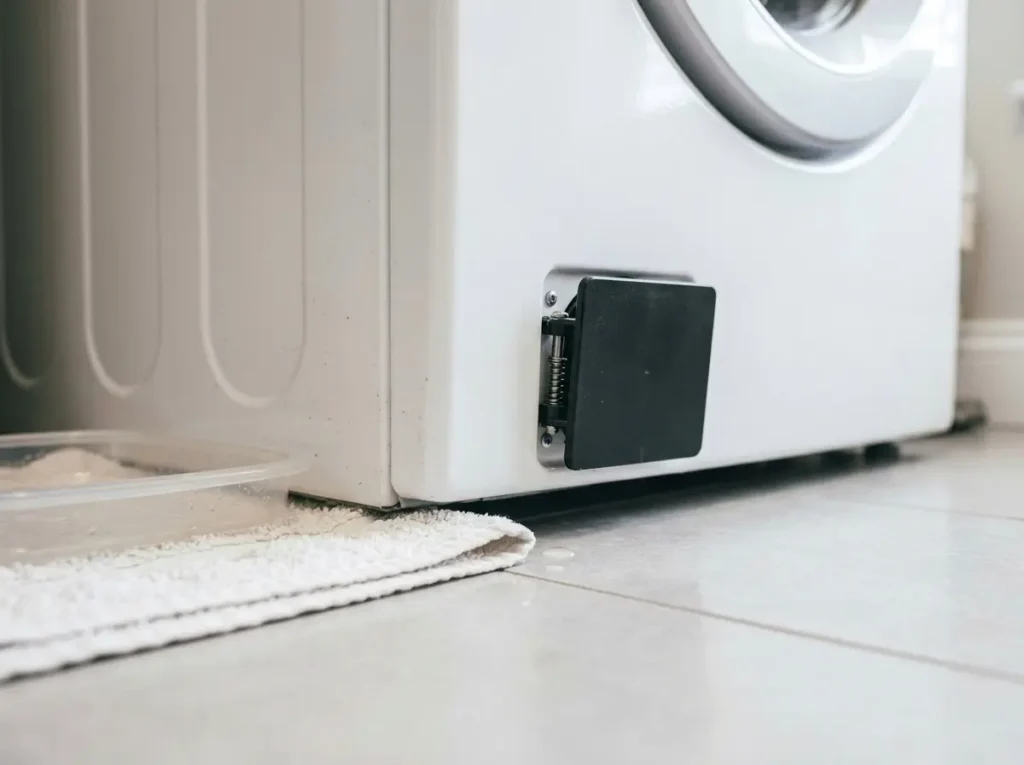
Most LG front-loaders have a small square access panel low on the front of the machine, sometimes hidden behind a snap-off strip near the bottom-left or bottom-right corner. Behind it is the drain filter cap (also called the coin trap).
- With the machine unplugged and towels down, open the access panel.
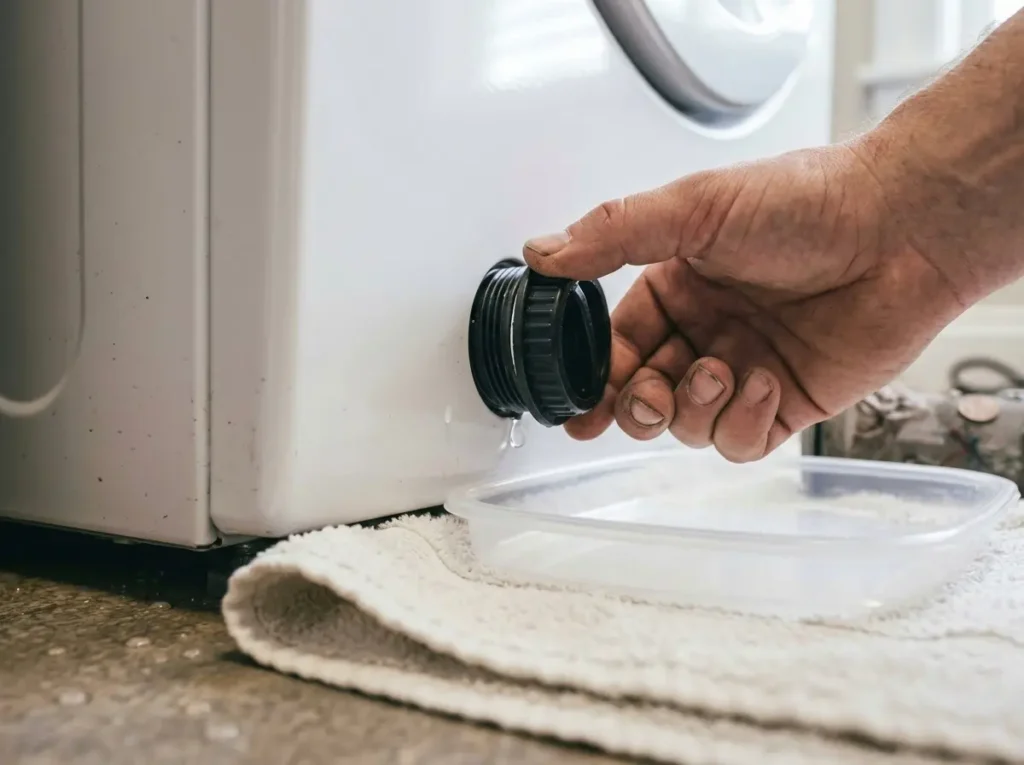
- Slowly turn the filter cap counterclockwise; do this in small increments, because water will come out as soon as it breaks the seal. Let it drain into your pan between turns rather than all at once.
- Once fully unscrewed, pull the filter straight out.
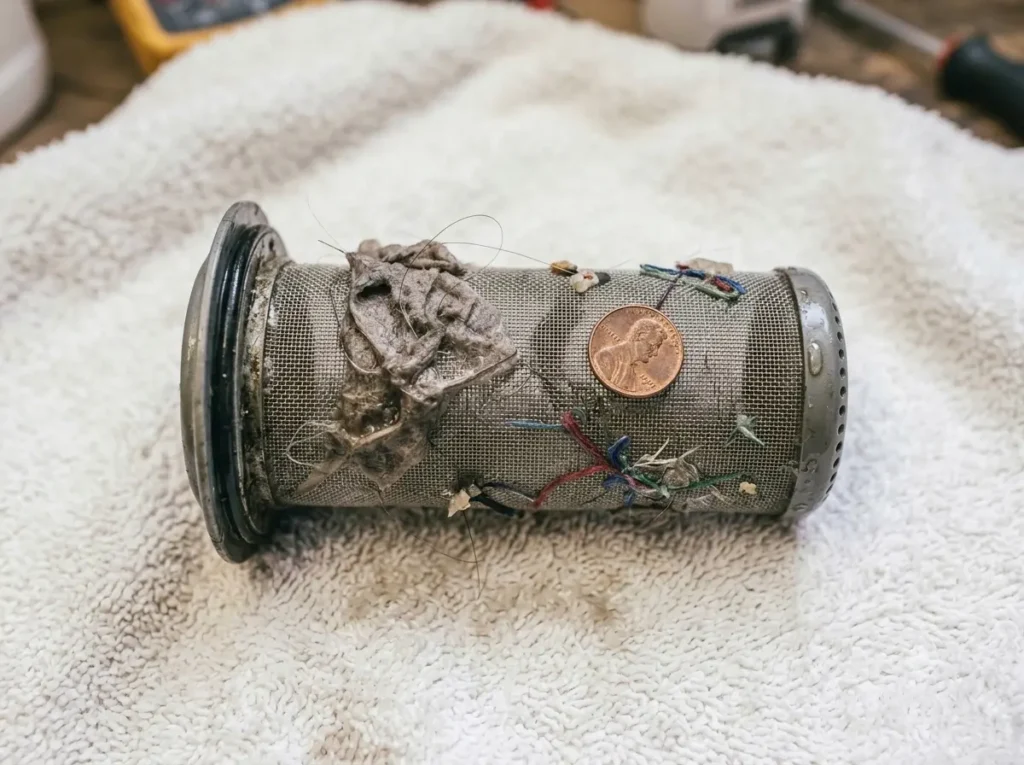
- Inspect it for lint, hair ties, small socks, coins, bra underwires (genuinely one of the most common culprits), or built-up gray sludge.
- Rinse it thoroughly under a tap and check that the small impeller wheel visible inside the housing spins freely with a finger.
If the impeller was stiff or wouldn’t turn before cleaning and turns freely afterward, you’ve very likely found and fixed your buzzing-no-drain issue. Reinstall the filter, hand-tighten (don’t overtighten; it’s a rubber-gasket seal, not a hard stop), close the panel, and run a drain/spin test cycle before you consider it done.
Step 2: Inspect the Drain Hose for Kinks or Clogs
If the filter was clean and the impeller spun freely, the blockage is likely downstream, in the corrugated drain hose that runs from the pump to your wall standpipe or utility sink.
Pull the washer away from the wall (carefully; see the safety section on two-person lifts if needed) and look at the hose for the following:
- Sharp kinks where the machine has been pushed too close to the wall, pinching the hose shut
- Sagging loops that trap standing water and eventually gray sludge, which hardens into a soft clog over time
- A hose pushed too far into the standpipe, creating a vacuum seal that prevents proper flow
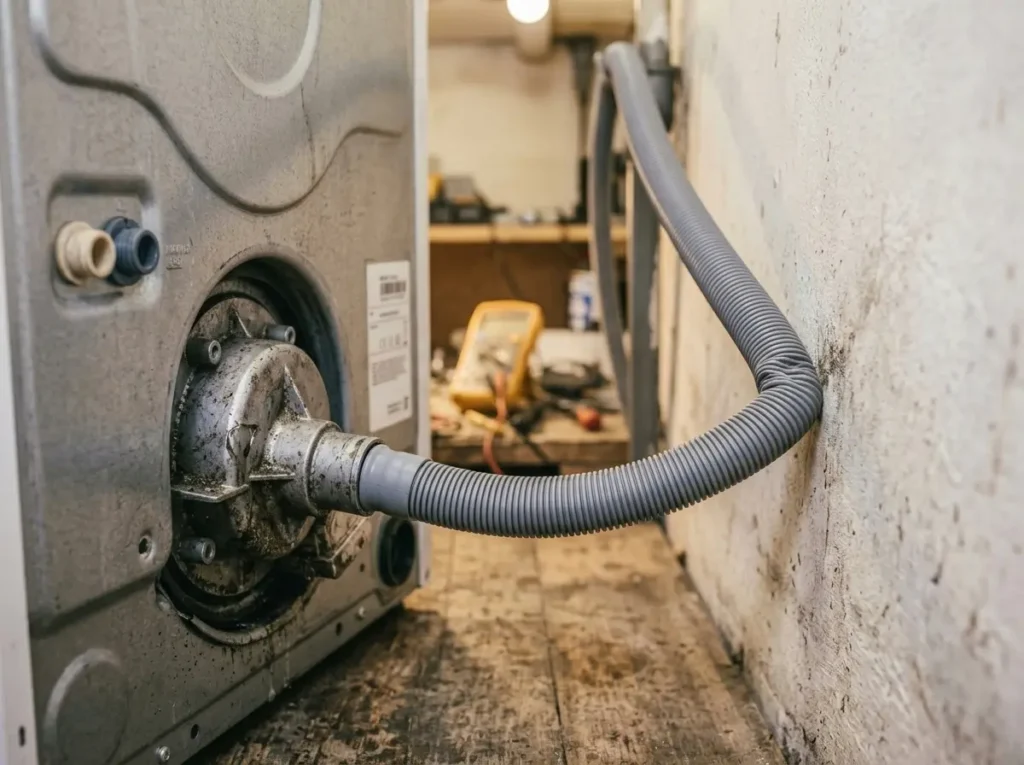
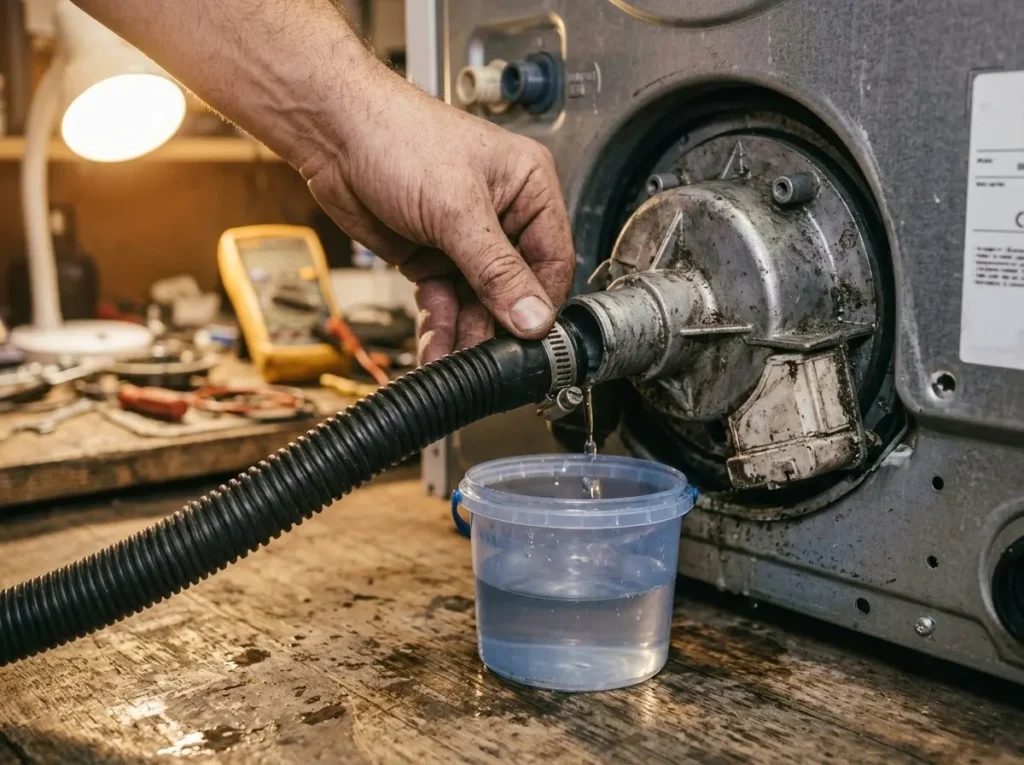
Disconnect the hose at the pump end (again, towels and pan ready; this will release trapped water), and check for a physical obstruction by shining a flashlight through it or running water through it into a bucket. A hose that’s clear but was kinked just needs to be rerouted with a gentler curve, not squeezed against the wall.
Step 3: Test the Drain Pump Itself
If the filter is clear, the impeller spins freely by hand, and the hose is unobstructed, but you still get the buzz-no-drain pattern, the pump motor itself may be weak or failing, even though it’s still receiving power (hence the buzz).
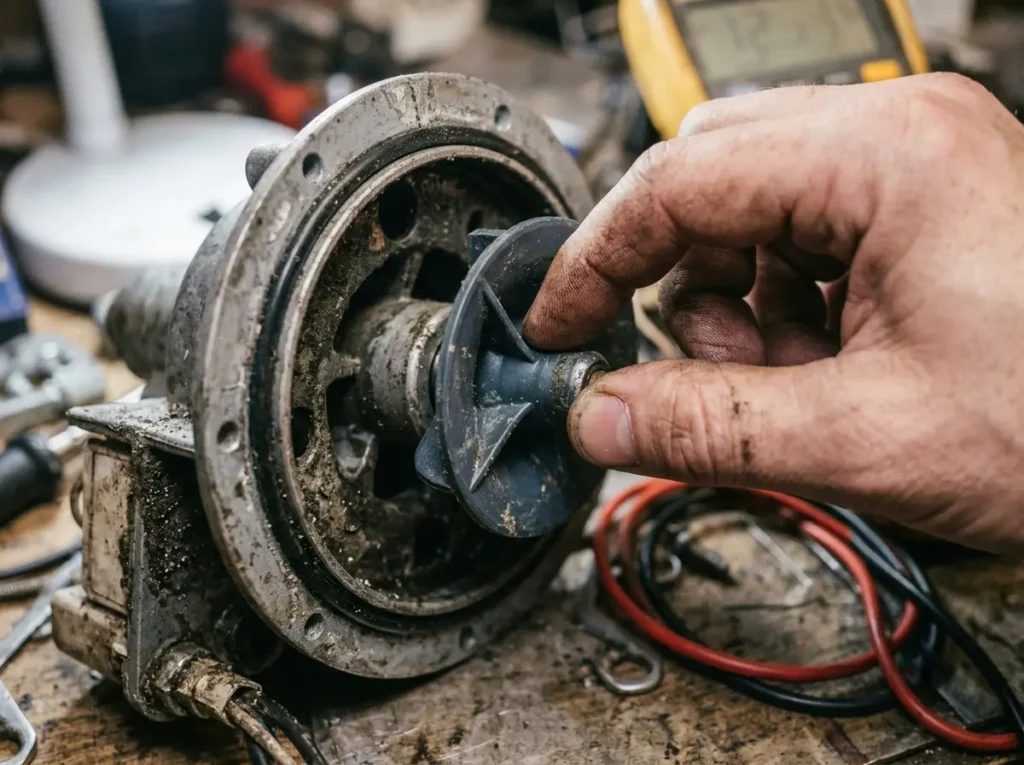
What I check at this stage:
- Impeller resistance under power: with the pump accessible (this typically means removing the front lower panel on many LG models, not just the small filter door), gently try to turn the impeller by hand while the unit is unplugged. Any grinding, grit, or partial resistance suggests a foreign object lodged between the impeller and housing wall that wasn’t visible from the filter opening.
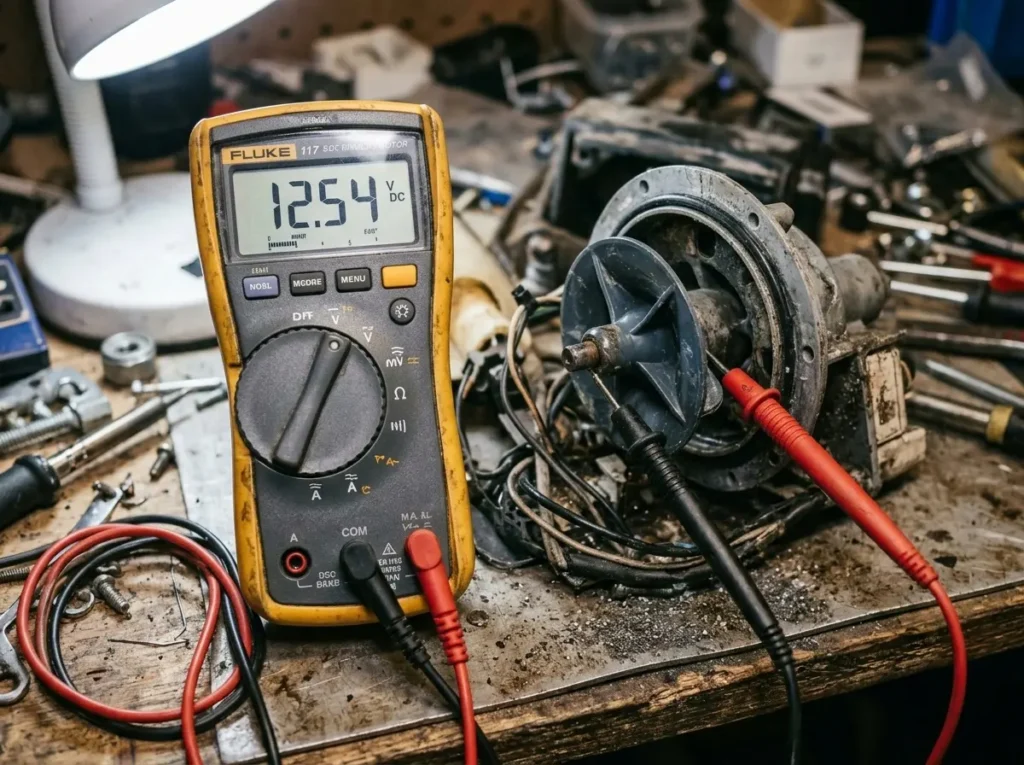
- Pump motor windings: a multimeter continuity check across the pump’s electrical terminals will tell you if the motor windings themselves have failed versus just being mechanically obstructed. This step is where I’d recommend stopping if you’re not comfortable with basic multimeter use; misreading this test leads people to replace a perfectly good pump.
- Listen for pitch changes: a pump buzzing at a consistently low, straining pitch (versus a higher, whining pitch) often indicates the motor is under mechanical load rather than electrically faulting, reinforcing that it’s a blockage, not a dead pump.
The detail most articles skip: on many LG models, a pump that “just needs replacing” after 6+ years of hard water use is often cheaper to replace than diagnose further, especially once you factor in labor time. But on a machine under 3–4 years old, a buzzing pump is rarely actually dead; it’s almost always mechanically obstructed. That age-based judgment call is exactly the kind of thing that determines whether this is a $25 filter fix or a $120 pump replacement, and it’s worth knowing before you order parts.
When It’s Not the Pump: Coin Trap and Impeller Debris
One misdiagnosis I see constantly: people assume a buzzing, non-draining washer needs a new pump when the actual problem is a single rigid object, a hair clip, a small toy, a bottle cap, wedged specifically between the impeller blade and the pump housing wall, not sitting loose in the filter chamber where it would’ve been found in Step 1.
This is a different failure mode from general lint buildup. The impeller will feel like it “catches” at one specific point when turned by hand, rather than being uniformly stiff or free. If you find this, the object usually has to be extracted with needle-nose pliers through the pump housing opening (after the filter is removed), not just rinsed out.
A homeowner question I always ask before starting any of this: “Did the washer drain fine on the last few loads, or has this been building for weeks?” A sudden onset (worked fine yesterday, buzzing today) points strongly to a single lodged object. A gradual worsening over several loads points to lint/sludge buildup narrowing the passage. That one question changes where I look first far more than any visual inspection does.
Comparison Table: LG washer Buzzing Causes Ranked by Likelihood
| Cause | Likelihood | Buzzing Pattern | Fix Difficulty |
| Clogged/dirty drain filter | Very High (~60%) | Steady, constant hum | Easy, DIY, 15 min |
| Kinked or clogged drain hose | Moderate (~20%) | Steady, sometimes intermittent | Easy–Moderate, 20–30 min |
| Object lodged in impeller | Moderate (~15%) | Surging or catching, uneven | Moderate, 30–45 min |
| Failing pump motor/windings | Low (~5%) | High-pitched, worsens over time | Harder, part + install |
FAQ
1. Is it safe to run another wash cycle if my LG washer is buzzing and not draining?
No, running another cycle just adds more standing water on top of the existing blockage and increases the mess when you finally open the filter. Cancel or unplug the machine first.
2. Why does my washer buzz instead of just staying silent when it can’t drain?
Buzzing means the pump motor is receiving power and attempting to spin; it’s mechanically blocked, not electrically dead. A truly failed pump typically produces no sound at all during the drain step.
3. How often should I clean the drain filter to prevent this?
For households doing 4–6 loads a week, every 1–2 months is a reasonable interval, more often if you regularly wash items with loose debris like pet bedding or sandy clothing.
4. Can hard water cause this buzzing-no-drain issue specifically?
Indirectly, yes, hard water accelerates sludge and mineral buildup inside the drain hose and around the impeller, which narrows the passage over months and eventually triggers this exact symptom.
5. My filter and hose are both clear, but it’s still buzzing. What now?
At that point, you’re likely looking at impeller obstruction inside the pump housing itself or a genuinely failing pump motor; proceed to the impeller and multimeter checks in Step 3, or call a technician if you’re not comfortable opening the pump housing.
6. Will ignoring this eventually damage the washer further?
Yes, a pump straining against a blockage for repeated cycles generates extra heat and mechanical stress, which can shorten the motor’s lifespan even if the immediate cause was a simple clog.
7. Is this the same issue as an LG “OE” error code?
Related but not identical, OE is the washer’s own error code response to a detected drain failure, while this article covers the physical mechanical cause behind that failure. For the code itself and what the display is telling you, see our dedicated error code guide.
👉 LG Washer OE Error Code Explained
Final Word
A buzzing LG washer that won’t drain is rarely the disaster it sounds like in the moment; nine times out of ten, it’s a twenty-dollar filter or a kinked hose, not a dead machine. Start at the filter, work your way down the drain path methodically, and only reach for a replacement pump once you’ve actually ruled out everything upstream of it. If you’ve gone through all three steps and you’re still stuck, that’s your cue to bring in a licensed technician rather than start guessing at parts.