
Table of Contents
LG Washing Machine Common Problem
The biggest mistake homeowners make when their LG washer acts up is jumping straight to repairs. They take off the back panel, start disconnecting wires, and create three new problems while trying to fix the first one. Smart troubleshooting means reading what the machine is telling you before you pick up a single tool.
This guide is about symptoms, what you see, what you hear, and when it happens. Nothing here requires a multimeter or a screwdriver. The goal is to pinpoint the most likely cause of your problem through observation alone so that when you do move to repair, you’re fixing the right thing the first time.
👉 [Read More: LG washer DIY repair step-by-step guide]
How to Use This Guide
Each section below describes a specific symptom category. Read the description carefully before jumping to a cause. Many washing machine symptoms overlap; for example, vibration during spin can come from four completely different sources, and each one points to a different fix. The questions within each section help you narrow it down.
If your machine is showing an error code on the display, this is not the guide for that; error codes have their own technical breakdown.
👉 [Read More: LG washer error code technical reference guide]
Symptom 1: The Machine Won’t Turn On At All
What You’re Experiencing
You press Power and nothing happens. No display, no beep, no lights. The machine is completely silent and unresponsive, as if it’s not plugged in, even though it is.
Narrowing It Down
Before assuming the machine itself has failed, work through these observations in order:
- Test the outlet: plug a phone charger or lamp into the same wall socket. If it doesn’t work, your circuit breaker has tripped, not the washer.
- Check the power cord: trace the cord from the back of the machine to the outlet. Look for any visible kinking, pinching under the machine feet, or burn marks near the plug.
- Listen for a click: when a front-load LG washer is plugged in and the door is properly closed, you should hear a faint relay click from the control board. No click at all, even when you just plug it in, suggests the board is not receiving power.
- Check the lid or door position: on top-load models, if the lid is even slightly out of alignment, a small plastic actuator tab may not be pressing the lid switch. This can make the machine appear completely dead.
Most Likely Cause by Symptom Pattern
| What You Observe | Most Likely Cause | Least Likely Cause |
| No lights, no beep, and the outlet works fine | Power cord damage or failed power relay on main PCB | Control board failure (less common) |
| The display flickers then dies | Loose internal wiring connection at the board | Failed display ribbon cable |
| Everything dead, happened after a storm | Surge-damaged main PCB | Power supply module failure |
| Intermittent, works sometimes | Loose plug connection at outlet or cord terminal | Temperature-sensitive PCB fault |
💡 PRO TIP: LG front-loaders store a small amount of residual power in the control board capacitors. Even with the door open and the cord unplugged, this stored charge can keep LEDs dimly lit for up to 30 seconds. If you see this, it is normal, not a sign that power is somehow reaching the board from another source.
Symptom 2: The Machine Starts But the Drum Doesn’t Move
What You’re Experiencing
The wash cycle begins, you hear the water filling, and the control panel shows the cycle is running, but the drum is completely still. No rotation, no agitation, nothing. Or perhaps the drum makes one attempt to turn, then stops.
Narrowing It Down
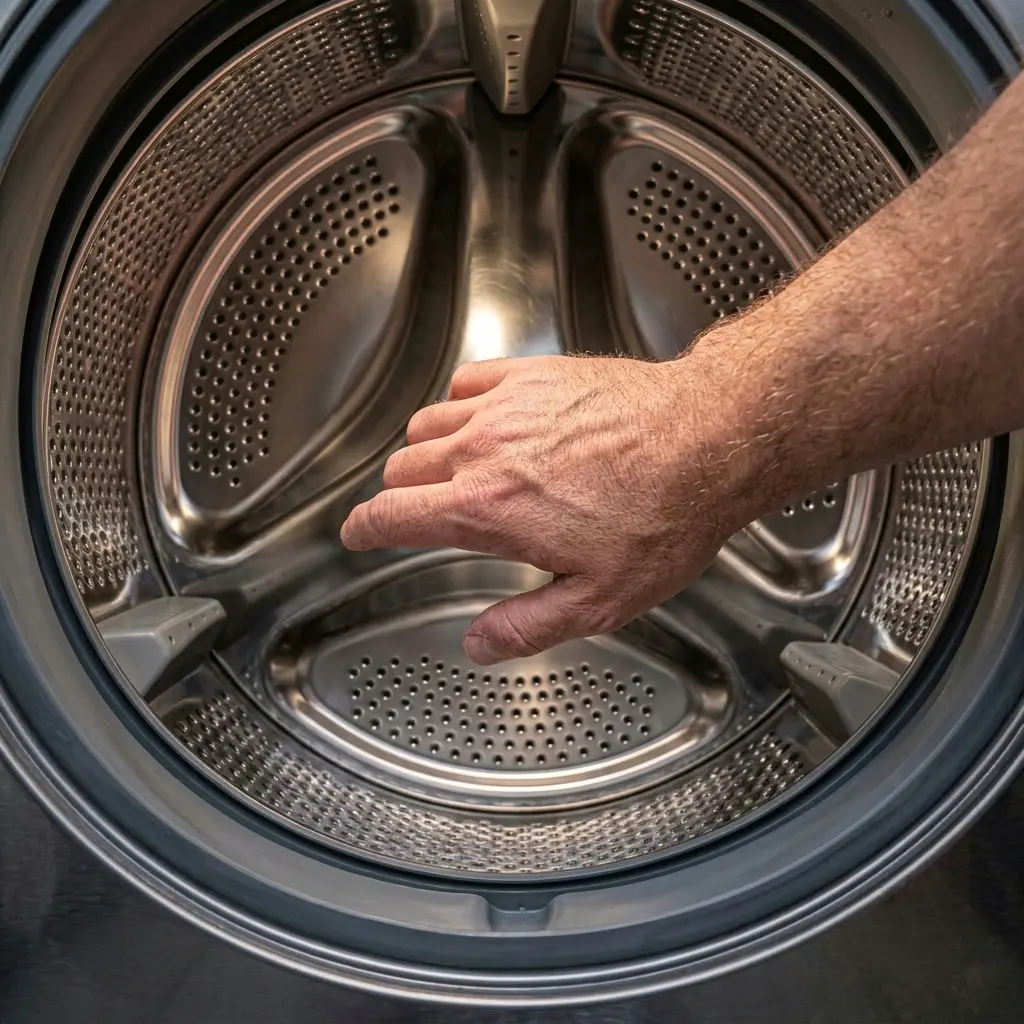
Open the door mid-cycle (use Pause). Try turning the drum by hand with moderate force. This one test tells you a great deal:
- Drum spins freely by hand with light resistance: the motor is likely receiving no signal, or the drive system is disconnected. The drum itself is mechanically fine.
- The drum feels stiff or notchy when you turn it by hand: something is physically obstructing it, a foreign object is between the tubs, or there is early bearing wear is occurring.
- The drum rocks slightly but won’t rotate fully: this typically means the load is unbalanced and the machine is in a suspended state. Try running with an empty drum.
- You hear a low hum but no movement: the motor is receiving power but cannot overcome a mechanical resistance. This is different from no movement and no sound.
What the Sounds Tell You
| Sound During Non-Spinning Cycle | What It Suggests |
| Loud hum, no movement | Motor receiving power but mechanically blocked (object between tubs, or seized bearing) |
| Rapid clicking | The control board relay attempting to engage motor repeatedly; there is a possible motor driver fault |
| Water sounds but no motor sounds | The motor circuit is not being activated; check door lock signal first |
| Complete silence despite display running | The motor driver chip on PCB may have failed |
⚠️ WARNING: If you hear a grinding noise when turning the drum by hand, stop immediately and do not run the machine. Grinding from inside the tub usually means a foreign object, a coin, a wire bra underwire, or something similar, is caught between the inner and outer drums. Continuing to run the machine can tear the inner drum lining.
Symptom 3: The Machine Fills With Water But Never Starts Washing
What You’re Experiencing
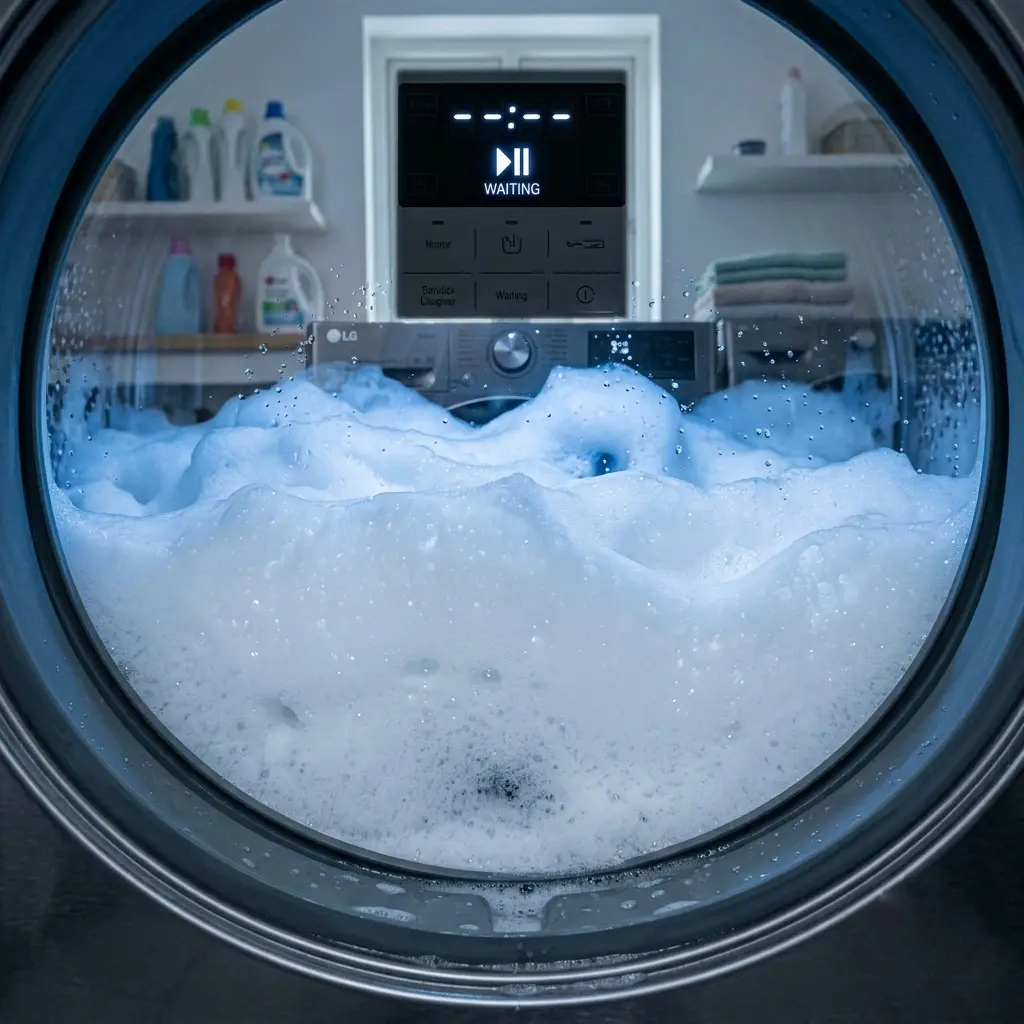
Water enters the drum normally. The fill cycle completes. But then… nothing. The machine just sits there with a tub full of water, or it drains and tries to fill again, looping without ever starting the wash cycle.
Narrowing It Down
This symptom pattern almost always involves the machine not being satisfied that conditions are safe to begin agitation. Work through these observations:
- Is the door making a solid click when closed? On front-load models, the door lock must fully engage before the wash program advances. If the lock is even slightly worn, the machine may fill but stall waiting for the lock confirmation signal.
- Is there foam visible in the drum before the cycle starts? Excess detergent from a previous wash can leave residual foam. The machine’s foam sensor will delay washing until foam levels drop. You may see the drum rotate very slowly to dissipate heat.
- Does the delay happen at a specific temperature? If the machine stalls on hot cycles but starts fine on cold cycles, the heating element or the NTC temperature sensor may be signaling an out-of-range temperature, preventing wash start.
- Does it happen every cycle or randomly? Intermittent fill-but-no-wash behavior is almost always a loose wire connector at the PCB, not a failed component. The machine works when the vibration hasn’t shifted the connector; it fails when it has.
💡 PRO TIP: LG’s 2026 AI DD models use a weight sensor in the motor to estimate load size and set water level automatically. If the machine fills and then immediately drains and refills once, that is normal behavior, it is the machine calibrating its water volume to match the detected load weight.
Symptom 4: Clothes Come Out Soaking Wet After the Full Cycle
What You’re Experiencing
The cycle completes without any error code. The display shows the wash is done. But when you open the door, the clothes are dripping wet, far wetter than they should be after a spin cycle.
Narrowing It Down
This is one of the most misdiagnosed symptoms because it feels like a drain problem but is usually a spin problem. These two issues look identical from the outside but have different causes:
| Observation | Likely Issue | Distinguishing Test |
| Standing water visible in drum | The drain did not complete; water could not leave | Check if drain pump runs (listen for hum during drain phase) |
| No standing water, clothes wet | Spin did not reach full speed | Run Spin-Only mode and listen for high-speed motor sound |
| Clothes wet only on one side | The load was unbalanced during final spin | Run an empty spin. Only cycle; if it completes, the issue is load distribution |
| Clothes wet, faint mildew smell | Drum not draining fully over multiple cycles, buildup in pump | Check for slow-drain behavior across several washes |
The key diagnostic split: does the pump run? During the final drain, press your hand against the machine at the front bottom corner. A working pump creates a faint vibration you can feel through the cabinet. No vibration means the pump is not running at all. Vibration being present means the pump is running, but water is meeting resistance.
👉 [Read More: LG washer complete error code reference guide]
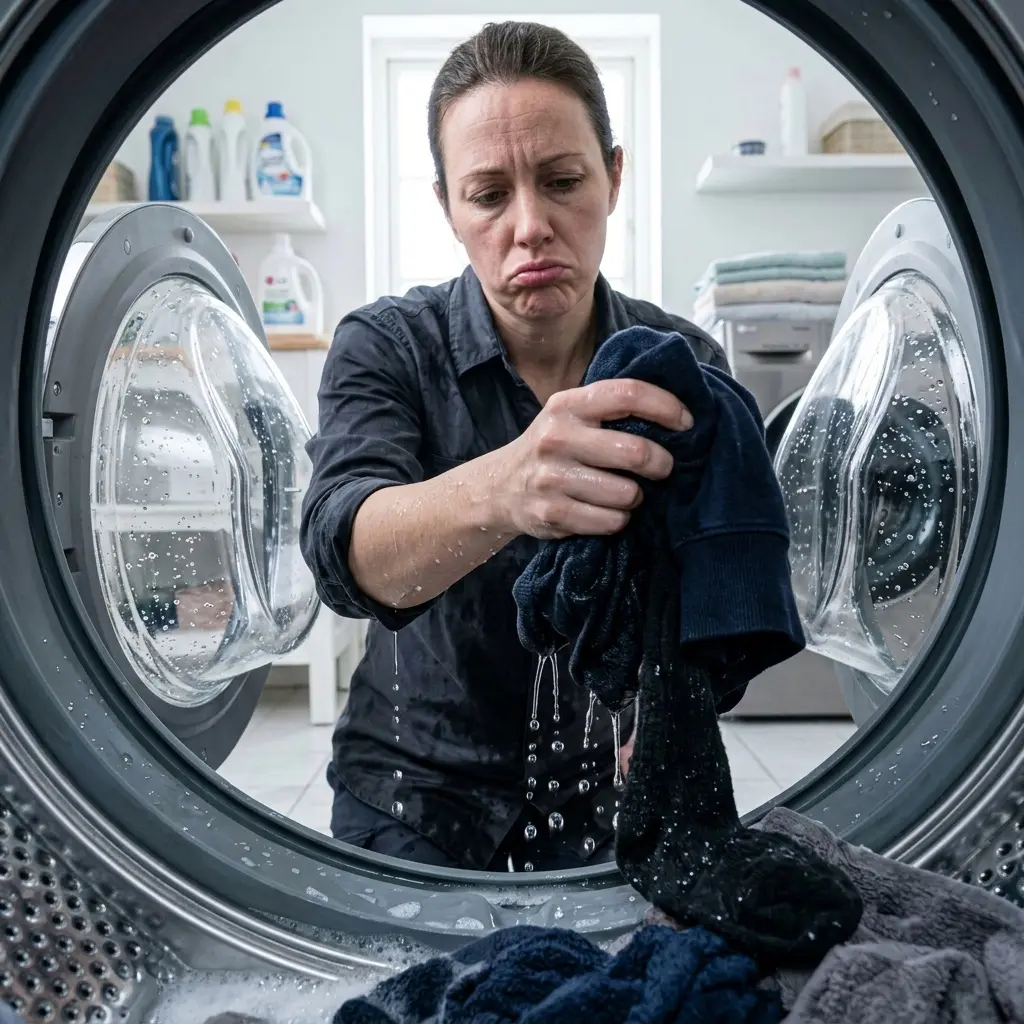
Symptom 5: The Machine Is Making an Unusual Noise
What You’re Experiencing
Something sounds wrong. It might be a banging, a grinding, a rattling, a high-pitched squeal, or a rhythmic thumping that wasn’t there before. The machine is finishing cycles, but the sound is getting worse.
Decoding Washing Machine Noises
Different noises come from entirely different parts of the machine. Using the cycle phase when the sound occurs, you can identify which system to inspect:
| When It Happens | Sound Type | Most Likely Source |
| During filling (first 5 minutes) | Hammering or water-knock sound | Water hammer in supply hoses, no machine fault |
| During agitation/wash | Rhythmic clunking | Foreign object (coin, button) hitting outer drum |
| During agitation/wash | Grinding or groaning | The drum bearing beginning to fail |
| During spin (ramp-up phase) | Loud banging that eases at high speed | Unbalanced load redistributing during acceleration |
| During spin (consistent at high speed) | High-pitched whine or squeal | Drum bearings or motor bearing wear |
| During spin (consistent) | Deep thumping/bass vibration | The machine is not level; there is a feet contact issue |
| During drain phase | Grinding or rattling | Foreign object in drain pump impeller |
⚠️ WARNING: A rhythmic metallic scraping during the spin cycle, like a coin scraping in a dryer, usually means a small object has made its way between the inner and outer drum. This must be addressed immediately. Continued operation can puncture the drum or damage the bearing seal.
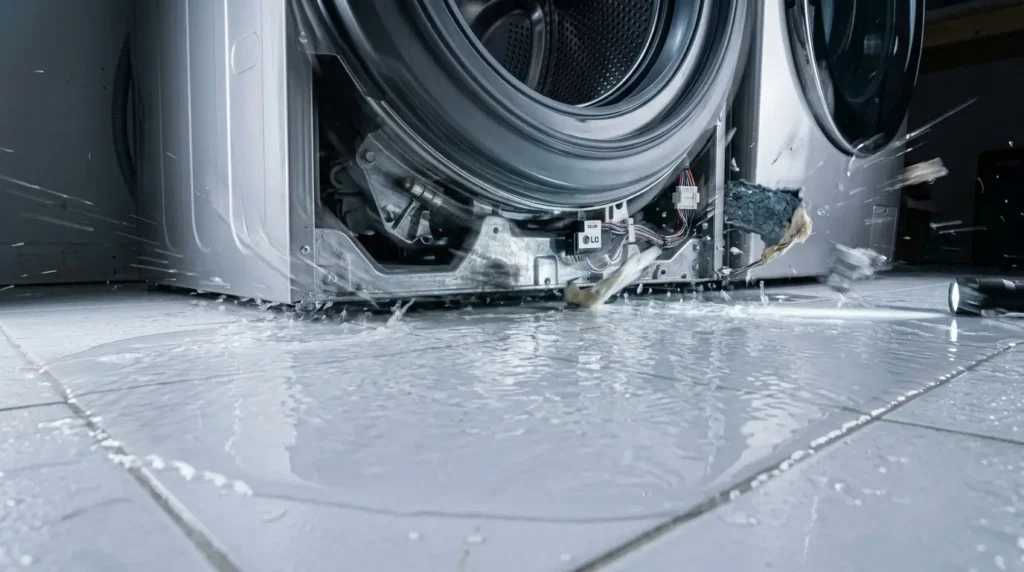
Symptom 6: The Machine Leaks Water
What You’re Experiencing
You find water on the floor around or underneath the machine. The leak may happen during filling, during washing, or during draining; the timing matters enormously for diagnosis.
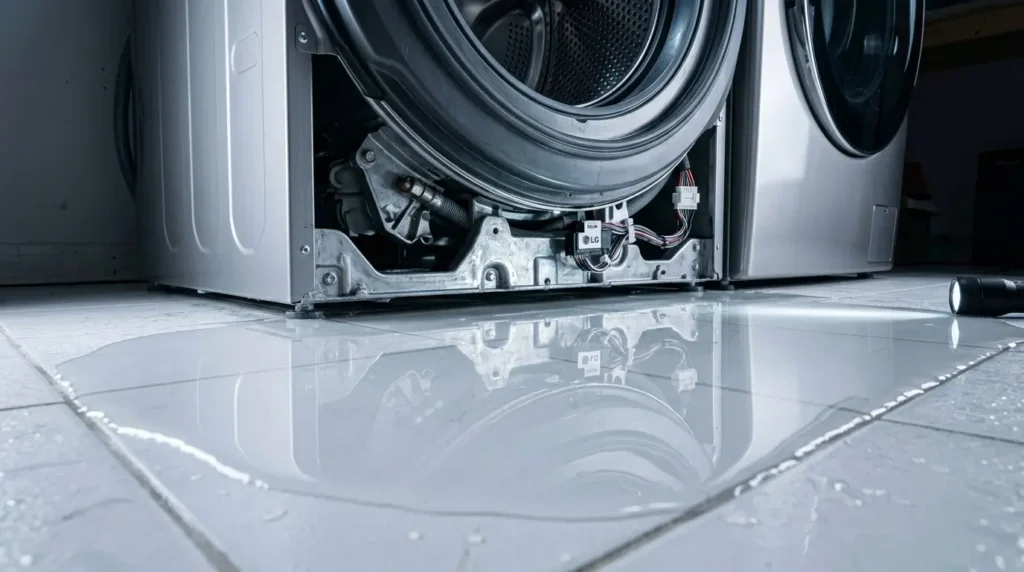
Using Leak Timing and Location to Diagnose
| Leak Timing | Leak Location | Most Likely Source |
| During filling (first few minutes) | Behind machine | Loose supply hose connection at rear inlet valve |
| During wash cycle | Front of machine, below door | Damaged or dirty door gasket (front-load) |
| During drain phase | Beneath machine, center | Drain pump housing crack or loose hose clamp |
| Any phase | Beneath machine, rear | Outer tub crack, rare but serious |
| Only on hot cycles | Beneath machine, varies | Heating element seal failure: hot water expansion breaks an aged seal |
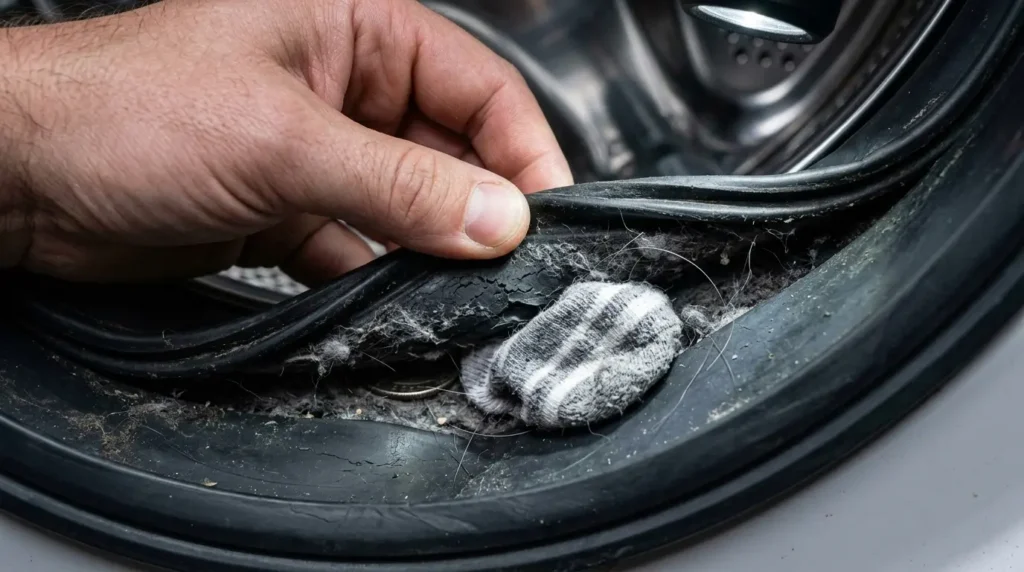
💡 PRO TIP: Front-load washer door gasket leaks are frequently caused by small items caught in the rubber folds, not by gasket damage itself. Before assuming the gasket needs replacement, pull back each fold and check for socks, tissue paper, or lint that could be breaking the water seal.
👉 [Read More: LG washer maintenance and cleaning guide]
Frequently Asked Questions: LG Washer Symptoms
Q1: My LG washer makes a loud noise during spin but only on certain fabric types. Is this a machine problem?
Not necessarily. Waterproof fabrics, raincoats, mattress protectors, and certain athletic wear trap air in their sealed weave during spinning. This creates a rhythmic, loud drumming called the ‘sail effect. ‘Use the delicate or handwash cycle with a reduced spin speed for these items. If the noise happens on regular cotton loads too, then investigate the drum bearings.
Q2: The machine starts fine on cold cycles but stalls on warm or hot cycles. What’s the pattern here?
This almost always points to the NTC temperature sensor (also called the thermistor) reading out-of-range values. On hot cycles, the machine monitors water temperature and will pause or abort the cycle if the sensor reports temperatures that seem impossible, either far too high or stuck at a fixed reading. The sensor itself is a small, cheap component that screws into the bottom of the outer tub.
Q3: My washer vibrates but only during the last 5 minutes of the spin cycle. Earlier in the spin, it’s quiet. What causes late-cycle vibration?
The final spin phase accelerates to maximum drum speed, typically 1,000 to 1,400 RPM on LG 2026 models. Vibration that only appears at peak speed usually indicates the drum is microscopically out of balance at high RPM. This is commonly caused by worn shock absorbers that can dampen slow-speed vibration but cannot absorb the energy at full spin speed. The symptom worsens gradually over time.
Q4: How do I tell if a washing machine problem is electrical or mechanical?
Electrical problems tend to be inconsistent; the machine works one day and fails the next, or errors appear then disappear without any physical change. Mechanical problems are consistent; if a bearing is worn, it will make the same noise every single cycle. If a noise, vibration, or failure happens predictably every time, assume it’s mechanical. If it’s random or intermittent, assume electrical.
Q5: The machine finished the cycle, but the door won’t open. Is this a fault?
Usually not. LG front-loaders hold the door locked for 1–3 minutes after a cycle ends to allow the drum to decelerate fully and ensure no residual water is near the door seal. If the door still won’t open after 3 minutes, press Pause, wait 30 seconds, then press Start/Pause again to trigger a door unlock. If it remains locked, the machine may have water it cannotdrain;, check the drain filter.