
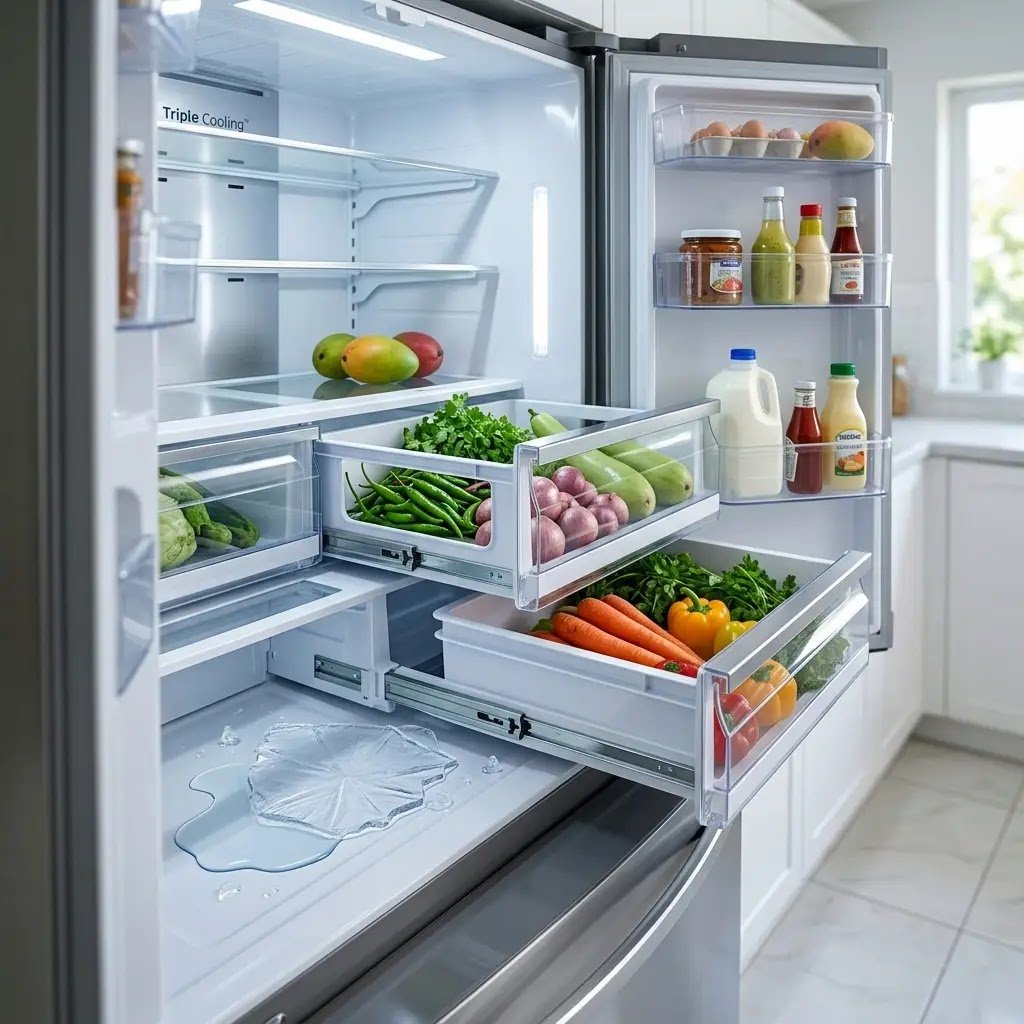
Samsung Fridge Water Leaking Under Drawers? If you’ve found a lake under your vegetable bins, it’s not a burst pipe; it’s a drainage failure. Here’s the professional way to diagnose and fix it safely, without guessing your way through it.
Table of Contents
1. Safety First, Read This Before You Start
⚠️ Critical Safety Warning
- Unplug your refrigerator before attempting any repair. You’ll be working near the evaporator coils and rear compressor area, both of which involve electrical components and sharp aluminum fins.
- Use Samsung-certified parts. DIY hacks like bare copper wire “fixes” are popular online, but they skip the insulation and fit tolerances the OEM parts are built with, a real fire hazard, not just a cosmetic shortcut.
- Never touch the sealed refrigerant system. The copper lines running to and from the compressor are part of a pressurized, sealed circuit. Don’t cut, crimp, and disturb them under any circumstances; refrigerant handling legally requires EPA certification. If you smell a chemical odor and hear hissing near the compressor, stop immediately and call a licensed technician.
- Work with patience, not force. The internal foam insulation is delicate; this is covered in detail in Section 5, but it applies everywhere you’re working near a panel.
- Stop and call a technician if the compressor itself needs to be accessed, you’re not confident distinguishing a drain issue from a sealed-system issue, and the defrost heater tests dead and you’re not comfortable replacing an electrical component yourself.
Struggling with other fridge issues? Check the full troubleshooting list: 👉 [Samsung Refrigerator Troubleshooting, Common Problems & Fixes]
2. Identifying the Puddle: Clear Water vs. Solid Ice
Before pulling the fridge away from the wall, identify how the water is getting there. In Samsung French door and side-by-side models, symptoms fall into two categories:
Scenario A: Standing water.
If you see liquid under the crisper drawers, the drain line is likely blocked by debris and a sticky duckbill valve at the back. Water has nowhere to go, so it overflows into the cabinet.
Scenario B: Frozen sheet of ice.
If the floor of the fridge is solid ice, the defrost system is failing, either the heater isn’t melting frost, or the drain hole itself is frozen shut, turning your fridge into a freezer.
3. Phase 1: The Sticky Duckbill Valve
The most common culprit behind a Samsung leak is a small rubber part behind the lower rear access panel; technicians call it the duckbill valve. Its job is to let defrost water drip out while keeping warm, humid air from entering the fridge.
The sticky lips problem: over time, dust and sugar-rich food vapors cause the rubber lips of this valve to stick together. Since defrost water only drips down via gravity, it isn’t heavy enough to force a sticky valve open, creating a backup that eventually leaks into your drawers.

Professional repair protocol:
- Access: remove the 7 screws from the rear bottom cover. Locate the two hanging tubes (the fridge drain is typically on the right).
- Inspect: pull the rubber nipple (valve) off. If it’s full of gunk and stuck shut, you’ve found the leak source.
- Fix it properly: some guides suggest snipping 2 mm off the bottom lip to keep it from re-sticking. This can work temporarily, but snipping too much lets humid air in, causing snow buildup on your evaporator coils. If the valve is already stiff, cracked, and has been snipped before, replace it outright with a new OEM duckbill valve rather than modifying the old one again.
4. Model-Specific Anatomy: Where Is the Drain?
Depending on your Samsung series, the drain’s location varies. Knowing this prevents you from prying the wrong panel and cracking the plastic liner.
| Model Type | Drain Location | Difficulty Level |
| French Door (RF Series) | Centered behind the Fresh Food evaporator panel | Hard, requires panel removal |
| Side-by-Side (RS Series) | Behind the lower freezer panel (primary) and fridge floor | Moderate |
| Bespoke / AI Series | Internalized with updated heater clips | Expert electronic diagnosis first |
The steamer rule of expertise: if you suspect the drain is frozen inside the cabinet, never use a hairdryer. High heat will warp the plastic interior of your refrigerator almost instantly. Use a garment steamer and a turkey baster with warm (not boiling) water instead. If the water doesn’t disappear down the hole immediately, the duckbill valve at the back is still stuck.
5. Clearing the Frozen Drain Hole
If the rear duckbill valve is clear but water is still pooling, the problem is likely inside the cabinet. Under the evaporator cover (the back wall panel), there’s a small drain hole. In many Samsung models, this freezes shut because the defrost heater doesn’t reach deep enough into the drain.
⚠️ Protect the Styrofoam: the back panel is lined with delicate foam insulation. If there’s ice buildup, the foam will be frozen to the coils; do not pull the panel hard. Ripping the foam reduces your fridge’s insulation efficiency permanently and can even lead to broader cooling problems down the line. 👉 [Samsung Refrigerator Ice-maker not working, Causes & Fixes]
Use a steamer to melt the ice until the panel slides off effortlessly.

The permanent fix, now updated for 2026: Samsung’s official solution has been an upgraded drain heater clip, part DA61-06796A, longer than the factory clip, sitting deeper in the drain hole to keep the path melted through every defrost cycle. As of 2026, an even newer version, DA61-14306A, has superseded it with an improved reach and fit. If you’re ordering a replacement clip today, check for the newer part number first; it’s designed as a direct upgrade replacement, not a separate compatibility path.

6. Secret Tech Mode: Forced Defrost (Fd)
Before disassembling anything, you can use the refrigerator’s own computer to melt the ice; this is Forced Defrost (Fd) Mode. It manually runs the heater for about 20–30 minutes.
How to trigger FD mode:
- Standard digital models: hold the Freezer and Lighting (or Fridge) buttons simultaneously for 8–10 seconds until the screen flashes and beeps. Press any button until “Fd” appears.
- Bespoke / Family Hub models: these often require the SmartThings app and the Self-Diagnosis menu under Settings > Support instead of a button combo.
The fridge will beep continuously during Fd mode; this is normal. Once finished, unplug it for 30 seconds to return to normal operation.

7. Measuring Resistance: Is the Heater Dead?
If forced defrost doesn’t melt the ice, the defrost heater and sensor may be faulty. With a multimeter:
- Defrost heater: should read between 60 and 120 ohms. A reading of OL (open loop) means the heater is burnt out and needs replacement.
- Defrost sensor (thermistor): at freezing temperatures (32°F / 0°C), expect roughly 13 kΩ. At room temperature (77°F / 25°C), expect roughly 5 kΩ.
If your fridge is flashing a code like 5E and 22E while leaking, that’s a separate diagnostic path worth checking directly: 👉 [Samsung Refrigerator Error Codes 2026, 4E, 5E, 22E Explained]
8. FAQ: Samsung Fridge Water Leaking Under Drawer
Why does water keep coming back even after I melt the ice?
Usually the duckbill valve is still stuck shut, and the heater clip isn’t reaching deep enough into the drain hole. Both the internal and external components need to be addressed for a permanent fix.
Can I use a hair dryer to melt the ice?
No. Hair dryers and heat guns generate intense, concentrated heat that can melt the plastic interior liner and damage sensitive sensors. Use a steamer and warm water flushes instead.
Will leveling my fridge help with drainage?
Yes. Your refrigerator should tilt slightly backward (about 0.5 degrees) so water flows naturally toward the rear drain hole instead of pooling at the front under the drawers. 👉 [INTERNAL LINK: How to Level a Refrigerator Correctly]
Is this leak covered under Samsung’s warranty?
Generally, drain clogs are treated as maintenance issues rather than manufacturing defects, unless there’s a confirmed component failure like a dead heater. Check your regional Samsung support terms for specifics.
How often should I clean the duckbill valve to prevent this from happening again?
Once and twice a year for most households, more often if you store a lot of sugary and syrupy foods, since residue vapor is the main cause of the valve sticking shut.
Is it normal for the fridge to make noise right after the forced defrost mode finishes?
A brief hum and click as the compressor restarts is normal. Continuous loud noise and grinding afterward suggests a separate mechanical issue, not related to the defrost cycle itself.
How long should I monitor the fridge after replacing the duckbill valve and heater clip?
Give it a full 2–3 defrost cycles (roughly 2–3 days of normal use) before concluding the fix worked; a slow re-freeze can take that long to show up if the underlying blockage wasn’t fully cleared.
9. Conclusion
Finding water under your drawers is a nuisance, but it’s rarely a reason to replace the whole appliance. Address the rear duckbill valve and the internal drain hole together; fixing only one usually means the leak returns within days. Run the forced defrost check first since it costs nothing and can save you a full teardown; if ice keeps returning after that and both components check out, the resistance test in Section 7 will tell you whether you’re dealing with a simple clog and an actual failed heater.
Thinking of upgrading instead of repairing? See if the latest models fit your needs: 👉 [Samsung Refrigerator, Pros, Cons, and Smart Features Explained]