
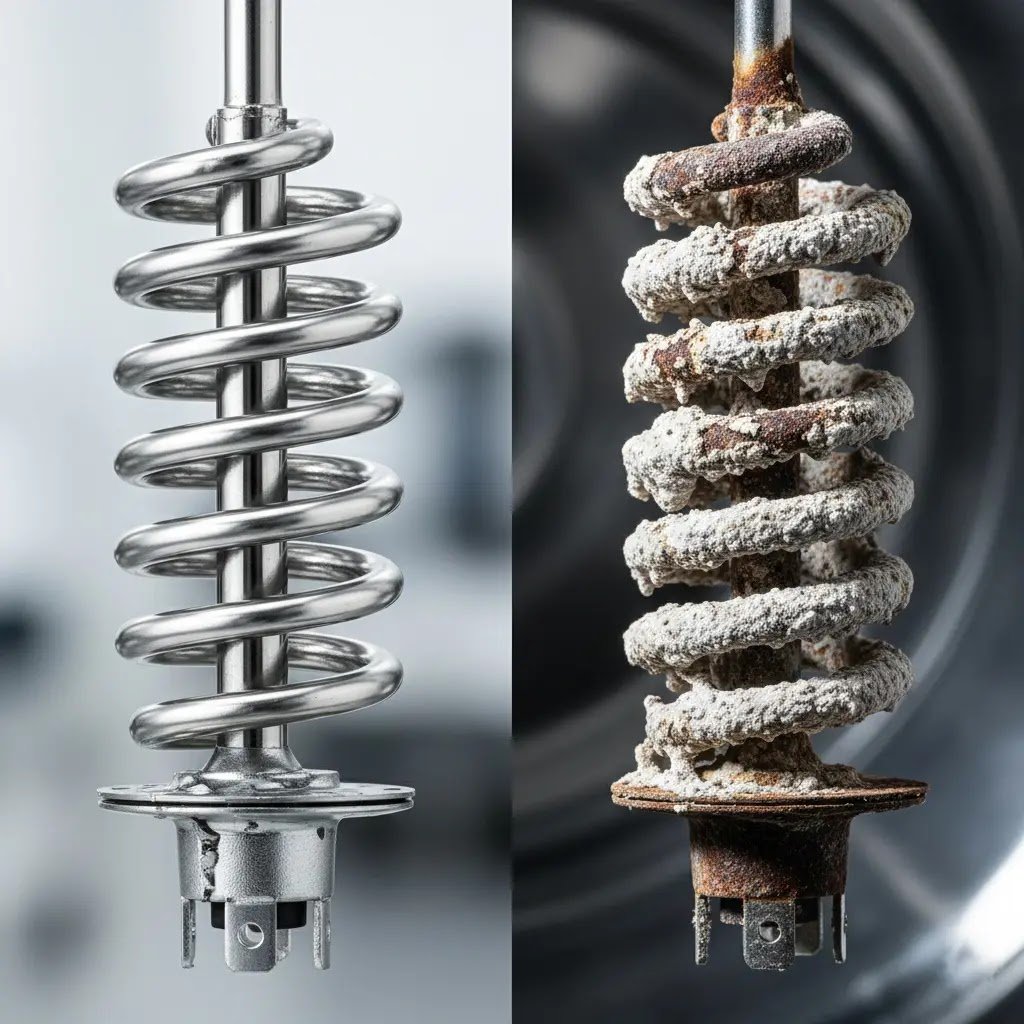
That chalky white residue on your dark clothes isn’t a detergent problem; it’s your washer quietly cooking itself from the inside. Limescale builds up on the heating element with almost every wash in a hard water area, and by the time you notice the signs, it’s already costing you money on every single cycle.
Table of Contents
Quick Summary: The Deep Flush Protocol to Descale Washing Machine
- The agent: roughly 200 g of food-grade citric acid
- The temperature: an empty cycle at 90–95°C
- Frequency: every 3 months in hard water areas, every 6 months in soft water areas
- Key benefit: a scaled heating element has to work harder to reach temperature, so keeping it clear helps keep energy use and long-term motor strain down
1. The Silent Killer of Washing Machines
Limescale is a chalky, rock-hard buildup of calcium and magnesium that clings to the heating element and the hidden back of the drum, and because it builds up out of sight, most people don’t notice it until something else starts going wrong.
The cost of neglect: once the heating element is coated in scale, it can’t transfer heat to the water efficiently, so the machine has to run longer and draw more power to reach the same temperature. Over time, the added weight and friction from scale buildup also put real strain on the motor and moving parts.
Technician’s take: it’s genuinely common to see a two- or three-year-old high-end machine develop expensive problems that trace back to something a $5 bottle of citric acid would have prevented. This isn’t just a cleaning task; it’s one of the cheapest insurance policies in appliance ownership.
2. 3 Signs Your Machine Is Choking on Scale
Before a scale-related failure happens, your machine usually gives you warning signs:
- Chalky residue: white streaks or spots on the drum surface or on dark clothes after a wash.
- Strange odors: a musty, damp smell that persists even on clean laundry, often a combination of limescale and biofilm, since scale gives bacteria something to cling to. If descaling alone doesn’t fully clear the smell, the buildup may need a deeper sterilization pass; see our [👉 Expert Maintenance Tips for Washing Machines] guide for that next step.
- Noisy heating: a hissing or whistling sound as the water heats up is a strong sign the element is heavily encrusted; this is usually the clearest, least ambiguous of the three signs.
3. Hard Water Checklist: Do You Need to Descale?
Use this quick self-check to gauge how seriously to take a descaling schedule:
- Does your kettle or coffee maker develop visible white scale, even with regular cleaning?
- Does soap struggle to lather easily or leave a filmy residue on dishes and glassware?
- Do you live in a region known for hard water? Much of the southwestern US, large parts of the UK, and many areas across South Asia and the Middle East are commonly hard-water regions.
- Has your local water utility’s annual water quality report listed hardness above roughly 120 mg/L (a commonly used general threshold for “hard” water)?
If you answered yes to two or more of these, treat the 3-month descaling interval as the right starting point rather than the 6-month one; you can always space it out further if you find scale buildup is lighter than expected.
4. Vinegar vs. Citric Acid: The Real Answer
For years, white vinegar (acetic acid) was the default recommendation for home descaling. It still works, but citric acid is generally the better regular-use choice: it’s odorless, dissolves calcium effectively at high temperatures, and is gentler on rubber gaskets and internal seals than repeated acetic acid exposure. Vinegar’s acidity is well-documented to degrade rubber over time with frequent use, which matters more the more often you’re running this cycle.
The practical rule: if you prefer vinegar occasionally, limit it to once a year at most. For a regular 3-to-6-month schedule, citric acid (👉 AMAZON LINK: “Food-Grade Citric Acid Descaler”) is the safer long-term choice for your seals.

5. Critical Safety Notes Before You Start
These matter enough to read before you begin, not after:
Never mix citric acid or vinegar with chlorine bleach. Mixing an acid with bleach produces chlorine gas, which is genuinely toxic to inhale. If you used bleach in a recent wash, run a plain-water rinse cycle first to make sure the drum is chemically neutral before adding any acid.
Don’t overdo the concentration. Roughly 200 g of citric acid per cycle is a reasonable standard dose; going well beyond that doesn’t meaningfully improve results and increases the risk of it affecting rubber components over time.
Run it empty, always. Descaling at 90°C with clothes inside risks damaging fabric fibers and can cause zippers or metal fasteners to discolor or corrode. This cycle is for the machine, not the laundry.
Ventilate the room. High heat turns old detergent residue and loosened mineral deposits into vapor during the cycle, which can be mildly irritating if you’re sensitive to fumes or have asthma or allergies; cracking a window or door during the cycle is a reasonable precaution.

6. Step-by-Step Deep Flush Method
- The filter purge: open the drain filter at the bottom front and clear out coins, lint, and hair first. Skipping this means a loosened scale can clog the filter mid-cycle.
- The solution load: add roughly 200 g of food-grade citric acid directly into the empty drum, not the detergent drawer, since it needs to sit where the heating element actually is.
- The 90°C cycle: select the hottest available cycle (typically 90–95°C), enable Extra Rinse if your model has it, and run it completely empty.
- The gasket wipe: once finished, pull back the rubber door seal and wipe away any loosened sludge or scale particles with a microfiber cloth. This is the step most people skip, and it’s where a lot of the flushed-out residue actually ends up.
7. Brand-Specific Descaling Modes
Most modern manufacturers build in a dedicated cycle for this, generally using higher water levels to make sure the whole drum stays submerged:
| Brand | Mode Name | Notes |
| LG | Tub Clean | Selected from the cycle dial or menu; check your manual for the exact activation steps, since these vary by model generation. |
| Samsung | Eco Drum Clean | A self-cleaning cycle, usually with an on-screen reminder after a set number of washes |
| Bosch | Drum Clean | Includes an automatic reminder on many current models |
If your specific machine won’t start its built-in clean cycle at all, that’s a diagnostic question rather than a cleaning one; our [👉 The Ultimate LG Washing Machine Repair Guide: OE, LE & UE Codes] is the right place to check what’s actually going on before assuming it’s related to descaling.
8. Descaling Myths vs. Realities
| Myth | Reality |
| More detergent means a cleaner machine. | Excess detergent creates soap scum, which binds with scale into a cement-like buildup that’s harder to remove. |
| Dishwasher tablets work for descaling. | They’re formulated for grease, not calcium, and are largely ineffective for real scale buildup. |
| High heat damages the machine. | Modern washers are designed to handle it; the heat is actually necessary to break down mineral bonds effectively |
9. Prevention: How to Stop Scale Early
- Detergent dosage: use only what’s recommended for your water hardness level; over-sudsing is a leading contributor to the grime that scale then binds to.
- Magnetic descalers: These external pipe magnets are sometimes marketed as a passive water-softening solution. Technician’s take: the evidence for meaningful scale prevention from these is weak at best; they’re not a substitute for a regular chemical descaling schedule.
- Leave the door open: always leave the door and detergent drawer slightly ajar after a wash; trapped moisture combined with existing scale is exactly where bacteria tend to nest.

Frequently Asked Questions
Q: Can I descale with clothes inside?
A: No, the acid concentration and high heat needed for effective descaling can damage fabric fibers and discolor or corrode zippers and metal fasteners. This is strictly an empty-drum cycle.
Q: How often should I descale?
A: Every 3 months in a known hard-water area, every 6 months in a soft-water area. Use the checklist above if you’re not sure which applies to you.
Q: Will descaling actually lower my electricity bill?
A: Indirectly, yes, a scaled heating element has to work harder and longer to reach temperature, so clearing it generally reduces that extra energy draw. The exact savings depend on how scaled the element was to begin with and your local water hardness, so treat any specific percentage figure as a rough estimate rather than a guarantee.
Q: Is it safe to descale a machine that’s still under warranty?
A: Generally yes, descaling with a manufacturer-approved method (citric acid or the machine’s built-in clean cycle) is standard maintenance, not something that typically voids a warranty. If you’re unsure, check your specific model’s warranty documentation for any stated maintenance requirements.
Q: My machine has a built-in Tub Clean or Drum Clean cycle; do I still need to add citric acid?
A: For most models, yes, the built-in cycle handles the water volume and temperature, but you generally still need to add the descaling agent yourself unless your specific model explicitly states otherwise in its manual.
Q: I skipped descaling for over a year. Is it too late, or is the damage already done?
A: It’s rarely “too late” to start. A first deep flush after a long gap may take more than one cycle to fully clear heavy buildup, but starting now still meaningfully reduces further strain on the heating element and motor compared to continuing to skip it.
Q: Can heavy scale buildup actually cause a leak?
A: Indirectly, scale that dislodges during a wash can sometimes interfere with seals or get lodged somewhere it shouldn’t. If you’re dealing with an actual active leak rather than just buildup signs, that’s a separate repair question; our [👉 How to Fix a Leaking Washing Machine Drum] guide covers that directly.
Conclusion
Descaling is one of the highest-value maintenance tasks you can do for a washing machine; fifteen minutes every few months with citric acid keeps the machine energy-efficient, hygienic, and running well for years longer than neglect would allow.
Next step: run through the hard-water checklist above today, and if it points to “hard water,” put a recurring reminder on your calendar right now rather than waiting for the hissing sound to tell you it’s overdue.