
You walk up to your fridge, press the dispenser lever, and nothing comes out. No water. Not even a trickle. If your Samsung refrigerator water dispenser has suddenly stopped working, you are not alone, and the good news is that most causes are fixable in under 30 minutes without calling a technician.
The Samsung refrigerator water dispenser is one of the most-used features on the entire appliance. When it stops working, it is easy to assume the worst. But in the majority of cases, the problem comes down to one of just a handful of common issues, a clogged filter, a frozen water line, a faulty door switch, or a failed inlet valve.
In this guide, you will learn every possible reason your Samsung refrigerator water dispenser has stopped working, how to diagnose each one accurately, and how to fix it yourself, with specific steps, real part numbers, and costs. Let us get your dispenser flowing again.
Table of Contents
How the Samsung Refrigerator Water Dispenser System Works
Before you can fix the problem, it helps to understand what is actually happening when you press that dispenser lever. The Samsung refrigerator water dispenser is not just a simple tap; it is a chain of five components that all have to work together.
Water enters through a supply line connected to your home’s cold water valve. It passes through a water inlet valve (an electrically controlled solenoid valve), then through the water filter, and finally through a water line inside the fridge door to the dispenser nozzle.
When you press the lever, a door switch or dispenser switch sends a signal to the control board. The control board opens the inlet valve, and water flows through. If any one component in that chain fails, valve, filter, line, switch, or board; the Samsung refrigerator water dispenser stops working entirely or dispenses very slowly.
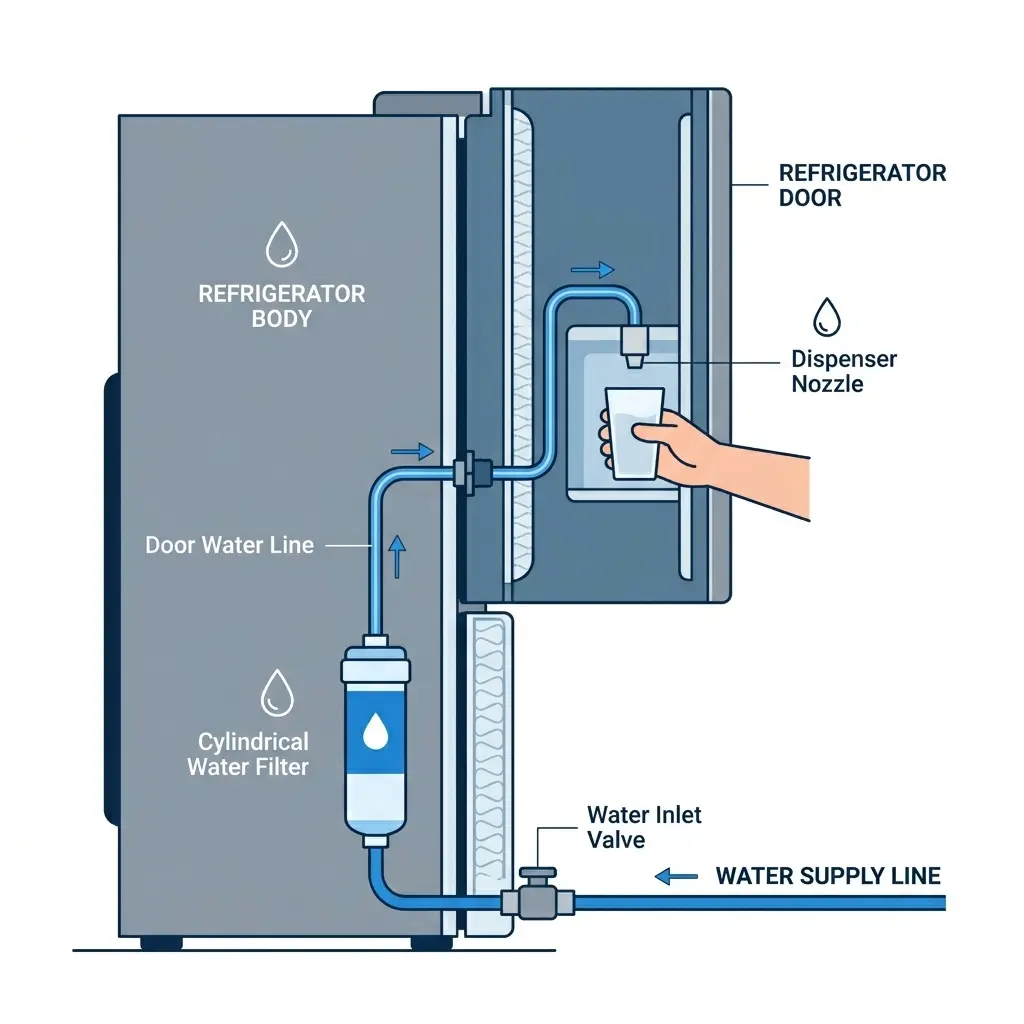
Samsung Water Dispenser System, Key Facts
| Component | Function | Average Replacement Cost |
| Water filter | Removes contaminants; restricts flow when clogged | $20 to $55 (OEM) |
| Water inlet valve | Opens/closes water supply electrically | $25 to $65 |
| Door switch / dispenser switch | Triggers dispenser when lever pressed | $10 to $30 |
| Water supply line (door) | Carries water from valve to nozzle | $15 to $40 |
| Dispenser control board | Processes dispenser commands | $45 to $120 |
| Water tank (some models) | Holds chilled water inside the fridge. | $30 to $70 |
| Dispenser actuator / lever | Physical button mechanism | $8 to $25 |
👉 Read More: [How Samsung refrigerator water filter works and when to replace it]
Quick Diagnosis: Find Your Problem Fast
Run through these quick checks before pulling anything apart. Most people find their answer right here.
- No water at all, no sound: Likely an inlet valve, water supply line issue, or Child Lock is active.
- Slow trickle of water: Almost always a clogged water filter or partially frozen line.
- Water dispenses but no ice: Separate ice maker issue; the dispenser system is fine.
- Dispenser works sometimes, not others: Faulty door switch or loose wiring connection.
- Dispenser makes a buzzing sound but no water: Inlet valve is receiving power but is stuck or faulty.
- Samsung refrigerator water dispenser worked fine, then stopped after filter change: Improperly seated filter or air lock in the line.
| 💡 PRO TIP: The very first thing to check on any Samsung refrigerator water dispenser problem is the child lock. If it is active, the display shows ‘CL’ or a lock icon. Hold the Child Lock button for 3 seconds to deactivate it. This solves the problem in roughly 15% of reported cases. |
7 Reasons the Samsung Refrigerator Water Dispenser Is Not Working, and How to Fix Each
1. Clogged or Expired Water Filter
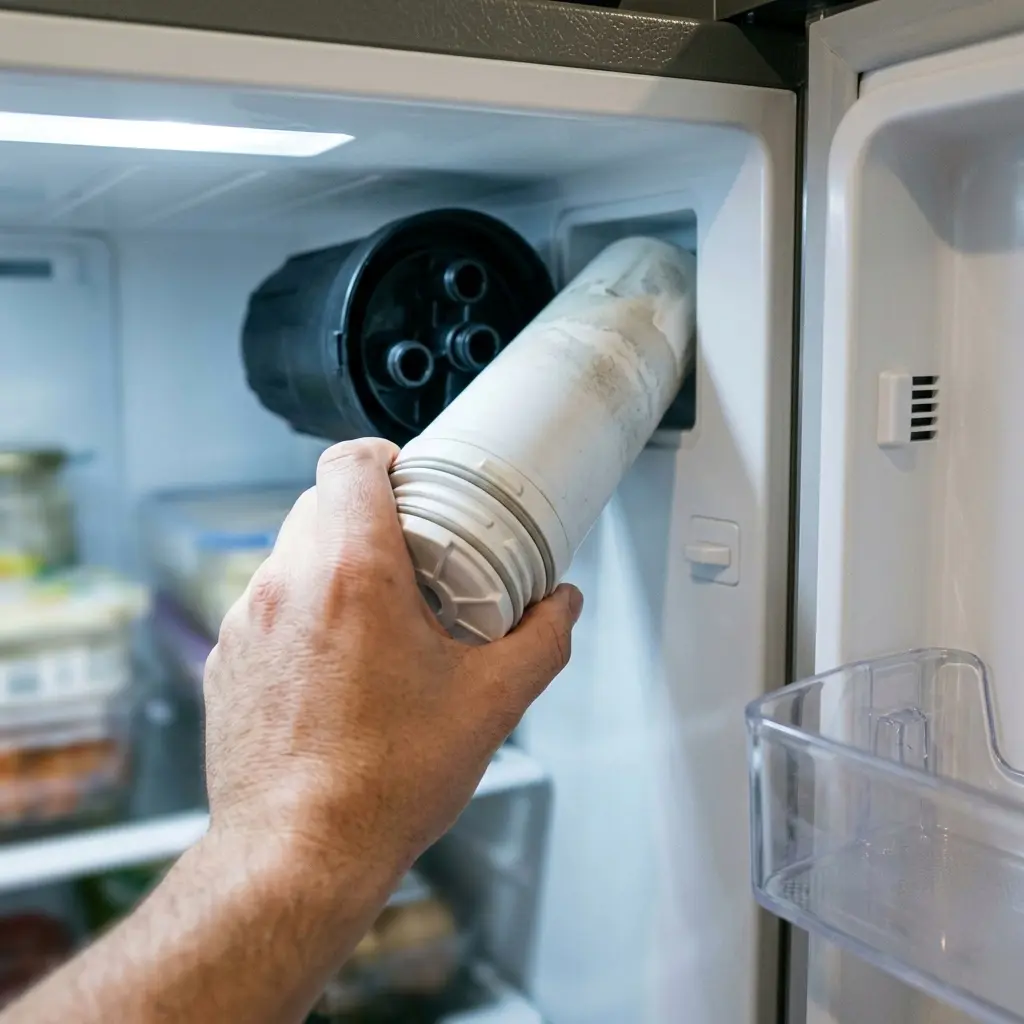
This is the single most common reason a Samsung refrigerator water dispenser slows down or stops completely. Samsung recommends replacing the water filter every 6 months or after 300 gallons (approximately 1,140 liters), whichever comes first.
When the filter becomes clogged, it restricts water flow to the point where the dispenser produces only a trickle, or nothing at all. Some Samsung models will actually stop the dispenser entirely when the filter restriction gets severe enough.
How to fix it: Locate your filter. On French door models (RF28, RF23, and RF27 series), it is usually in the upper right corner of the fresh food compartment. On side-by-side models (RS27, RS28 series), it is typically at the bottom front grille. Remove it by turning counterclockwise, insert the new filter, and turn clockwise until it clicks.
After installing a new filter, flush 2 to 3 gallons of water through the Samsung refrigerator water dispenser before drinking. This clears any carbon particles and removes air from the line.
| ⚠️ WARNING: Never operate the dispenser without a filter installed, and never use a filter past 12 months regardless of usage; bacteria can colonize an old filter. Samsung’s OEM filter part number for most current models is DA29-00020B. |
2. Frozen Water Line in the Door
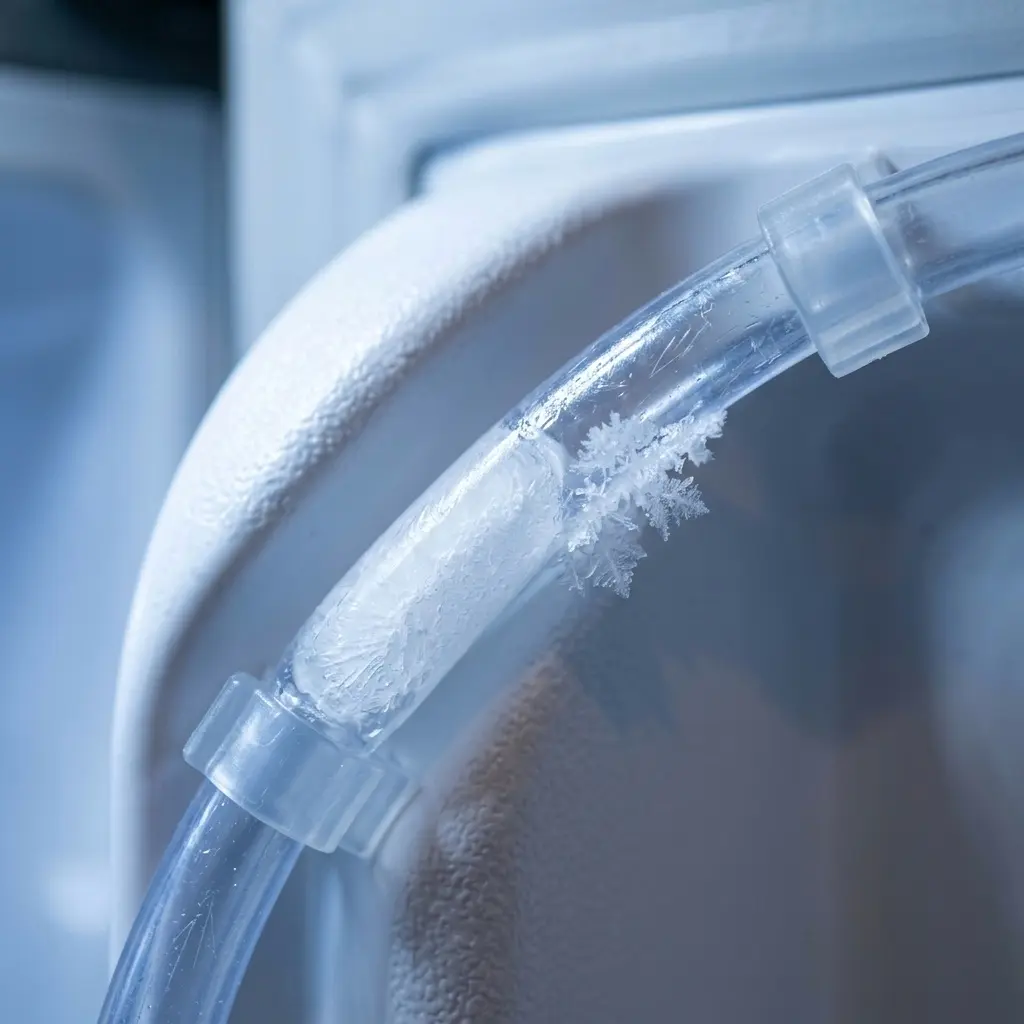
If you live in a cooler climate or your freezer temperature is set below -4°F (-20°C), the water supply line running through the refrigerator door can freeze solid. This is a surprisingly common issue on Samsung French door models with the dispenser built into the door.
How to confirm it: Disconnect the water line at the bottom of the door hinge. If no water comes out when you open the supply valve briefly, the line inside the door is frozen.
How to fix it: Use a hair dryer on low heat along the full length of the door, moving slowly. It typically takes 10 to 20 minutes. Once water flows freely, set your freezer to 0°F (-18°C), Samsung’s recommended setting, to prevent refreezing.
| 💡 PRO TIP: If your Samsung refrigerator water dispenser line freezes repeatedly, check the door gasket seal. A damaged gasket lets warm humid air into the freezer door cavity, which freezes around the water line overnight. A new door gasket costs $20 to $45 and fixes the root cause permanently. |
3. Faulty Water Inlet Valve
The water inlet valve is the electrically controlled gate that opens to let water enter the fridge from your home supply line. On Samsung models, this valve is located at the bottom rear of the refrigerator. It is a dual or triple solenoid assembly; one solenoid feeds the dispenser and another feeds the ice maker.
When the dispenser solenoid fails, the Samsung refrigerator water dispenser stops working, while the ice maker may continue to function normally (or vice versa). A buzzing sound when you press the lever is a classic sign that the valve is receiving power but the solenoid is stuck.
How to test it: Use a multimeter set to resistance. Disconnect power first. The dispenser solenoid on most Samsung inlet valves should read 200 to 500 ohms. A reading of OL (open circuit) means the solenoid is burnt out and the valve needs replacing.
Common part numbers: DA62-02635A (RF28, RF23 French door models) and DA62-01118B (RS27, RS28 side-by-side models).
4. Defective Door Switch or Dispenser Switch
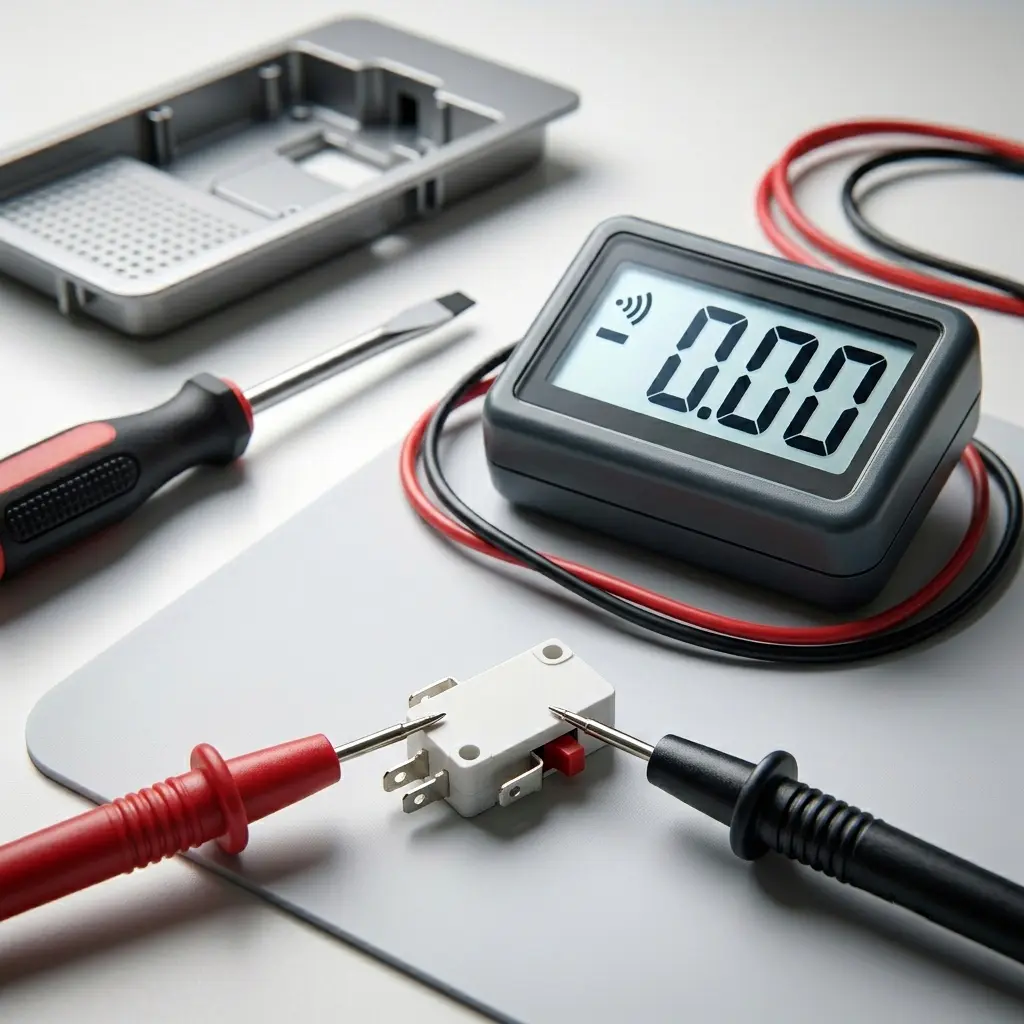
Every Samsung refrigerator water dispenser relies on a microswitch inside the dispenser lever assembly. When you press the lever, the switch closes and sends a signal to the control board. If the switch is worn or broken, no signal is sent and nothing happens.
How to test it: With the fridge unplugged, remove the dispenser lever panel (usually 2 Phillips screws). Locate the microswitch behind the lever. Use a multimeter on continuity mode and press the switch by hand. A working switch clicks and shows continuity. No continuity means the switch is faulty.
Dispenser switches are inexpensive. Samsung part DA34-00006C fits many current models and costs $10 to $20. Replacement takes about 20 minutes.
5. Child Lock or Demo Mode Is Active
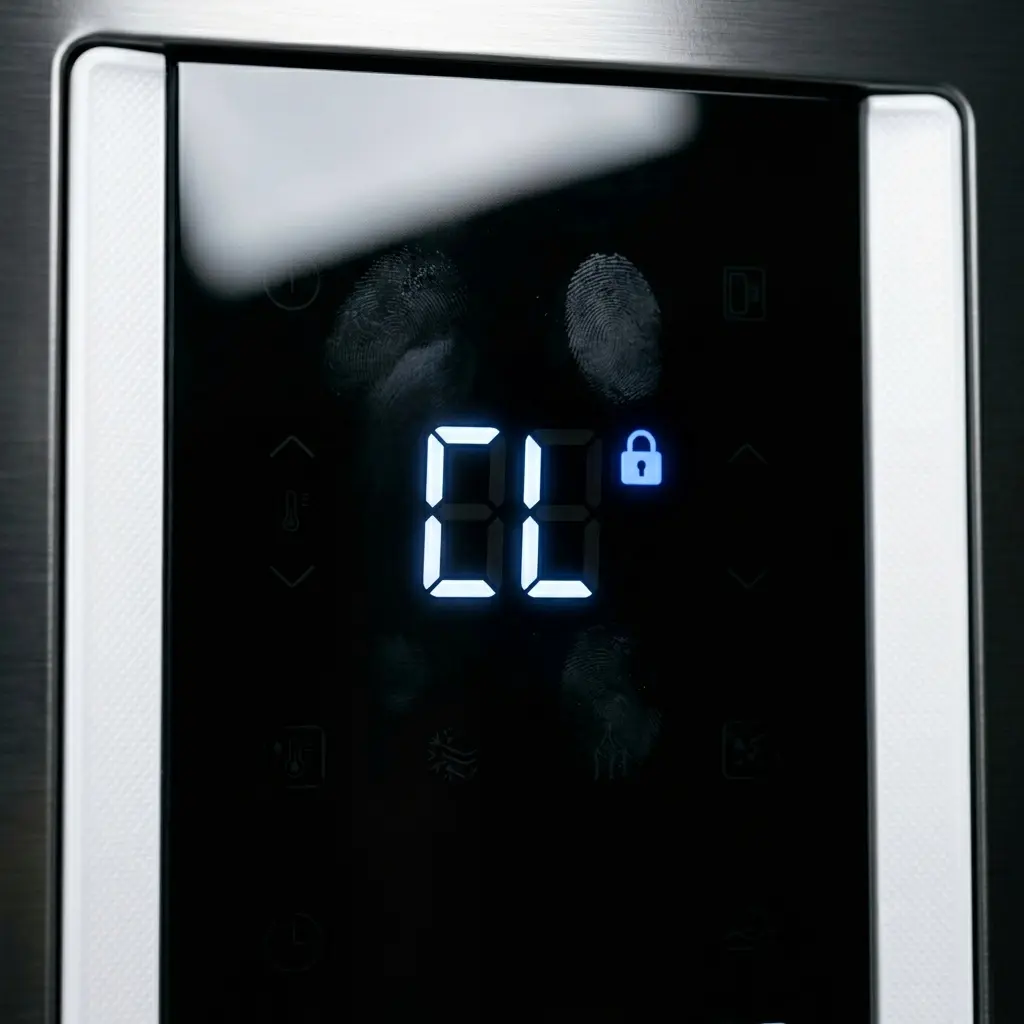
Both Child Lock and Demo Mode (also called Showroom Mode) disable the Samsung refrigerator water dispenser completely. Demo Mode is sometimes accidentally activated during setup or after a power outage, and it can be tricky to identify because the display still lights up normally.
To deactivate Child Lock, press and hold the Child Lock button (labeled on the display panel) for 3 seconds. The CL icon disappears.
To deactivate Demo Mode on most Samsung models: Press and hold both the Energy Saver and Freezer buttons simultaneously for 5 seconds. The fridge will chime and resume normal operation.
| ⚠️ WARNING: In demo mode, the compressor does not run, and the fridge does not cool. If your Samsung fridge has been in Demo Mode for more than a few hours, check food temperatures before consuming anything perishable. |
6. Low Water Pressure from Home Supply
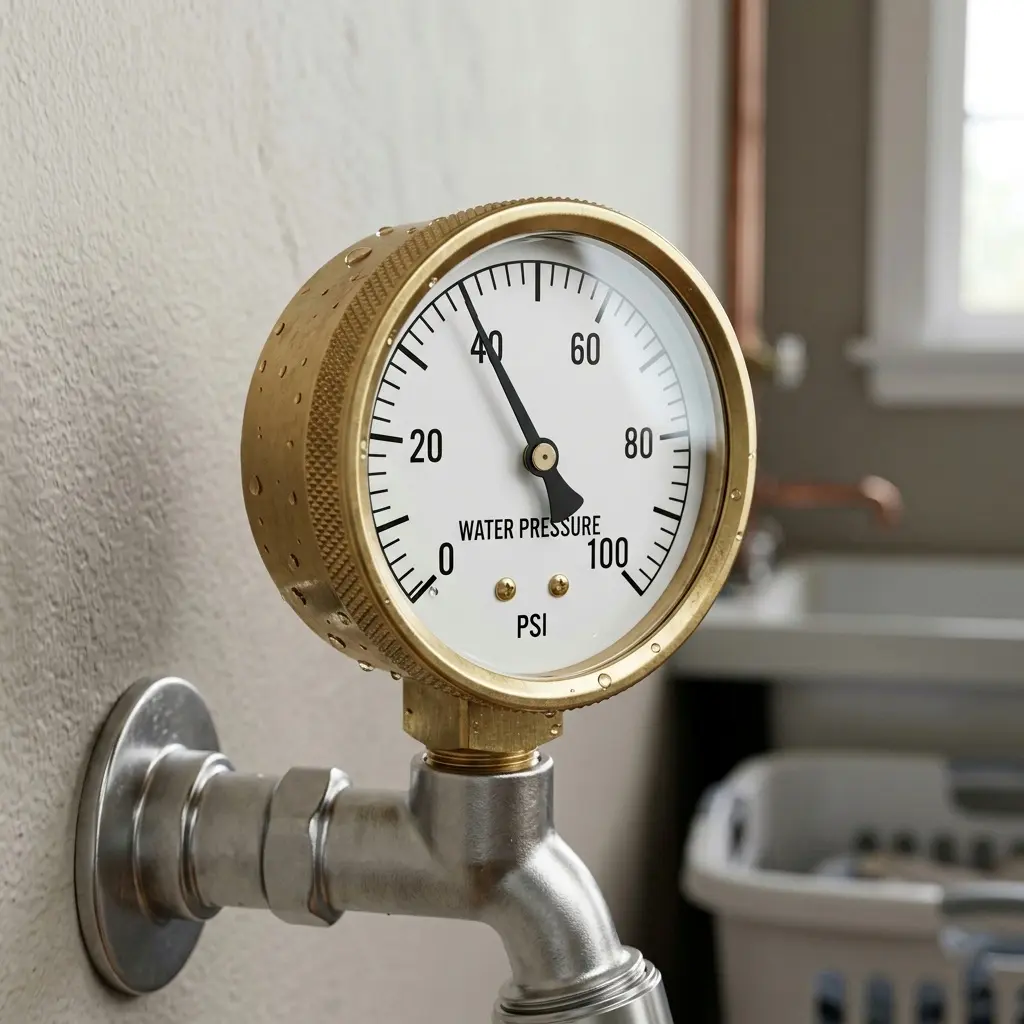
The Samsung refrigerator water dispenser requires a minimum household water pressure of 20 psi (pounds per square inch) to operate properly. The recommended range is 20 to 120 psi. If your home water pressure is below 20 psi, the inlet valve cannot open fully, and the dispenser produces only a trickle or nothing.
How to check it: Attach a water pressure gauge to a nearby faucet or hose bib. Gauges cost $8 to $15 and are available at any hardware store. If pressure is below 20 psi, the issue is with your home plumbing, not the fridge.
Also check the water supply valve behind the fridge. It should be fully open (turned counterclockwise all the way). A partially closed valve creates exactly the same symptom as low household pressure.
7. Faulty Dispenser Control Board
The dispenser control board sits behind the display panel on the front of the door. It processes input from the dispenser switch and sends the command to open the inlet valve. When it fails, the Samsung refrigerator water dispenser and often the ice dispenser both stop responding.
This is the least common failure, but it does happen, particularly on Samsung models that are 5+ years old or have experienced power surges. If you have ruled out all other causes and the Samsung refrigerator water dispenser is still not working, the control board is the likely culprit.
How to confirm it: If the dispenser display panel is completely dark or showing scrambled characters, and you have already confirmed the door switch and inlet valve are working correctly, the control board is almost certainly the fault. Samsung part DA92-00215A covers several French door models; always confirm with your model number first.
👉 [Samsung Fridge Warm Freezer Cold?] 3 Easy DIY Fixes]
Samsung Water Dispenser Parts Reference Table
Use your model number (sticker inside the fresh food compartment or on the door frame) to confirm the right part before ordering.
| Samsung Model Series | Water Filter | Inlet Valve | Dispenser Control Board |
| RF28R, RF23R, RF27T (French door) | DA29-00020B | DA62-02635A | DA92-00215A |
| RS27T, RS28A (side-by-side) | DA29-00020B | DA62-01118B | DA41-00784A |
| RH25H, RH29H (4-door flex) | DA97-17376B | DA62-02635A | DA92-00215A |
| RT18M, RT21M (top freezer) | No filter (direct connect) | DA62-00914B | DA41-00784A |
| RFG297, RF268 (older French door) | DA29-00003G | DA62-00914B | DA41-00784A |
Common Mistakes People Make When Troubleshooting the Samsung Water Dispenser
| ⚠️ NOTE: These mistakes are the main reasons people spend hours troubleshooting without finding the answer or make the problem worse. |
- Replacing the water filter before checking Child Lock: Child Lock disables the Samsung refrigerator water dispenser completely. Always check it first; it takes 3 seconds and costs nothing.
- Installing the new filter incorrectly: The filter must align and click into place fully. A filter that is 90% seated will restrict water to almost nothing. After installation, always push firmly until you feel and hear the click.
- Forgetting to flush the new filter: Running the Samsung refrigerator water dispenser for 2 to 3 gallons after a filter change is not optional; it clears air bubbles that cause stuttering or no flow.
- Assuming inlet valve failure without testing: Many people replace the inlet valve unnecessarily. Always test with a multimeter first; a $60 valve replacement is wasted money if the real problem is a $12 switch.
- Not checking the water supply valve behind the fridge: This valve sometimes gets bumped closed when moving the fridge for cleaning. A fully closed supply valve perfectly mimics inlet valve failure.
- Skipping the water pressure test: Low pressure from the home supply looks identical to a faulty inlet valve from the outside. A pressure gauge test takes two minutes and rules this out completely.
Pro Tips from Appliance Technicians
| 💡 TIP 1: After any repair on the Samsung refrigerator water dispenser, hold a cup under the nozzle and press the lever for a full 60 seconds continuously. This primes the line, pushes out any air pockets, and confirms the repair is holding under sustained use. |
| 💡 TIP 2: Once or twice a year, wipe the dispenser nozzle and drip tray with a mixture of white vinegar and water (1:1 ratio). Mineral deposits from hard water build up inside the nozzle over time and can partially block water flow, creating a symptom that looks like a major component failure. |
| 💡 TIP 3: On Samsung French door models with a door-in-door design, the water line runs through a hinge assembly. If the Samsung refrigerator water dispenser starts leaking or dripping inside the door, inspect the hinge water connection for cracks; the plastic fitting becomes brittle after 5+ years. |
| 💡 TIP 4: If you have replaced the filter and the Samsung refrigerator water dispenser flow is still slow, remove the filter and run the dispenser briefly without it. If flow immediately becomes strong, you have a confirmed filter restriction, but also check that you installed the correct filter model, as an incorrect filter can restrict flow even when new. |
| 💡 TIP 5: Samsung SmartThings-connected fridges (RF28BB6900, RF32CG5400, and similar 2024-to-2026 models) can display filter status, water flow rate, and even error codes related to the dispenser system directly in the app. If your model has Wi-Fi connectivity, check the SmartThings app before doing any physical troubleshooting; it often identifies the problem component immediately. |
Pros and Cons of Samsung Refrigerator Water Dispensers
| Pros | Cons |
| Filtered water on demand, no buying bottles | Filter replacement costs $20 to $55 every 6 months |
| Dual dispenser (water + ice) on most models | Door water line can freeze in very cold climates |
| SmartThings app tracks filter life on 2024+ models | Dispenser control board replacement is expensive ($45 to $120). |
| Child Lock prevents accidental activation | More components = more potential failure points vs basic fridge |
| NSF/ANSI 42 and 53 certified filtration on OEM filters | Requires a minimum of 20 psi household water pressure |
| Easy filter replacement, twist-and-lock design | Non-OEM filters can void warranty on some Samsung models |
FAQ, Samsung Refrigerator Water Dispenser Not Working
1. Why did my Samsung refrigerator water dispenser suddenly stop working overnight?
The most sudden overnight failures are usually caused by either child lock being accidentally activated, the water supply line freezing (if temperatures dropped overnight), or the water inlet valve solenoid failing. Start by checking Child Lock on the display panel, then feel the fridge door; if the outside feels unusually cold, a frozen line is likely. Use our quick diagnosis checklist at the top of this guide to narrow it down in under five minutes.
2. How often should I replace the Samsung water filter to keep the dispenser working well?
Samsung officially recommends every 6 months or 300 gallons (approximately 1,140 liters). In practice, if you have very hard water or a large household, you may need to replace it closer to every 4 to 5 months. The indicator light on the display (red or orange) signals when the filter is due. Never ignore this warning; a severely clogged filter can strain the inlet valve and cause it to fail prematurely.
3. My Samsung refrigerator water dispenser works, but the flow is very slow. What causes this?
Slow flow from a Samsung refrigerator water dispenser is almost always caused by one of three things: a clogged filter that needs replacing, household water pressure below 20 psi, or a partially frozen water line inside the door. Run through these three checks in order. If flow is strong when you bypass the filter entirely, the filter is confirmed as the culprit. If bypass does not help, check your supply pressure.
4. The dispenser makes a buzzing sound when I press the lever, but no water comes out. What is wrong?
A buzzing sound with no water is a very specific symptom. It means the inlet valve is receiving the electrical signal (the buzzing is the solenoid trying to open), but water is not passing through. The most likely causes are a seized or failed solenoid inside the inlet valve or an air lock after a filter change. Try pressing and holding the dispenser lever for 60 continuous seconds to break an air lock. If that does not work, test the inlet valve with a multimeter and replace it if the solenoid reads open circuit.
5. Can I use a non-Samsung aftermarket filter without affecting the dispenser?
Physically, yes, most aftermarket filters are designed to fit Samsung twist-lock filter housings. However, there are two real risks. First, some aftermarket filters have slightly different internal dimensions that restrict flow more than OEM filters at the same fill level. Second, Samsung’s warranty documentation states that using non-OEM filters can void coverage for water-related damage. For everyday use, reputable NSF-certified aftermarket brands (Waterdrop, ICEPURE, and Brita) generally perform well. For warranty peace of mind, stick to Samsung OEM part DA29-00020B.
6. After I replaced the filter, my Samsung refrigerator water dispenser stopped working completely. Why?
This is almost always caused by an airlock in the water line. When you remove the old filter, air enters the line. If the line is not properly primed after the new filter is installed, the trapped air creates a blockage. Press and hold the dispenser lever for 2 to 3 minutes continuously (release and re-press every 30 seconds if your model has a timeout). Alternatively, the new filter may not be fully seated; remove it and re-insert it firmly until it clicks. A filter that is slightly misaligned blocks water flow completely.
7. Is it worth repairing a Samsung refrigerator water dispenser on a 10-year-old fridge, or should I replace the whole appliance?
If the only issue is the Samsung refrigerator water dispenser and the compressor, cooling system, and ice maker are all working fine, repair is almost always the right call. Even a worst-case dispenser repair, replacing the inlet valve and control board together, costs $70 to $185 in parts. That is a fraction of the $900 to $3,000 cost of a comparable new Samsung French door refrigerator. The exception would be if the fridge has multiple simultaneous failures, visible rust, or significant compressor problems; in that case, a new appliance makes more economic sense.
Conclusion
A Samsung refrigerator water dispenser that stops working feels like a big problem, but in almost every case, the fix is straightforward and affordable. Start with the simplest checks first: Child Lock, the water filter, and the supply valve. Work your way through the causes in order, and you will find the answer without spending money on parts you do not need.
Most repairs cost under $35 and take less than an hour. The Samsung refrigerator water dispenser is a well-engineered system, and with the right diagnosis, you can get it back to full working order yourself. If you found this guide helpful, check out our related articles below for more Samsung fridge troubleshooting and maintenance tips.