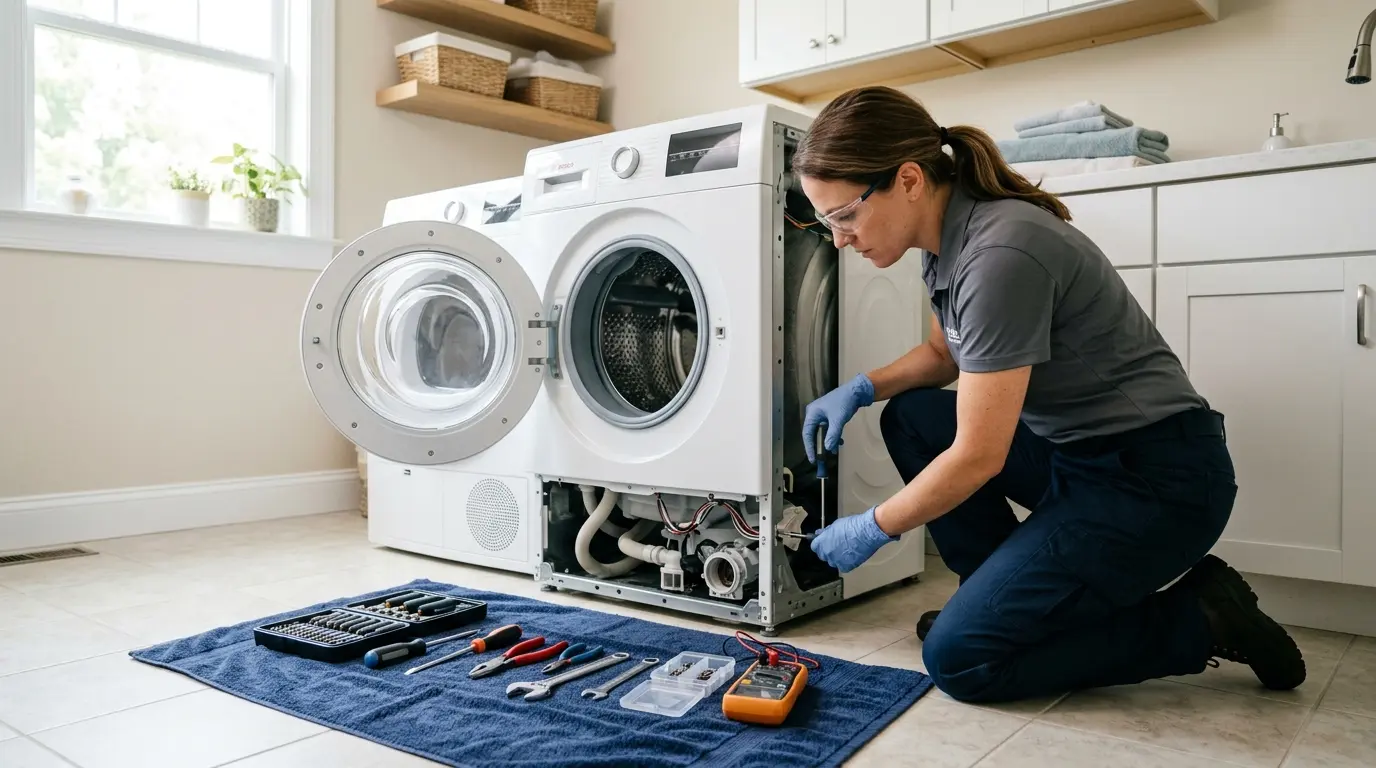
A washer that quits mid-cycle can often be fixed for far less than the cost of a service call. Many Frigidaire washer repair jobs come down to five commonly failing parts, and a patient homeowner with basic tools and a free afternoon can replace most of them. If you’re still trying to work out what failed, start with 👉 [Frigidaire washer error codes diagnostic guide]. This guide picks up once you know which part is bad.
| Note: The steps in this guide are written for front-load Frigidaire washers. Top-load models have different layouts, and parts like the drain pump and lid lock are in different locations. Always check your model’s manual first. Disclosure: As an Amazon Associate, we earn from qualifying purchases. This does not affect the price you pay. |
Table of Contents
1. Safety First: Read This Before You Touch Anything
| ⚠ SAFETY WARNING |
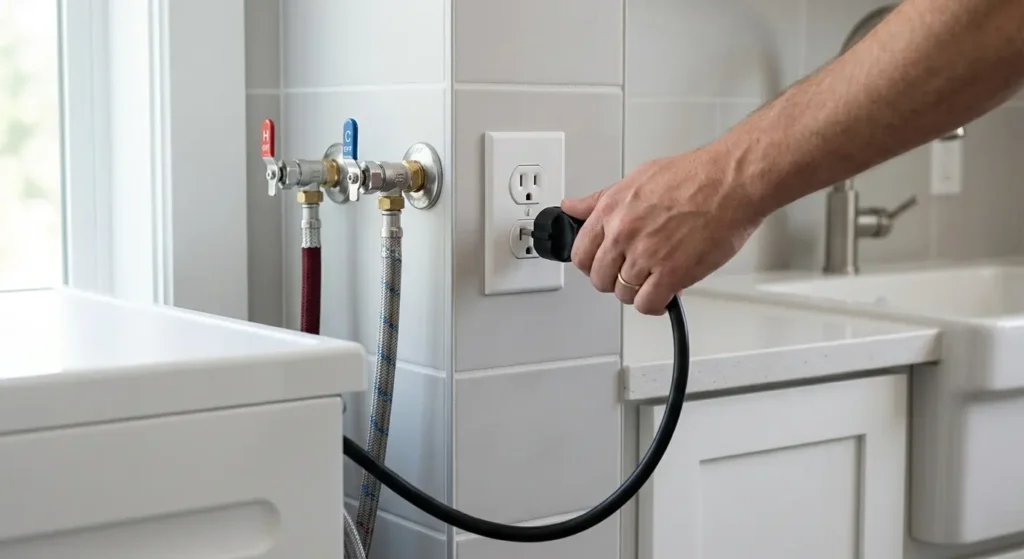
| Every repair in this guide starts with these steps. No exceptions. Unplug the washer. Pull the plug from the wall. Switching it off at the control panel is not enough, because the control board and several components stay live. Shut off both water valves behind the washer and disconnect the hoses if you need to move the machine. Have a shallow pan and towels ready; hoses and pumps always hold some water. Drain the machine first. A front-loader can hold a surprising amount of water in the tub and sump. Drain through the small hose on the lower front panel or the coin trap. Never tilt or lay down a washer that still holds water. Keep your hands dry and stay off wet floors while working near the plug, wiring, or control board. Do not touch the control board or its connectors with the machine plugged in. Wait several minutes after unplugging before reaching near it. Watch for sharp edges. Cabinet panels and the rear housing can cut. Wear cut-resistant gloves. Get a second person for anything involving lifting, pulling the washer out, or handling the tub. Washers are heavy and top-heavy. Photograph every wire connector before disconnecting it. This prevents the most common reassembly mistake. STOP and call a licensed technician if you see scorched or melted wiring, a burning smell, water reaching electrical components, a damaged power cord or outlet, or any problem inside the tub bearing or suspension that requires splitting the tub. Do not attempt work on your home’s wiring or breaker panel. That is electrician territory, not appliance repair. |
2. Before You Buy a Part: Confirm the Model and the Culprit
Frigidaire has made many washer platforms, and parts that look identical often differ by a tab or a connector. Find the model and serial number tag, usually inside the door frame on front-loaders or under the lid on top-loaders, and search parts by that full model number.
The insider step most guides skip: test the part before you order it. A drain pump that hums but doesn’t move water is often just clogged, and a pump that is silent might have a bad wire connection rather than a dead motor. Set a multimeter to continuity or resistance and check the component against the spec in your model’s tech sheet, which is often tucked behind the machine or in the parts documentation. Ten minutes with a meter saves a return shipment. Always unplug the washer and disconnect the part from the machine before testing it. Never test a part while the washer is plugged in.
3. Tools and Parts at a Glance
| Repair | Typical Difficulty | Approx. Time | Extra Tools Beyond Basic Set |
| Drain pump | Easy to moderate | 45–90 min | Shallow pan, towels, pliers |
| Door lock assembly | Easy | 30–60 min | Flathead screwdriver |
| Door boot (gasket) | Moderate | 60–90 min | Zip tie, flathead screwdriver |
| Water inlet valve | Easy | 30–45 min | Pliers, bucket |
| Drive belt | Moderate | 60–120 min | Second person, nut driver |
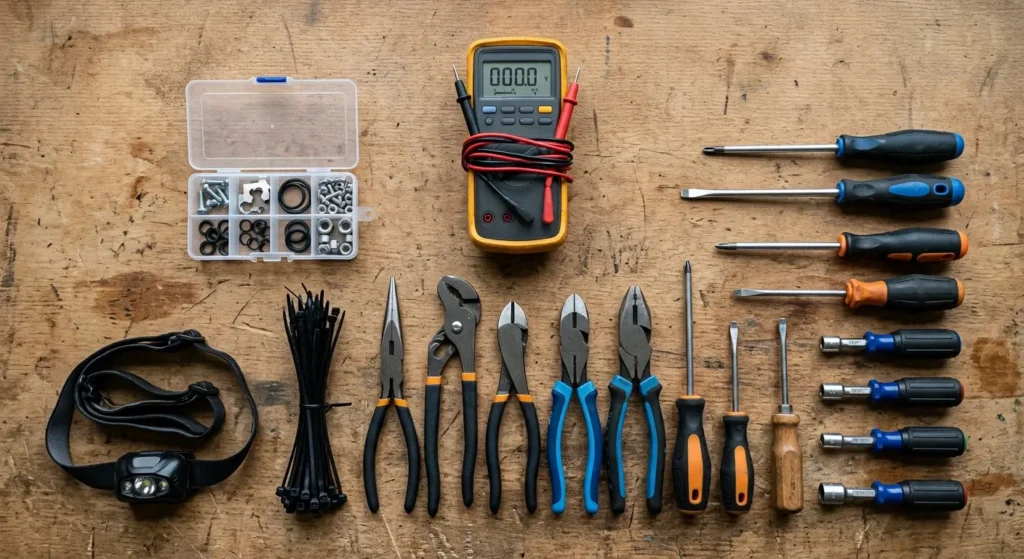
Your basic kit: a Phillips screwdriver, a flathead, a 1/4″ and 5/16″ nut driver, pliers, a multimeter, a phone for photos, and a flashlight. A headlamp beats a flashlight because it frees both hands.
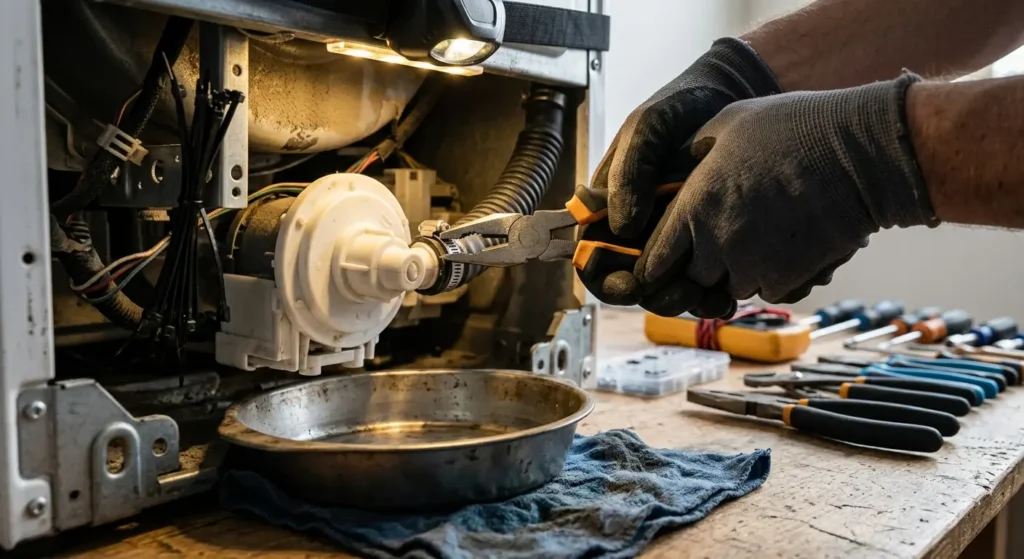
4. Replacing the Drain Pump
When it’s worth it: the machine sits full of water, and you’ve already cleaned the coin trap and inspected the drain hose. Before buying anything, check the trap. Coins, hair ties, and underwire fragments are the usual clog, and clearing them costs nothing. 👉 [Frigidaire Washer E20 Drain Error: Drain Pump Filter, Hose & Pump Check & Easy Fix]
Steps on a typical front loader:
- Complete the safety steps and drain the machine through the coin trap.
- Remove the lower front panel (a few screws or clips depending on the model).
- Photograph the pump, its hoses, and its wiring connector.
- Loosen the hose clamps with pliers and slide them back. Expect a trickle of water.
- Disconnect the wiring connector, then remove the pump’s mounting screws or twist lock, depending on the design.
- Clean any debris out of the hose stubs before installing the new pump. A new pump on a clogged hose fails fast.
- Install the replacement, reattach hoses and clamps, and reconnect the wiring.
- Restore power and water, run a short drain-and-spin cycle, and check for leaks with a dry paper towel around each clamp.
Tip: If the machine has leaked near the pump for months, the pump itself may be fine while the cabinet base or floor has soaked through. Check for water damage or rust before closing everything up.

- Brand New WH11X34742 Washer Drain Pump Assembly Compatible with Follow Models: MLV41N1AWW MLV45N1BWW MLV45N1BWWC MLV45N3…
- WH11X34742 Washer Drain Pump Assembly Replace Part Number: WH01X28078 11001011000071 B40-3A 4980769 4584305 5304511363 A…
- Drain pump WH11X34740 removes water from the washer during the drain portion of the cycle.
5. Replacing the Door Lock and Door Boot
Door lock assembly
A failed lock leaves the door either stuck shut or unable to latch, so the cycle won’t start. On most Frigidaire front-loaders, the lock sits on the front panel behind the door boot’s outer edge.
- Unplug the washer. If the door is stuck shut, use the manual release cord or tab near the lock first (check your manual), then open the door.
- Peel back the outer lip of the boot from the front panel.
- Remove the mounting screws holding the lock assembly and pull it forward.
- Photograph, then disconnect the wire harness.
- Connect the new lock, mount it, and seat the boot lip back into place.
If the door is stuck shut with the machine unplugged and drained, a small release cord or tab sometimes sits near the lock. Check your manual before forcing anything, because prying the door can crack the frame. 👉 Frigidaire Washer Door Lock Error: Test the Lock Assembly

- Widely Compatible: Upgrade washing machine with this premium quality washer door latch replacement, suitable for various…
- Replacement Part Number: 1312694, 1531974, 3626240, 131269400, 131763200, 131763202, 131763245, 131763255, 131763256, AH…
- Premium Quality Materials: Made with high-quality materials and updated for maximum durability, this 131763256 washer do…
Door boot (gasket)
Tears, black mold buildup that won’t wipe out, or leaks around the door all point to the boot. The job takes patience more than skill.
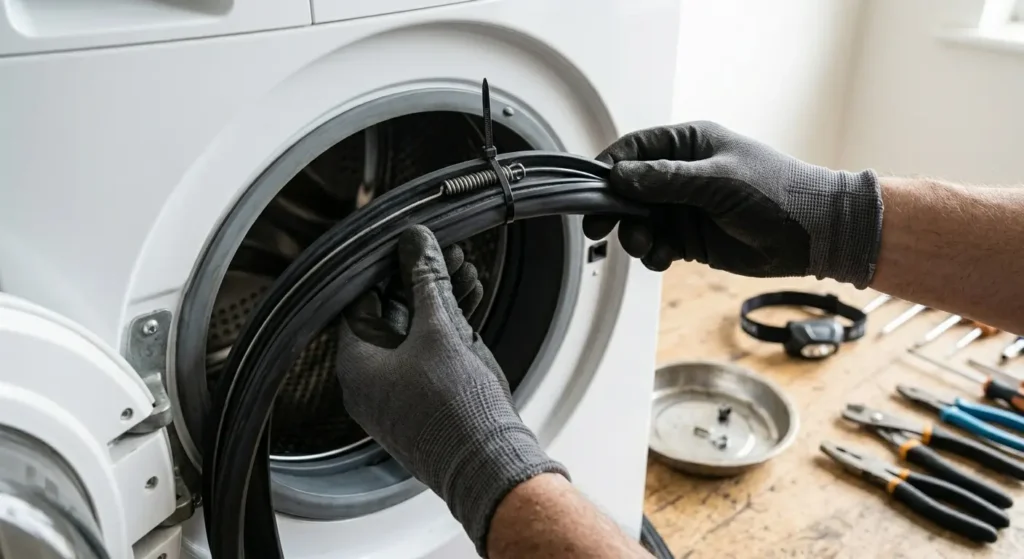
- Remove the outer clamp ring. It’s usually a wire spring; pry it up gently with a flathead and work it around.
- Repeat on the inner ring at the tub side, reaching in through the front.
- Note how the boot’s drain hole and tabs align, then remove it.
- Fit the new boot, matching those alignment marks exactly.
- Reinstall the inner clamp first, then the outer.
Insider trick: the wire spring clamps are hard to hold while they seat. Loop a zip tie around the spring as a temporary hold, then cut it off once the clamp sits fully in its groove. This saves a lot of knuckle scrapes.

- 【Product Overview】5304505004 Washer Door Boot Seal provides complete drum containment to prevent leaks for your washer
- 【High Quality】This 5304505004 Washer Door Boot Seal is made of high-quality materials
- 【Replaceable Models】The 5304505004 Washer Door Boot Seal replaces the following parts: 4931397, 5304505239, 5304516744, …
6. Replacing the Water Inlet Valve
A weak or failed inlet valve gives you a washer that fills slowly, overfills, or won’t fill at all. The valve sits at the back of the machine, where the hoses attach.
- Complete the safety steps, then remove the hoses from the back and drain what’s in them into a bucket.
- Remove the top or rear panel to reach the valve body.
- Photograph the internal hoses and the wire connectors on the solenoid terminals.
- Release the hose clamps, disconnect the wires, and unscrew the valve from the cabinet.
- Install the new valve, reconnect hoses and wires in the same positions, and tighten the clamps.
- Reattach the fill hoses and check for drips before running a cycle.
Insider tip: before you install the new valve, look at the small mesh screens inside the hose connections on your washer. Grit clogs them and mimics a failing valve. If those screens are packed with sediment, cleaning them may solve the problem entirely, and you’ll want them clean anyway so the new valve isn’t starved.


7. Replacing the Drive Belt
Important: This repair applies only to belt-drive models. Many newer Frigidaire front-loaders use a direct-drive motor and have no belt at all. Check your model’s parts diagram before ordering a belt.
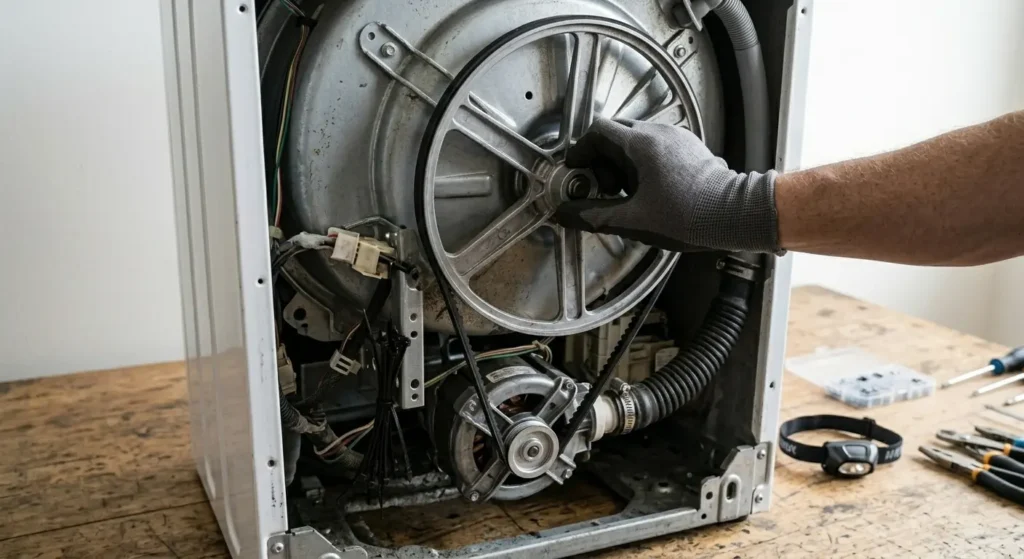
Belt problems show up as a drum that barely turns, a burning-rubber smell, or a motor that runs while the drum sits still. You’ll generally reach the belt through the rear panel of the washer, so this is the job where a helper matters most.
- Unplug, close the water valves, and pull the washer out with a second person.
- Remove the rear panel screws.
- Inspect the belt for glazing, cracks, or fraying, and check it sits properly on both the motor pulley and the drum pulley.
- Slip the new belt onto the motor pulley first, then roll it onto the drum pulley while rotating the drum by hand.
- Spin the drum slowly by hand to confirm the belt tracks straight and doesn’t rub the housing.
Know where DIY ends: if the belt is fine but you hear a deep rumble or grinding from the drum, or the drum wobbles with side-to-side play, the problem is likely the tub bearing. That repair usually requires removing and splitting the tub, and it’s a job most homeowners should hand to a technician.
8. Repair or Replace the Whole Washer?
A common rule of thumb: if the repair costs more than roughly half the price of a comparable new washer, and the machine is a decade or more old, replacement usually makes sense. Parts like the drain pump, lock, and inlet valve almost always pay off, since they’re inexpensive and the rest of the washer is usually healthy. A tub bearing or a control board on an older machine is where the math turns against repair.
One small detail that decides many cases: if the drum shows rust streaks or the cabinet base is corroded from long-term leaks, other failures are likely to follow. Walk away from a cheap repair on a rotting machine.
9. FAQ: Frigidaire Washer Repair
1. Can I replace a Frigidaire washer drain pump myself?
Yes, in most cases. It requires draining the machine, removing a lower panel, and swapping hoses and a wire connector. Follow the safety steps first.
2. How do I know which part number to order?
Use your full model number from the tag inside the door frame or under the lid, and match it on a parts lookup. Similar-looking parts often differ by connector or fitment.
3. Is it safe to open the washer while it’s plugged in?
No. Always unplug it before removing any panel. Live components remain energized even when the machine is off.
4. Why does my new door lock still not work?
The lock may not be the problem. A damaged wire harness or a door that isn’t aligning with the latch can prevent locking. Inspect the harness connector and the door strike.
5. Do I need special tools to change a door boot?
Not really. A flathead screwdriver and a zip tie for holding the clamp spring are usually enough.
6. How long does a Frigidaire washer belt last?
It varies with load size and usage. Replace it when you see glazing, cracks, or slipping rather than on a fixed schedule.
7. When should I call a professional instead?
Call one for a tub bearing, any scorched wiring, water damage near electrical parts, or any repair where you’re unsure about the safety steps. A misjudged DIY repair can cost more than a service call.
10. Conclusion
Most washer failures come from a small group of inexpensive parts, and you now know how to replace the five that fail most often. Confirm your model number, test before you buy, and treat the safety steps as part of every job, not an optional extra. Pick the repair that matches your symptom and start this weekend. If this guide saved you a service call, tell other readers in the comments, and browse the rest of TechElectronicLive.com for more washer and refrigerator repair walkthroughs