
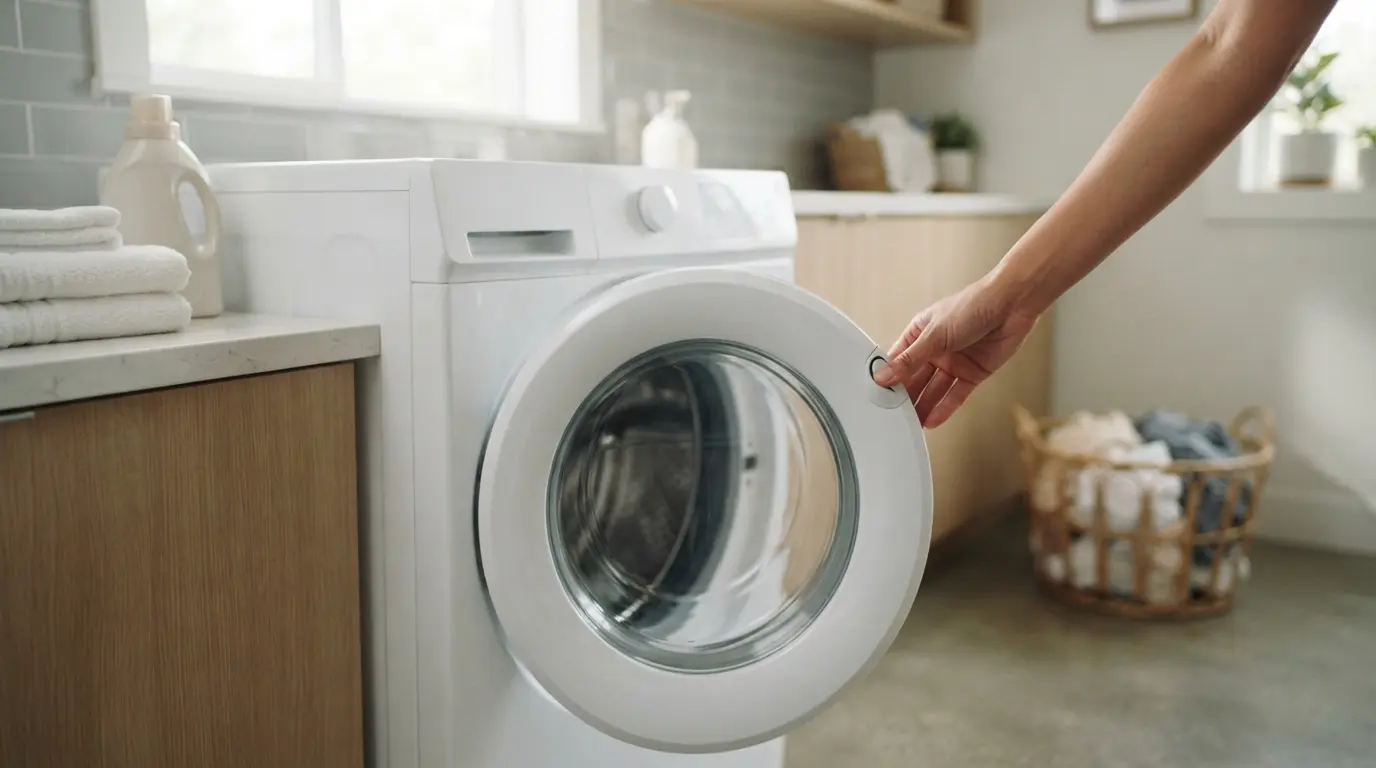
Half the door lock errors I get called to be fixed by closing the door properly, and the other half ends with a part that costs less than the visit. If your washer is flashing a Frigidaire washer door lock error and refusing to start, you can sort out which half you’re in with a flashlight, a towel, and a cheap multimeter. This guide walks through the checks in the order a technician runs them, so you only buy a part once the test says you need one.
Not sure your code is a door fault? Start with [INTERNAL LINK: Frigidaire washer error code guide: what the codes actually mean], then come back here.
Table of Contents
Before you start: tools and safety
You need a flashlight, a multimeter, a nut driver or screwdriver set, a flat plastic trim tool or putty knife, a towel, and gloves. Panel and cabinet designs differ between Frigidaire series, so keep your full model number and manual handy. They tell you how your cabinet opens and where the lock assembly sits.
| SAFETY: READ BEFORE YOU TOUCH ANYTHING Unplug the washer from the wall, not just switch it off, before you open any panel or touch the lock wiring. Never force the door open while there’s water in the drum, since the water will pour out onto the floor. Drain the machine first and check your manual for a manual door release if your model has one. Wear gloves, because cabinet edges are sharp. Never test the lock with the washer plugged in unless your model’s service data specifically calls for it, and if you’re not comfortable working near wiring, stop after Check 2 and call a technician. |
Check 1: Rule out the door itself.
Before you open any panel, treat the door as the suspect, because that’s where I look first on every call. The control board only wants one thing before a cycle: confirmation that the door is shut and locked. A door that isn’t seated cleanly can’t give it.
- Look around the gasket. A sock corner, a bra strap, or a pocket item pinched between the door and the rubber seal is the most common cause of a door lock fault, and it’s invisible from the front.
- Check the load size. An overstuffed drum pushes laundry against the glass, and the door ends up barely latching. Remove a few items and try again.
- Close the door and listen. A firm click means the latch engaged. A soft thud with no click means the door isn’t reaching the lock. Press gently on the door’s edge while you start a cycle and see if the error clears.
- Try the controls. Many models have a control lock feature that blocks cycle starts. If the panel shows a lock indicator or the buttons seem dead, check your manual for how to turn it off before suspecting any hardware.
- Reset the washer. Unplug it for a few minutes, plug it back in, and try again. This clears one-time glitches. If the code returns right away, treat it as a real fault.
| INSIDER TIP: WHAT TECHNICIANS ASK FIRST The question most owners never think of is, “Does the door feel different than it used to?” A door that has started to sag, or one you now have to lift slightly to make it latch, usually means the hinge has loosened or the strike is no longer lining up with the lock. That’s a mechanical alignment problem, and no amount of new electronics will fix it. |
If the washer started fine until the door closed and then did nothing at all, that’s a different symptom, covered in [INTERNAL LINK: Frigidaire washer won’t start with the door closed: control lock, start button, and lock switch].
Check 2: Look at the latch, strike, and wiring.
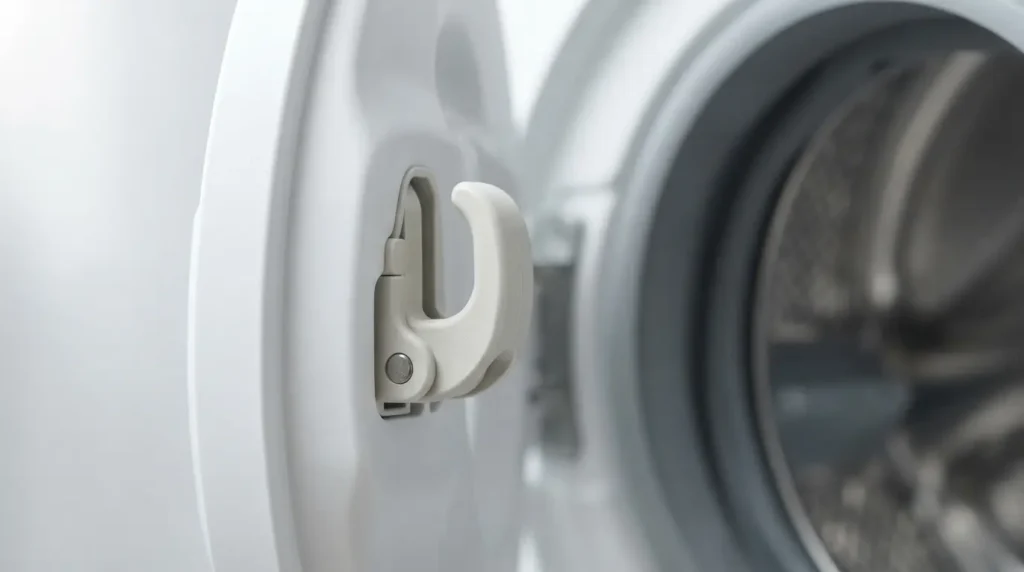
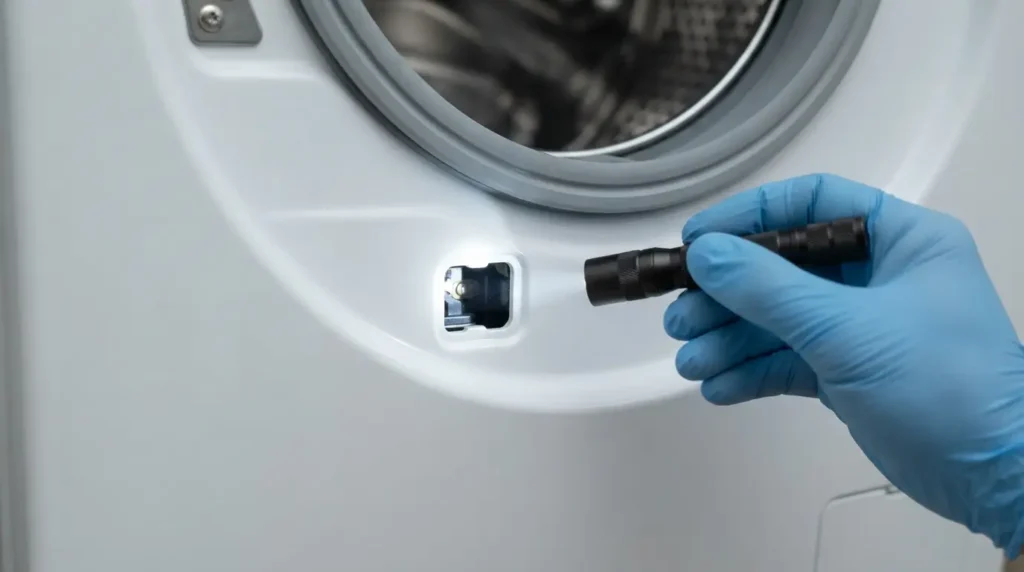
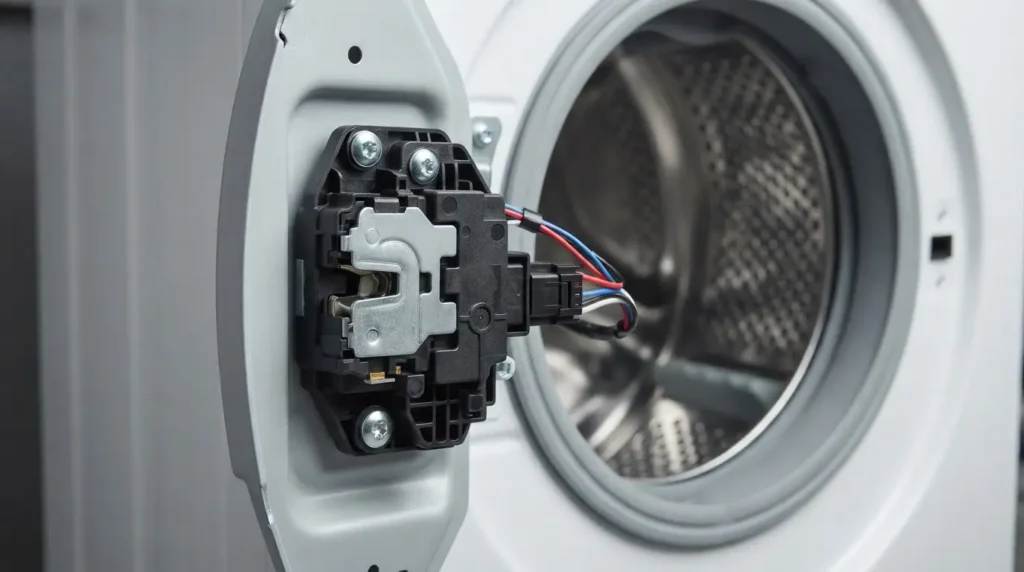
With the washer unplugged, open the door fully and look at the two halves of the latch: the plastic hook (the strike) on the door and the lock opening on the washer’s front.
- Shine the flashlight into the lock opening and look for debris, lint, or detergent residue packed around the slot.
- Inspect the plastic strike on the door. Look for cracks, chips, or a hook worn round at the tip.
- Close the door slowly and check that the strike enters the slot squarely. A strike that hits the edge of the opening points to a door alignment problem.
- Wiggle the lock assembly gently with a fingertip if you can reach it. It should sit firmly in the cabinet, not rattle.
- Check the door and the lock for any melted plastic or burn marks, which suggest a deeper electrical fault and a reason to stop and call a technician.
Wiring problems turn up more often than you’d expect. Once the cabinet is open for Check 3, look for the connector feeding the lock. A loose, corroded, or heat-darkened connector can fake a failed lock. Reseat it firmly before you condemn the part.
Routine care for the gasket, including wiping the fold and clearing small items from it, is part of [INTERNAL LINK: Frigidaire washer maintenance schedule].
Check 3: Test the lock assembly.
If the door seats cleanly and the strike is sound, the lock assembly is next. The assembly combines a latch, a switch that tells the board the door is closed, and a mechanism that physically locks it during a cycle. On many front-loaders the locking part is heated and released when current flows through it, which is why a washer can take a short while to unlock after a cycle.
Get access.
On many Frigidaire front-loaders the lock sits behind the front of the cabinet near the door opening, and you reach it by opening the top panel or lifting the front panel, but this varies between series. Check your manual for your model. Photograph the wiring connectors before you touch them, then unplug them one at a time.
Test it.
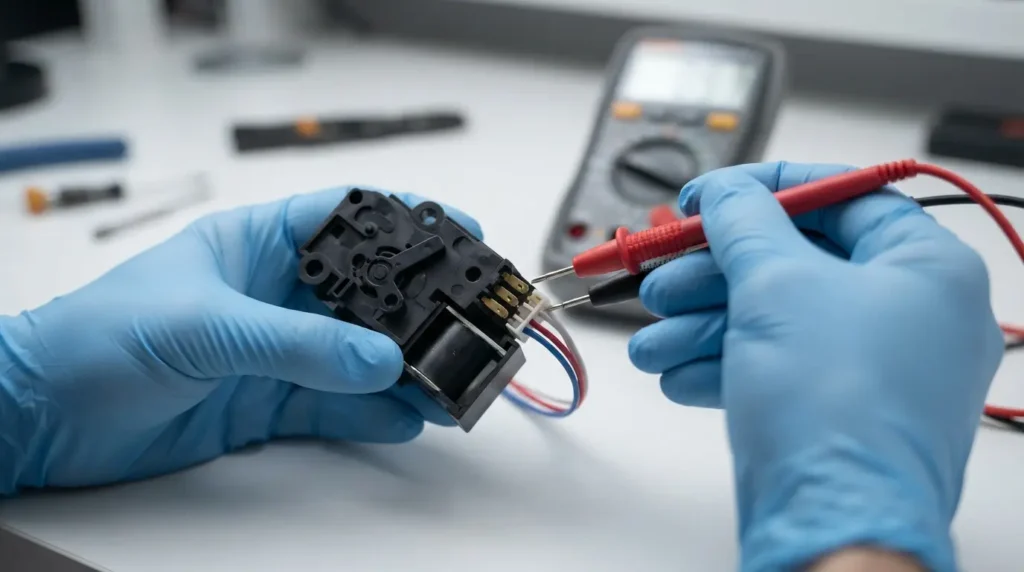
Set your multimeter to resistance (ohms) and measure across the terminals of the lock assembly’s locking element. Compare your reading with your model’s service data, because the correct range varies between lock designs. Here’s how to read the result:
- A reading in the expected range means the locking element’s coil is intact. The fault may be in the switch contacts, the wiring, or the board.
- No reading at all (an open circuit) means the locking element has failed and the assembly needs replacing.
- A reading wildly outside the range (near zero or far too high) also points to a failed assembly.
For the switch side, set the meter to continuity and check whether the door-closed contacts connect when you press the latch closed by hand and open when you release it. A contact that doesn’t close or flickers when you tap the assembly tells you the switch has worn out.
| INSIDER TIP: THE LOCK THAT TESTS FINE BUT FAILS HOT Heat-based locks can pass a cold test and still fail in a real cycle once warmed up. If your readings look good but the washer faults at the same point every cycle, note exactly when it happens. A fault that appears only after the lock has been energized for a while points at the lock. If the evidence keeps pointing there, replace it, since the part is inexpensive relative to a service call. |
Fix: Replace the door lock assembly.
If the test shows a failed assembly, replace it as a complete unit. Match it to your full model number, because assemblies look alike but differ in connectors and mounting. A wrong part is the most common reason this repair goes sideways.
- Unplug the washer and open the cabinet as your manual describes. Ask for help if you need to move the machine.
- Photograph the wiring connectors and how the assembly sits, then unplug each connector in turn.
- Remove the screws or release the clips holding the lock assembly. Some models have the door frame or gasket ring in the way, so work slowly and keep track of screw lengths.
- Lift out the old assembly and compare it side by side with the new part, checking that the connector shapes and mounting points match.
- Fit the new assembly, secure it, plug each connector back where it came from, and refit the panels.
After the repair: test and confirm
Before you push the washer back, plug it in and close the door. You should hear a firm click. Run a short rinse-and-spin cycle with the drum empty. Watch whether the door locks at the start, whether the cycle runs without the error, and whether the door releases at the end after a short wait. Check that the new assembly sits firmly and nothing rattles during the spin.
If the code returns within a few loads, look first at what’s getting caught in the door seal, and ease off on load size. A new lock can’t fix a door that keeps being pinched shut by laundry. If the error persists with a good lock and a clean door seat, the wiring between the lock and the board, or the board itself, is the likely cause. That’s the point of calling a technician instead of buying more parts.
Door lock fix path at a glance
| What you found | Most likely culprit | Fix | Skill level and time |
| Sock or item pinched in the gasket | Door not seating | Clear it and close the door cleanly. | Beginner, 2 minutes |
| Overstuffed drum, door barely latches | Overloading | Reduce the load. | Beginner, 2 minutes |
| The door sags or strikes the slot edge. | Alignment or worn strike | Replace the strike or adjust the hinge. | Beginner to intermediate, 20-45 minutes |
| Loose or darkened connector | Wiring fault | Reseat or replace the connector. | Intermediate, 20-30 minutes |
| Open circuit on the locking element | Failed lock assembly | Replace the assembly. | Intermediate, 45-60 minutes |
| Lock tests are good, but the fault persists. | Wiring or control board | Call a technician | Not a DIY repair |
FAQ: Frigidaire washer door lock error
1. Can I bypass the door lock to run my washer?
No. The lock is a safety interlock, and bypassing it lets the drum spin with the door open or without water-tight sealing. Fix the lock instead.
2. Why does the door lock error appear only on some loads?
Heavy or bulky loads push against the door and can stop it latching. If the code appears only with big loads, the cause is probably load-related, not a failed lock.
3. How do I know if the door is the problem or the lock?
If the door doesn’t click firmly, sags, or has the strike hitting the edge of the slot, the door is the problem. If the door seats cleanly but the multimeter shows an open circuit on the locking element, the lock has failed.
4. Is replacing the lock assembly a safe DIY job?
It’s a reasonable job for a careful beginner when the washer is unplugged and you photograph every connector before touching it. If you’re uneasy around wiring, a technician can do it quickly.
5. Why is my door stuck locked after the cycle?
Many locks release after a short wait, because the locking element needs a moment to cool. If the door stays locked long after the cycle ends, check your manual for a manual release and see the separate guide on doors that won’t unlock.
6. Will a new lock stop the error coming back?
Only if the lock was the cause. If a pinched item or an overloaded drum caused the fault, the code can return even with a new assembly. Fix the door seating first.
7. When should I call a technician instead?
Call one if you see melted plastic or burn marks, if the lock tests good but the error persists, or if the connector and wiring look damaged. Those point beyond a simple part swap.
Final word
Start with the door, because that’s where most of these faults live. Then check the strike and wiring, then test the assembly, and replace it only when the meter backs you up. If your washer is latching cleanly and starting again, put a quick glance at the gasket on your list for the next time you do laundry.