
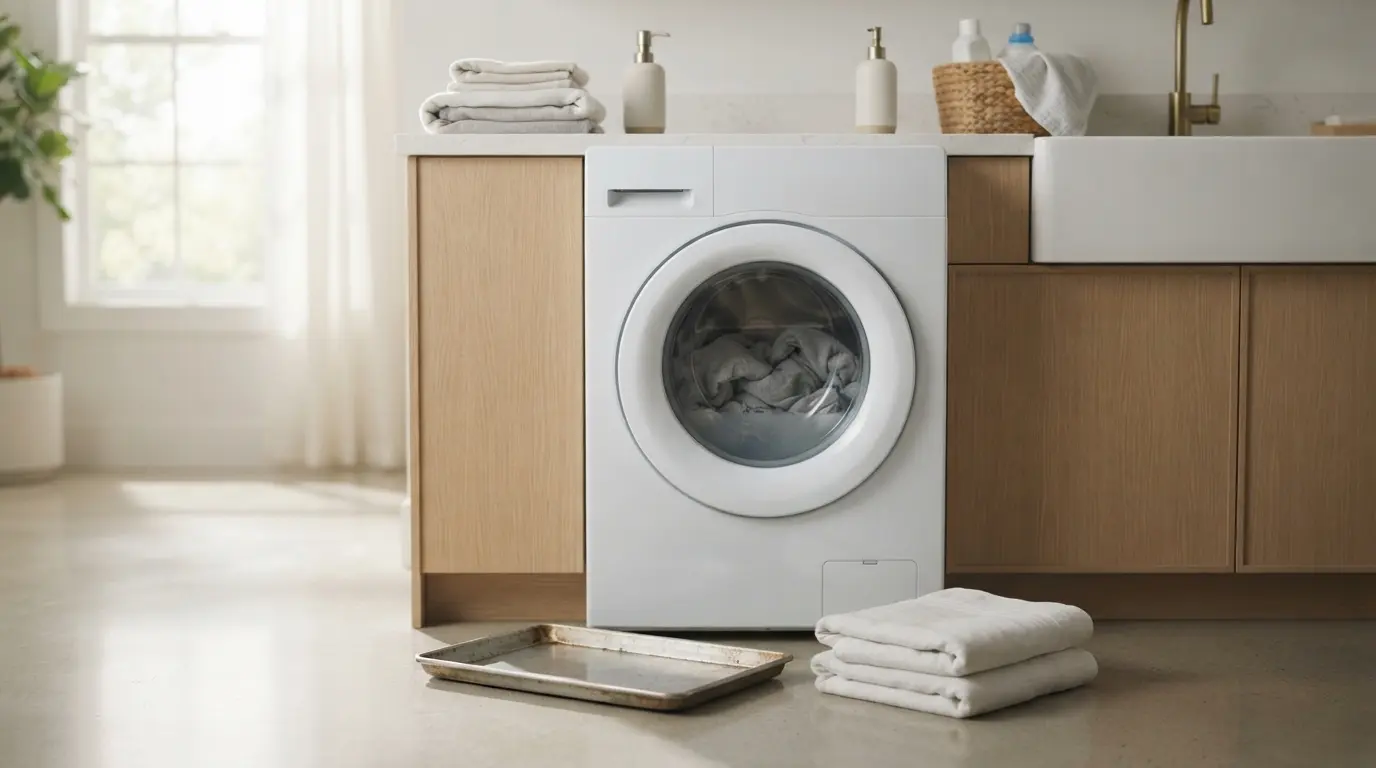
A drum full of gray water looks like a dead washer, and it rarely is. Most Frigidaire washer E20 drain error calls end at a plastic filter the size of a film canister, and the pump never needs touching. This guide takes you through the checks in the order a technician runs them, from the free fix to the part swap.
Table of Contents
Before you start: tools, safety, and getting the water out
Gather a shallow baking tray or low pan, a bucket, a stack of old towels, a flashlight, pliers, a nut driver or screwdriver, and work gloves. A multimeter is needed only for Fix 3. Panel layouts differ between Frigidaire series, so keep your full model number and manual nearby.
| SAFETY: READ BEFORE YOU TOUCH ANYTHING Unplug the washer from the wall before you open any panel. The water in the drum can be hot, so drain it slowly. Never tip or lay down a washer with water still inside, since it’s heavy and the water will pour out of the pump and hoses. Wear gloves, because the filter and pump housing can trap sharp items like underwire, glass, and broken buttons. Never put a hand into the pump housing while the washer is plugged in. |
A full drum holds a lot of water, so plan to drain it in stages through the filter. Many washers keep the door locked while the water is above a certain level, so drain first and open the door afterward. If the door stays locked even after the drum is empty, the Frigidaire washer door won’t unlock after a cycle: lock assembly check covers that separate problem.
Fix 1: Clear the drain pump filter.
On most Frigidaire front-loaders, the filter sits behind a small access panel at the bottom front corner. This is the first place to look because it catches everything the pump would otherwise swallow.
- Unplug the washer, then lay towels and set the shallow tray under the access panel.
- Open the panel. Some pop off by hand, and others need a flat tool.
- If your model has a small emergency drain tube beside the filter, drain through it first. Otherwise, turn the filter counterclockwise a quarter-turn at a time, let water flow into the tray, tighten, empty the tray, and repeat until the flow stops.
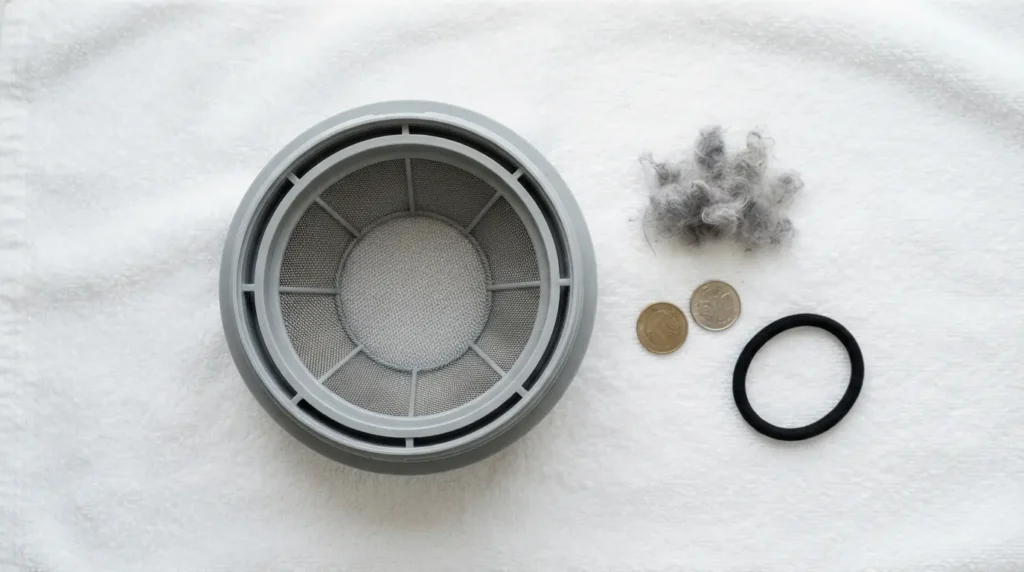
- Unscrew the filter completely and clear out lint, coins, buttons, hair, and anything else lodged in it.
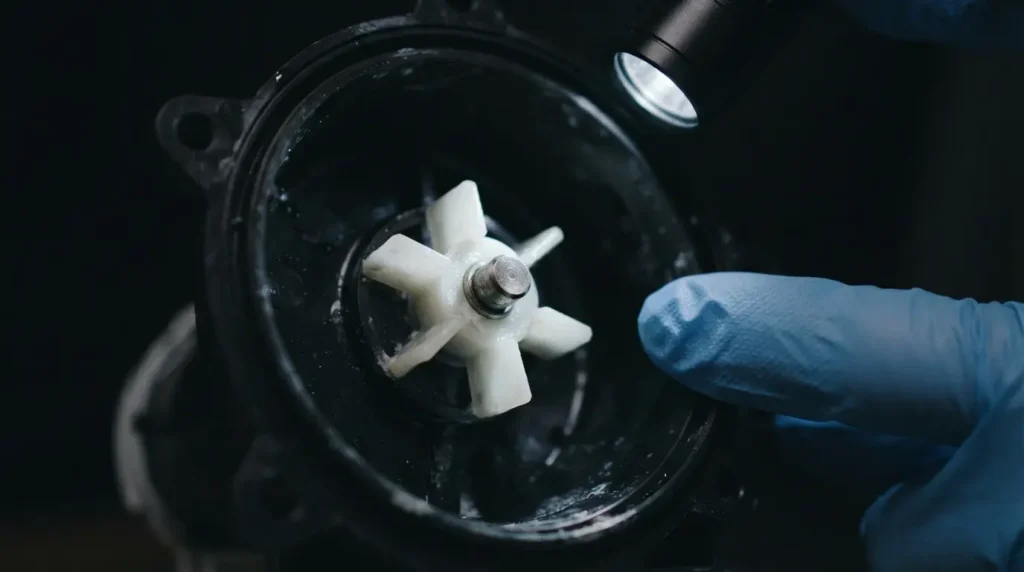
- Shine the flashlight into the filter housing. Reach in with a fingertip and spin the small fan (the impeller) by hand. It should turn smoothly with slight resistance. Pull out anything wedged around it.
- Rinse the filter, check its threads and seal for cracks, and screw it back in until it’s fully seated and hand-tight. A half-seated filter leaks.
How often to open this filter as routine care is covered in [Frigidaire washer maintenance schedule]. For now, the goal is getting the washer draining again.
| INSIDER TIP: READ THE DAMAGE, NOT JUST THE DEBRIS. While the impeller is exposed, check the blades with the flashlight. Elastic from socks and hair ties wraps around the impeller shaft and stalls it, which clearing by hand fixes. But if the blades are chipped, snapped, or chewed from a hard object, the pump will drain slowly or rattle even after the clog is gone. That’s the one case where cleaning the filter isn’t enough, and it’s how owners end up replacing a pump that “should have been fine.” |
Fix 2: Check the drain hose and standpipe.
If the filter and impeller were clear, follow the water downstream. Pull the washer forward carefully so you can see the back panel.
- Kinks and crush points: Look along the whole drain hose for sharp bends, especially where it’s squeezed between the washer and the wall. A hose that’s crushed halfway looks fine from the front.
- Hose height and the loop: The hose usually needs a high loop or guide so water doesn’t siphon out of the drum during the fill. Too low at the end, and water can run out when it shouldn’t. Too high a standpipe, and the pump struggles to push water up to it. Your manual lists the allowed standpipe height for your model, and it’s typically well above the washer’s water level.
- How the hose sits in the standpipe: Insert it only a few inches and leave it loose, with a gap for air. Taping or sealing it airtight can cause siphoning and slow drainage.
- The hose itself: Disconnect the hose at the washer end over a bucket, hold it up to the light, and run tap water through it. If water struggles or you see lint packed inside, replace it.
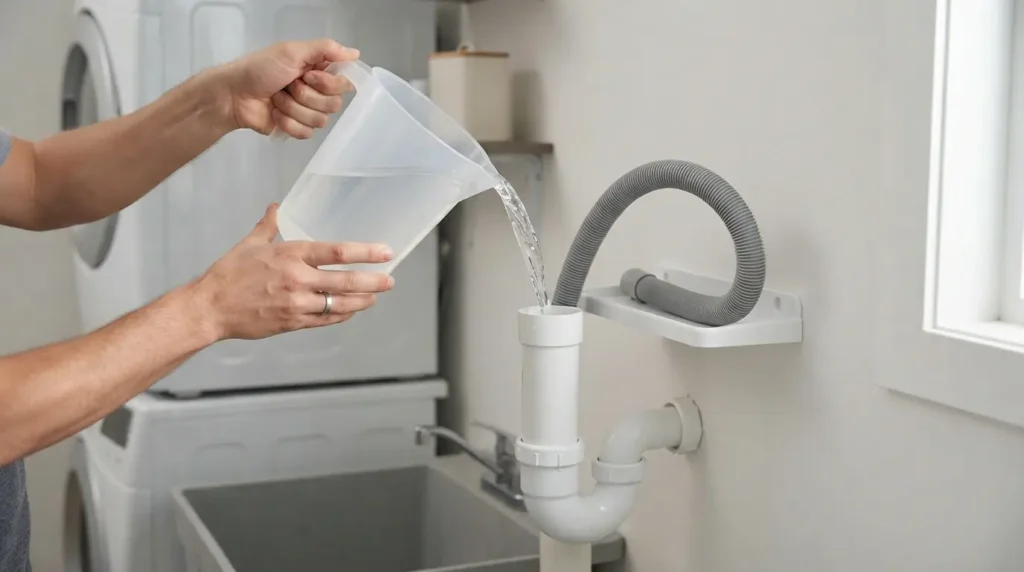
| INSIDER TIP: RULE OUT THE BUILDING BEFORE YOU BLAME THE WASHER. With the hose lifted out, pour a few liters of water down the standpipe. If it gurgles, rises, or drains slowly, the clog is in your household drain, and no washer part will fix it. A second clue is a kitchen sink or floor drain that gurgles whenever the washer drains. |
Fix 3: Test the drain pump
If the filter, impeller, hose, and standpipe are all clear and water still sits in the drum, the pump itself is next. You’re checking whether it’s electrically intact.
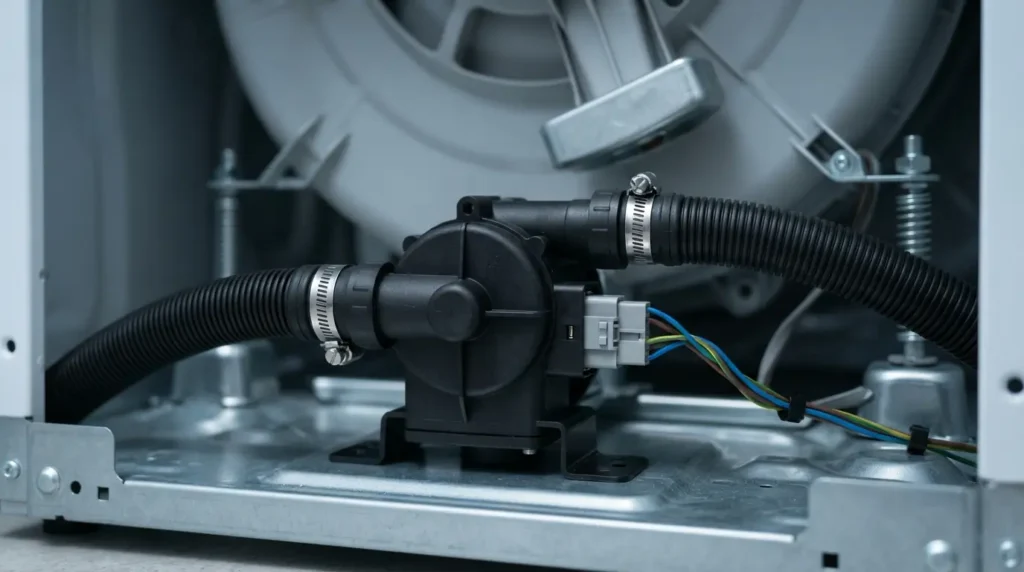
With the washer unplugged, open the cabinet as your manual describes and find the pump. On many front-loaders it sits low behind the front panel, and the pump has two hoses attached and a wiring connector. Photograph the connector and its wires before touching them, then unplug it. Set a multimeter to resistance and measure across the pump’s two terminals.
- A reading in a moderate range (compare it with your model’s service data, since values vary between pump designs) means the pump’s winding is intact. A pump that hums but doesn’t move water usually has a jammed or damaged impeller
- No reading at all (an open circuit) means the pump motor has failed and needs replacing.
- A good reading but no pump activity means the problem is upstream, in the wiring or control board. Check the connector for corrosion or looseness, and if everything looks sound, a technician is the sensible next call.
Fix 4: Replace the drain pump.
If the pump has failed or its impeller is damaged, replace it as a unit. The part is typically modest in cost compared with a technician visit, so on a washer in otherwise decent shape, this is usually worth doing. Match it to your full model number, because pumps look alike but differ in connectors and mounting.
- Unplug the washer, drain all water through the filter, and get access to the pump as your manual describes. If that means moving the machine, ask for help because it’s heavy.
- Photograph the wiring connector and the hose positions, then unplug the connector.
- Release the clamps on the two hoses attached to the pump. Expect a little leftover water, so keep the tray and towels below.
- Remove the screws or release the mounting tabs holding the pump, and lift it out.
- Fit the new pump, reattach both hoses with their clamps, plug the connector back in, and refit the filter and panels.
After the repair: test and confirm
Before the washer goes back in place, plug it in and run a drain-and-spin or rinse-and-spin cycle with the drum empty. Watch for water leaving the drum, and listen for a smooth pump sound with no rattling or grinding. Check the filter and hose connections for drips during and after the cycle, because a fitting that seeps under pressure shows itself within minutes. Leave a small towel under the access panel for a day, since a slow drip dries before you notice it, but a towel shows it.
If the code returns within a few loads, recheck the filter first, because debris from a pocket can reach it quickly. Also look at how much detergent you’re using, since heavy suds can make a pump struggle to move water.
Frigidaire Washer E20 Drain Error Fix Path at a Glance
| What you found | Most likely culprit | Fix | Skill level and time |
| Filter packed with lint, coins, or fibers | Blocked filter | Clear it and spin the impeller by hand (Fix 1). | Beginner, 15-20 minutes |
| Filter clear, hose kinked or crushed | Drain hose restriction | Straighten or replace the hose (Fix 2). | Beginner, 10-30 minutes |
| The standpipe gurgles or backs up. | Household drain clog | Clear the line, or call a plumber | Beginner to plumber |
| Impeller jammed or blades chipped | Damaged pump | Free the obstruction; replace the pump if blades are broken. | Intermediate, 20-60 minutes |
| Open circuit on the multimeter | Failed pump motor | Replace the pump (Fix 4). | Intermediate, 45-75 minutes |
| Pump tests are good but won’t run. | Wiring or control fault upstream | Call a technician. | Not a DIY repair |
FAQ
1. Why is my washer door locked with water still inside?
Many washers hold the door locked while water is above a certain level as a safety feature. Drain through the filter first, and the door should release once the water is gone.
2. How much water will come out when I open the drain filter?
Possibly most of the drum’s contents. Use a shallow tray, drain in stages by turning the filter a quarter-turn at a time, and keep towels ready.
3. How do I tell a clog from a failed pump?
A filter full of debris or a stalled impeller points to a clog. If the filter, impeller, hose, and standpipe are all clear and the pump shows an open circuit on a multimeter, the pump has failed.
4. Can my drain hose setup cause an E20 error?
Yes. A kinked hose restricts flow, a standpipe that’s taller than the manual allows makes the pump work too hard, and a hose pushed deep into the standpipe and sealed can cause siphoning or slow drainage.
5. If a coin jammed the pump, do I need a new one?
Not necessarily. If the impeller blades are intact after you remove the object, the pump may work fine. Replace it only if the blades are chipped or broken, or if it tests as an open circuit.
6. Can I use chemical drain cleaner on the washer’s drain path?
It’s not a good idea. Harsh chemicals can damage the washer’s rubber and plastic parts, and splashing is a hazard. For a household drain clog, use a drain snake or call a plumber instead.
7. The error came back after I cleaned the filter. What now?
Recheck the hose and standpipe, then look at the impeller blades for damage, then test the pump. Also ease off on detergent, since heavy suds can slow a pump’s output.
Final word
Work through the filter first, then the hose and standpipe, then the pump, and stop as soon as the water leaves the drum. Most E20 repairs end with a handful of lint in your palm. Once your washer is draining again, put that access panel on your radar so the next clog never reaches the pump.