
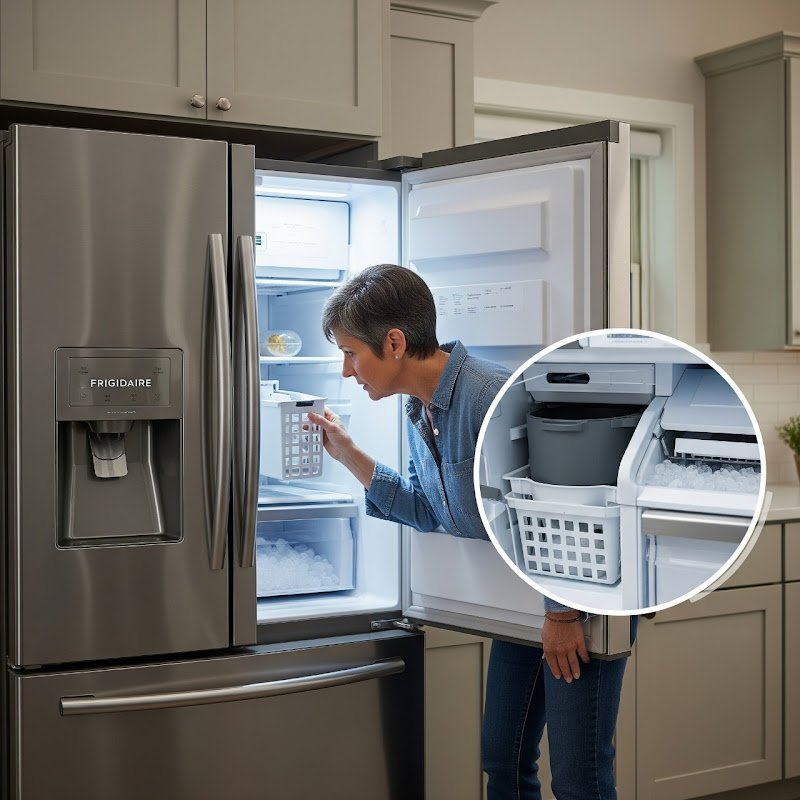
Nothing is more frustrating than opening your freezer to find no ice, especially on a hot day. If your Frigidaire refrigerator ice maker isn’t working, don’t panic. Most issues can be fixed with simple troubleshooting.
In this detailed guide, we’ll explain the most common causes and provide step-by-step solutions to get your ice maker running again. Whether the problem is a clogged water line, a faulty thermostat, or a broken motor, we’ll help you diagnose and fix it, in most cases, without needing a repair technician.
Is your whole fridge warm, not just the ice maker? That’s a separate issue from what’s covered here.
👉 [Frigidaire Gallery Not Cooling, Full System Fix] covers that specific pattern if the entire unit is warm rather than just the ice compartment.
Table of Contents
Why Is My Frigidaire Refrigerator Ice Maker Not Making Ice? (Top 6 Causes)
Before diving into repairs, let’s identify the most likely culprits:
- Clogged Water Supply Line (mineral buildup or frozen line)
- Faulty Water Inlet Valve (no water reaching the ice maker)
- Stuck or Broken Ice Maker Assembly (mechanical failure)
- Freezer Temperature Too Warm (needs to be 0°F or colder)
- Defective Thermostat or Sensor (prevents ice production)
- Ice Maker Turned Off (accidentally disabled)
We’ll explore each issue in detail, with easy-to-follow fixes below.
⚠️ Safety Before You Start
- Unplug the refrigerator at the wall outlet before disconnecting the water line, testing the inlet valve, or reaching into the ice maker assembly.
- Shut off the water supply line at its source (typically a small valve behind the fridge or under a nearby sink) before disconnecting any water line; this prevents an unexpected spray or leak once the line is loose.
- Never test the inlet valve with a multimeter while it’s connected to live household power; unplug the unit first, then follow the specific test sequence in that section.
- Watch for sharp edges around the ice maker assembly housing and mold tray, and be cautious of pinch points if the ejector arm mechanism moves unexpectedly during inspection.
- Stop and call a licensed technician if the water inlet valve replacement involves modifying household plumbing beyond the fridge’s own supply line or if you’re not confident working with the electrical side of the valve test; misdiagnosing an electrical fault and proceeding anyway risks further damage to the control board.
Comparing the Six Causes at a Glance
| Cause | Key Symptom | DIY Difficulty | Approx. Cost (USD, if part needed) |
| Clogged water line | Weak/hollow ice, no production | Easy | Minimal, no part usually needed |
| Faulty inlet valve | No water reaching ice maker at all | Moderate | $30–$80 |
| Broken ice maker assembly | No sound, tray doesn’t move | Moderate–Advanced | $100–$200 |
| The freezer is too warm | Slow or inconsistent ice production | Easy | No part needed |
| Faulty thermostat | The harvest cycle stops prematurely | Easy–Moderate | $20–$50 |
| Ice maker switched off | No ice; otherwise, fridge seems fine | Very Easy | No part needed |
These cost ranges are approximate and reflect typical US pricing for the part alone, not labor; actual availability and pricing will vary if you’re ordering parts outside the US, so treat this as a rough planning reference rather than a fixed quote.
Check the Water Supply Line (Most Common Fix)
If your Frigidaire refrigerator ice maker isn’t dispensing ice, the first thing to check is the water supply line. This is also the cause an experienced technician checks first, before touching anything else, simply because it’s the fastest to rule out and resolves the largest share of ice maker complaints on its own.
Symptoms of a Clogged Line:
- No ice production
- Weak or hollow ice cubes
- Slow water flow from the dispenser
How to Fix It:
- Inspect the water line behind the fridge for kinks or leaks
- Thaw a frozen line by unplugging the fridge for 2 hours
- Flush the line by disconnecting it and blowing air through it (or use a diluted vinegar solution to dissolve mineral buildup)
Pro Tip: If your water has high mineral content, install a water filter to prevent future clogs; this matters more on Frigidaire units than some other brands, since the supply line’s inner diameter is narrow enough that even moderate scale buildup noticeably restricts flow well before it would fully block a wider line.

Test the Water Inlet Valve (No Water Flow?)
The water inlet valve controls water flow into the ice maker. If it fails, no water reaches the ice maker.
How to Check the Valve:
- Unplug the fridge and locate the valve (usually at the back)
- Disconnect the water line and check for blockages
- Use a multimeter to test for continuity (if there’s no continuity, replace it)
Replacement Cost: $30–$80 (DIY-friendly)

Inspect the Ice Maker Assembly (Mechanical Issues)
The motor or gears may be broken if the ice maker is completely dead, no sound or movement at all.
Signs of a Faulty Frigidaire Refrigerator Ice Maker:
- No humming or clicking sounds
- The ice tray doesn’t move
- Ice cubes stuck in the mold
Quick Fixes:
- Manually reset the ice maker (press the reset button for 10 seconds, if equipped)
- Check for ice jams (clear any stuck cubes)
- Replace the ice maker assembly if there’s no power response at all (~$100–$200 part)
A detail worth knowing here: an ice maker that hums but never completes the harvest cycle is a different problem from one that’s completely silent, and they get misdiagnosed as the same issue constantly. A humming-but-stuck assembly usually points to a mechanical jam or a gear issue; a completely silent assembly with no sound at all is far more likely an electrical or motor failure, and testing the wrong one first wastes time chasing the wrong fix.

Verify Freezer Temperature (Too Warm = No Ice)
Your freezer must be at 0°F (-18°C) or colder for the ice maker to work properly.
How to Check & Adjust:
- Use a thermometer to verify the actual temperature, rather than trusting the display setting alone
- Adjust the thermostat to a colder setting if needed
- Ensure proper airflow; don’t overpack the freezer around the ice maker area specifically
Incorrect freezer temperature is a commonly reported cause of reduced ice production, though the exact share of cases this accounts for varies by source. Treat any specific percentage you see cited elsewhere as a general estimate rather than a confirmed figure for your situation.
Temperature-related ice production issues follow a similar pattern across most refrigerator brands, not just Frigidaire, since ice makers universally depend on the surrounding freezer air staying consistently cold enough for the harvest cycle to complete correctly.

Test the Frigidaire refrigerator ice maker thermostat (faulty sensor).
The thermostat may be defective if the ice maker starts but stops prematurely.
How to Diagnose:
- Listen for the harvest cycle; it should run for roughly 7 seconds
- If it stops significantly sooner than that consistently, the thermostat likely needs replacement
Cost: $20–$50 (easy DIY fix)
A question worth asking yourself before replacing the thermostat: does the cycle stop at roughly the same point every time, or is it inconsistent? A thermostat failing electrically tends to cut off at a consistent point cycle after cycle, while an inconsistent stopping pattern is more likely tied to a mechanical jam or a freezer temperature issue rather than the thermostat itself.
Make Sure the Ice Maker Is Turned On (Simple Oversight!)
It sounds obvious, but many people accidentally turn off their ice maker, particularly after cleaning the freezer or during a power outage that resets certain digital control panels to a default off state.
How to Enable It:
- Locate the on/off switch, usually a wire-arm switch or a physical button
- Check the control panel; some models have a digital toggle in the display menu instead of a physical switch

Final Fixes and When to Call a Pro Panel;
Most Frigidaire refrigerator ice maker issues can be fixed in under an hour with basic tools. However, it’s best to call a certified technician if:
- The water inlet valve tests as electrically dead
- The ice maker motor shows no response to power at all
- You’re not comfortable working with the electrical or water-line components involved
FAQ
1. Why is my Frigidaire refrigerator ice maker not dropping ice?
This is likely a stuck ice cube or a broken ejector arm rather than a production issue; clear any visible obstructions in the tray and reset the ice maker before assuming a deeper mechanical fault.
2. How do I reset my Frigidaire refrigerator ice maker?
Hold the reset button, if your model is equipped with one, for about 10 seconds, or unplug the refrigerator for roughly 5 minutes and plug it back in to force a full reset.
3. Why is my ice maker running but not making ice?
Check the water supply line or inlet valve first; a clog or restricted water pressure is the most common reason the mechanism runs normally but no ice actually forms.
4. How long does it take for a Frigidaire refrigerator ice maker to start working after a fix?
After resetting or fixing the underlying cause, producing the first full batch can take up to 24 hours, since the system needs to complete several harvest cycles before ice accumulates visibly.
5. Can I use a water filter that isn’t Frigidaire-branded?
Many third-party filters are compatible by size and thread pattern, but it’s worth confirming compatibility with your specific model number before purchasing, since an improperly fitted filter can restrict flow just as much as a clog would.
6. Does an ice maker eventually wear out even with no obvious failure?
Yes, motors and gear assemblies experience normal wear over years of use, so an older unit producing progressively less ice over time even after troubleshooting may simply be nearing the end of its service life rather than having one specific fixable fault.
7. Is it normal for ice cubes to taste or smell slightly off after a repair?
This is usually residual buildup in the line or tray rather than the repair itself; running a few discard cycles of ice after any fix involving the water line typically clears it within a day or two.
Final Word
These steps resolve the large majority of Frigidaire refrigerator ice maker issues without a repair bill. Start with the water line, the reset, and the temperature check, since those three cover the most common causes, before moving on to part replacements. Still stuck after working through all six? Drop a comment below, and we’ll help you narrow it down further.