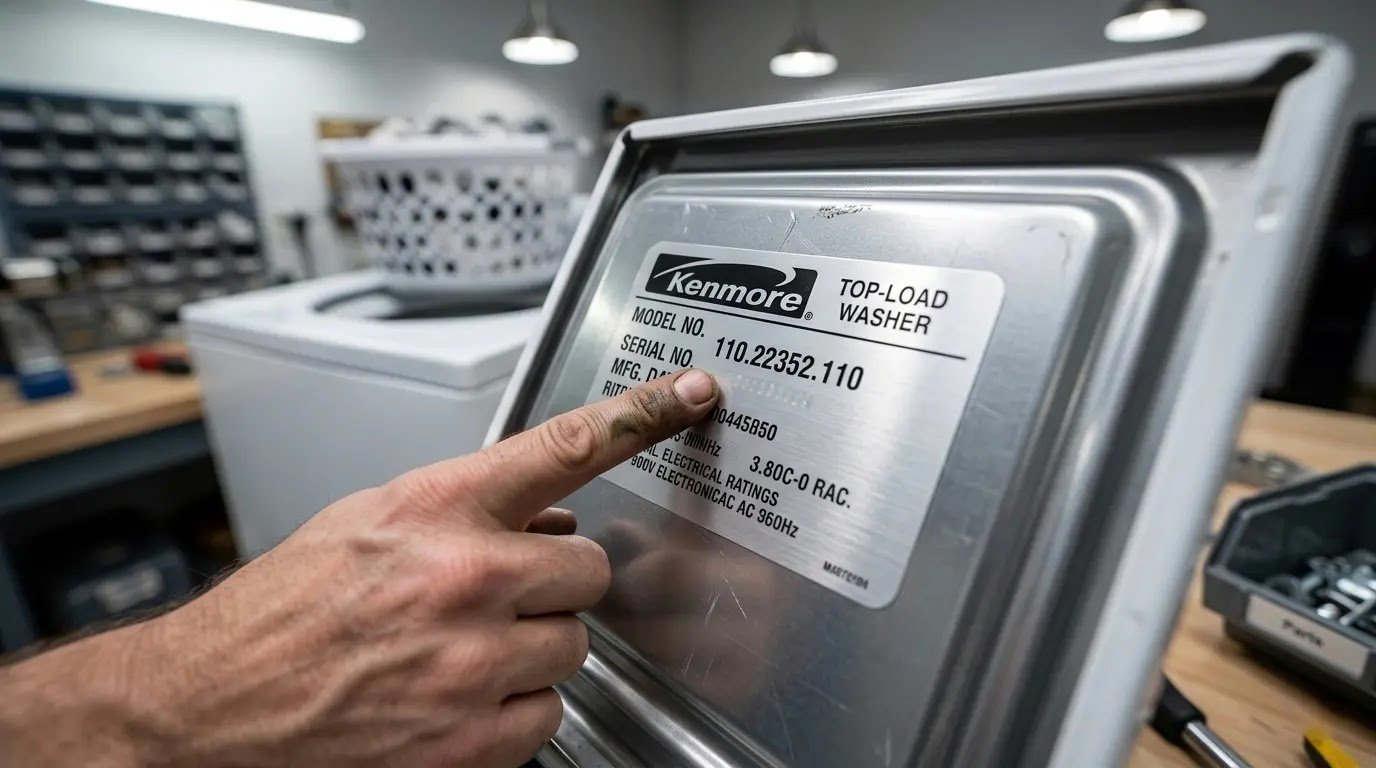
Sears doesn’t own a factory. The company that puts the Kenmore logo on your washer has never built one, and the three digits printed on your model tag reveal exactly who did.
The Kenmore washer secret: Most people assume Kenmore manufactures its own washing machines. It doesn’t, and never really has. Sears (Kenmore’s owner) pays other manufacturers, historically Whirlpool, LG, Samsung, Frigidaire/Electrolux, and GE, to build the machine and put the Kenmore name on it. If you’ve never checked the first three digits of your model number, you’re shopping and repairing blind.
Table of Contents
1. Model Number Magic: What Is a Prefix?
To find the truth about your washer, look for the silver metal tag, usually inside the door frame on front-loaders, or under the lid or on the back panel on top-loaders. The model number printed there is your roadmap. The first three digits (the prefix) tell you which company actually engineered and built the machine:
🔹 110 prefix (Whirlpool): The most common Kenmore prefix by far, covering both top-load and front-load models. Built on Whirlpool’s own platform, with widely available, inexpensive parts.
🔹 796 prefix (LG): Used on Kenmore Elite front-load models. Quieter and more energy-efficient, but it leans on more complex electronic control boards.
🔹 402 prefix (Samsung): Samsung-built front-load models. Feature-rich, but replacement electronics tend to be pricier and less widely stocked than Whirlpool-sourced parts.
Kenmore has also used other manufacturers over the years, 417 for Frigidaire/Electrolux-built units and 363/364 for GE-built units, for example, so if your prefix isn’t one of the three above, it doesn’t mean the identification system has failed you; it just means your machine came from a different partner factory. If you’re not sure, a quick search of your exact prefix against a manufacturer-prefix lookup tool will confirm it before you order parts or judge the machine’s build quality.
2. Prefix At-a-Glance: The Full Comparison
| Prefix | Actual Builder | Typical Format | Known Strength | Known Long-Term Weak Point | Parts Availability |
| 110 | Whirlpool | Top-load & front-load | Simple belt/clutch mechanics, heavy-duty frame | Bearings eventually wear on high-mileage units. | Excellent, widely stocked, often cheaper |
| 796 | LG | Front-load (Elite line) | Quiet, energy-efficient, direct-drive motor | Control board and sensor failures after the warranty window | Moderate, available but pricier electronics |
| 402 | Samsung | Front-load | Feature-rich, fast cycle times | Electronic boards and specialty parts cost more to replace. | Fair, available, but often costs more than Whirlpool equivalents |
This is a relative comparison based on common repair-industry experience with these platforms, not a scored or certified test; treat it as a starting point for what to ask about, not a guarantee of how any individual unit will perform.
3. The 1,200 RPM Trap: Speed vs. Structural Integrity
Modern Kenmore washers, particularly the 796 and 402 lines, are built to spin fast, with many current front-load models rated up to around 1,200 RPM to wring more water out before the drying cycle. Older machines commonly topped out closer to 600–800 RPM.
Here’s why that matters mechanically: the centrifugal force acting on a spinning drum doesn’t scale in a straight line with speed; it scales with the square of the rotational speed. So doubling the spin speed doesn’t just double the stress on the frame, bearings, and suspension; it roughly quadruples it. That’s the physics reason higher-RPM machines are engineered with beefier suspension components in the first place, and it’s also why a suspension part that’s worn or slightly out of spec tends to fail faster on a high-RPM machine than it would have on an older, slower-spinning one.
This doesn’t mean every 1,200 RPM machine is destined to fail; reputable manufacturers design the suspension system around the rated speed. It does mean that when something in the suspension is worn (see The Walking Washer below), the consequences show up faster and more violently on a high-RPM unit than they would have a decade ago.

4. Why Modern Control Boards Burn Out
Newer washers use a computerized inverter board to manage the motor rather than a simpler mechanical timer. The board’s biggest enemy is heat, and heat is largely a byproduct of current draw.
Overload warning: When you stuff a washer with several heavy, water-logged blankets, the motor has to pull more current to move that mass, and more current flowing through the board’s components generates more heat. Sustained overloading, cycle after cycle, is a real contributor to premature board failure on 796 and 402 models, since replacing a control board on those platforms is one of the pricier single repairs you can face on a home washer (commonly running into several hundred dollars in parts alone, before labor).
A simple habit that helps: keep loads to roughly two-thirds of drum capacity rather than packing it to the rim, especially with heavy items. For a deeper walkthrough of what else affects the lifespan of these boards, see our [👉 Kenmore Buying Guide 2026“].
5. Prefix 110: The King of Durability
If your model number starts with 110, you have a Whirlpool-built machine, and in the appliance-repair world, that generally means good news for long-term ownership. Most 110-series top-loaders use a classic belt-and-clutch mechanism instead of an inverter board, which means fewer expensive electronic failure points. Parts for these units tend to be widely available at local appliance shops and online, often at a fraction of the cost of the electronics-heavy parts used on 796 or 402 models.
These machines are also typically built with more metal and heavy-duty screws than plastic clips, and their spin speed is usually capped closer to 800 RPM rather than the 1,200 RPM ceiling on newer front-loaders, meaning less mechanical stress on the frame and bearings over the years. It’s the same “built to survive, not to impress” philosophy we found in our [👉 “Maytag Washer Teardown Report”], and if long-term reliability matters more to you than quiet operation or fast cycles, it’s worth weighing heavily.
6. The Walking Washer: Why Some Kenmores Jump
Does your washer dance across the floor or thump violently during the spin cycle? Repair technicians call this uncontrolled resonance, and on Whirlpool-built (110-prefix) top-loaders specifically, it’s usually a suspension problem: the drum is supported by a set of suspension rods and springs, and inside those rods sits a plastic piston and damping grease that wears out over time.
As the grease hardens and the piston degrades, the drum loses its damping and starts moving more than it should during high-speed spin, and, combined with the RPM-related stress described above, that movement gets worse, not better, the longer it’s ignored. Left unaddressed, the vibration can eventually damage the control board and motor bearings, turning an inexpensive fix into a much larger repair bill.
For 110-prefix Whirlpool-built top-loaders, replacing the suspension rod kit (Whirlpool part #W10780048, Whirlpool W10780048 Washer Suspension Rod is a well-documented, moderate-difficulty DIY repair. Always confirm the part number against your exact model before ordering, since Whirlpool has used several superseded part numbers for similar kits over the years. Note that this specific fix applies to the rod-and-spring suspension used on Whirlpool top-loaders; 796 and 402 front-load models use a different suspension design entirely (see the Spider Arm Crisis section below) and don’t use this same part.
We’ve detailed the full step-by-step replacement in our [👉 Kenmore Washing Machine Not Spinning: The 5-Minute Rod Fix].

7. The Post-Mortem: What Your Error Code Actually Means
When your washer starts beeping and flashing a code, the meaning depends heavily on which manufacturer actually built it, the same-looking flashing light or two-letter code can mean completely different things on a 110 versus a 796 versus a 402.
| Prefix | Common Code | General Meaning |
| 110 (Whirlpool) | Flashing sensing light | Often points to a stuck shift actuator (gear) |
| 796 (LG) | OE / LE | OE commonly indicates a drain issue; LE often points to a motor-related fault. |
| 402 (Samsung) | 4E / dc | 4E typically means a water-supply issue; dc usually flags an unbalanced load. |
Treat this table as a starting point rather than a full diagnostic guide; exact code meanings can vary between specific model years even within the same prefix. If your display freezes or won’t respond to any input at all, a hard reset is usually the first thing worth trying; the sequence is in our [👉 “How to Reset Your Kenmore Washing Machine (2026 Protocol)”].
8. The Spider Arm Crisis in Front-Load Models
In Kenmore front-load washers built by LG and Samsung (the 796 and 402 lines), a three-legged cast-aluminum support called the spider arm holds the drum from behind. Over years of use, particularly with certain detergent and water-hardness combinations, this part can be prone to galvanic corrosion, where the aluminum slowly degrades at points where it contacts other metal components.
This isn’t a new-for-2026 phenomenon; it’s a longstanding, well-documented failure mode on front-load washers from multiple brands, not unique to Kenmore. But it’s worth knowing about specifically because when the arm does eventually crack, the drum wobbles violently and the machine can sound like it’s grinding metal, and by that point, repairing it (the spider arm sits behind the drum and isn’t a quick swap) often costs close to what the machine is worth if it’s more than about five years old.
A basic spider-arm inspection kit or replacement bracket The Front-Load Washer Spider Arm Replacement Kit is available for the DIY-inclined, but this repair is genuinely more involved than the suspension-rod fix above and is a reasonable one to hand to a technician if you’re not comfortable pulling the drum.

9. Total Cost of Ownership by Prefix
Sticker price is only part of the story. Here’s how the three main prefixes tend to compare once you factor in the repairs each platform is prone to over a typical 8–10 year ownership window:
- 110 (Whirlpool): Usually the lowest total cost of ownership. Fewer electronic parts to fail, and the parts that do wear out (belts, suspension rods, water inlet valves) are inexpensive and widely available.
- 796 (LG): Mid-range total cost. Energy savings on the utility bill can offset some of the higher repair cost if a control board or sensor eventually fails, but that’s a real risk to budget for once the warranty ends.
- 402 (Samsung): Often the highest total cost among the three if something in the electronics or spider arm assembly fails after the warranty period, since Samsung-specific boards and components tend to run more expensive than Whirlpool equivalents.
A heavy-duty appliance surge protector is a genuinely cheap way to reduce the odds of an expensive board failure on 796 or 402 models, since power surges are one of the more preventable causes of control-board damage.
10. Common Buyer Regrets by Prefix
- 110 owners rarely regret the purchase itself, but some wish they’d known upfront that these machines are noisier and slower per cycle than the quieter LG- and Samsung-built alternatives.
- 796 owners most commonly report frustration when a sensor or control board fails a year or two after the warranty ends, especially since the repair cost can approach a meaningful fraction of what a new entry-level unit would cost.
- 402 owners report similar electronics-related regret, plus occasional frustration at how long specialty parts can take to source compared to the same-day availability of Whirlpool parts for a 110-prefix machine.
Frequently Asked Questions: Kenmore Washer Secret
Q: How do I find my Kenmore’s model number to check the prefix?
A: On front-load washers, check inside the door frame or on the inner edge of the door gasket area. On top-load washers, check under the lid, on the back of the control panel, or on the rear cabinet panel. The full model number usually looks like three digits, a dot, then several more digits.
Q: Does the prefix affect what parts I can order?
A: Yes, significantly. You’ll generally need to search using either the Kenmore model number or the equivalent manufacturer part number (Whirlpool, LG, or Samsung, depending on your prefix), since a Kenmore-branded part listing may not always turn up every compatible option.
Q: Can two Kenmore washers with different prefixes look nearly identical on the outside?
A: Yes, Sears historically kept a fairly consistent Kenmore look and badge across machines from different manufacturers, so the cabinet design tells you very little. The prefix on the model tag is the only reliable way to know who actually built what’s inside.
Q: Are new 110-prefix (Whirlpool-built) Kenmore washers still being made this way, or is this an older design?
A: The 110 prefix has been used across many production years and generations of Whirlpool-built machines, including newer ones, so seeing a 110 prefix doesn’t automatically mean you’re looking at an old or discontinued design, check the rest of the model number and features to judge the machine’s actual age.
Q: If my washer’s prefix isn’t 110, 796, or 402, what does that mean?
A: It simply means a different manufacturer built it, Kenmore has sourced washers from several companies over the years, including Frigidaire/Electrolux and GE. It’s still worth looking up that specific prefix before assuming anything about reliability or parts availability, since each manufacturer’s platform has its own track record.
Q: Does the manufacturer prefix affect my warranty or where I get service?
A: Not usually for warranty coverage, since Sears/Kenmore typically handles that regardless of who built the machine. It can matter for independent repair technicians, though; some specialize in Whirlpool-platform mechanics and may be less familiar with LG- or Samsung-built electronics, so it’s a reasonable question to ask when booking a service call.
Q: Is a higher spin speed always worse for long-term reliability?
A: Not inherently, manufacturers engineer higher-RPM machines with suspension systems designed to handle that stress. The real risk shows up when a suspension component wears out or a machine isn’t properly leveled, since the consequences of that failure escalate faster on a high-RPM unit than they would have on an older, slower-spinning design.
Final Verdict: Which Kenmore Fits You?
Prefix 110 (Whirlpool) is the strongest pick if long-term reliability and cheap, easy-to-find parts matter more to you than quiet operation or fast spin speeds, a genuine “tank” in the appliance-repair sense of the word.
Prefix 796 (LG) is worth choosing if you specifically want a quiet, energy-efficient machine and you’re comfortable budgeting for the possibility of a control-board or sensor repair somewhere down the line, a cheap surge protector is a smart companion purchase either way.
Prefix 402 (Samsung) makes the most sense if you’re drawn to a specific feature set Samsung offers and you’ve priced in that replacement electronics tend to run higher than the Whirlpool equivalent.
None of these is objectively “the best washer” in isolation, the right one depends on whether you’re optimizing for lowest lifetime cost, quietest operation, or a specific feature list. If you’re still comparing specific current models rather than just the underlying platform, our [👉 “Kenmore Buying Guide 2026”] walks through today’s actual lineup model by model.