
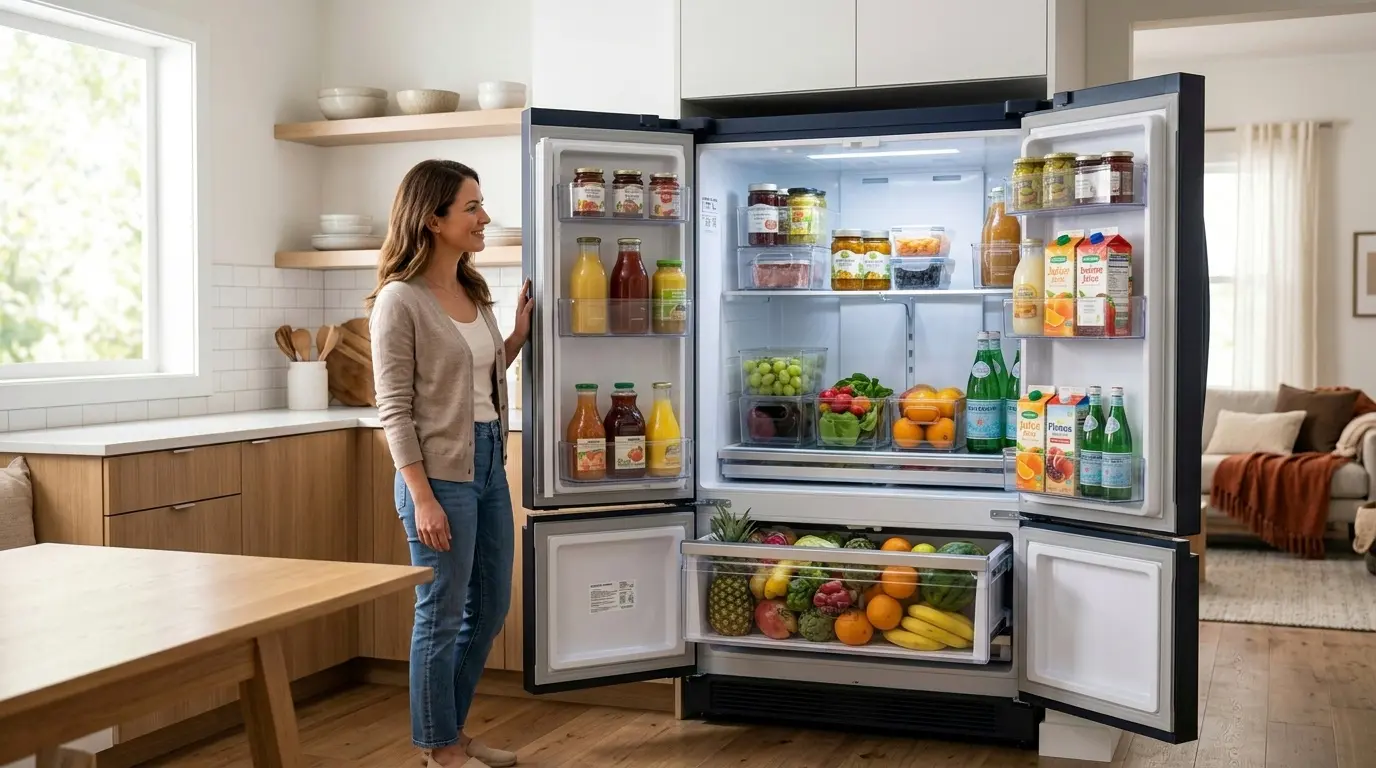
The best Samsung refrigerator for large families in 2026 is different. A family of six goes through groceries at a pace that breaks most refrigerators within two years, overstuffed shelves, a door that won’t seal because it’s fighting a gallon of milk wedged sideways, and a freezer that turns into Tetris every Sunday after the big shop. If that sounds familiar, the fix isn’t a bigger fridge; it’s the right fridge, and in 2026 Samsung’s lineup has more genuinely large-family-optimized options than ever.
Table of Contents
What “Large Family” Actually Means in Refrigerator Terms
Appliance sizing guides love to say “large family” without defining it, so let’s be specific: for refrigerator shopping purposes, a large family is generally 5+ people or any household doing a weekly grocery shop that regularly fills two or more shopping carts. That’s the threshold where a standard 18-22 cu ft refrigerator starts failing you within the first year, not because it’s broken, but because it was never sized for that volume.
| ✅ Tip: Constant overcrowding blocks internal air vents, causing uneven cooling that often gets misdiagnosed as a mechanical fault when it’s really a capacity mismatch. |
The practical symptom technicians see most often in these households: constant overcrowding leads to blocked air vents inside the fridge, which causes uneven cooling, which then gets misdiagnosed as a mechanical fault when it’s really just a capacity mismatch. Before you replace a “broken” fridge, it’s worth asking whether the real problem was always size.
Capacity Numbers That Matter (And the Ones That Don’t)
For large families, Samsung’s 2026 lineup that genuinely works starts around 26 cu ft and goes up to 31+ cu ft in their largest 4-door Flex and Family Hub models. As a general rule of thumb: budget roughly 4-6 cu ft of total capacity per person for a household that cooks most meals at home, and lean toward the higher end if you buy in bulk or meal-prep for the week.
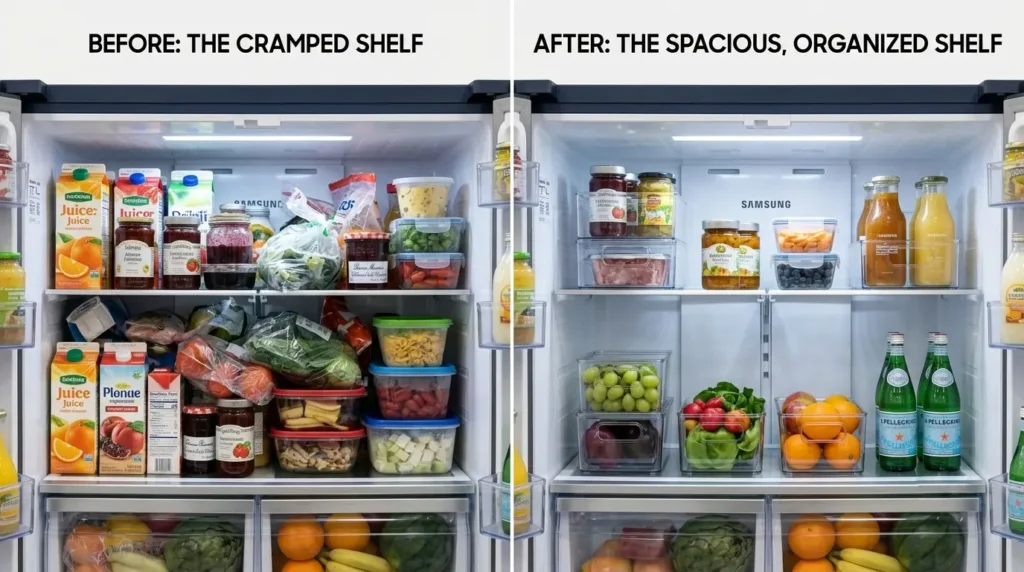
But total cubic footage is a misleading headline number on its own; what actually matters for large families is the ratio of fresh food space to freezer space and how much of that fresh space is flexible (adjustable shelves, bins that can be reconfigured) versus fixed. A 28 cu ft refrigerator with rigid, non-adjustable shelving can feel more cramped in daily use than a well-designed 26 cu ft model with flexible bins because large families need to fit oddly-shaped items, sheet cakes, party trays, and large stockpots of leftovers far more often than small households do.
Door bin depth and shelf spacing also matter more than raw volume here. Samsung’s deeper door bins on models like the RF29 and RF23 series accommodate gallon containers upright without eating into shelf space, which is a small feature that has an outsized effect on how usable the fridge actually feels once it’s stocked for six people.
Samsung’s 2026 Large-Family Lineup Compared
| Model Line | Capacity | Layout | Best For |
| RF23 Series | 23-24 cu ft | French Door | Families of 4-5, moderate budget |
| RF29 Series | 29 cu ft | French Door | Families of 5-6, balanced fresh/freezer ratio |
| RF31 4-Door Flex | 31 cu ft | 4-Door Flex | Families of 6+, need convertible zone |
| RS27/RS28 Side-by-Side | 27-28 cu ft | Side-by-Side | Narrower door swings, tighter kitchens |
| Family Hub RF29/RF31 | 29-31 cu ft | French Door/4-Door Flex | Meal planning, grocery tracking |
Note that exact cu ft specs shift slightly between sub-models and regional releases within the same series name, so always confirm the specific model number’s capacity on Samsung’s regional spec sheet before buying; a US-market RF29 and a Middle East-market RF29 variant aren’t always identical internally.
Features That Actually Matter for High-Volume Households
Not every feature Samsung markets are worth paying extra for if you’re specifically shopping for large-family use. Here’s what genuinely earns its keep in a high-turnover kitchen:
Dual ice maker (in-door plus freezer bin): for families of 5+, a single ice maker often can’t keep up with daily demand, especially in warmer climates. The dual system on higher-tier RF29 and RF31 models refills faster and reduces the “we’re out of ice again” complaint that’s extremely common in big households.

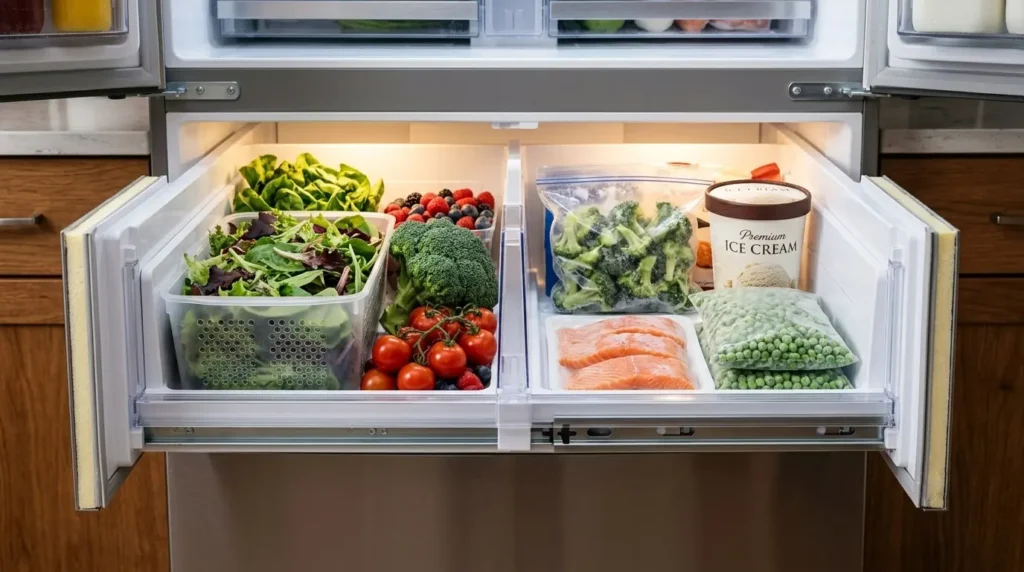
4-Door Flex convertible zone: this is arguably the single most useful feature for large families specifically because it lets you shift a section between fridge and freezer temperature depending on the week, extra freezer space before a big holiday cook-up, and extra fridge space the week you’re hosting a party. Fixed-layout fridges can’t do this.
Metal cooling / multi-airflow systems: Samsung’s multi-vent cooling technology matters disproportionately more in large families because the fridge is opened far more often per day, and each door opening lets warm air in. Better multi-point airflow recovers target temperature faster after frequent opening, which matters for food safety in a household with heavy daily traffic.
Family Hub screen: genuinely useful for coordinating groceries and schedules across a big household, but it’s a comfort feature, not a core capacity or cooling feature; don’t let it push you toward a smaller-capacity model just because it has the screen.
Layout: French Door vs Side-by-Side vs 4-Door Flex for Big Families
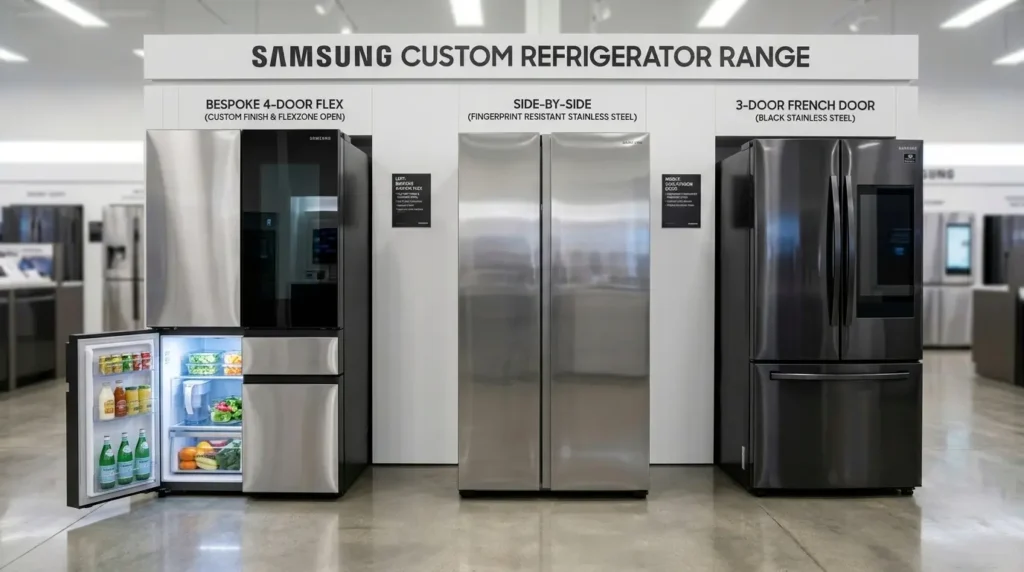
French door models generally give large families the widest, most usable fresh food shelf space, because the full-width shelves accommodate large platters and party trays that a side-by-side’s narrower single-door width simply can’t fit. This is the layout technicians recommend most often for households of 5+ unless kitchen door clearance is a hard constraint.
Side-by-side models remain relevant for large families, specifically when kitchen layout limits door swing; the narrower doors need less clearance to open fully, which matters in galley kitchens or apartments with island counters close to the fridge. The tradeoff is narrower shelves that struggle with large or oddly shaped items.
4-Door Flex is the purpose-built answer for large families whose needs fluctuate seasonally, needing more freezer space around holidays and more fridge space during the summer entertaining season. It costs more upfront but functionally replaces needing a separate chest freezer for many households.
Energy Costs When You’re Running a Fridge Hard
Large-family refrigerators get opened dramatically more often per day than a small-household unit, often 40-60+ times daily across a family of six compared to roughly 15-20 for a couple. This directly affects real-world energy consumption beyond what the EnergyGuide label reflects, since that label is tested under standardized, infrequent-opening lab conditions.
| ✅ Tip: Prioritize Samsung’s Digital Inverter Compressor line for large-family use; the efficiency gap versus standard compressors compounds with usage frequency. |
In practice, this means the efficiency gap between a base-tier and a higher-tier Samsung compressor (inverter-based digital compressors versus older standard compressors) becomes more financially meaningful for large families than for small households, because the compressor cycles far more often to recover temperature after frequent door openings. Samsung’s Digital Inverter Compressor line, standard across most 2026 RF-series models, is worth prioritizing specifically for this reason if you’re shopping in the large-family bracket; the efficiency difference compounds with usage frequency.
What to Check Before You Buy (Kitchen Fit and Delivery)
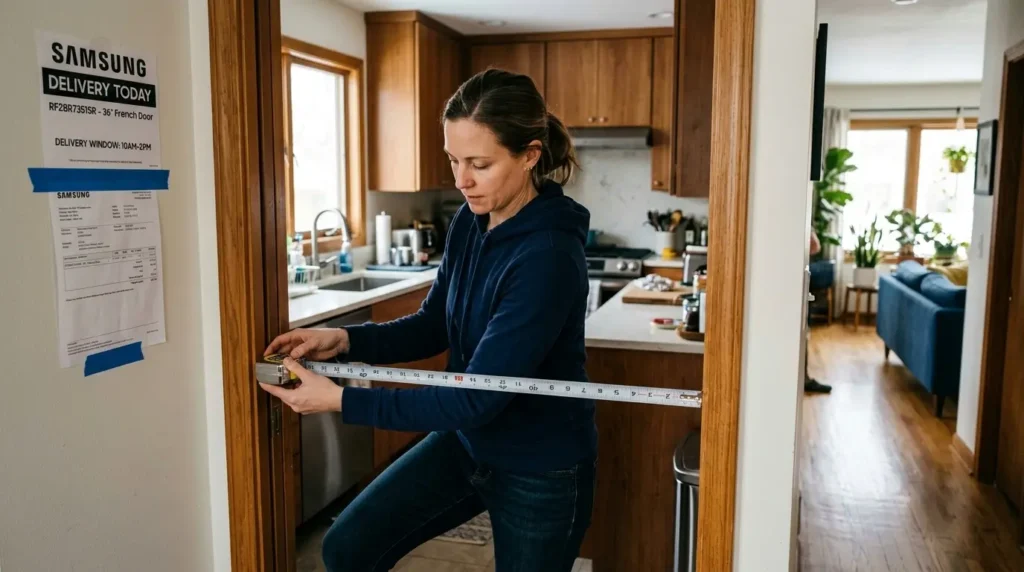
Large-capacity refrigerators are physically large appliances, and it’s worth measuring twice before ordering. A 31 cu ft 4-door Flex model typically requires close to 36 inches of width and can exceed 70 inches in height, includft,g the hinge. Measure your doorway, hallway turns, and the actual cabinet opening, not just the fridge’s footprint, since delivery teams commonly encounter fridges that fit the kitchen space but can’t physically get through the entry path.
It’s also worth checking counter-depth versus standard-depth models specifically for large families: counter-depth models look sleeker and don’t jut into the walkway, but they sacrifice several cubic feet of capacity compared to a standard-depth model of the same width, often the exact capacity difference that matters when you’re already sizing up for a big household.
👉 [Read More: 5 Best Samsung Counter-Depth Refrigerators of 2026: Sleek, Flush]
👉 [Read More: Samsung Family Hub features explained]
Samsung refrigerator for large families: FAQ
1. What size Samsung refrigerator do I need for a family of 6?
Most technicians recommend starting at 28-31 cu ft for a family of six that cooks most meals at home, with a strong lean toward Samsung’s 4-door Flex layout if your freezer needs fluctuate seasonally.
2. Is a bigger refrigerator always better for a large family?
Not automatically, capacity matters less than shelf flexibility and fresh-to-freezer ratio, so a well-designed 26-28 cu ft model with adjustable bins can outperform a rigid 31 cu ft model in daily usability.
3. Do large-capacity Samsung refrigerators cost significantly more to run?
Raw capacity has less impact on energy cost than door-opening frequency, which is naturally higher in large households, so prioritizing a digital inverter compressor model matters more than chasing the largest cu ft number.
4. Is Family Hub worth the extra cost for a large family?
It genuinely helps with grocery coordination and meal planning across a busy household, but it’s a convenience feature layered on top of a model’s core capacity and cooling system, not a reason to size down.
5. French Door or 4-Door Flex for a family that hosts often?
4-Door Flex is generally the better fit for households that host frequently, since the convertible zone lets you temporarily add freezer or fridge capacity around specific events rather than living with a fixed ratio year-round.
6. How often should ice makers be cleaned in a large-family refrigerator?
Because ice makers in large households cycle far more often, technicians generally recommend a deeper clean every 3-4 months rather than the 6-month interval often quoted for average households.
7. Do I need counter-depth or standard-depth for a large family?
Standard depth is usually the better practical choice for large families specifically since counter-depth models sacrifice several cubic feet of capacity in exchange for a look that matters less once the kitchen is in daily heavy use.
Conclusion
Buying a Samsung refrigerator for a large family in 2026 isn’t about grabbing the biggest cu ft number on the showroom floor; it’s about matching layout, shelf flexibility, and compressor efficiency to a household that opens that door dozens of times a day and stocks it for six people, not two. Start with the RF29 or RF31 4-Door Flex if your needs shift seasonally; measure your doorway before you order, and you’ll land on a fridge that actually keeps up with your family instead of constantly feeling one grocery run behind.
👉 [Read More: Samsung Refrigerator Pros and Cons: 5 Smart Features (2026)]
👉 [Read More: Samsung Refrigerator Water Dispenser Not Working