
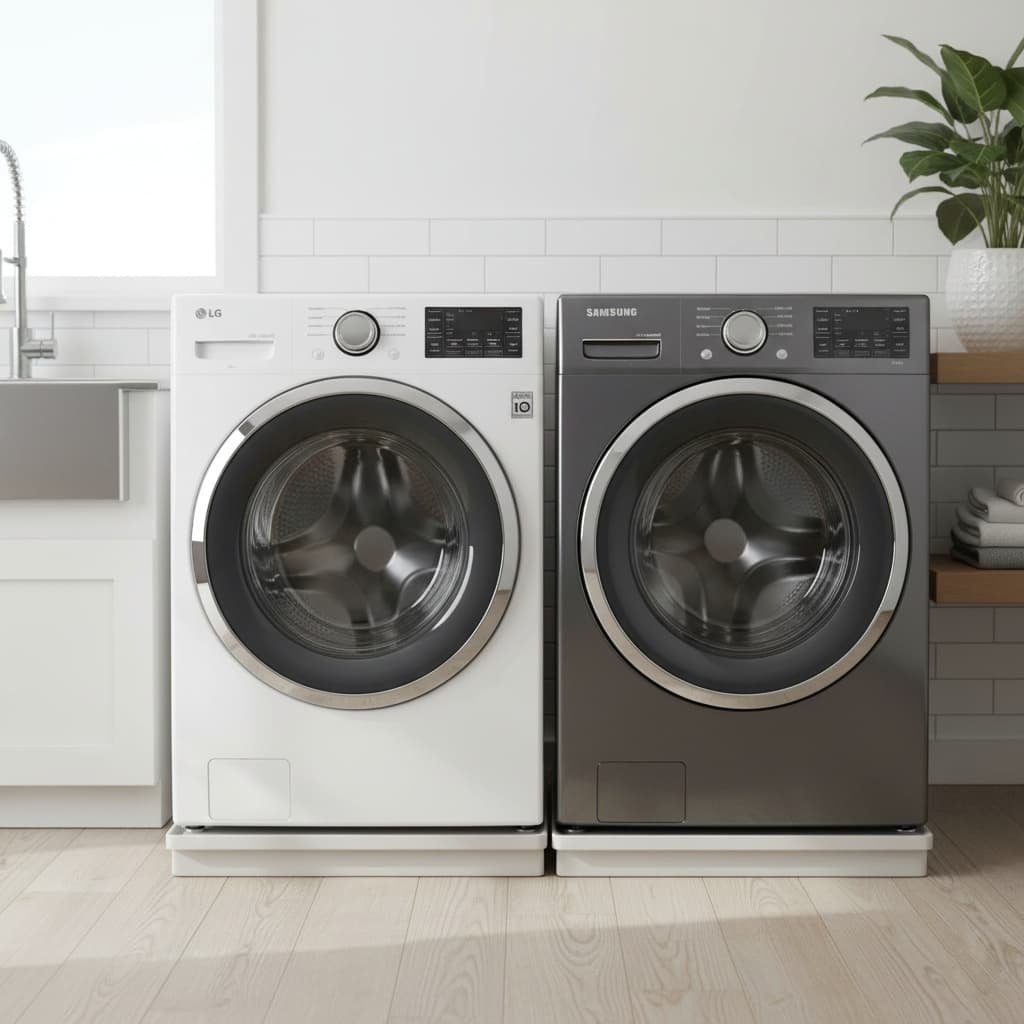
Updated 2026: Practical durability comparison of LG washing machine vs. Samsung for buyers and families
Two washers, same price range, same promises, but only one is still running smoothly after eight years. Here’s what actually separates LG washing machine vs. samsung durability once the warranty runs out, based on build quality, real repair costs, and how each brand fails when it eventually does.
Table of Contents
Why Durability Matters
Durability affects long-term costs and stress. A longer-lasting washer saves money over its life. In addition, reliable appliances reduce laundry downtime for families.
Consumer Reports found that the average lifespan of a washer is between 10 and 13 years. Therefore, choosing a sturdy model matters for savings and convenience.
Consider two households buying a washer the same week: a family of five running 8–10 loads a week and a couple running 2–3. The family’s machine accumulates roughly three times the drum rotations and motor cycles per year, which means any weak point in the drivetrain shows up years earlier for them than for the couple. This is why durability ratings that average across “typical use” can be misleading; your actual load frequency matters more than the brand name alone.
Key Durability Features: LG Washing Machine vs. Samsung
LG Strengths
- Direct drive motor reduces moving parts and wear.
- Strong warranties on some motor parts, often up to 10 years.
- Lower vibration because of fewer components in the drivetrain.
Samsung Strengths
- Advanced features like EcoBubble for low-temperature cleaning.
- VRT Plus technology reduces noise during spin cycles.
- Great smart features and app integration for connected homes.
In short, LG focuses on mechanical simplicity and reliability. Samsung emphasizes smart features and user experience. Therefore, the long-term outcome depends on use patterns and maintenance.
LG’s direct drive motors, used in models like the LG WM4000HBA and WM3555HW, connect the drum straight to the motor shaft, eliminating the belt and pulley system that Samsung’s traditional belt-driven models (such as the WF45T6000AW) rely on.
Belts stretch and pulleys wear over thousands of cycles; removing them removes a common failure point entirely, which is the mechanical reason LG’s warranty terms for the motor run as long as 10 years on many models. Samsung’s engineering trade-off goes the other direction: models like the WF45B6300AV invest that complexity budget into features like EcoBubble, which dissolves detergent before it touches fabric, and VRT Plus vibration reduction, technology that improves the wash experience but adds more electronic components that can eventually fail.

LG Washing Machine vs. Samsung Repair Costs and Common Failures
Repair history influences which brand holds up better over time. Below we list common repairs, typical costs, and the mechanical reason each one tends to happen.
| Issue | LG Typical Cost | Samsung Typical Cost | Why It Happens |
| Motor replacement | $150–$300 | $200–$400 | LG’s direct drive has fewer wear parts; Samsung’s belt-driven models add belt/pulley wear points |
| Control board | $200–$400 | $250–$450 | Heat and moisture inside the cabinet gradually degrade board components on both brands |
| Water pump | $120–$220 | $130–$240 | Debris and lint buildup are the most common cause on either brand |
| Door seal or gasket | $100–$200 | $100–$220 | UV exposure, detergent residue, and door-slamming wear down rubber over time |
| Suspension/shock absorbers | $130–$250 | $150–$270 | Unbalanced loads over years stress the suspension rods holding the drum |
Direct-drive motors in LG tend to lower motor failure rates. In contrast, Samsung owners report more electronic board issues after five to eight years. Statista data in 2025 shows that electronic faults cause longer service times for some smart models.

Real-World Scenario: Two Households, Two Outcomes
Picture a renter in a humid coastal apartment running a compact Samsung unit twice a week, light use, but the trapped moisture in the cabinet gradually corrodes control board connectors, so a board fault shows up around year six. Compare that to a family in a dry climate running an LG direct-drive machine daily for a household of five, with heavy mechanical use, but the drier air and simpler drivetrain mean the motor itself often outlasts the rest of the machine’s components. Same brands, opposite failure timelines, because climate and load frequency change which weak point gets tested first.
Energy and Water Efficiency of LG Washing Machine vs. Samsung
Efficiency affects long-term value. Energy and water savings reduce running costs over time. Energy Star reports modern washers cut energy use by up to 25 percent versus older models
The biggest energy draw in any wash cycle is heating water, not running the motor, which is why the difference between a hot-wash-heavy routine and a cold-wash routine can matter more for your electricity bill than which brand you buy. Samsung’s low-temperature wash technologies are built around this fact: by cleaning effectively at lower temperatures, they cut the water-heating load directly rather than relying on a more efficient motor alone.
- LG models often use slightly less water per cycle.
- Samsung models can save energy through low-temp wash technologies.
Therefore, efficiency gains depend on model choice and washing habits. Over the years, savings add up and can offset some repair costs.

LG Washing Machine vs Samsung Real-World Reliability: User Reports
User reviews tell a practical story. Many LG users praise motor longevity and quiet operation. Samsung users love features but sometimes report control panel problems after several years.
In practice, those control panel complaints usually take one of two forms: either specific buttons stop responding reliably, which often traces back to worn membrane contacts under the touch panel, or the display shows intermittent error codes that clear on their own, which is more commonly linked to a control board connector affected by heat cycling over time. Neither issue is typically a safety concern, but both usually mean a board or panel replacement rather than a simple fix.
👉 [Read More: LG Washing machines Reviews 2026: Real User Truth, Pros & Hidden Cons]
LG Washing Machine vs. Samsung Pros and Cons Summary
LG Pros
- Fewer moving parts usually lower mechanical failure rates.
- Strong motor warranties on many models.
- Good long-term value for heavy users and families.
LG Cons
- Upfront price on premium models can be higher.
- Some premium features cost more to repair if they fail.
Samsung Pros
- Innovative cleaning tech and smart home compatibility.
- Excellent quiet operation on modern units.
- Stylish designs and useful app features.
Samsung Cons
- Electronic control issues can appear after five to eight years.
- Parts and service times vary by region.
Who Should Choose Which Brand?
Choose based on your household needs and budget. For example:
- If you run heavy loads often, choose LG for long motor life.
- If you value smart features and design, pick Samsung.
- If you rent or move often, consider a compact model that is easy to service.
It’s worth thinking in terms of total cost of ownership rather than sticker price alone: a Samsung model with a lower upfront cost can still work out more expensive over a decade if it needs a board replacement at year six, while an LG model with a higher purchase price may pay that difference back through a decade of low-frequency mechanical repairs.
| Personal Suggestion: Students and renters often prefer Samsung for smart features and style. Families with frequent laundry loads may prefer LG for durability and lower repair frequency. |
How to Make Any Washer Last Longer
Whichever brand you choose, a few maintenance basics extend its life significantly regardless of manufacturer.
👉 [Read More: LG Washing Machine Common Problem Troubleshooting Guide 2026]
Conclusion
When comparing the LG washing machine vs. Samsung, both brands perform well. LG generally holds up better over time for heavy use. Samsung excels in smart features and user experience. Ultimately, choose based on usage patterns, budget, and how long you plan to keep the machine.
Still deciding between a specific LG or Samsung model?
👉 [Read More: LG vs. Other Washing Machines: 2026 Brand Reliability]

FAQs: LG Washing Machine vs. Samsung
Q1: Do LG washers last longer than Samsung?
Ans: On average, LG models exhibit fewer motor failures and a longer mechanical lifespan, largely due to the direct drive design eliminating belts and pulleys as failure points.
Q2: Which brand has cheaper repairs?
Ans: LG often has lower motor repair costs, while Samsung can have higher board-related costs, particularly on smart models with more electronic components.
Q3: Is smart functionality worth it?
Ans: Smart features add convenience, but they may increase repair complexity over time, since more sensors and connected components mean more potential points of failure as the machine ages.
Q4: Does climate affect which brand lasts longer?
Ans: Yes. Humid climates accelerate control board corrosion on both brands, which affects Samsung’s more electronics-dependent models somewhat more. Dry climates favor mechanically simple drivetrains like LG’s direct drive, since there’s less moisture to degrade connectors and sensors over time.
Q5: Is a direct drive motor always better than a belt-driven one?
Ans: Not universally, direct drive reduces moving parts and lowers failure risk, but belt-driven systems are often cheaper and faster to repair when something does go wrong, since belts and pulleys are inexpensive, commodity parts compared to a direct-drive motor assembly.
Q6: Do extended warranties make sense for either brand?
Ans: They’re most worth it for Samsung’s higher-end smart models, where control board and sensor repairs tend to be pricier. For LG’s simpler direct-drive models, the mechanical failure rate is often low enough that an extended warranty offers less value per dollar.
Q7: How much does household size actually affect washer lifespan?
Ans: Significantly. A household running 8+ loads a week can put three to four times the mechanical wear on a machine compared to a household running 2–3 loads, which means the “10–13 year average lifespan” figure can vary widely in practice depending on your actual usage, not just the brand you choose.