
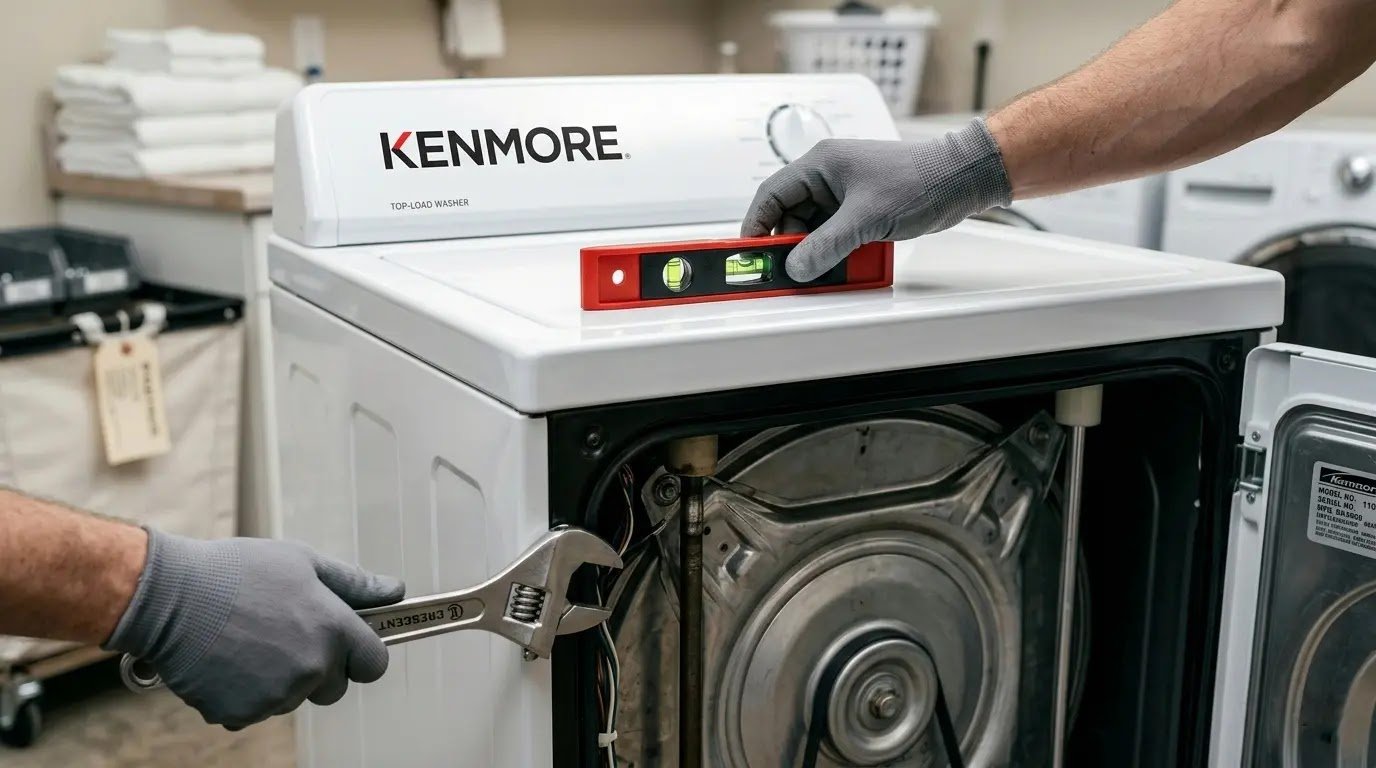
Stop your washer from dancing across the laundry room and add years to its life with five minutes of habit, not a mechanic’s visit.
Technician’s observation: I often see homeowners treating their Kenmore washers like a trash bin, loading heavy towels and a king-size comforter into the same cycle, then wondering why the machine is walking across the floor. A professional service call for this kind of issue commonly runs a couple hundred dollars and more depending on your area. Kenmore Washer Maintenance Hack: Five minutes of the right habits can help your machine avoid ever needing that call.
Table of Contents
1. The Walking Washer: What’s Actually Going On
When your Kenmore top-load washer bangs against the cabinet during spin, it’s not possessed; it’s stressed. The drum is held in place by suspension rods that work much like your car’s shock absorbers, absorbing the energy of a spinning, wet load.
Why load habits matter more than people realize: every suspension rod has a practical weight limit, and consistently washing heavy, fully saturated towels and bedding wears down that suspension faster than lighter, more evenly distributed loads. Once one rod loses meaningful tension relative to the others, the drum starts to tilt, and that’s when the banging and walking begins.
The maintenance-side fix is prevention: split oversized loads (a king comforter on its own, not alongside a full towel load) and avoid habitually overloading the drum past what your model’s capacity actually calls for.

2. Leveling Legs: The 2-Minute Balance Fix
A surprising number of “jumping machine” complaints trace back to something simpler than worn parts: an uneven floor. If the washer is tilted even slightly, water and heavy clothes settle toward the lowest corner every cycle, creating an imbalance that has nothing to do with the machine’s internal parts.
The hack: you don’t need a professional spirit level; a bubble-level app on your phone works fine. Place the phone on the top corners of the machine, and if it’s not centered, adjust the machine’s leveling legs until it is. This two-minute check, done once when you move the machine (or notice new noise), takes real long-term strain off the suspension and rear bearings, and a leveling problem left unaddressed forces those parts to compensate for an imbalance every single cycle.
3. Shipping Bolts: The Rookie Mistake
This one trips up new-home movers constantly. When a front-load Kenmore ships from the factory, four bolts are installed in the back specifically to lock the drum in place for transport.
If the machine runs with those bolts still in, it will genuinely try to walk off the floor, this isn’t a minor cosmetic issue, it’s the drum being physically prevented from floating on its suspension the way it’s designed to. Even now, it’s common enough for installers to forget this step that it’s worth checking yourself: look for four large plastic-headed bolts on the back panel and remove them before the first wash. For more on avoiding setup mistakes like this one, see our [👉 Kenmore Buying Guide 2026].
4. The Drain Filter: Your 90-Day Habit
Does your Kenmore make a grinding and growling noise while draining? In a large share of cases, the pump itself isn’t failing, it’s just holding a small treasure chest of coins, hairpins, and other debris that slipped through a pocket.
The habit: on a front-load washer, there’s a small access panel at the bottom front; open it and unscrew the filter to clear out debris. On a top-load model, you’ll typically need to tilt the machine back to reach the pump from underneath. Doing this roughly every 90 days is one of the simplest, most overlooked habits in washer maintenance, technicians see far more drain-related service calls from neglected filters than from actual pump failures.

5. Killing Biofilm: The Smelly Washer Fix
If your laundry room smells like a swamp, your machine has likely developed biofilm, a living buildup of bacteria that feeds on fabric softener and detergent residue. Modern cold-wash habits, chosen to save energy, unfortunately also let this buildup survive and grow far more easily than a regular hot cycle would.
Insider tip most guides skip: don’t mix vinegar and baking soda together for this. They chemically neutralize each other into mostly salt water and bubbles, which feels satisfying but does very little actual cleaning. Instead, run a dedicated hot cycle with vinegar first to dissolve mineral deposits, then a separate cycle with a proper washer-cleaning tablet, Affresh Washing Machine Cleaner Tablets, to address the bacterial buildup. Heat is what actually does the biological work here, since most of these bacteria are significantly reduced at temperatures well above what a cold cycle ever reaches.
For a deeper walkthrough of biofilm and mold specifically around door gaskets, see our [👉 How to Clean & Restore a Moldy Gasket] guide.

6. Hoses Matter: The Slow-Motion Flood Risk
The standard black rubber hoses behind most washers are a genuine long-term risk that’s easy to forget about because nothing looks wrong on the surface. After roughly five years, the rubber becomes noticeably more brittle, and a burst hose during a high-pressure fill and spin cycle can release a serious volume of water in a short time, enough to cause real flooring and subfloor damage before anyone notices.
The fix: upgrade to braided stainless steel hoses (👉 AMAZON LINK: “Braided Stainless Steel Washing Machine Hoses”) once your rubber hoses are past that five-year mark, regardless of whether they look fine. It’s a small upfront cost against a genuinely expensive potential repair, and it’s one of the cheapest insurance policies in appliance maintenance.
7. 2026 Kenmore Maintenance Schedule
| Frequency | Task | Why It Matters |
| Every wash | Leave the door/lid slightly open after use. | Prevents trapped humidity from becoming mold within days |
| Monthly | Hot vinegar cycle, followed by a cleaning tablet | Breaks down mineral deposits and kills biofilm bacteria |
| Every 90 days | Clean the drain pump filter. | Prevents debris-related noise and drain errors |
| Every 6 months | Recheck leveling with a bubble-level app | Catches floor settling and a shifted machine early |
| Every 5 years (or sooner in hard-water areas) | Inspect/replace supply hoses. | Prevents sudden hose failure and water damage |
| As needed, heavy-use households | Redistribute and split oversized loads. | Reduces long-term suspension wear |
Real-world note: households doing 5+ loads a week, and in known hard-water regions, should lean toward the shorter end of these intervals. Mineral buildup and suspension wear both accelerate with heavier use, and a household running a machine daily is putting years of wear onto it in a fraction of the calendar time a lighter-use household would.
Some current app-connected washers do support setting custom maintenance reminders through their companion app, worth checking if your specific model has this, though it varies enough by model and generation that I wouldn’t assume it’s there without checking your own unit’s app settings.
Frequently Asked Questions: Kenmore Washer Maintenance
Q: Why is my machine stuck on “Sensing” for a long time before starting?
A: This is often related to the machine detecting an unbalanced and unusual load and taking longer than normal to find a stable spin point, check that the load isn’t tangled and oddly distributed before assuming a part has failed. If it happens consistently even with normal loads, that’s worth investigating as a repair question rather than a maintenance one.
Q: Should I leave my front-load door open after a wash?
A: Yes, closing the door traps high humidity inside, and that trapped moisture can lead to mold growth within a couple of days. Leaving the door ajar lets the drum air out and dry completely between uses.
Q: My machine vibrates even when it’s empty, is that a maintenance issue?
A: Check your shipping bolts first, especially if the machine is new and was recently moved. If they’re still installed, the drum can’t float on its suspension the way it’s supposed to, and vibration when empty is a strong sign of exactly this.
Q: How do I know if my hoses actually need replacing, and if five years is just a rule of thumb?
A: Five years is a reasonable starting guideline, but inspect the rubber itself; any cracking, bulging, and stiffness is a sign to replace it regardless of exact age, and hard-water areas and households with higher water pressure may want to replace it preemptively rather than wait for visible wear.
Q: Is a monthly hot-water cycle really necessary if I never smell anything?
A: It’s meaningfully cheaper to prevent biofilm buildup than to deal with an established smell later, and buildup can be present before it’s noticeable as an odor, especially in households that wash almost exclusively in cold water. Monthly is a reasonable habit even without an obvious smell yet.
Q: Does overloading actually shorten the machine’s lifespan, and is that overstated?
A: It’s a genuine factor, not an exaggeration; consistently overloading past the machine’s intended capacity puts more strain on the suspension and motor on every single cycle, and that cumulative strain is one of the more common reasons a washer’s suspension wears out well before it “should.”
Q: I just moved into a hard-water area; does that change my maintenance routine?
A: Yes, meaningfully. Hard water accelerates mineral buildup on internal components and can shorten the interval between the monthly vinegar cycles that’s reasonable for your machine. If you notice buildup returning faster than expected, running that cycle a bit more often is a reasonable adjustment.
The Bottom Line: Maintenance Is the Secret
The path to getting the most life out of your Kenmore washer isn’t a trick; it’s a schedule. Keep the legs level, clean the drain filter every few months, run a dedicated hot vinegar wash monthly, and don’t let oversized loads become a habit.
Next step: pick one habit from the schedule above that you’re not currently doing, and start there this week, most of the machines that end up needing an early repair got there through a small, cheap habit that never got picked up, not a design flaw.