
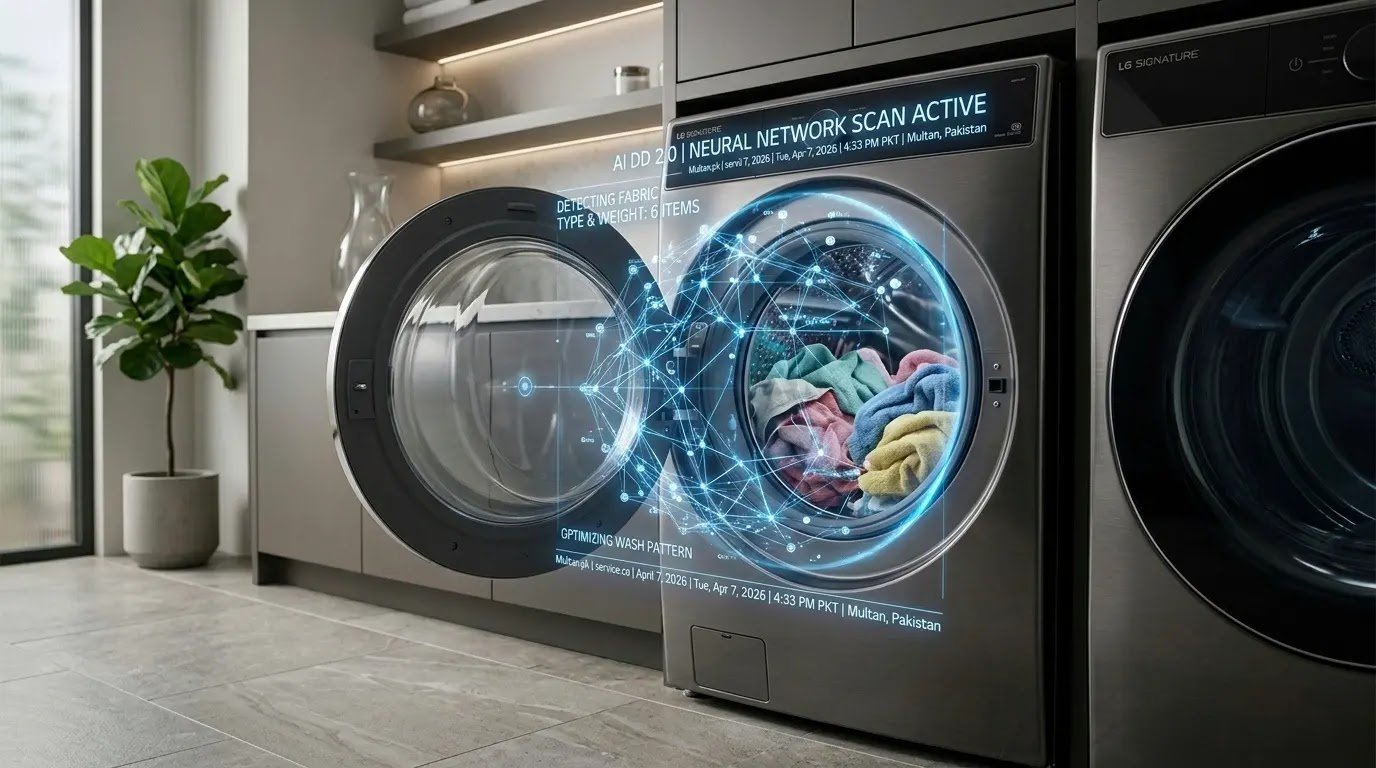
Your 2026 LG washer has more processing power packed into it than washers had a decade ago. The real question isn’t whether it’s smart; it’s whether that complexity is working for you and against you when something goes wrong. In this article we discuss the LG Washer 2026 audit report to secure your washer
Real talk: having looked closely at how these machines actually behave in real homes, patchy Wi-Fi, hard water, thick detergent doses, and a lot of what gets blamed on “hardware failure” traces back to a sensor getting confused rather than a part actually breaking. Knowing the difference is what keeps a $150 service call from turning into an unnecessary part replacement.
Table of Contents
Why “Smart” Can Mean “Fragile” in the Real World
LG’s current V-Series and Signature washers pack in more sensors and processing than earlier generations, including soil sensors, load-weight sensors, and vibration sensors, all feeding an onboard system that adjusts the wash automatically. In a lab, with clean test water and calibrated loads, that works beautifully. In a real home, a Wi-Fi hiccup during a firmware update and high-efficiency detergent that’s a bit thicker than usual because the laundry room runs cold can be enough for the machine to throw a generic system error and refuse to start rather than just washing imperfectly.
The sensor blindness problem: more sensors mean more points of failure, and the infrared soil sensors are a good example. If you wash almost exclusively in cold water, a thin biofilm layer can build up on the sensor lens over time; this is a well-documented pattern with optical sensors exposed to detergent residue and cool water generally, not unique to any one brand. Once that buildup is heavy enough to interfere with the reading, the AI can misread a clean load as dirty, pushing the machine into a longer, hotter cycle than the load actually needs, which is harder on both your clothes and your electricity bill.
If you’re dealing with a specific error right now rather than reading for background, our [👉 7 Expert Fixes for the LG Washing Machine UE Error Code] is the faster read.

AI DD: What It Actually Does (and Where It Struggles)
LG markets AI DD (AI Direct Drive) as fabric- and load-aware washing, using an array of sensors to estimate fabric weight and softness and adjust motor torque accordingly. It generally works well on uniform loads.
Where it struggles: mixed-weight loads. Throw in one heavy denim jacket alongside several light silk shirts, and the torque sensors have a genuinely harder job finding a stable balance point. In practice, this can mean the machine spends noticeably longer than expected redistributing and re-checking the load before settling into a wash, which puts more cycles of stress on the suspension components than a well-matched load would.
Insider tip: if you regularly notice long “settling” periods before the wash actually starts, separating loads by weight rather than just by color and fabric type tends to solve it more reliably than any setting change. It’s a habit most people don’t think to adjust because older machines never required it.
OE & IE Error Codes: What They Really Mean
Before you book a service call, it’s worth knowing that a meaningful share of OE and IE codes trace back to something you can check yourself:
- OE (drain/output error): the machine is having trouble pushing water out, most commonly because the drain pump filter at the bottom of the unit is clogged with lint, hair, and small debris like coins. This filter needs periodic cleaning; if it’s neglected for a long stretch, the pump motor can end up working harder than it should, which shortens its life.
- IE (inlet/water error): the machine isn’t detecting enough incoming water, in areas with older plumbing and sediment-heavy water supply, this is often simple debris caught in the small mesh screen where the fill hose connects. Scrubbing that mesh with an old toothbrush frequently resolves it without needing a new valve.
On the “recalibration” claim: some 2026 LG models do include a manual sensor recalibration option (sometimes called a “demo” and “diagnostic” mode) accessible through a button-hold sequence, but that sequence varies by model and has changed across generations. Check your specific model’s manual and LG’s official support site for the correct combination rather than relying on a generic instruction, since using the wrong sequence can put some models into an unrelated diagnostic and demo mode instead.
Hard Water: The Long-Term Threat Most Buyers Underestimate
LG’s engineering and lab testing happens with controlled water conditions. Real-world water, across much of Texas, the Gulf states, the Middle East, and large parts of the UK, carries far more dissolved calcium and magnesium. Over time, those minerals coat the internal heating element the same way they’d coat a kettle element, building up as scale.
Why this matters beyond a slower heat-up: a heavily scaled heating element has to work harder and longer to reach target temperature, which shows up on your electricity bill well before it shows up as a visible problem. Left unaddressed for a long time, scale buildup is a genuine contributing factor in some heating-element failures, though the specific interval at which you should descale depends heavily on your local water hardness, not a fixed cycle count. If you’re in a known hard-water area, a periodic descaling treatment washing machine descaler & Limescale Removing every few months is a reasonable, low-cost habit; softer-water areas can go considerably longer between treatments.
Connectivity problems compounding this issue are common enough that they’re worth a separate mention; see our [👉 LG Washer Wi-Fi Not Connecting? 7 Easy Fixes] if firmware updates and app syncing are part of what’s going wrong for you.

The ThinQ App: Convenience, Data, and What to Actually Worry About
The ThinQ app genuinely adds convenience, remote start, cycle notifications, and Smart Diagnosis for faster troubleshooting before a service call. It does collect usage data as part of how LG refines its AI features, which is worth knowing if data collection matters to you.
One claim worth being skeptical of: you may see warnings online that LG can use app-collected usage data to deny a warranty claim by flagging heavy use as “commercial use” (for example, running a residential machine for a small Airbnb and gym). I couldn’t find solid, verifiable evidence that this specific mechanism is actually how LG enforces its residential-use warranty terms; treat that claim with real skepticism rather than as a settled fact. What is worth doing is actually reading the residential-vs-commercial-use clause in your specific warranty documentation if you’re running an unusually heavy load schedule, since that clause itself is standard across most appliance warranties regardless of whether an app is involved.

A more grounded tip: some users report the touch panel feeling more responsive after disabling “Product Improvement” data sharing in the app’s privacy settings, presumably because it reduces background data logging. This is a reasonable thing to try if you’re noticing UI lag, though I’d treat it as an anecdotal fix rather than a guaranteed one.
The LG Washer 2026 Microfibre Filter Requirement: What’s Real
This part is genuinely worth knowing, and it’s more nuanced than “starting in 2026, LG added this to comply with new laws”: France made microfibre filters mandatory on all new washing machines sold there starting January 2025, a real, already-in-effect law, and the first of its kind globally. The EU has been actively discussing (as of 2026) whether to extend a similar mandate across the whole bloc, but that broader EU-wide requirement had not been finalized as of this writing, so whether your specific region requires one depends on where you are, not a blanket global 2026 rule.
Where LG models do include this secondary microfibre filtration cartridge, separate from your standard drain filter, it does need periodic cleaning of its own. Ignoring it for a long stretch can create back-pressure on the drain system, and in some cases that extra strain has been linked to pump-related failures rather than just triggering an OE code on its own, though I don’t have a verified, specific cycle-count interval to give you for cleaning it, so check your model’s manual for the manufacturer’s recommended frequency rather than relying on an unverified number.

Component Reliability: What Tends to Fail First
Rather than presenting fixed-dollar repair costs (which vary enormously by region, labor rates, and whether it’s an authorized repair), here’s the relative pattern worth knowing:
| Component | Typical Warranty Coverage | What Usually Fails First | Relative Repair Cost |
| Inverter motor | Often extended (check current terms) | Rarely, this is generally the most durable component. | Low likelihood, but higher cost if it does fail |
| Main control board (PCB) | Standard (often 1 year) | Moderate, a common failure point once out of warranty, sometimes tied to hard-water heater strain and power surges | Moderate-to-high |
| Drain pump | Standard | Common, especially without regular filter cleaning | Low-to-moderate |
| Sensors (soil, vibration, load) | Standard | Common, often a cleaning/calibration issue rather than a true failure | Low-to-moderate per sensor |
Technician’s take: the long motor warranty isn’t a marketing trick, but it isn’t the whole reliability story either; it’s genuinely the sturdiest component, which is exactly why manufacturers can afford to warranty it longer. The parts more likely to actually cause you a headache are the board and the sensors, and both are more failure-prone from neglect (dust, scale, skipped cleaning) than from a fundamental design flaw.
The 5-Year Financial Reality
Budgeting realistically for a smart washer means expecting at least one moderate repair and sensor-related service call somewhere in years 3–5 if you’re running it heavily (5+ loads a week) and skipping routine maintenance. That’s not a defect; it’s the trade-off of more sensors and more electronics doing more work. Households that stay on top of filter cleaning, descaling in hard-water areas, and keeping firmware updated tend to see meaningfully fewer of these calls than households that don’t.
A basic maintenance kit covering a tub cleaner, filter brush, and gasket-safe cleaner is a genuinely cheap way to reduce your odds of an expensive repair, and it’s the single most cost-effective thing most owners skip.
Frequently Asked Questions
Q: Is the 10-year (or similar) motor warranty on LG washers a marketing gimmick?
A: Not a gimmick, but not the full reliability picture either. The motor genuinely is the most durable component in most of these machines; the parts more likely to need attention first are the control board and the various sensors, which typically carry shorter standard warranty coverage.
Q: Why does my LG washer smell musty even though I clean it?
A: This is usually detergent and skin-cell residue buildup (“scrud”) in the drum and door gasket, often worse with heavy cold-water use. Running a sanitary and tub-clean cycle with a proper washer cleaner monthly and leaving the door open to air out between uses generally resolves it.
Q: Is the top-tier LG Signature model worth the price jump over the mid-range V-Series?
A: Largely a matter of finish and design (glass panels, aesthetics) rather than a meaningful reliability difference; the core mechanical and electronic components are broadly similar across the range, so the extra cost is buying looks more than durability.
Q: My washer keeps throwing an error with a full but lightweight load like a comforter. Is that normal?
A: Yes, this is a common AI DD limitation. Bulky, low-density items can confuse the torque/weight sensors similarly to a mixed-weight load. Redistributing the item manually and using a bedding-specific cycle if your model has one usually resolves it faster than letting the machine keep rebalancing on its own.
Q: Do I actually need to worry about the microfibre filter if I don’t live in France?
A: Not from a legal-compliance standpoint yet, since the broader EU mandate wasn’t finalized as of 2026 and other regions haven’t mandated it. If your specific model includes the filter anyway, it’s still worth cleaning it periodically regardless of local law, since neglecting it can strain the drain pump.
Q: Is hard water damage covered under warranty?
A: Generally no, mineral scale buildup is typically classified as a maintenance issue rather than a manufacturing defect, which is why descaling periodically in a hard-water area is worth the small cost compared to an out-of-warranty heating element repair.
Q: Should I disable Wi-Fi entirely to avoid firmware-related errors?
A: Not necessary for most users, firmware updates generally fix more issues than they cause. If you’ve specifically had a bad experience with an update interrupting a cycle, updating manually during a time you’re not actively using the machine is a reasonable middle ground rather than disabling connectivity altogether.
Final Verdict
A 2026 LG washer rewards attentive owners and punishes neglect more than older, simpler machines did; that part of the original framing holds up. What doesn’t hold up is treating every sensor hiccup as evidence of a fundamentally fragile machine and assuming a specific dollar figure and failure timeline apply to your household regardless of usage and water conditions.
Our take: buy it for the fabric care and quiet operation if that’s genuinely what you want, but budget mentally for basic upkeep, filter cleaning, occasional descaling in hard-water areas, and keeping firmware current, as part of the actual cost of the technology, not an optional extra.
For the wider brand-comparison picture beyond just LG, our [👉 LG vs. Other Washing Machine Brands: The Complete 2026 Comparison] covers how this reliability profile stacks up against Samsung, Whirlpool, Bosch, and the rest of the field.