
Table of Contents
LG Washing Machine Repair Error Code
Your LG washer just stopped mid-cycle and flashed a two-letter code. You pulled up every forum you could find, and half of them told you to ‘just clean the filter. This guide goes deeper. It gives you the actual electrical test values, the specific sensor locations, the resistance readings, and the component logic behind every major LG error code, the information a technician uses to decide whether to replace a part or walk away.
This is not a general troubleshooting guide. It does not tell you what symptoms to look for or how to load your laundry. It is a pure, technical error code reference for LG washing machines in 2026. If you want to know what an error code means at the circuit level and how to verify it with a multimeter, you are in the right place.
👉 [Read more: LG washing machine DIY repair guide]
How LG Error Codes Work: The Basics
Every LG washing machine runs a constant self-diagnostic loop. Sensors report to the main PCB (Printed Circuit Board) every few seconds. When a sensor reading falls outside the pre-programmed acceptable range for a set amount of time, usually 8 to 10 minutes, the PCB flags the fault and halts the cycle to prevent mechanical damage.
Understanding this is critical: most error codes are not proof that a component has failed. They are proof that a sensor reported an out-of-range value. In many cases, the sensor itself is fine, but a physical obstruction, a loose wire harness connector, or a water scale buildup is feeding it a bad reading.
The 2026 LG line also includes enhanced AI DD (Direct Drive) calibration firmware. This means some codes that previously required a technician reset can now be cleared via the LG ThinQ app after the physical root cause is resolved.
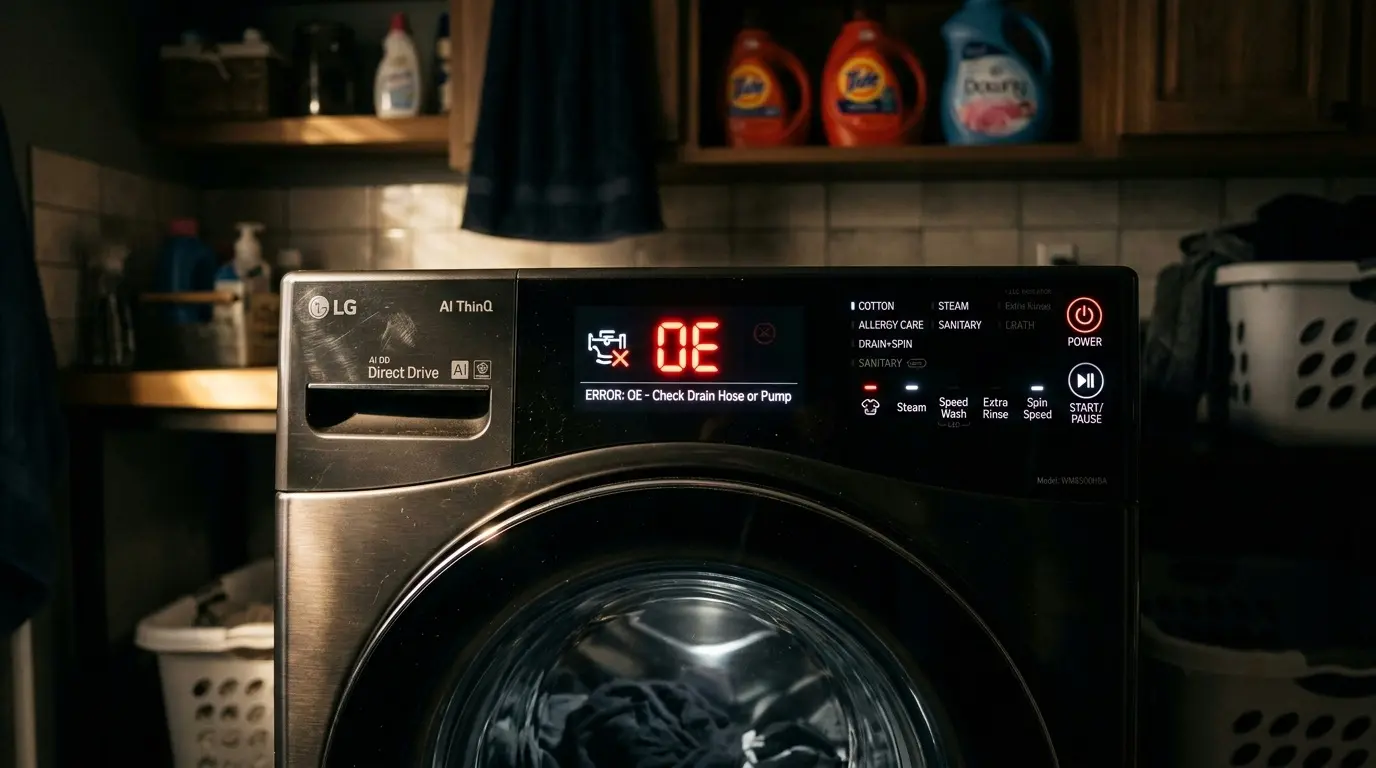
OE Error Code: Drainage System Failure
What OE Means at the Circuit Level
OE stands for ‘Output Error’ in LG’s firmware language. It triggers when the water level pressure sensor reports no significant drop in drum water level within a 10-minute drain window. The PCB cuts power to the motor and locks the door to prevent flooding.
The pressure sensor works by monitoring air trapped in a small rubber hose connected to the tub. As water drains, the air pressure in this hose drops. If the pressure sensor sees the same reading for too long, it raises the OE flag, even if the pump is running fine.
Component Test Sequence for OE
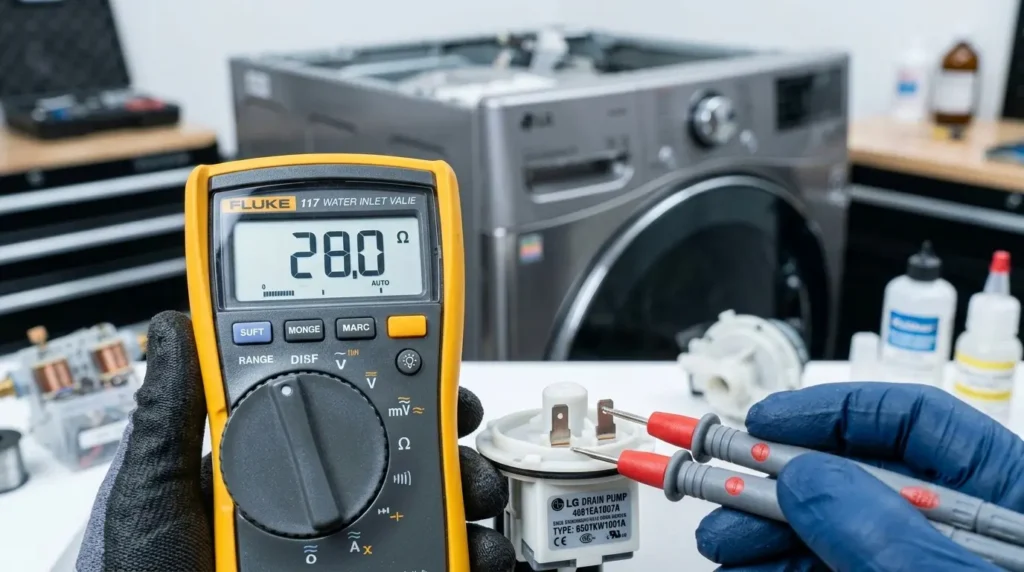
| Component | Test Method | Good Reading (2026 Models) | Fail Indicator |
| AC Drain Pump Motor | Multimeter Ω across motor terminals | 20–40 Ω | 0 Ω (short) or OL (open circuit) |
| BLDC Drain Pump (newer models) | Multimeter Ω between any two of 3 wires | 3–6 Ω per pair | Asymmetric readings between pairs |
| Pressure Sensor Hose | Visual inspection + blow test | Clear, no cracks | Water in hose, cracks, or disconnection |
| Impeller (pump fan) | Visual after filter removal | Spins freely by hand | Jammed, cracked, or missing blades |
💡 PRO TIP: On 2026 BLDC pump models, all three wire-pair resistance readings should be within 0.5 Ω of each other. If one pair reads significantly higher, the pump winding is partially burnt; replace the pump.
The Pressure Sensor Hose: The Hidden OE Cause
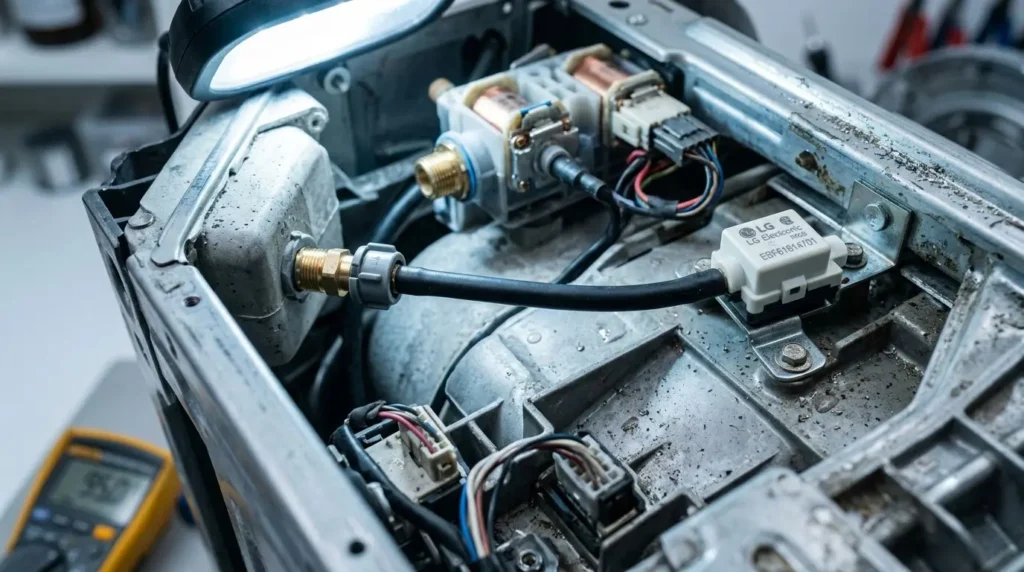
This is the component that generates the most misdiagnosed OE calls. The small rubber hose connecting the bottom of the tub to the pressure sensor can develop a crack, fill with soapy water, or detach at the sensor port. When this happens, the sensor reads maximum pressure (drum full of water) regardless of the actual water level, and the OE code fires even if the pump drains perfectly.
To test it: disconnect the hose from the pressure sensor port and blow through it firmly. You should feel clear airflow through to the tub connection. Any restriction, gurgling, or water backup means the hose needs to be cleaned or replaced.
👉 [Read More: OE error deep dive guide]
LE Error Code: Motor and Rotor System Failure
What LE Means at the Circuit Level
LE stands for ‘Locked Error.’ The PCB triggers this when the motor does not achieve rotation within a set start window or when rotation stops unexpectedly during a cycle. The machine cuts power immediately to prevent the motor from burning out.
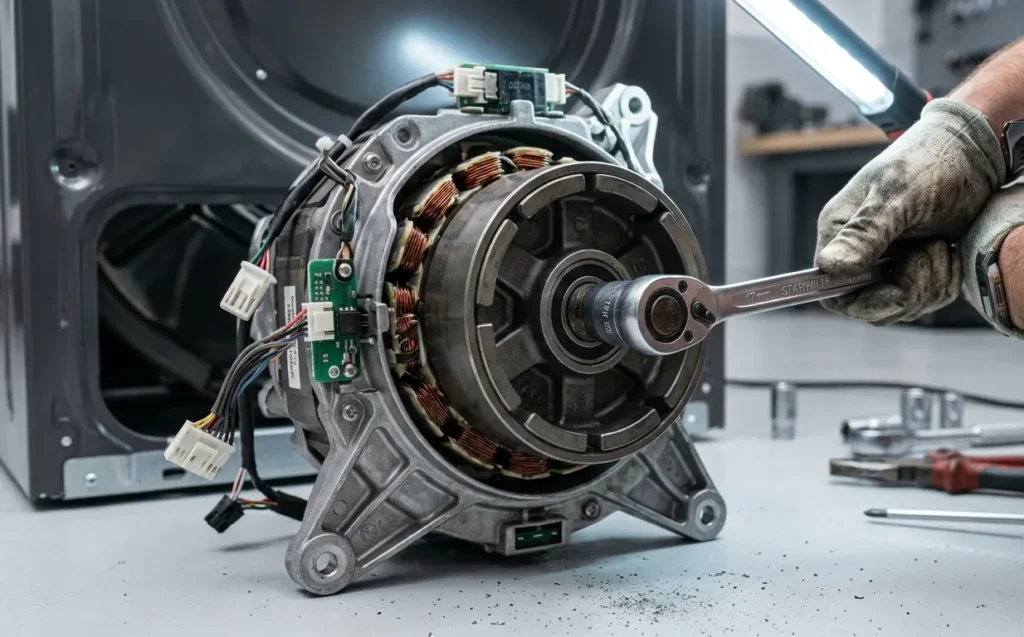
LG uses an Inverter Direct Drive motor: no belts, no gearbox, just a motor rotor directly attached to the wash drum. This motor design is extremely reliable, but it depends entirely on a small position sensor to function. Without accurate position feedback, the PCB cannot fire the motor windings in the correct sequence.
Hall Sensor (Rotor Position Sensor): Test Values
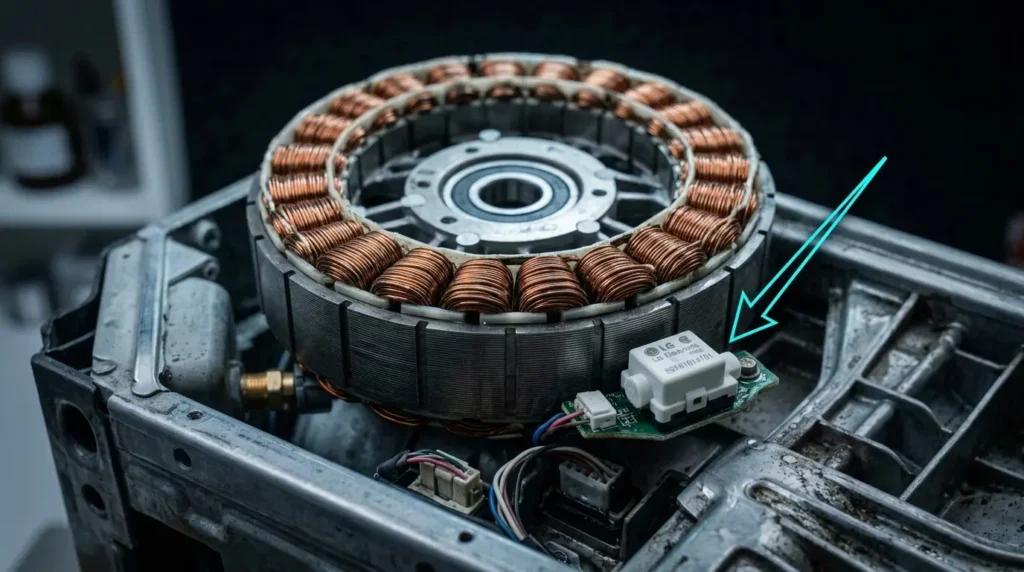
The Hall sensor, also called the Rotor Position Sensor (RPS), is a three-wire magnetic sensor mounted on the motor stator. It reads a ring of magnets on the rotor and sends position pulses to the PCB. Part number to reference: 6501KW2002B.
| Pin Pair | Multimeter Reading (Ω) | Interpretation |
| Pins 1 and 5 (Signal + Ground) | ~10,000 Ω (10 kΩ) | Sensor in good condition |
| Pins 2 and 5 (Signal + Ground) | ~10,000 Ω (10 kΩ) | Sensor in good condition |
| Any pin pair, reads 0 Ω | Short circuit | The sensor has internal short; replace it. |
| Any pin pair, reads OL | Open circuit (infinite) | Sensor wire or internal element broken |
⚠️ WARNING: Always unplug the machine before testing the Hall sensor. The sensor sits close to the rotor magnets, and accidental rotation during testing can pinch fingers. Remove the 17mm center rotor bolt before accessing the sensor housing.
Wire Harness Inspection for LE
Before ordering a Hall sensor, inspect the motor wire harness at the bottom of the machine. The tub vibrates against the chassis during spin cycles. Over years of use, this vibration rubs wires raw against the metal frame until the copper conductor breaks inside the insulation. The wire looks intact on the outside but is broken internally.
Use your multimeter in continuity mode. Follow each wire in the motor harness from the PCB connector down to the motor connector. Any break in continuity along the wire means the harness, not the sensor, needs replacement.
👉 [Read More: LG Washer LE Error Code Solved]
UE Error Code: Mechanical Balance System
What UE Means at the Circuit Level
UE stands for ‘Unbalanced Error.’ The PCB gets this signal from the motor’s current draw data. During high-speed spin, an unbalanced load causes the motor to spike in current as it fights vibration. When the current spike pattern exceeds a threshold, or when the machine detects chassis vibration via the motor’s torque feedback, it stops the spin and throws UE.
The distinction between ‘uE’ (lowercase u) and ‘UE’ (uppercase U) is a firmware status flag, not a different error. ‘uE’ means the machine is currently running its automatic redistribution routine, it slows down, reverses, and tries to spread the load. ‘UE’ means that routine failed after multiple attempts and the machine has stopped.
Mechanical Components to Test When UE Is Persistent
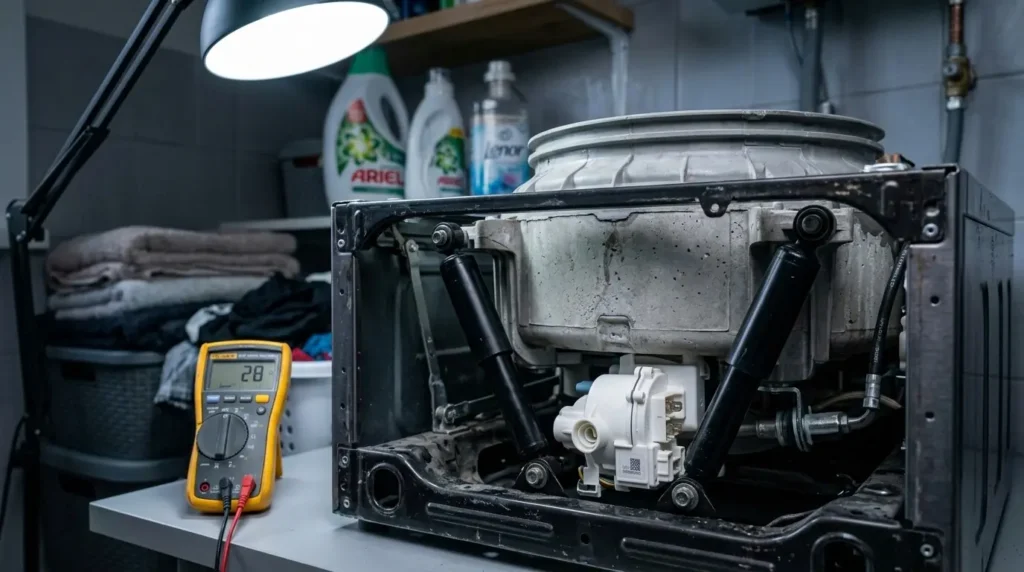
If UE appears consistently across multiple balanced loads, meaning you have verified the load is evenly distributed and the machine is level, the fault is mechanical, not behavioral. These are the components that fail and generate persistent UE codes:
| Component | Failure Symptom | Test Method | Typical Replacement Cost (2026) |
| Shock Absorbers (front-load) | Banging during spin, UE even on small loads | Compress by hand; it should resist firmly and return slowly | $30–$60 per pair |
| Suspension Rods (top-load) | The machine tilts or sways during agitation | Check rod ends for broken plastic clips or worn rubber buffers | $25–$45 per set |
| Rotor Mounting Nut | Intermittent UE on otherwise level machine | Torque to spec with 38mm socket, loose nut allows rotor wobble | N/A, just retighten |
| Tub Bearings | UE accompanied by grinding noise at high speed | Spin drum by hand; rough or notchy rotation indicates bearing failure | $80–$150 + labor |
👉 [Read More: 7 Expert Fixes for the LG Washing Machine UE Error Code
IE Error Code: Water Inlet System
What IE Means at the Circuit Level
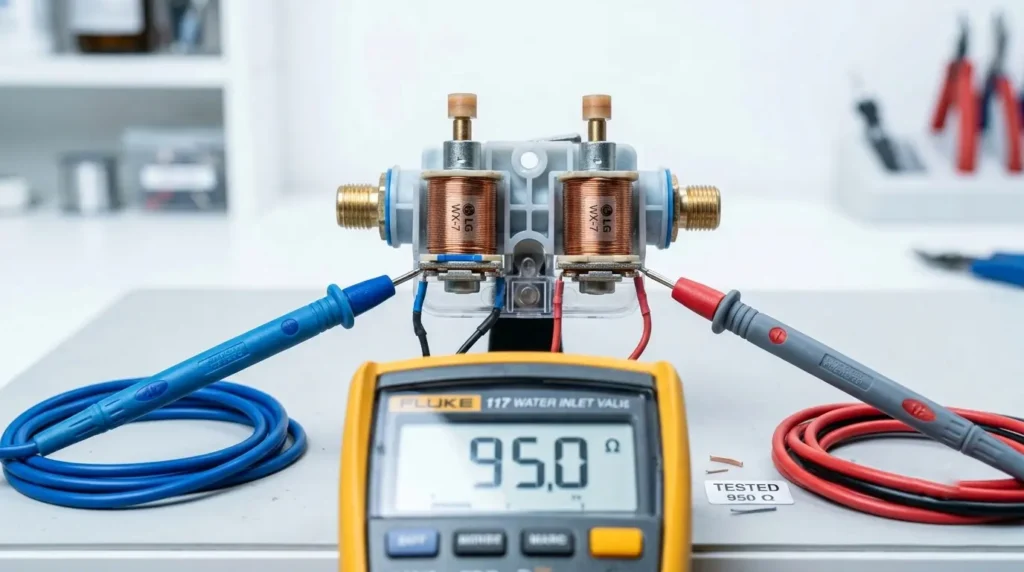
IE stands for ‘Inlet Error.’ The PCB triggers this when the water level pressure sensor does not register a rise in drum water level within an 8-minute fill window. The PCB sends a 120V signal to open the water inlet solenoid valves; if the tub does not fill, it concludes the water supply has failed.
The inlet valve is a dual solenoid: one coil for hot water, one for cold. Each solenoid should read between 900 and 1,000 ohms on a multimeter. A reading significantly below 800 Ω indicates a short; OL indicates an open coil and a failed solenoid.
Inlet Mesh Filter Test Specs
| Inlet Port | Filter Color (Standard LG) | Blockage Sign | Cleaning Agent |
| Cold Water | Blue mesh | IE code in first 2 minutes | White vinegar soak + soft brush |
| Hot Water | Red/orange mesh | IE code after hot fill begins | White vinegar soak + soft brush |
| Both ports blocked | Both colors show mineral scale | IE code immediately on start | Calcium descaler solution |
💡 PRO TIP: In hard water areas (TDS above 200 ppm), these mesh filters can clog in as little as 3 months. If you get seasonal IE codes, add a bi-monthly filter cleaning to your maintenance schedule.
dE Error Code: Door Lock System
What dE Means at the Circuit Level
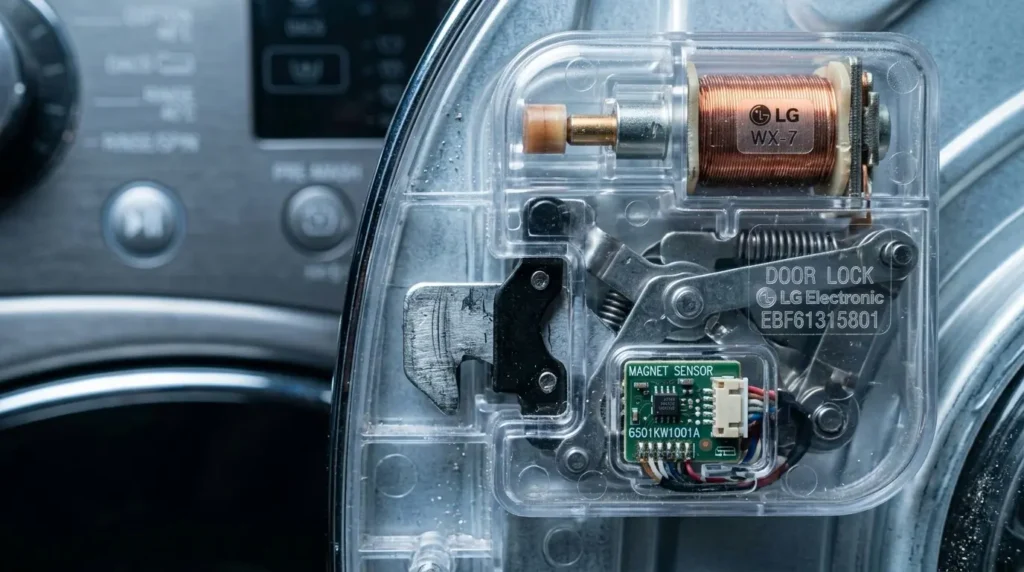
‘dE’ stands for ‘Door Error.’ The PCB will not begin or continue any cycle unless it receives a closed-circuit signal from the door lock assembly. The 2026 LG door lock uses both a mechanical latch mechanism and a magnetic Hall-effect sensor, the same principle as the motor position sensor but for door position.
The door lock solenoid coil resistance should measure 200–300 ohms. Below 150 Ω indicates a shorted coil. OL indicates an open circuit. If the coil tests good, the wax motor thermal actuator inside the lock assembly may have failed; this component uses heat to extend a pin that physically locks the door, and it has a limited lifespan.
dE2 vs dE Error Distinction
| Code | Specific Failure Point | Primary Test |
| dE | Door latch not detected as closed (sensor signal) | Check sensor wire continuity and latch alignment |
| dE2 | Door lock solenoid failed to engage (mechanical) | Measure solenoid coil resistance at harness connector |
⚠️ WARNING: Never reach inside the drum while a dE code is active. On some 2026 models, the lock assembly makes a second engagement attempt automatically, which can trap a hand in the door.
Read more: LG Washer dE Error Code Solved
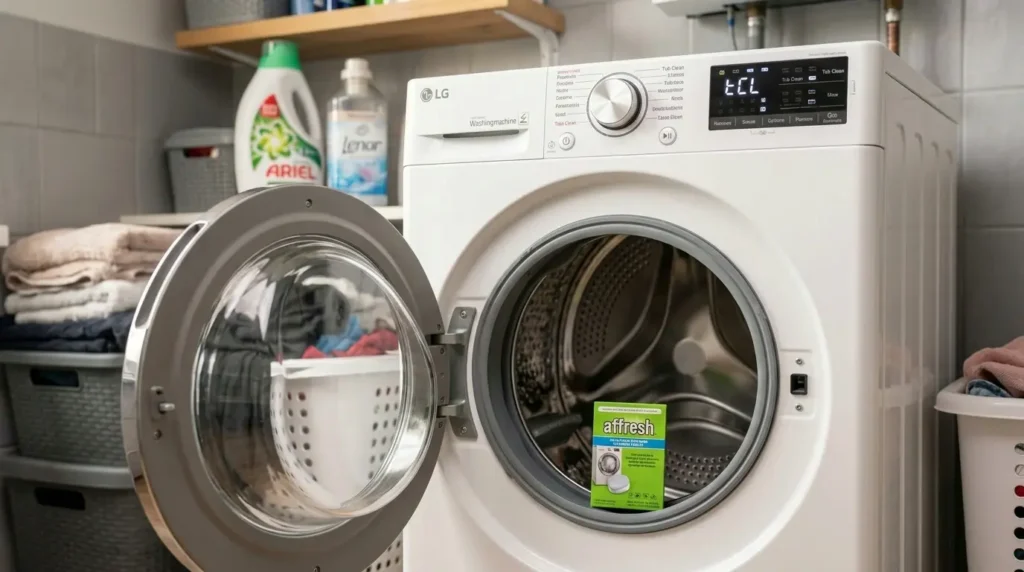
tCL Code: Drum Sanitation Protocol
tCL is not a fault code, it is a scheduled maintenance notification. The PCB tracks the number of wash cycles and displays tCL when the drum requires a sanitization cycle to clear biofilm accumulation on the inner tub surfaces and drum bearings.
Biofilm is a layer of bacteria, detergent residue, and mineral deposits that builds up behind the drum, where standard wash cycles cannot reach. Left untreated, it causes persistent odors and, in front-load models, accelerates rubber gasket degradation.
To run the tCL cycle: select the ‘Tub Clean’ mode on the control panel. Use a dedicated tub cleaning tablet rated for HE machines, not bleach, which can damage the gasket over time, and not vinegar alone, which lacks the enzymatic action to break down biofilm in 2026-model drum geometries.
👉 [Read More: LG washer monthly maintenance guide]
CL Code: Control Lock Active
CL is a status indicator, not a fault. It means the Control Lock (Child Lock) feature is active, which disables all buttons on the control panel. This is frequently mistaken for a system error because it appears suddenly and nothing responds.
To deactivate: locate the button with a padlock icon or the ‘Child Lock’ label. On most 2026 LG models, press and hold it for 3 seconds. The machine will beep once, and the CL indicator will disappear. If the lock reactivates on its own after every cycle, the button itself may be sticking due to detergent residue underneath the panel membrane.
Expert Diagnostic Protocol: Using the LG Service Test Mode
Before ordering any part based on an error code, LG’s built-in Service Test Mode lets you activate and isolate individual components. This mode runs each system independently, which tells you definitively whether the failure is in the component or in the circuit supplying it.
Activating Service Test Mode
- Machine must be powered OFF before starting.
- Press and hold Spin Speed + Soil Level (or Temp on some models) simultaneously.
- While holding those buttons, press Power. The machine will beep twice, and all LEDs will illuminate.
- Press Start. The machine begins a sequential component test: motor at low speed, high-speed spin, then water valve actuation.
- Each phase pauses at its own error if a component fails, displaying the relevant fault code in isolation.
💡 PRO TIP: If a component works in Service Test Mode but fails during a normal cycle, the issue is almost always in the PCB’s cycle logic or a sensor threshold setting, not the component itself. This distinction can save you from replacing a working part.
Read more: [LG Washer CL Error Code Fixed: The Ultimate Guide to Turn Off Child Lock Effortlessly! (2026)]
Frequently Asked Questions: LG Error Codes
Q1: My OE code returns every few months even after I clean the filter. What is the real cause?
Recurring OE codes after filter cleaning almost always point to the pressure sensor hose. This rubber hose develops small interior cracks that allow water to wick inside. Over a few weeks of normal use, the trapped water creates enough back-pressure to trigger the OE fault. Replacing the hose (a $5–$10 part) eliminates the cycle. Do not just blow it out; replace it.
Q2: Can I test a Hall sensor without a multimeter?
Functionally, no. The Hall sensor operates in the millivolt range under load, and its static resistance is the only measurement available with basic tools. If you absolutely cannot get a multimeter, the practical workaround is to unplug the sensor connector and try to spin the motor manually with a short wash cycle. If the motor attempts to run (even briefly) without the sensor connected, the sensor was definitely the problem. But this is a destructive test and can generate a secondary error, so a multimeter is strongly recommended.
Q3: What is the difference between the IE code and a 4C code I see in Samsung guides?
These are brand-specific codes for the same failure type, water inlet timeout. LG uses IE; Samsung uses 4C or 4E. The diagnostic process is similar (check mesh filters, inlet valve resistance, water pressure), but the resistance specifications and sensor logic differ between brands. Do not apply Samsung test values to an LG machine.
Q4: My machine shows an error code that is not in this guide. What do I do?
LG uses some model-specific extended codes that are not in the standard user documentation. For these, the LG ThinQ app’s Smart Diagnosis feature is the best first step, it captures the machine’s internal fault log and can identify codes that don’t appear in consumer guides. If the app cannot identify it, the service mode code can be cross-referenced with LG’s professional service manual for your specific model number, available on LG’s partner support portal.
Q5: After I fix the root cause, how do I clear the error code?
On most 2026 LG models, the error code clears automatically once the PCB confirms the sensor reading has returned to the acceptable range. If the code persists after repair, perform a PCB reset: disconnect power from the wall, then press and hold the Start/Pause button for 10 seconds to discharge the capacitors. Wait 5 minutes before restoring power. This forces the PCB to re-initialize all sensor baselines.
Parts Reference Table
| Error Code | Primary Suspect Part | LG Part Number (Reference) | Avg. Part Cost (2026) |
| OE | Drain Pump Motor | 4681EA2001T | $45–$65 |
| LE | Hall Sensor (RPS) | 6501KW2002B | $15–$30 |
| LE | Motor Wire Harness | EAD61905003 | $20–$40 |
| UE (persistent) | Shock Absorber Pair | 4930ED3003A | $30–$60 |
| IE | Water Inlet Valve (Dual) | 5221ER1003B | $35–$55 |
| dE | Door Lock Assembly | 6601ER1004C | $25–$50 |
| OE (recurring) | Pressure Sensor Hose | 4738ER1002A | $5–$15 |