
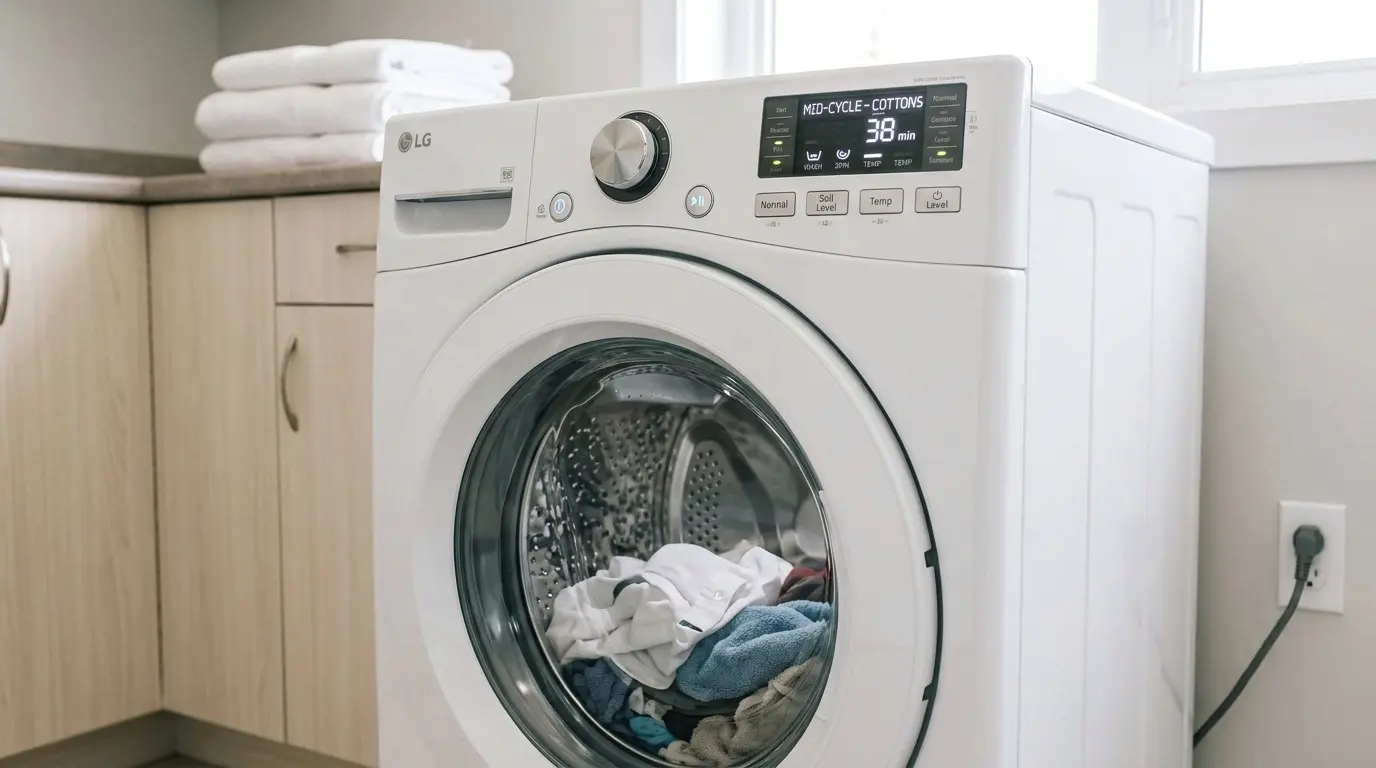
The tub is full, the cycle is running, and the motor is clearly getting power; you can hear it humming under the machine. But the drum just sits there. If you’ve ever popped the lid mid-cycle expecting to see wet laundry flying and instead found it floating motionless in soapy water, you already know how unsettling that sound is. It’s not silence. It’s the machine telling you exactly where to look if you know how to listen.
This guide walks through the full diagnostic path for this one specific symptom on LG washers, direct-drive and belt-drive models alike, and the physical repair steps for each likely cause. We’re not covering LG’s error code system here, and we’re not covering general troubleshooting for problems unrelated to a spin failure. If your machine is throwing a specific code on the display, that’s a different fix entirely and worth checking separately.
Table of Contents
Why the Motor Hums Instead of Turning the Drum
A hum with no rotation almost always means the motor is receiving voltage and trying to turn, but something between the motor and the drum isn’t transferring that motion. It’s a mechanical disconnect, not an electrical dead-end, which is actually good news, because a dead motor usually stays silent, not humming. On LG machines the culprit sits in one of three places depending on your model: the motor coupler, the drive belt and pulley, or, in less common cases, the drum bearings seizing up enough that the motor can’t overcome the resistance.
The specific pitch and rhythm of the hum is a genuine diagnostic clue. A steady, continuous hum that doesn’t change tone usually points to a coupler or belt that has completely failed and is spinning freely with nothing to grab. A hum that pulses or stutters, almost like the motor is trying and stalling repeatedly, points toward a partial mechanical bind, like a coin lodged between the tub and drum or bearings that are dragging rather than fully seized.
⚠ SAFETY FIRST: READ BEFORE OPENING THE MACHINE
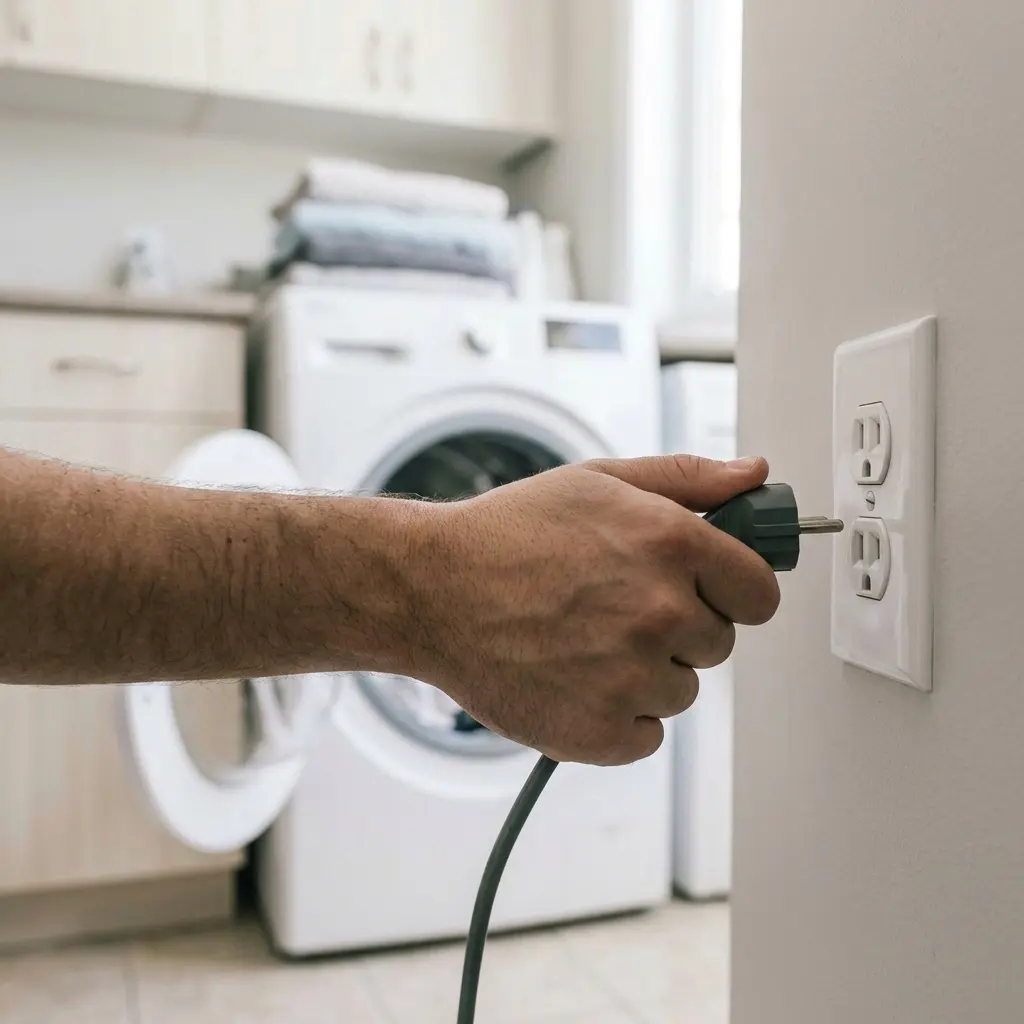
- Unplug the washer from the wall outlet before removing any panel. Don’t just pause the cycle; a paused machine is still live.
- If your model is hardwired or on a dedicated circuit, switch off the breaker as well and confirm with a non-contact voltage tester before touching internal wiring.
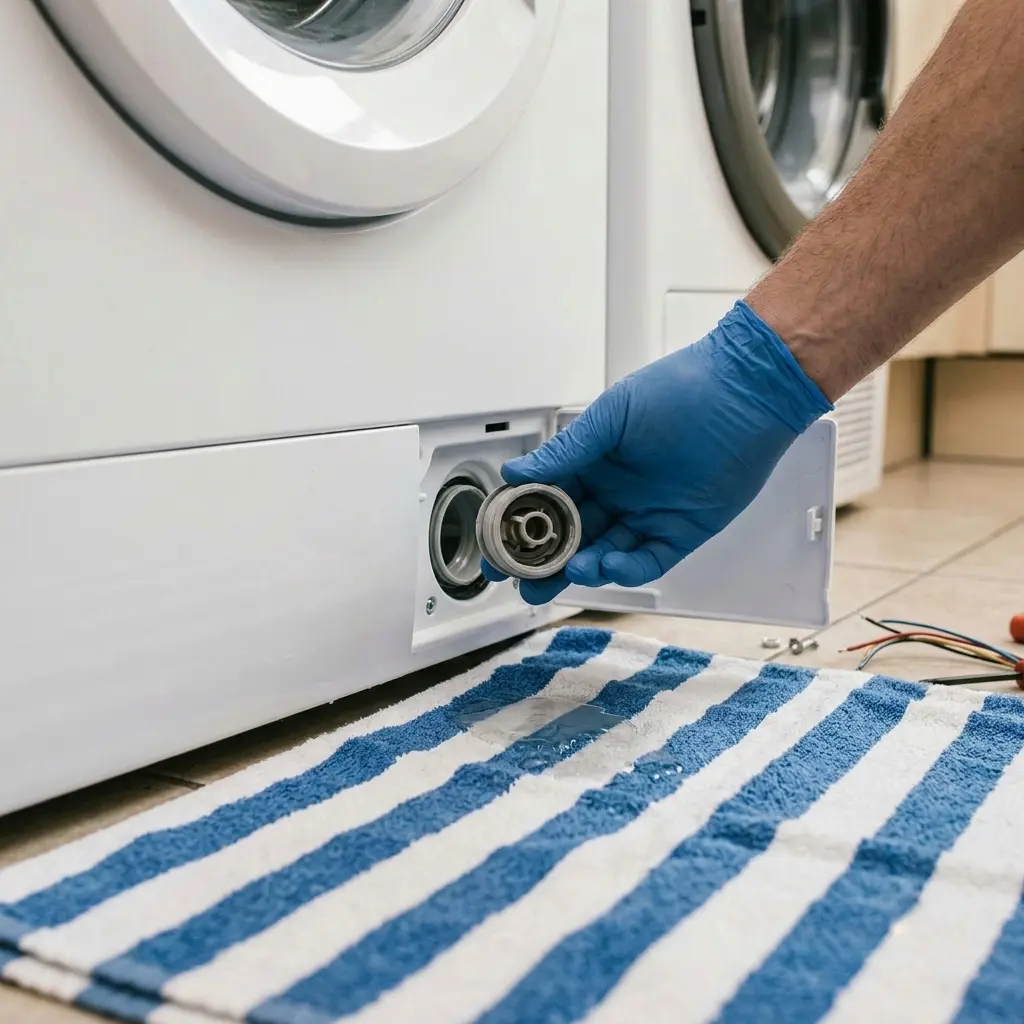
- Front-load and top-load LG washers hold several gallons of water in the tub and hoses even after a cycle stops. Place towels down and be ready for residual water when you access the drum or pump area.
- The tub and drum assembly are heavy, especially on front-load models. If you need to tip or lay the machine down to access the belt or motor, do it with a second person.
- Never bypass or defeat the door/lid lock switch to test spin with the door open. The interlock exists because a spinning drum with an open door is a real injury risk.
- STOP and call a licensed technician if the issue involves the main electrical panel or if you smell burning insulation, which points to wiring or board damage beyond a mechanical fix.
Step 1: Rule Out the Non-Mechanical Causes
Before you open a panel, spend five minutes ruling out the causes that have nothing to do with a broken part. This step alone resolves the issue often enough that it’s worth doing every time.
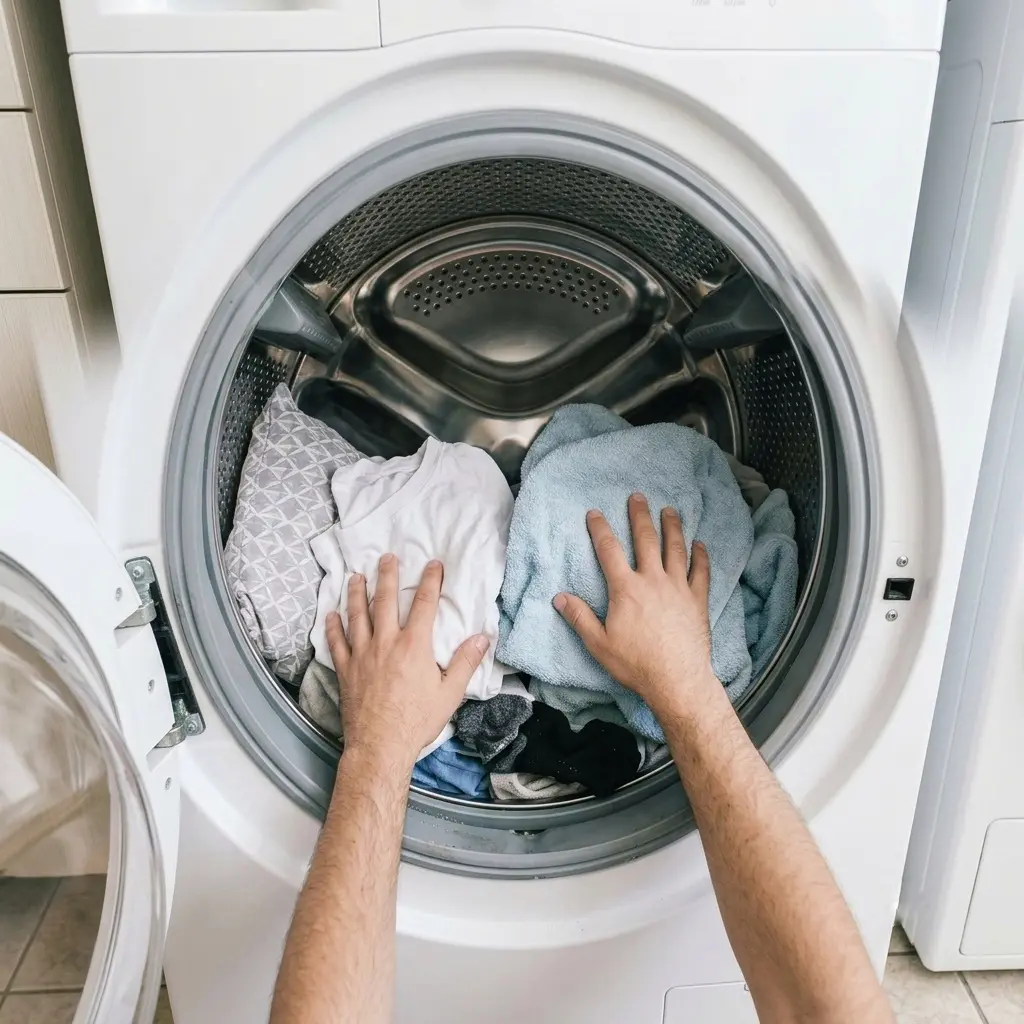
Check the load balance
LG washers use a balance sensor that will interrupt spin, sometimes with a humming attempt to redistribute the load, if the wash is bunched to one side of the drum. A single heavy item like a comforter or a pair of jeans wadded together is a common trigger. Open the door, manually redistribute the load so it’s roughly even around the drum, and restart the spin cycle.
Confirm the door or lid is actually locking
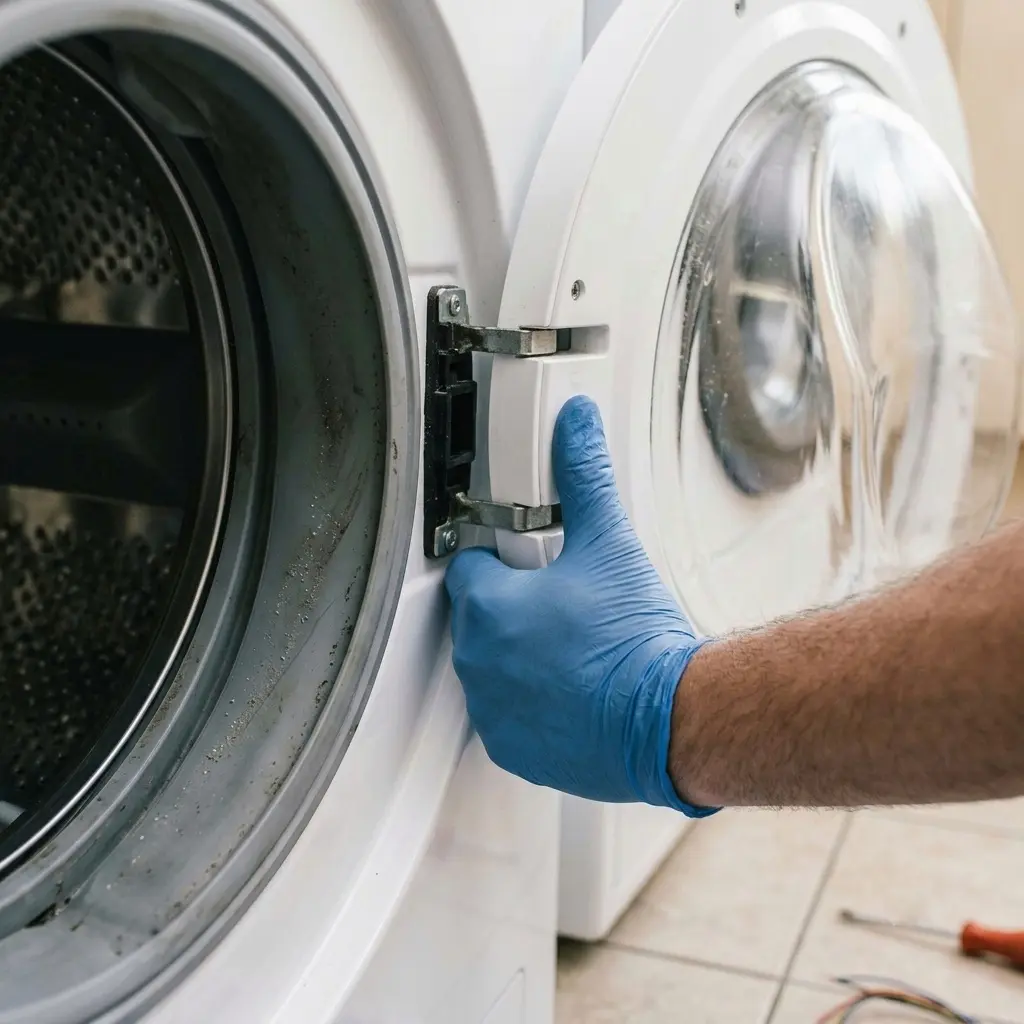
The machine will not spin, and the motor may still attempt to engage and hum if the door lock switch isn’t reporting a locked state to the control board. On front-load models, push firmly on the door while the machine attempts to start a spin cycle and listen for the lock solenoid engaging (a distinct clunk). No clunk usually means the door lock assembly itself needs testing or replacement, a separate, well-documented part swap.
Check for a drain problem
This one catches people off guard. Many LG models will not enter spin if the tub hasn’t drained, and the pump attempting to clear a clog can produce a hum that sounds very similar to a motor trying to turn. If you can hear standing water sloshing in the tub, or the drain hose is kinked or pinched, or the drain filter is clogged, clear that first. Spin often resumes normally with zero parts replaced.
👉 [How to Clean LG Washing Machine: Front & Top Load 2026]
Step 2: Identify Your Drive Type
LG makes both direct-drive washers (the motor mounts directly to the tub, no belt) and belt-drive washers (an external motor spins a pulley connected to the tub by a belt). This matters because the failure point and the fix are completely different between the two. Most modern LG front-load washers are direct-drive; many top-load and older models use a belt.
Quick way to tell: if you can see or feel a rubber belt looping around a pulley at the base of the tub when you remove the rear or bottom panel, it’s belt-drive. If the motor is a flat, disc-shaped unit bolted directly to the back of the tub with no belt in sight, it’s direct-drive.
Step 3: Diagnosing and Fixing a Direct-Drive Machine
On direct-drive models, the most common cause of a hum without spin is a worn or broken motor coupler or, on models that skip a separate coupler, worn motor mounting bushings that let the rotor spin without transferring torque cleanly to the shaft.
The insider check most people skip
Before condemning the coupler, unplug the machine and try turning the drum by hand through the door opening. A healthy drive system resists rotation firmly. If the drum spins freely with almost no resistance and you can feel or hear a faint clicking or grinding from the motor area as you turn it, that’s a coupler or bushing that has stripped its teeth. This single hand-spin test is often faster and more reliable than pulling the whole rear panel to look, and it’s the first thing most techs do on a service call before opening anything.
Replacing the motor coupler
- Disconnect power and access the rear panel per your model’s service points.
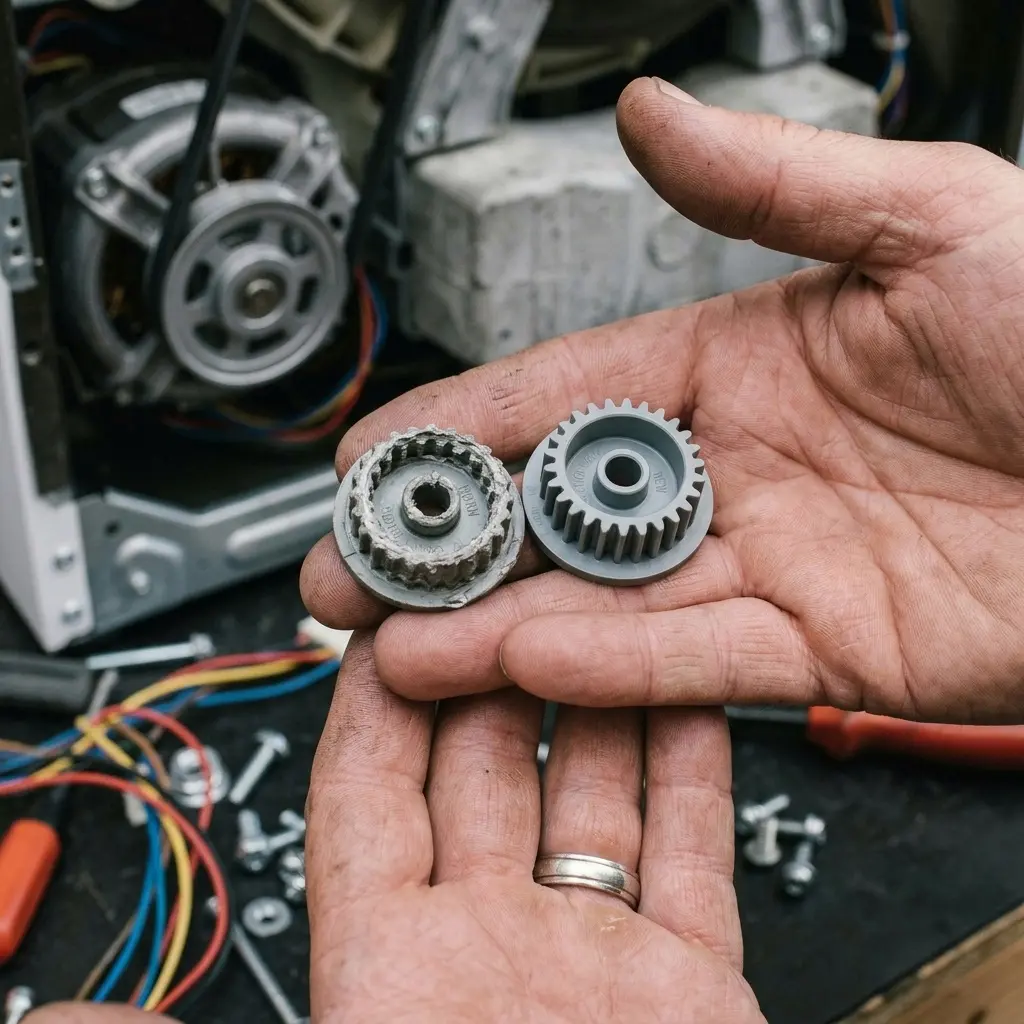
- Remove the motor mounting bolts and gently pull the motor back to expose the coupler, which sits between the motor shaft and the tub shaft.
- Inspect the plastic coupler halves; stripped or rounded-off teeth confirm the diagnosis. It’s a wear part by design; it’s meant to fail before the motor or transmission does.
- Replace both coupler halves as a set, even if only one looks worn; they wear as a pair.
- Reseat the motor, torque the mounting bolts evenly, and hand-spin the drum before reassembling the panel to confirm resistance has returned.
Step 4: Diagnosing and Fixing a Belt-Drive Machine
On belt-drive LG washers, a hum with no spin points almost immediately to the belt itself, either snapped, slipped off the pulley, or so glazed and worn it’s slipping under load without fully coming off.
Visual and manual inspection
With power disconnected and the appropriate panel removed, look at the belt path between the motor pulley and the tub pulley. A snapped belt is obvious. A belt that’s still intact but glazed (shiny, hard, slightly stretched) will often stay looped but slip and squeal under load; that slip is what produces the hum since the motor is spinning freely while the belt fails to transfer enough force to overcome the wash load.
Replacing the belt
- Confirm power is disconnected and, if needed, lay the machine on its side or back per the service manual; this is a two-person job on most models.
- Remove the old belt from both pulleys, noting the routing path.
- Check the tub pulley for freedom of movement by hand; if it’s stiff or gritty, the tub bearing may be the actual root cause, and the belt is a secondary casualty.
- Fit the new belt starting on the larger tub pulley, then walk it onto the motor pulley while manually rotating the pulley.
- Verify correct tension and alignment before closing the machine back up, then hand-spin the drum to confirm smooth engagement.
Step 5: When It’s the Control Board, Not the Drive
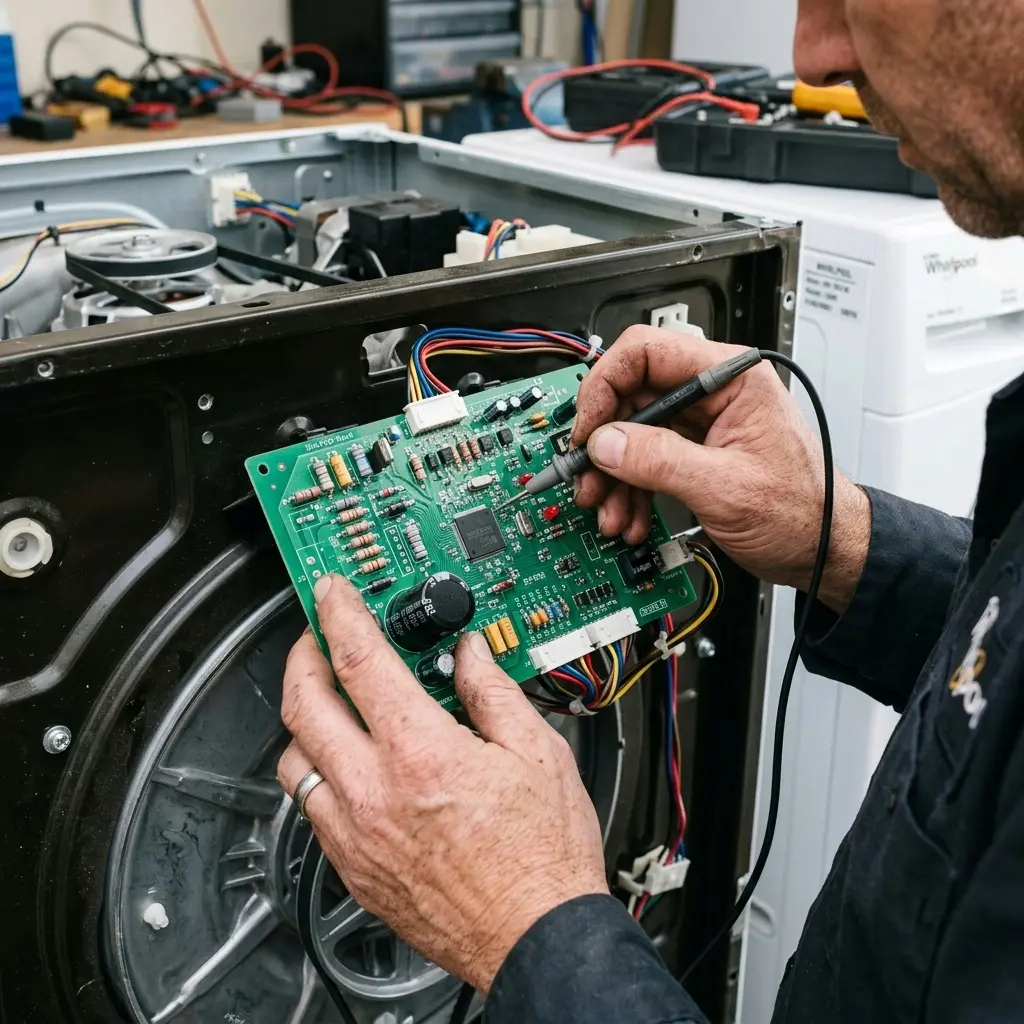
If the hand-spin test showed normal resistance, the coupler or belt looks fine, and the drain and door lock check out, the remaining suspect is the motor control board (often called the MCU or inverter board on LG models with inverter-driven motors). This board sends the drive signal to the motor. A partially failed board can still send enough voltage to make the motor hum and attempt to start without producing the sustained signal needed to actually ramp up to spin speed.
A detail most owners never think to check first
Ask yourself whether the hum happens on every cycle or only on high-speed spin specifically, while wash and low-speed drain-spin work fine. A board that fails only at higher speed demand is a different symptom profile than a board that fails to drive the motor at all, and it changes whether a tech treats this as a board-level fault versus a motor winding problem; it’s one of the first questions a technician will actually ask the customer over the phone before ever showing up, because it narrows the diagnosis before a single screw comes out.
Board diagnosis and replacement involve working around line-voltage connections and, on inverter models, capacitors that can hold a charge after power is disconnected. This is where the repair crosses from a straightforward mechanical swap into work that carries real electrical risk if you’re not experienced reading a board layout and discharging capacitors safely. If you’ve confirmed the drive mechanism is fine and the fault traces to the board, this is a reasonable point to call a technician rather than push forward; board-level diagnosis is genuinely a different skill set than swapping a belt or coupler.
LG Washing Machine Humming Cause Comparison Table
| Symptom Detail | Drive Type | Most Likely Cause | Repair Difficulty |
| The drum spins freely by hand, faint clicking | Direct-drive | Worn motor coupler | Moderate, DIY-friendly |
| The belt visibly snapped or off the pulley. | Belt-drive | Broken drive belt | Moderate, two-person job |
| Belt intact but squealing under load | Belt-drive | Glazed/worn belt | Moderate, DIY-friendly |
| The drum resists hand-turning normally, hum only at high spin | Either | MCU/inverter board | Advanced, consider a technician |
| Sloshing water heard, hum during spin attempt | Either | Drain blockage, not drive fault | Easy, DIY-friendly |
| No lock clunk heard at the door. | Either | Door lock switch/assembly | Moderate, DIY-friendly |
Frequently Asked Questions about LG Washing Machine Humming
1. Can a washer hum but not spin because it’s simply overloaded?
Yes, but usually only briefly. A genuinely overloaded machine will typically pause, display a load-size or balance-related response, and may attempt to redistribute rather than hum continuously. A sustained hum on a normal-sized load points more toward the drive components than the load size itself.
2. Is it safe to run more cycles to try to fix it myself before opening the machine?
Running additional cycles won’t damage anything further if the cause is a drain clog or unbalanced load, and it’s a reasonable first troubleshooting step. If the cause is a worn coupler or belt, though, repeated attempts to spin against resistance can accelerate wear on nearby components, so once you’ve ruled out drain and balance issues, move on to inspection rather than repeating cycles indefinitely.
3. How long does a motor coupler typically last on an LG washer?
It varies a lot with load habits, but couplers on frequently used machines with regularly overloaded washes tend to fail sooner. It’s a deliberately sacrificial part, so treat a coupler failure as normal wear rather than a sign something else is wrong with the machine.
4. Do I need to remove the whole tub to replace a motor coupler or belt?
No, on the large majority of LG models, both the coupler and the belt are accessible by removing a rear or bottom service panel without pulling the tub itself. Full tub removal is typically only needed for bearing or shaft-seal work.
5. My machine hums and then shows nothing on the display. Is that related?
A hum paired with a display going blank is more consistent with a power or control board issue than a pure drive-mechanism fault, since a mechanical coupler or belt problem shouldn’t affect the display at all. Treat that combination as a separate electrical symptom rather than assuming it’s the same coupler or belt issue covered in this guide.
6. Can I test the motor coupler without fully removing the motor?
The hand-spin test described above is the fastest non-invasive check and will tell you whether resistance is present at all. Confirming the coupler visually still requires pulling the motor back enough to see the coupler halves, since a coupler can be partially worn and still provide some resistance while being close to failure.
7. Is a hum-but-no-spin issue ever covered under an LG warranty?
It depends entirely on your unit’s age and warranty terms, since LG’s coverage windows differ by component; motors and electronic parts often carry different coverage lengths than general workmanship. Check your specific model’s warranty documentation or contact LG support directly before opening the machine if it’s still within a plausible coverage window, since DIY disassembly can affect a warranty claim.
Getting the Drum Turning Again
A hum with no spin is one of the more satisfying washer symptoms to diagnose; honestly, it narrows the search dramatically compared to a machine that just goes dead. Work through the non-mechanical checks first, confirm your drive type, and let the hand-spin test tell you whether you’re dealing with a coupler, a belt, or something further upstream at the control board. Most of the time, this is a part swap well within reach of a confident DIYer with a couple of hours and the right replacement kit on hand.