
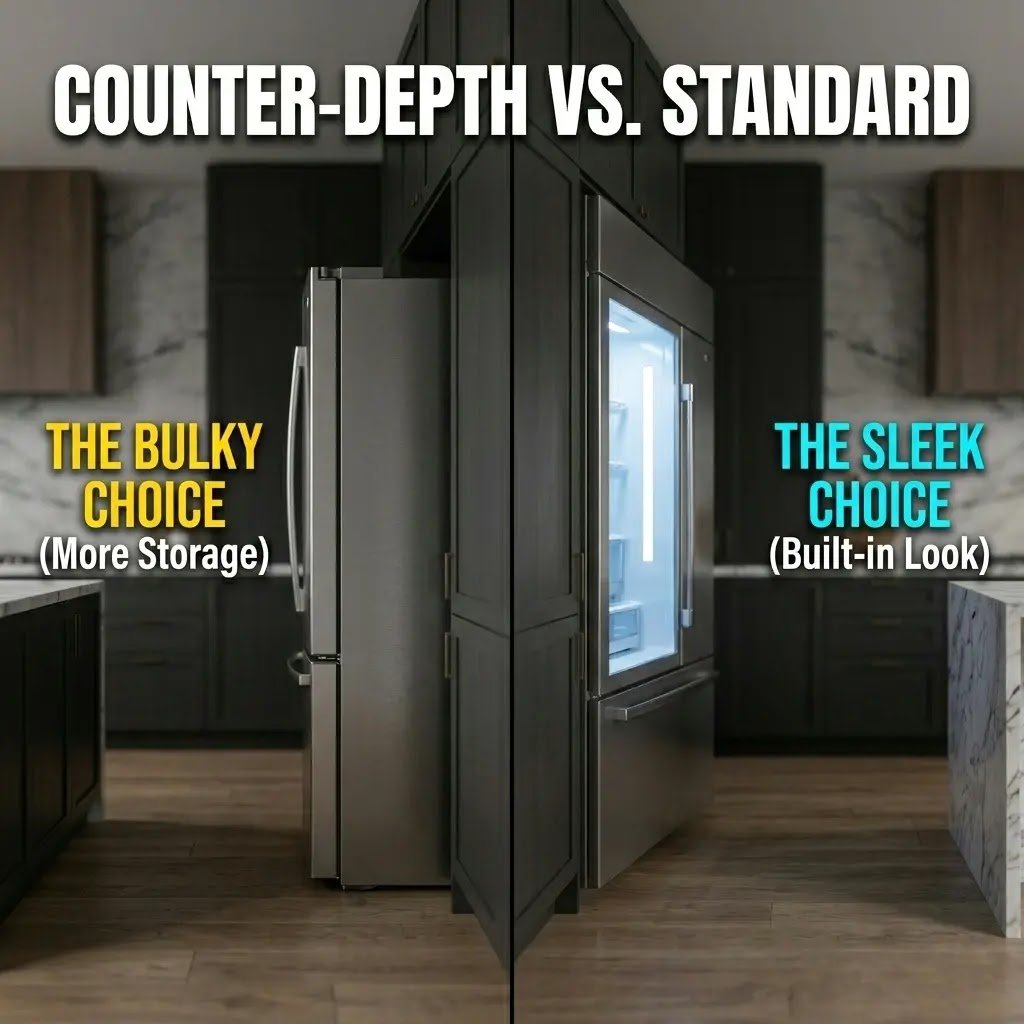
When you walk into a kitchen showroom, every counter-depth refrigerator looks perfect, flush with the cabinets, with no ugly overhang, like it was built into the house. Your brain reads that as “organized” and “high-end.” But plenty of buyers feel a strange buyer’s remorse exactly two weeks after spending $2,500 on one, once they realize what that sleek look actually cost them in usable space. In this Guide we Discuss some Counter-Depth refrigerator myths that really matter before buying a counter-depth refrigerator
Why the disconnect? Because a counter-depth refrigerator isn’t just a regular fridge with the back cut off, the sleek look comes at a real engineering and storage cost that showrooms rarely explain. Here are the 4 biggest myths about these fridges so you can decide if the Sleek Tax is worth it for your home.
Table of Contents
Myth #1: It’s Just a Regular Fridge, Only Thinner
Many people assume manufacturers just cut the back off a regular fridge. That’s wrong. Making a fridge thinner while keeping the inside just as cold is a genuine engineering challenge. Standard fridges rely on thick foam insulation, while counter-depth models often require Vacuum Insulation Panels (VIPs), which are thinner but considerably more expensive to manufacture.
That’s the real reason you pay more for less physical space: you’re paying for the insulation engineering, not just the smaller footprint. Samsung’s Bespoke series, for example, uses thin-wall technology specifically to claw back every possible inch of interior volume, and that engineering is part of what drives the premium price tag.
Myth #2: You Lose Too Much Food Storage
It’s true you lose roughly 4 to 6 cubic feet of space, but how you use that space changes in a way that isn’t obvious until you live with it. In a deep, standard fridge, food often ends up in what techs call the “back-wall graveyard,” pushed out of sight and forgotten until it spoils. In a counter-depth model, everything sits in the front row, visible at a glance.
The Deli Drawer Secret
Because counter-depth fridges are typically wider to compensate for the lost depth, they often include a full-width deli drawer instead of the split two-drawer layout common in standard fridges. That means large party platters, long boxes of celery, or a pizza box can lie flat, something that’s often impossible in a deep fridge, where you’re forced to stack vertically. GE Profile models lean into this especially well, often pairing it with door-in-door storage to reclaim volume lost from the shallower shelves.

Myth #3: It Fits Perfectly Flush with Cabinets (The Big Lie)
This is the most important myth to understand before you buy. If you push a “counter-depth” fridge all the way back until it touches the wall, the doors won’t open, because most refrigerator doors need to swing past 90 degrees for the drawers to clear, and thick doors (usually 3–4 inches) need room to swing past your cabinet edge.
Case Depth vs. Depth with Handles
Spec sheets list case depth (the box itself) separately from depth with handles, and many buyers only check the first number. Handles alone can add 2 to 3 inches. If your cabinet run is 24 inches deep and your fridge’s case is also 24 inches, the handles will still stick out noticeably into your walkway. Unless you buy a zero-clearance or fully integrated model (like the LG Studio series), expect either a 1–2 inch gap or handle interference; showroom catalog photos often hide this by removing handles or using specialty hinges that cost significantly more.

Myth #4: Counter-Depth Always Costs More
This used to be reliably true. But heading into 2026, several brands are treating counter-depth as closer to a standard offering for modern kitchens rather than a luxury upcharge. Frigidaire Gallery in particular has narrowed the price gap; you can now find solid counter-depth models close in price to their deeper counterparts, especially during holiday sales windows. The Sleek Tax is shrinking, at least at the entry-level luxury tier.
The Reddit Verdict: Real Owners Speak
Looking at owner discussions on r/Appliances and Quora after a year of real use, the feedback is genuinely split rather than uniformly positive or negative:
- Door bin capacity is a recurring complaint; several owners switched to smaller milk cartons because the bins couldn’t hold two gallons side-by-side the way their old fridge could.
- Visibility is the most cited upside; multiple owners specifically credit not throwing out forgotten leftovers anymore since nothing gets lost in a deep back corner.
- Hosting large gatherings requires more planning; the “pizza box Tetris” problem shows up repeatedly in reviews from owners who entertain often.
Installation Considerations
Before you buy, check your water line clearance. In a standard deep fridge, there’s plenty of room behind the unit for a bulky water valve and hose. In a counter-depth setup, every millimeter matters; a protruding water valve can push your “flush” fridge out several extra inches you didn’t plan for.
cabinetry; you’ll also want to confirm side and top clearance before installation, since counter-depth units run hotter when boxed tightly into cabinetry; inadequate airflow forces the compressor to work harder, which can shorten its lifespan over time.
The specific clearance measurements, recessed water box options, and step-by-step installation prep are covered in 👉 [Fit Issues Fixed, Making Your Fridge Truly Flush].

Resale Value & Home ROI
Does a counter-depth refrigerator help resale value? Many real estate professionals suggest buyers increasingly favor a built-in look, and a fridge that juts out can make a kitchen feel dated by comparison, even when the actual storage capacity is nearly identical. This is a directional trend rather than a guaranteed dollar return, so treat it as one factor among several rather than the deciding one.
The Ruthless Cheat Sheet
| Category | Model | Best For |
| The Beauty King | LG Studio Series | Buyers prioritizing the truest flush look, best-in-class hinge engineering |
| The Space Saver | GE Profile | Families needing reclaimed volume via door-in-door and smart shelving |
| The Budget Pick | Frigidaire Gallery | Buyers who want the look without the full $500 Sleek Tax |
10. Counter-Depth refrigerator myth FAQs & Conclusion
Can I fit a full-size frozen pizza in a counter-depth fridge?
Usually yes, but you may need to angle it or remove it from the box first; this is one of the most common complaints in owner reviews, precisely because the shelf depth is tighter than people expect.
Do counter-depth refrigerators use more electricity?
Generally no. Because they’re smaller and typically paired with higher-end insulation, they’re often more energy-efficient than larger standard-depth models, not less.
Is a counter-depth refrigerator worth it for a family of five?
Usually only if you also have a secondary garage or basement fridge for bulk items. As a sole main fridge for five people, most owners find it cramped for a full week’s groceries.
How much more should I expect to pay for a counter-depth model versus a standard?
The gap has narrowed considerably heading into 2026, especially at brands like Frigidaire Gallery, but premium brands like LG Studio and high-end Samsung Bespoke still carry a real price difference tied to insulation engineering and hinge design, not just the smaller footprint.
Will a counter-depth fridge actually fit flush against my cabinets?
Only if you account for handle depth, not just case depth, and only if your door swing clearance allows drawers to fully extend. Most installations still end up with a small gap or slight handle protrusion unless you choose a zero-clearance model.
Do these fridges need special installation compared to a standard fridge?
Yes, in a few specific ways, water line clearance and side/top airflow gaps matter more here than in a standard deep fridge, since there’s less forgiving space behind and around the unit.
Is the interior layout actually different, or just the outside dimensions?
It’s genuinely different. Full-width deli drawers, door-in-door storage, and shallower-but-wider shelving are common design choices specifically made to offset the lost depth, it’s not simply a shrunken version of a standard fridge’s interior.
The Final Reality Check
The choice comes down to this: do you want a kitchen that looks like a magazine, or a fridge that holds two extra gallons of milk without a fight? If visibility and a modern, built-in aesthetic matter most to you, a counter-depth refrigerator is genuinely a win. But if you have a large family or buy in bulk, don’t let the showroom’s flush-fit photos talk you into a layout that won’t actually work for how you live.
📐 Master Your Counter-Depth Setup
Don’t let the Sleek Tax turn into a maintenance headache. Use these guides to get a proper fit and long-term cooling efficiency:
👉 [Fit Issues Fixed, Making Your Fridge Truly Flush]