

Pull the back panel off an LG refrigerator, and you’ll find a compressor that looks almost nothing like the one in most other brands: no crankshaft, no connecting rod, and no rotating motor turning a wheel. That’s not a styling choice. It’s a fundamentally different way of moving refrigerant, and understanding how it actually works explains almost everything people notice about LG refrigerators, from the unusually quiet hum to why LG backs these units with such long compressor warranties. LG Refrigerator linear compressors are quiet and reliable for those families who want a peaceful and quieter home.
Table of Contents
What “Linear” Actually Means Mechanically
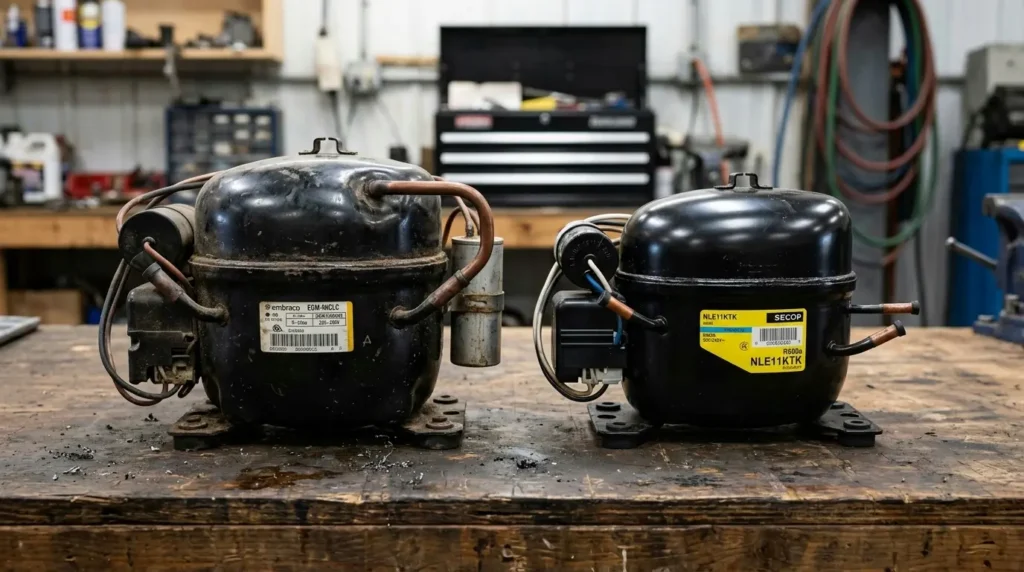
In a traditional compressor, an electric motor spins a rotating shaft, which is connected to a piston through a crankshaft and connecting rod, essentially converting circular motion into the back-and-forth movement needed to compress refrigerant gas. That conversion step, from rotational to linear motion, involves friction at every joint: the crankshaft bearing, the connecting rod pin, and the piston skirt against the cylinder wall.
A linear compressor skips that conversion entirely. Instead of a motor spinning a shaft, it uses a reciprocating linear motor, essentially a magnet-and-coil system, similar in principle to a solenoid, that moves the piston directly back and forth along a single axis. There’s no crankshaft, no connecting rod, and critically, no side-loading force pushing the piston against the cylinder wall the way a crankshaft mechanism does. The piston travels in a straight line because the motor itself only produces motion in that direction.
This isn’t a minor engineering footnote; removing an entire mechanical conversion stage removes an entire category of friction, wear points, and energy loss that traditional compressors have lived with since they were invented.
👉 [LG refrigerator energy efficiency: is it really worth the price?]
How a LG Refrigerator Linear Compressor Differs From a Rotary Compressor
Rotary and reciprocating-crankshaft compressors both rely on continuous rotational motion from the motor, which means they’re generally more efficient running at a fixed speed or a small number of preset speeds. A linear compressor’s motor, by contrast, can vary its stroke length and frequency independently, allowing it to modulate cooling output far more precisely, running at low output to maintain a stable temperature most of the time, then ramping up smoothly when the door opens or a large amount of warm food is added.
| Feature | Linear Compressor | Rotary/Reciprocating Compressor |
| Motion type | Direct linear motor drive | Rotational motor + crankshaft conversion |
| Moving parts | Piston + linear motor (fewer parts) | Piston, connecting rod, crankshaft, bearings |
| Side-loading on piston | Minimal (motion is inherently linear) | Present (crankshaft introduces lateral force) |
| Speed modulation | Continuous, fine-grained | Typically fixed or limited preset speeds |
| Typical noise level | Lower, more consistent hum | More variable, audible cycling on/off |
| Common in | LG premium and mid-tier refrigerators | Most base-tier refrigerators across brands |
The practical result of fewer moving parts and no side-loading is straightforward: less friction wear per hour of operation, which is the mechanical reason LG has historically offered extended compressor-specific warranties (commonly longer than the warranty on the rest of the appliance); the company’s own reliability data supports doing so.
Why LG Built It This Way
The linear compressor wasn’t designed primarily to be quieter or last longer as an end goal; those are downstream benefits of the actual design goal, which was precise, efficient cooling modulation. A traditional compressor is fundamentally a binary device at the mechanical level: it’s either running at its designed speed or it’s off, with sophisticated electronics sometimes simulating variable behavior by cycling on and off rapidly. A linear compressor’s motor can genuinely vary its output continuously because stroke length and frequency aren’t fixed by a crankshaft’s geometry.
This matters practically because refrigerators don’t need constant maximum cooling; they need to maintain a narrow temperature band with occasional bursts of extra capacity. A compressor that can throttle down to a fraction of its maximum output rather than fully stopping and restarting avoids the energy spike that happens every time a traditional compressor’s motor has to overcome static inertia from a dead stop.
What the Design Means for Noise and Vibration
Side-loading is the real source of most compressor noise and vibration in traditional designs; every time the crankshaft pushes the piston at an angle rather than straight down its cylinder, that lateral force translates into audible vibration transmitted through the compressor housing and refrigerator frame. Since a linear compressor’s motor drives the piston along a single true axis with essentially no lateral component, there’s meaningfully less vibration generated at the source, not just better sound insulation around it.
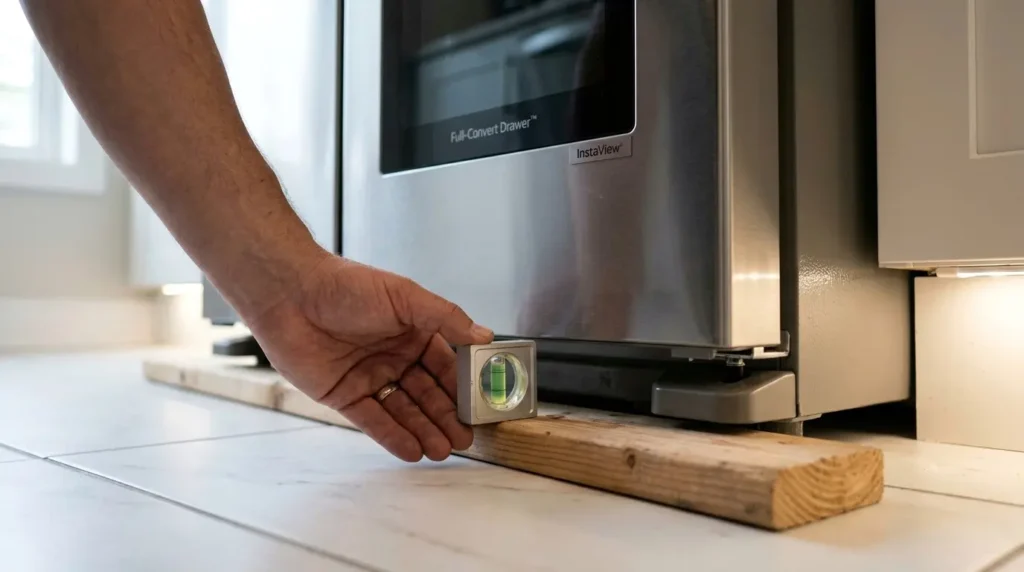
| 💡 Insider Knowledge: When a technician gets a call about a sudden noise increase on an LG fridge, the first check isn’t the compressor; it’s whether the unit is level and the rear feet still have floor contact. Because linear compressors run quieter at baseline, any new vibration from an unlevel cabinet becomes far more noticeable. |
Common Misconceptions About LG Refrigerator Linear Compressors
Misconception: “Linear means it only runs at one speed.”
The opposite is true; linear refers to the piston’s straight-line motion, not a fixed operating speed. Linear compressors are actually more capable of variable-speed operation than most traditional designs, not less.
Misconception: “LG refrigerator linear compressors can’t be repaired, only replaced.”
This is partially true but often overstated. The compressor itself is typically a sealed unit on both linear and traditional designs; that’s standard across almost all modern refrigeration compressors, not something unique to LG’s design. The difference in repair economics comes from the compressor’s price and labor complexity, not from the linear mechanism making it inherently unrepairable.
Misconception: “If it’s quieter, it must be weaker.”
Noise level and cooling capacity are unrelated in this design. The reduced noise comes from eliminated side-loading and vibration, not reduced power. Linear compressors in LG’s higher-capacity refrigerator lines produce comparable or greater cooling output than traditional compressors of similar size.
How LG Refrigerator Linear Compressors Fail (and Why Rarely)
When a linear compressor does fail, the failure mode looks different from a traditional compressor’s typical wear pattern. Traditional compressors most often fail from bearing or crankshaft wear accumulating over years, eventually causing a seized or noisy mechanical failure. Linear compressors, having no bearings or crankshaft to wear down the same way, more commonly fail from electrical winding issues in the linear motor itself, refrigerant leaks unrelated to the compressor’s mechanical action, or start relay/capacitor component failure in the driving electronics.
| 💡 Insider Knowledge: The detail that actually determines repair vs. replace on a failed linear compressor isn’t its age; it’s whether the failure is electrical (start components) or a sealed refrigerant system failure. Electrical failures are often reasonably repairable; sealed-system failures usually mean replacing the whole compressor assembly, and with labor to evacuate and recharge, that cost frequently rivals a replacement refrigerator. |
What This Means for Long-Term Ownership
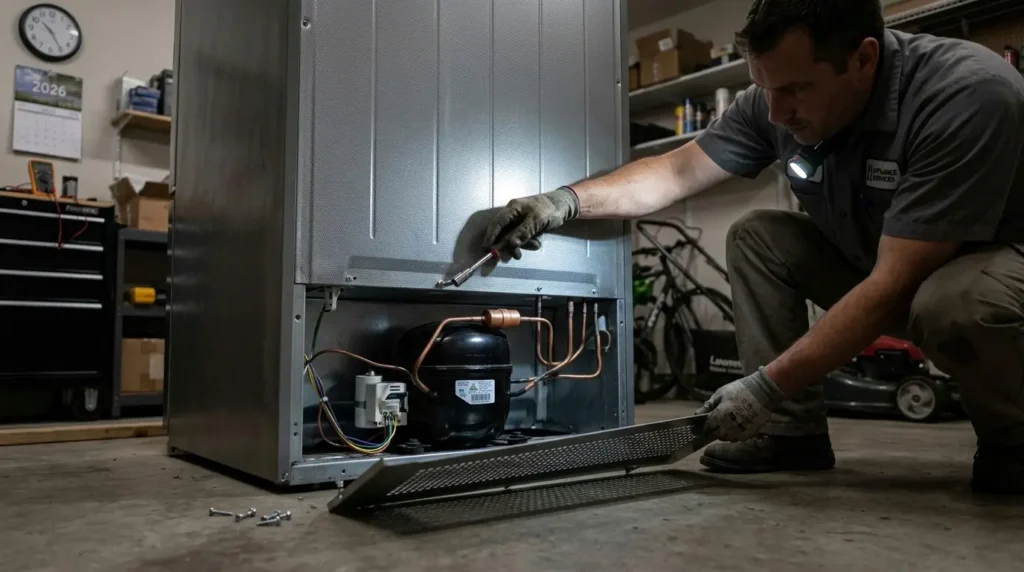
The practical takeaway for someone who already owns or is considering an LG refrigerator with a linear compressor isn’t that it’s immune to failure, nothing mechanical is, but that its failure patterns and maintenance needs are genuinely different from what most people expect based on experience with older or traditional-compressor refrigerators. Keeping the unit level, ensuring adequate rear clearance for heat dissipation, and not dismissing a sudden noise increase as automatic compressor failure (when it’s often a leveling or contact issue) are the highest-value things an owner can actually do, since there’s no belt, filter, or user-serviceable maintenance task inside the compressor itself the way there might be with other appliance components.
FAQ
1. Is a linear compressor the same thing as an inverter compressor?
They’re related but not identical terms. “Inverter” refers to variable-speed electronic control, which linear compressors use, but some rotary compressors are also built with inverter technology, so not every inverter compressor is a linear compressor specifically.
2. Do linear compressors need any maintenance the average rotary compressor doesn’t?
No, there’s no additional user-serviceable maintenance specific to the linear design; the main difference is what technicians check first when diagnosing a problem, not what an owner needs to do proactively.
3. Why does my LG refrigerator’s compressor sound like it’s constantly running instead of cycling on and off?
This is normal and expected behavior; the continuous, low-variable hum is the compressor modulating output to maintain temperature rather than fully stopping and restarting, which traditional compressors do audibly.
4. Are LG refrigerator linear compressors more expensive to replace than traditional compressors?
Generally yes, both the part cost and the specialized electronics involved tend to make replacement more expensive than a comparable traditional compressor, which is part of why LG’s extended compressor warranties matter more here than they might on a base-tier appliance.
5. Does an LG refrigerator linear compressor use a different refrigerant than other compressors?
No, the compressor design (linear vs. rotary) is independent of refrigerant type; the same common refrigerants used across the refrigeration industry are compatible with linear compressor systems.
6. Can a linear compressor be retrofitted into an older refrigerator?
No, this isn’t a component that can be swapped between compressor types; the entire sealed system and control electronics are engineered around the specific compressor design from the factory.
7. Does the Linear Compressor’s design affect how long the refrigerator itself lasts overall?
It can positively influence longevity since it reduces one common failure category, but overall appliance lifespan still depends on other components (door seals, control boards, and evaporator fans) that fail independently of compressor type.
Conclusion

The LG Refrigerator linear compressor isn’t a marketing buzzword sitting on top of a normal compressor; it’s a genuinely different mechanical approach that removes an entire category of friction and wear by driving the piston directly instead of converting rotational motion into linear motion. Understanding this mechanism explains why these units run quieter, modulate more precisely, and fail differently than the compressor in most other refrigerators, and it’s worth knowing before you assume a noise change or aging unit automatically means compressor failure.